
Breaking Down the Chicago Bridge and Iron Securities Settlement


Breaking Down the Chicago Bridge and Iron Securities Settlement
Chicago Bridge and Iron Securities Litigation: Settlement at a Glance
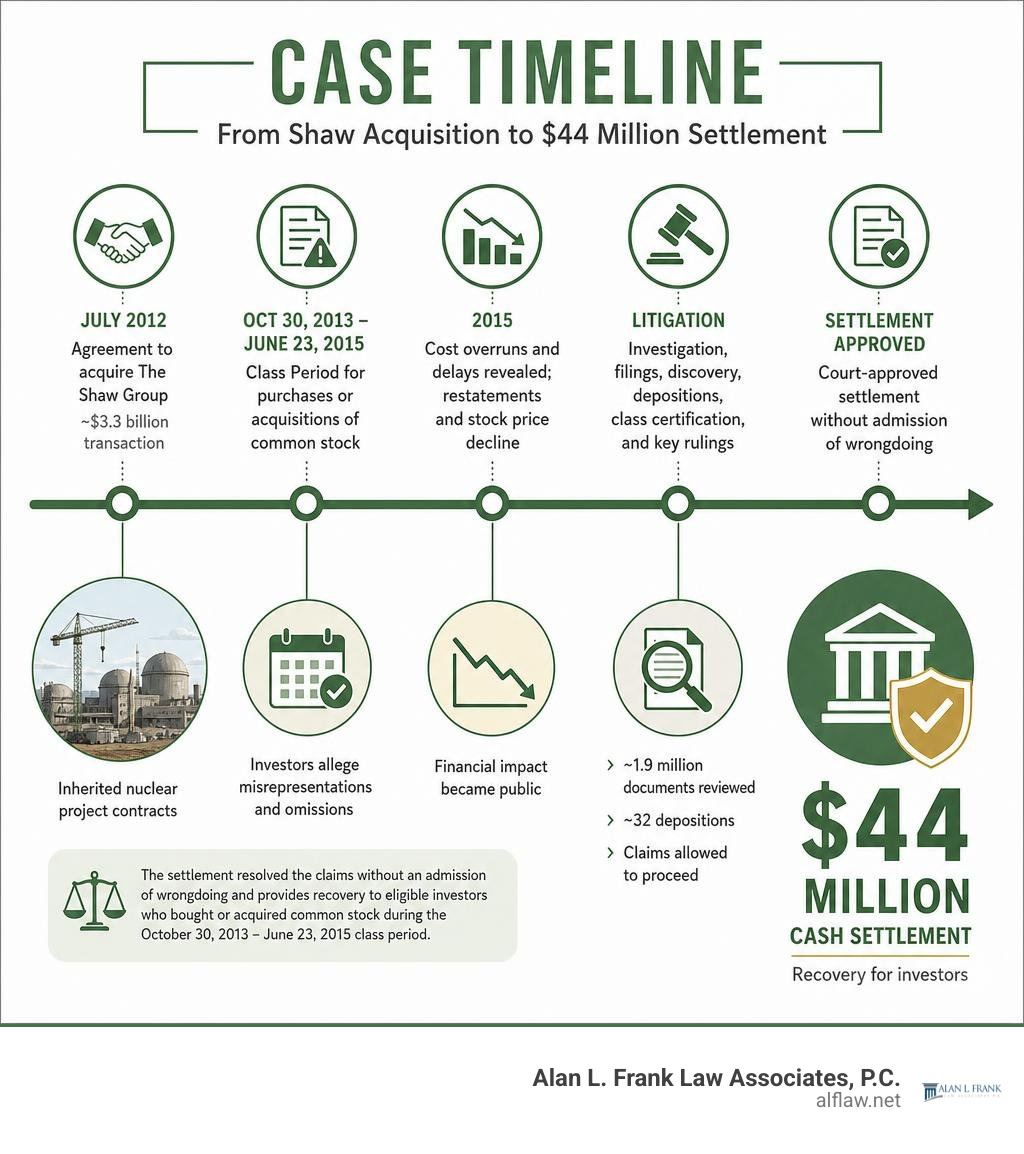
The Chicago Bridge and Iron securities litigation ended in a court-approved $44 million cash settlement for investors who bought or acquired CB&I common stock from October 30, 2013 through June 23, 2015. The case alleged that CB&I and certain former executives hid serious nuclear-project cost overruns and delays while using disputed purchase-accounting adjustments and goodwill reporting after the Shaw Group acquisition.
The settlement resolved the claims without an admission of wrongdoing. It followed years of litigation, including roughly 1.9 million documents reviewed, about 32 depositions, class certification, and a ruling that allowed most claims to proceed toward trial.
For investors, the case is a clear example of why post-acquisition accounting matters. Reported goodwill, contract liabilities, and assurances about project performance can affect a company’s stock price long before the full financial impact becomes public.
I am Alan L. Frank, a CPA and managing attorney with more than 20 years of experience handling complex commercial disputes, investment-loss claims, and securities matters. In reviewing cases such as the Chicago Bridge and Iron securities litigation, I focus on translating complicated financial reporting and legal issues into the practical facts investors need to evaluate potential recovery.
Core Allegations in the Chicago Bridge and Iron Securities Litigation
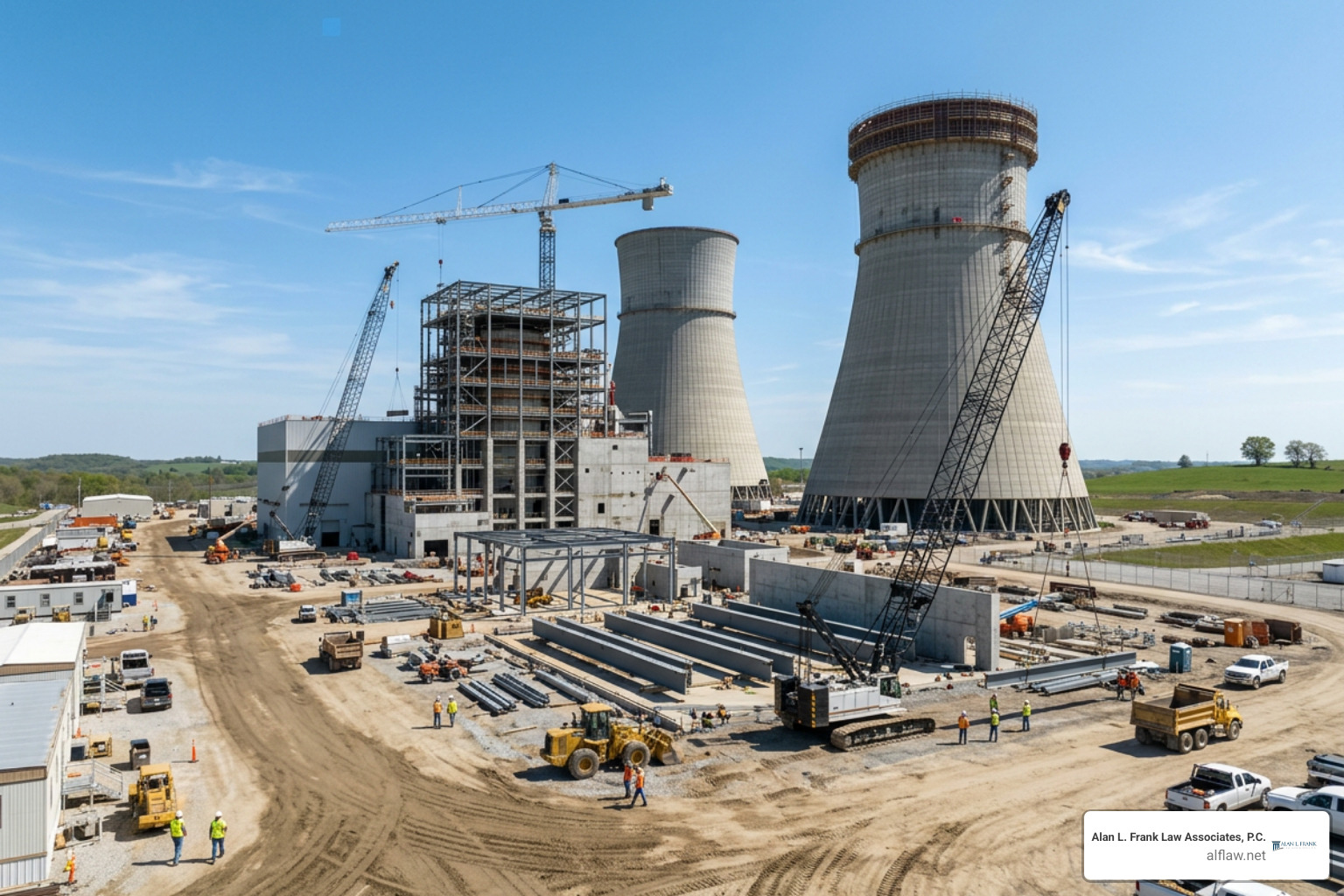
The roots of the dispute trace back to July 2012, when Chicago Bridge & Iron Company N.V. (CB&I) announced its agreement to acquire The Shaw Group for approximately $3.3 billion. Through this major transaction, CB&I inherited engineering, procurement, and construction (EPC) contracts for two signature nuclear power projects: the Vogtle project in Georgia and the V.C. Summer project in South Carolina. Both ventures relied on Westinghouse AP1000 advanced passive pressurized water reactors, which were meant to lead a modern nuclear revival in the United States.
Instead, the projects encountered operational and regulatory turbulence. Plaintiffs in the federal securities class action—brought under Section 10(b) and Section 20(a) of the Securities Exchange Act of 1934 and SEC Rule 10b-5—alleged that CB&I and its top corporate officers concealed severe construction delays, extensive safety defects, and billions of dollars in cost overruns.
Rather than disclosing that modular fabrication facilities had received safety-related stop-work orders and that project completion schedules had slipped by over a year, the company allegedly reassured the public that work was progressing as planned. When utility owners and contractors clashed over responsibility for these ballooning expenses, CB&I treated disputed change orders as collectible revenue, failing to record timely impairments on its balance sheet.
For institutional and retail shareholders navigating complex corporate disclosures, these practices obscured the firm’s true financial standing. When evaluating Securities Litigation & Investment Losses, unmasking the difference between genuine project risks and actionable balance-sheet manipulation is essential.
Purchase Price Adjustments and Goodwill Accounting in the Chicago Bridge and Iron Securities Litigation
At the center of the plaintiffs’ accounting allegations was the manipulation of post-acquisition purchase price adjustments (PPAs) and goodwill. Under Generally Accepted Accounting Principles (GAAP), acquiring companies must record the fair value of acquired assets and liabilities as of the acquisition date. Any excess purchase price over net tangible and identifiable intangible assets is classified as goodwill.
Following the close of the Shaw acquisition, CB&I recorded initial goodwill of approximately $2.5 billion in February 2013. However, over the course of the one-year GAAP measurement period, management dramatically revised its purchase price allocations:
- Liabilities for acquired contracts in progress were raised from $1.1 billion to approximately $2.3 billion—an increase of $1.2 billion.
- Correspondingly, goodwill was pushed upward by $847 million, reaching approximately $3.3 billion by the end of 2013.
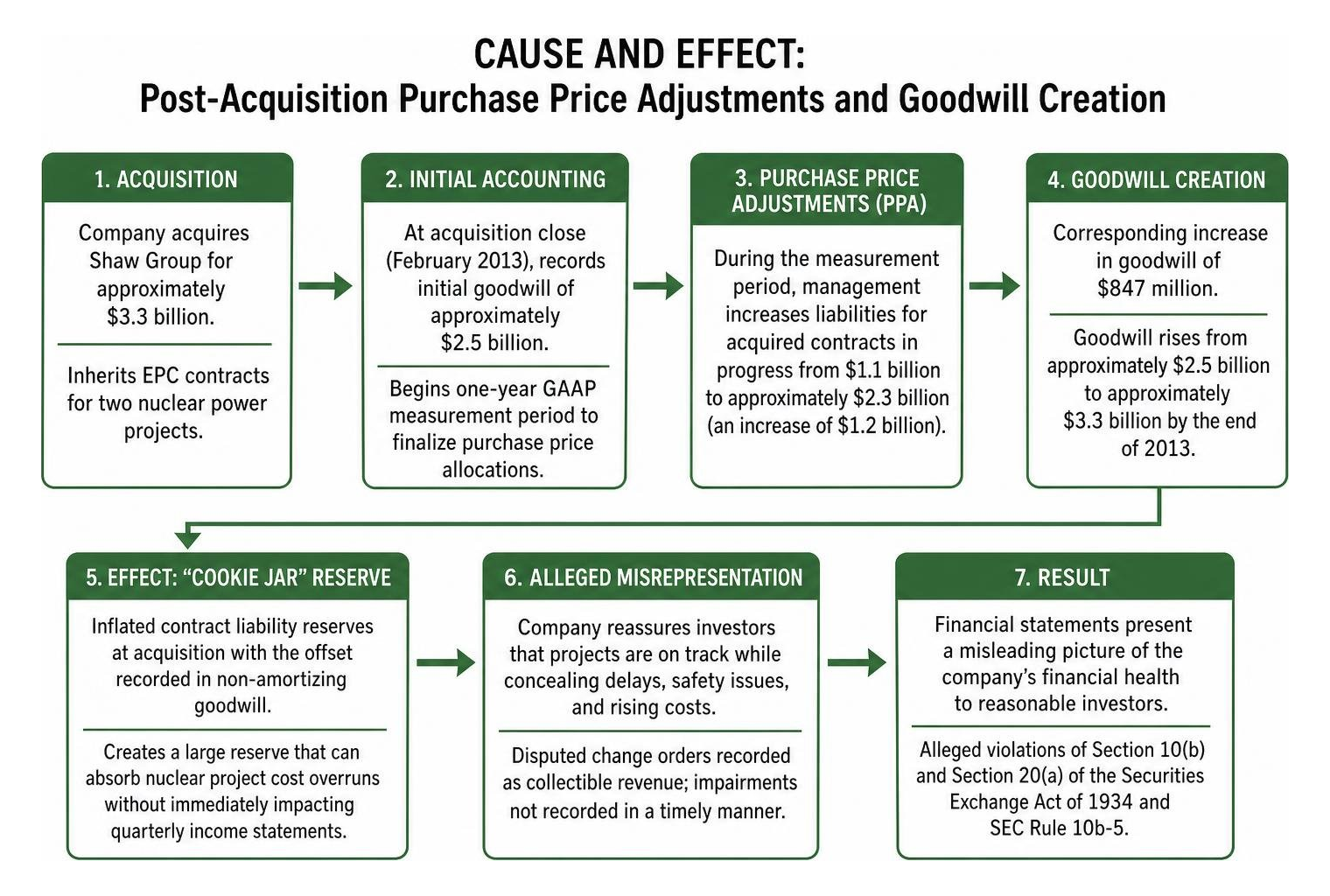
The plaintiffs alleged that this maneuver established a massive “cookie jar” reserve. By inflating contract liability reserves at acquisition and parking the offsetting debit in non-amortizing goodwill, CB&I was able to absorb hundreds of millions of dollars in ongoing nuclear project cost overruns without hitting quarterly income statements.
When defendants argued that their accounting treatment complied with technical GAAP rules, the court rejected that defense as an absolute shield. In In re Chicago Bridge & Iron Company N.V. Securities Litigation, No. 1:2017cv01580 – Document 306 (S.D.N.Y. 2021), the Southern District of New York emphasized that technical compliance with specific accounting guidelines does not protect a company from securities fraud liability if the overall financial statements present a misleading picture of corporate health to reasonable investors.
Executive Statements Challenged by Lead Plaintiffs
The litigation challenged a series of public statements delivered by former Chief Executive Officer Philip Asherman, former Chief Financial Officer Ronald Ballschmiede, and former Chief Accounting Officer Westley S. Stockton across quarterly earnings calls, press releases, and SEC filings.
Lead plaintiffs demonstrated that executives repeatedly gave false comfort to the market:
- Management maintained that cost overruns on the Vogtle and V.C. Summer plants were manageable and that commercial dispute mechanisms with utility owners would ensure full cost recovery.
- Executives failed to disclose that internal estimates reflected over $1 billion in unrecoverable losses and that manufacturing defects at module production facilities had stalled operations.
- Management asserted that goodwill was fully unimpaired, even while shifting the nuclear business unit into the broader, profitable “Power” operating segment to avoid standalone impairment testing.
The truth began leaking out through investigative analyst reports, state Public Service Commission filings by project utilities, and progressive earnings adjustments between June 2014 and June 2015, steadily eroding the company’s market capitalization. The ultimate reality materialized in October 2015, when CB&I divested its nuclear operations to Westinghouse at an estimated $1 billion loss, confirming the depth of the project impairments. In instances involving contractual misrepresentation and breach of operational warranties, our team handles corresponding Commercial Litigation to hold corporate leadership accountable.
Key Legal Rulings: Summary Judgment and the McDermott Bankruptcy
The litigation reached a major milestone when the United States District Court for the Southern District of New York evaluated the defendants’ motion for summary judgment. Presiding over the consolidated action, District Judge Lorna G. Schofield reviewed the comprehensive evidentiary record developed through years of intense discovery.
Earlier in the proceedings, the court adopted the thorough 108-page Report and Recommendation of Special Master Shira A. Scheindlin, certifying the investor class under Federal Rule of Civil Procedure 23(b)(3). The court held that defendants failed to rebut the Basic fraud-on-the-market presumption, noting that the defense bears the burden of persuasion to demonstrate a complete lack of price impact by a preponderance of the evidence, as formalized in In re Chicago Bridge & Iron Company NV Securities Litigation.
Non-Actionable Puffery vs. Material Misstatements in the Chicago Bridge and Iron Securities Litigation
In its summary judgment decision, the court drew a sharp line between general corporate optimism and actionable, false statements of fact under the Supreme Court’s Omnicare framework.
Defendants argued that all challenged statements were merely non-actionable puffery—vague expressions of corporate pride that no reasonable investor would rely upon. Judge Schofield agreed in part, dismissing Defendant Asherman’s public statement regarding the company’s “relentless focus and commitment to safety” as classic, non-actionable puffery.
However, the court denied summary judgment on the core financial claims. The court ruled that a reasonable jury could find that management’s public statements regarding:
- The recoverability of nuclear contract change orders,
- The health and valuation of recorded goodwill, and
- The underlying schedule progress of the AP1000 builds
were materially misleading when made, given that internal documents showed executives were well aware of severe unapproved cost overruns and persistent fabrication defects. The court reaffirmed that questions of fraudulent intent (scienter) under Section 10(b) are questions of fact that generally belong before a jury.
Impact of McDermott International’s Chapter 11 Bankruptcy
A critical strategic complication arose in May 2018, when CB&I combined with McDermott International, Inc. In January 2020, McDermott and its operating subsidiaries—including CB&I—filed for Chapter 11 bankruptcy protection.
The bankruptcy filing triggered an automatic stay under Section 362 of the Bankruptcy Code, and the subsequent confirmation of McDermott’s reorganization plan discharged CB&I’s direct corporate liability for pre-petition shareholder claims.
Plaintiffs navigated this hurdle through nominal party litigation:
- The bankruptcy court and district court permitted the securities claims to proceed against CB&I nominally, allowing plaintiffs to seek recovery exclusively from available Directors and Officers (D&O) liability insurance proceeds.
- Claims against the individual executive defendants under Section 10(b) and Section 20(a) (control person liability) remained active, as individual liability for intentional or reckless misrepresentations is not extinguished by a corporate employer’s bankruptcy discharge.
This structure kept substantial recovery avenues open, leading directly to high-stakes mediation.
Terms and Allocation of the $44 Million Settlement
Following extensive formal mediation sessions conducted before former federal judge Hon. Layn Phillips, the parties reached an agreement on December 31, 2021—just weeks before the scheduled jury trial. The formal agreement was executed in the 2022.02.04CBIStipulation of Settlement_FINAL.
On August 2, 2022, the federal court granted final approval to the $44,000,000 all-cash settlement, establishing a Qualified Settlement Fund under Treas. Reg. § 1.468B-1. The recovery was achieved after plaintiffs’ counsel reviewed approximately 1.9 million documents (comprising roughly 9 million pages) and conducted 32 depositions.
| Settlement Component | Detail / Approved Amount | Legal Authority & Context |
|---|---|---|
| Gross Settlement Fund | $44,000,000.00 (Cash) | Fed. R. Civ. P. 23(e) Final Approval |
| Lead Plaintiff ALSAR Ltd. Partnership | $60,000.00 | PSLRA Service Award (15 U.S.C. § 78u-4(a)(4)) |
| Lead Plaintiff Iron Workers Locals 40, 361 & 417 | $25,000.00 | PSLRA Service Award (15 U.S.C. § 78u-4(a)(4)) |
| Lead Plaintiff Iron Workers Local 580 Joint Funds | $20,000.00 | PSLRA Service Award (15 U.S.C. § 78u-4(a)(4)) |
| Eligible Class Period | Oct 30, 2013 – June 23, 2015 | Common stock purchases during artificial inflation |
| Total Discovery Volume | ~1.9M documents (~9M pages) | 32 depositions and extensive expert witness reports |
Distribution and Lead Plaintiff Service Awards
Under the Private Securities Litigation Reform Act (PSLRA), 15 U.S.C. § 78u-4(a)(4), courts may grant reasonable compensatory awards to lead plaintiffs for the time and resources dedicated to representing the class.
Recognizing their active participation throughout four years of contentious litigation, Judge Schofield approved the following service awards:
- ALSAR Ltd. Partnership: $60,000
- Iron Workers Locals 40, 361 & 417 Union Security Funds: $25,000
- Iron Workers Local 580 Joint Funds: $20,000
The final judgment entered a formal bar order dismissing all claims with prejudice and enjoining class members who did not opt out from pursuing released claims in any other forum. As is standard in federal class settlements, the agreement explicitly noted that neither the settlement nor the payment of funds constituted an admission of wrongdoing, liability, or fault by CB&I or its former executives.
Frequently Asked Questions About the CB&I Settlement
What was the eligible Class Period for the CB&I settlement?
The court-certified Class Period spanned from October 30, 2013 through June 23, 2015, inclusive. Investors who purchased or acquired Chicago Bridge & Iron Company N.V. common stock on the open market during this timeframe and suffered economic losses upon the revelation of corrective disclosures were eligible to submit a claim for a pro-rata distribution from the net settlement fund.
Did Chicago Bridge & Iron admit liability in the settlement?
No. Under the terms of the stipulation and the final judgment, the defendants expressly denied all allegations of wrongdoing, fault, and liability. The $44 million settlement represented a standard compromise under Rule 23 to eliminate the substantial risks, uncertainties, and expenses associated with a complex federal jury trial and subsequent appeals.
How did accounting for the Shaw Group acquisition lead to shareholder losses?
CB&I absorbed billions in nuclear project risks when it acquired Shaw. Instead of immediately recording project cost overruns on its income statement, the company retroactively adjusted purchase accounting by increasing contract liabilities and inflating goodwill by $847 million. By later folding the nuclear reporting unit into its profitable Power unit, CB&I avoided mandatory goodwill write-downs. When recurring construction defects, stop-work orders, and unapproved change orders became public, the stock suffered multiple sharp drops, ultimately leading to a $1 billion loss when the nuclear unit was sold.
Conclusion
The resolution of the Chicago Bridge & Iron securities litigation illustrates the critical role that forensic accounting and thorough legal discovery play in complex post-M&A investor recoveries. Mega-mergers involving large infrastructure contracts carry unique operational risks. When corporate executives use aggressive purchase price adjustments and goodwill maneuvers to mask mounting project losses, public shareholders are left holding the bill.
At Alan L. Frank Law Associates, P.C., we draw upon decades of combined legal and CPA accounting insight to represent institutional funds, businesses, and individual investors in complex securities disputes and commercial recovery actions. Operating from our offices in Philadelphia, PA, Jenkintown, PA, and New Jersey, we are committed to helping clients uncover balance-sheet misrepresentations and pursue meaningful financial recoveries.
If your organization has suffered significant portfolio losses stemming from misleading corporate reporting or securities fraud, learn more about our approach to Securities Litigation & Investment Losses and how we protect investor interests nationwide.