
Everything Shareholders Must Know About Geron Securities Litigation


Everything Shareholders Must Know About Geron Securities Litigation
Geron Securities Litigation: The Key Updates Shareholders Should Know
The Geron securities litigation over 2018 disclosures about the drug candidate imetelstat ended in a $24 million class-action settlement. Eligible investors who bought Geron common stock from March 19, 2018, through September 26, 2018, had to submit valid claims to share in the recovery. The court-approved plan called for payments to authorized claimants no later than July 11, 2024.
The settlement resolved allegations that Geron and certain executives misled investors about the IMbark clinical trial. Geron denied wrongdoing. The case also produced important later developments: a separate federal securities fraud case involving statements about RYTELO’s launch was dismissed without prejudice on March 30, 2026, because the court found the complaint did not adequately plead intent to defraud.
This guide breaks down the settlement, the deadlines that applied, the estimated $0.17-per-share recovery before fees and expenses, and what the court rulings mean for investors reviewing potential biotech-related losses.
I am Alan L. Frank, managing attorney at Alan L. Frank Law Associates, P.C., with more than 20 years of experience handling complex commercial disputes, investment-loss matters, and securities cases nationwide. In the sections that follow, I explain the Geron securities litigation in plain English and identify the facts shareholders should understand.
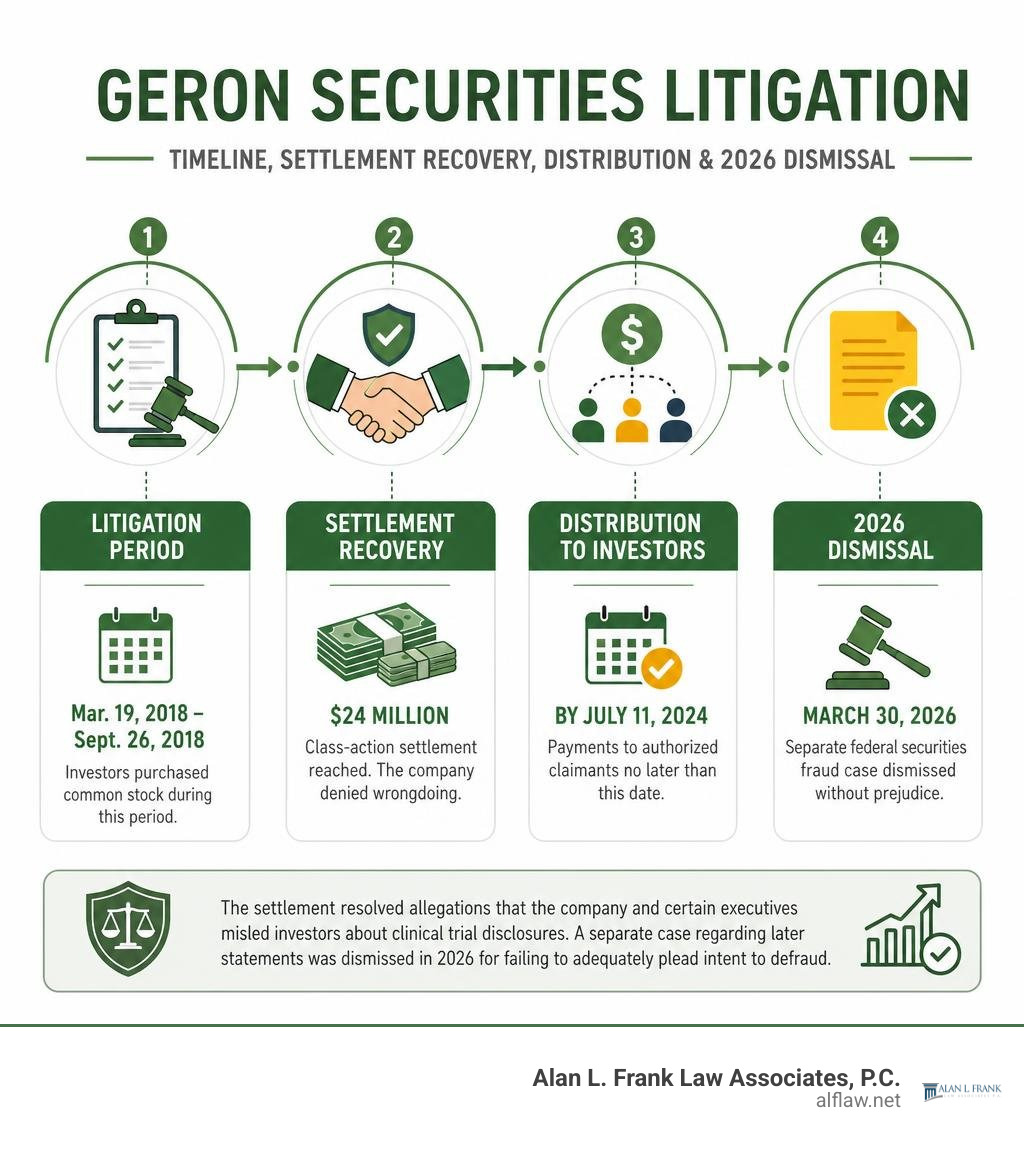
Geron securities litigation basics:
Overview and Allegations in the Geron Securities Litigation
Biotechnology companies often trade almost entirely on the promise of clinical trial pipelines. When a company hinges its future on a flagship drug candidate, full transparency is critical. For Geron Corporation, that focal point was imetelstat, a telomerase inhibitor evaluated for the treatment of hematologic myeloid malignancies, specifically myelofibrosis.
The central class action alleged that Geron and its top leadership violated Section 10(b) and Section 20(a) of the Securities Exchange Act of 1934, alongside SEC Rule 10b-5. Plaintiffs asserted that during 2018, the company issued materially misleading statements regarding the interim results of its Phase 2 “IMbark” clinical trial.
Specifically, the trial established primary efficacy endpoints requiring:
- A 35% or greater reduction in spleen volume.
- A 50% or greater reduction in the Total Symptom Score (TSS).
While Geron publicly focused on secondary endpoints such as overall survival and potential clinical benefits, plaintiffs alleged the company concealed that imetelstat was overwhelmingly failing its designated primary endpoints. Behind the scenes, development partner Janssen Biotech was evaluating its collaboration agreement with Geron, which carried substantial milestone payments. When Janssen ultimately opted to walk away and terminate the partnership following the disappointing data disclosures, the market impact was severe. Investors who find themselves blindsided by omitted clinical trial data often rely on securities litigation to hold corporate leadership accountable for misleading statements.
Clinical Trial Disclosures and Stock Price Impact
The certified Class Period spanned from March 19, 2018, through September 26, 2018. During this window, internal corporate records—later scrutinized in court filings—revealed that company directors had access to numerical data indicating substantial primary endpoint shortfalls. Approximately 90% of evaluated patients failed to achieve the target spleen volume reduction, and roughly 68% missed the symptom reduction target, figures sharply at odds with earlier, more promising pilot studies.
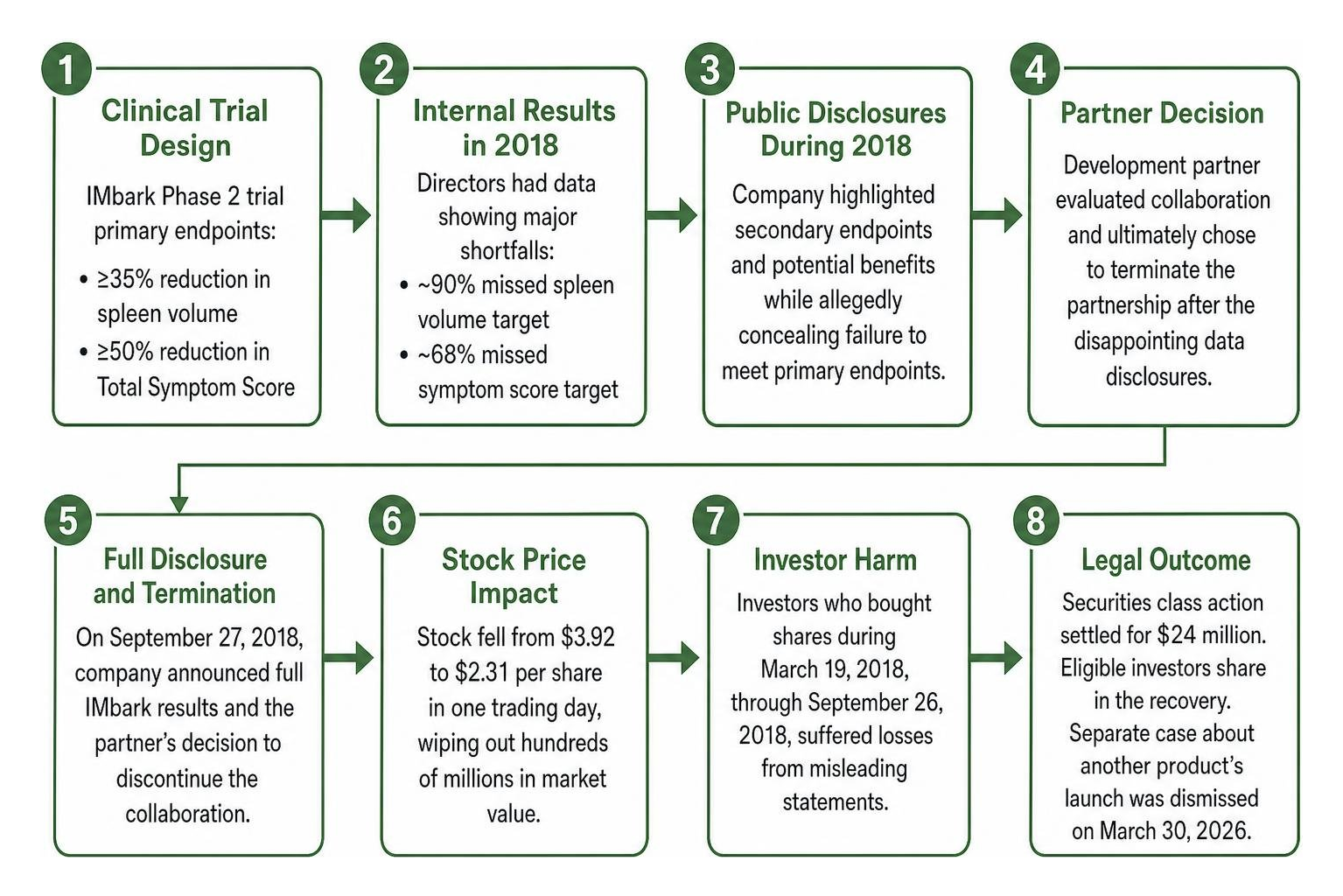
On September 27, 2018, Geron announced the full results of the IMbark study alongside Janssen’s decision to discontinue the collaboration. In response, Geron’s common stock tumbled from $3.92 to $2.31 per share in a single trading session, wiping out hundreds of millions of dollars in market capitalization. Investors who bought shares at prices inflated by positive public statements suffered steep losses. In our practice evaluating securities litigation investment losses, we frequently see how sudden disclosures regarding biotech pipeline setbacks trigger massive, immediate institutional and retail damage.
Terms and Allocation of the $24 Million Settlement Fund

To avoid the risks, expense, and delay of trial, the parties agreed to a comprehensive $24,000,000 settlement. The agreement was structured to provide direct financial compensation while taking advantage of corporate insurance protections.
The funding breakdown included:
- $17,000,000 in cash, funded through Geron’s available Directors and Officers (D&O) liability insurance coverage.
- $7,000,000 in either Geron settlement stock, cash, or a combination of both at the company’s election.
Lead Counsel petitioned the court for an award of attorneys’ fees not exceeding 18% of the Settlement Fund (amounting to $4.32 million), plus interest, alongside litigation expenses capped at $1,140,000. These deductions, combined with notice administration costs and court-approved taxes, were subtracted from the gross settlement amount to form the Net Settlement Fund distributed to eligible claimants.
| Settlement Component | Amount / Percentage | Purpose / Description |
|---|---|---|
| Gross Settlement Fund | $24,000,000 | Total recovery pool ($17M cash + $7M cash/stock) |
| D&O Insurance Contribution | $17,000,000 | Cash portion funded by insurance carriers |
| Geron Contribution Component | $7,000,000 | Elective cash or common stock contribution |
| Attorneys’ Fees Requested | Up to 18% ($4,320,000) | Court-approved compensation for class counsel |
| Litigation Expenses | Up to $1,140,000 | Reimbursement of out-of-pocket legal costs |
| Estimated Gross Recovery | ~$0.17 per share | Average recovery across all eligible damaged shares |
Estimated Average Recovery and Net Fund Distribution
Before the deduction of fees and administrative expenses, the estimated average gross recovery was approximately $0.17 per affected share of Geron common stock. Individual recoveries varied depending on when shares were purchased, how many were acquired, whether they were sold during the Class Period, and the specific loss calculation formulas set forth in the court-approved Plan of Allocation.
Following preliminary approvals, the United States District Court for the Northern District of California issued an order approving the final distribution plan on May 28, 2024. The court mandated that the settlement claims administrator initiate and complete distribution of the Net Settlement Fund to all authorized claimants no later than July 11, 2024. Claimants tracked their claim status through the Geron Securities Litigation – Home portal.
Class Member Deadlines in Geron Securities Litigation
Class members were required to navigate several strict procedural deadlines to protect their rights:
- Objection Deadline (March 9, 2023): Class members who wished to object to the fairness, reasonableness, or adequacy of the settlement or the fee motion were required to submit formal written objections to the court by midnight Pacific Time.
- Exclusion Deadline (July 14, 2023): Investors who preferred to retain their individual right to sue Geron independently had to opt out in writing by 11:59 p.m. PST.
- Claim Filing Deadline (July 14, 2023): To participate in the cash and stock distributions, authorized claimants had to submit a completed Claim Form with supporting trade verification online or postmarked by July 14, 2023.
Parallel Derivative Lawsuits and Corporate Governance Reforms

Beyond the direct investor class action, Geron faced shareholder derivative lawsuits filed in the Delaware Court of Chancery on behalf of the company itself. These actions targeted individual directors and officers, claiming breaches of fiduciary duty under the Malone v. Brincat disclosure framework and the Caremark oversight doctrine.
Plaintiffs alleged that board members failed to properly oversee trial reporting and allowed false public statements to persist despite possessing internal clinical data. In a detailed opinion by GLASSCOCK, Vice Chancellor , the Delaware Court of Chancery analyzed these claims, staying the state-level proceedings while the federal litigation progressed.
The derivative litigation ultimately resolved with substantial structural victories rather than a cash distribution to individual shareholders:
- Geron agreed to adopt and maintain comprehensive corporate governance reforms for a minimum of five years.
- The company overhauled its insider-trading compliance policy and enhanced clinical trial disclosure protocols.
- Plaintiffs’ counsel in the derivative action received a mediator-recommended fee award of $1,350,000, funded by insurers.
Key Legal Milestones and Subsequent Fraud Allegations
The procedural arc of the IMbark litigation demonstrates the complex path modern biotech securities class actions must travel:
- January 2020: The initial class-action complaint is filed in the Northern District of California following the fallout from the trial endpoint disclosures.
- August 2020: Lead plaintiffs are appointed and file a consolidated amended complaint detailing false statements under Rule 10b-5.
- 2021–2022: The court adjudicates motions to dismiss, certifies the class of common stock purchasers, and oversees extensive discovery.
- October 2022: The court grants preliminary approval to the $24 million settlement terms.
- October 2023: Final judgment and order of dismissal with prejudice is entered regarding the 2018 IMbark claims.
- May–July 2024: Final distribution plan is authorized and executed for all eligible class claimants.
This was not Geron’s first encounter with class-action settlements. The company had previously resolved a separate, earlier securities class action in 2017 for $6.25 million—where $6.0 million was covered by insurance providers—as reflected in its disclosures.
The 2026 Dismissal and the Future of Geron Securities Litigation
As the 2018 settlement distributions concluded, Geron faced a separate federal securities fraud class action in the Northern District of California involving its newly commercialized drug, RYTELO. Plaintiffs alleged that management misled investors regarding commercial readiness, demand forecasts, and product launch timelines.
However, on March 30, 2026, U.S. District Judge Vince Chhabria granted Geron’s motion to dismiss the lawsuit. The court held that the plaintiffs failed to satisfy the stringent pleading standards of the Private Securities Litigation Reform Act (PSLRA). Specifically, the complaint failed to raise a plausible inference of scienter—the intent to deceive, manipulate, or defraud investors.
Because the dismissal was granted without prejudice, plaintiffs were afforded an opportunity to amend their complaint. Nonetheless, the March 2026 ruling highlights the heavy legal burden shareholders face when seeking to prove that overly optimistic commercial forecasts amount to actionable securities fraud.
Frequently Asked Questions About Geron Securities Litigation
What was the total recovery amount per share in the settlement?
The $24 million gross settlement represented an estimated average recovery of approximately $0.17 per affected share across the eligible Class Period before deducting court-approved legal fees, litigation expenses, and administrative costs. Net payouts per claimant varied based on purchase dates, sale prices, and overall recognized loss calculations.
When were settlement funds distributed to authorized claimants?
The federal court approved the final settlement distribution plan on May 28, 2024. Under that order, the claims administrator was directed to complete all distribution payments to authorized claimants with approved claims no later than July 11, 2024.
Why did the federal court dismiss the separate 2026 securities fraud lawsuit against Geron?
On March 30, 2026, Judge Vince Chhabria dismissed the lawsuit without prejudice because the plaintiffs failed to meet PSLRA pleading standards for scienter. The court found that the complaint lacked specific facts demonstrating that Geron leadership knowingly misled investors or acted with reckless disregard regarding the launch of RYTELO.
Conclusion
The resolution of the Geron securities litigation provides valuable lessons for biotech investors. Pharmaceutical development carries substantial scientific risks, but public companies remain legally bound to report clinical outcomes accurately. When corporate disclosures diverge from internal clinical trial realities, securities class actions serve as an essential tool for recovering shareholder value.
Navigating complex disclosure rules, evaluating portfolio damages, and understanding federal class action settlements requires deep legal analysis. Whether you are dealing with clinical trial misrepresentations or reviewing losses across other complex asset classes, experienced legal counsel can help you evaluate your legal remedies.
At Alan L. Frank Law Associates, P.C., we advocate for retail and institutional investors facing substantial losses resulting from corporate misrepresentations, stockbroker misconduct, and complex securities fraud. If you have questions regarding your shareholder rights or investment losses, we welcome the opportunity to review your situation.