
How a Private Placement Fraud Attorney Holds Dishonest Issuers Accountable


How a Private Placement Fraud Attorney Holds Dishonest Issuers Accountable
How a Private Placement Fraud Attorney Can Help You Pursue Recovery
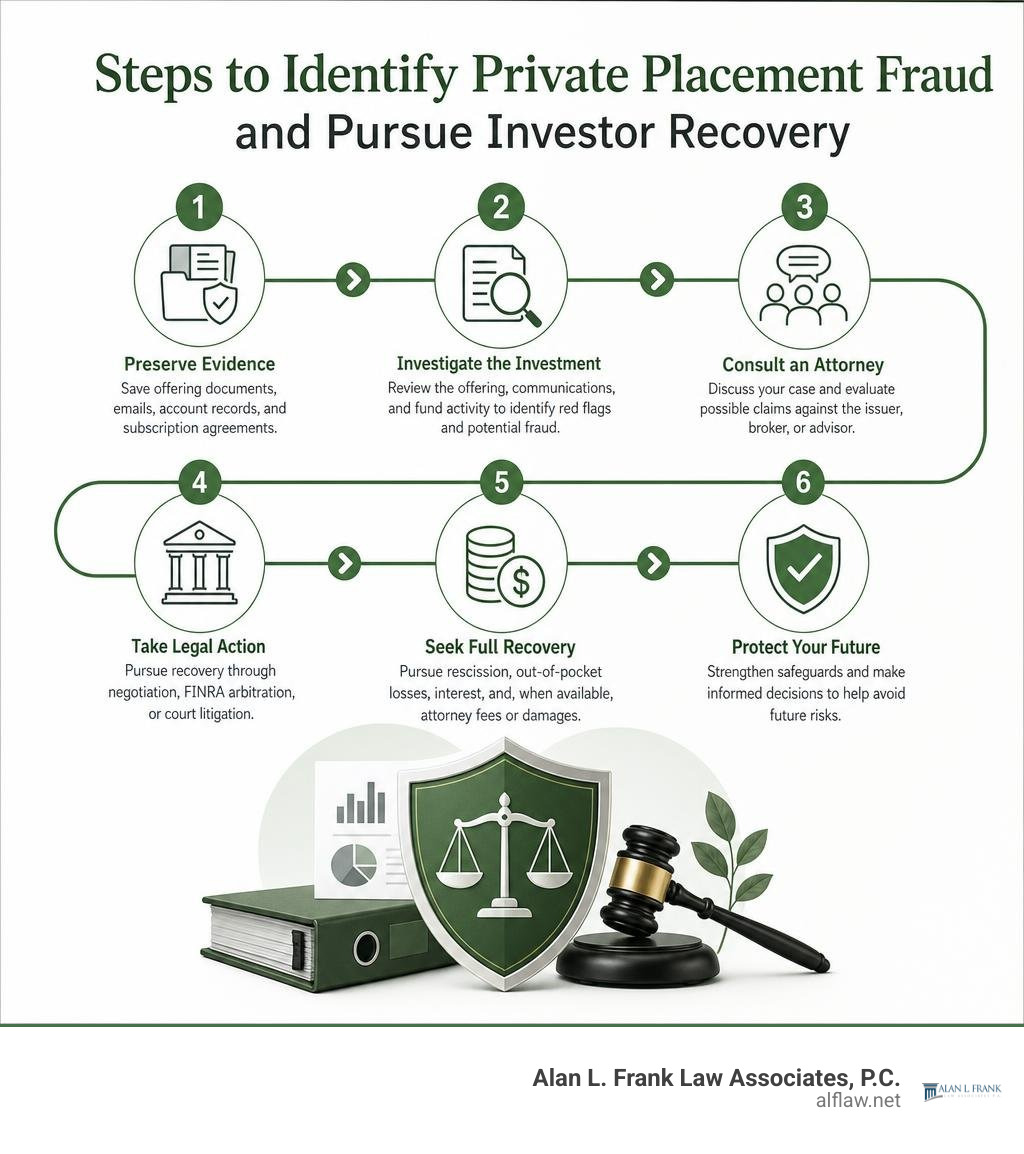
If you suspect a private placement was sold through false statements, hidden risks, or misuse of investor funds, act quickly to preserve the offering documents, emails, account records, and subscription agreement. A private placement fraud attorney can review the transaction, identify possible claims against the issuer, broker, or advisor, and pursue recovery through negotiation, FINRA arbitration, or court litigation.
Private placements are investments offered outside the public markets, often under Regulation D exemptions. They can be legitimate, but investors may receive less public disclosure and have fewer ways to sell their investment. Warning signs include guaranteed returns, pressure to invest fast, vague use-of-proceeds language, missing financial records, undisclosed conflicts, and distributions that appear to come from new investor money rather than business income.
A strong claim may seek rescission of the investment, out-of-pocket losses, interest, and, in some cases, attorney fees or punitive damages. Deadlines can be short and vary by claim and forum, so waiting may limit your options.
I am Alan L. Frank, Managing Attorney of Alan L. Frank Law Associates, P.C., with more than 20 years of experience in complex commercial litigation, investment-loss matters, and securities disputes. As a CPA, attorney, and holder of a Master’s in Tax Law, I bring financial and legal analysis to the work of a private placement fraud attorney.
Private placement fraud attorney helpful reading:
Understanding Private Placement Fraud and Warning Signs

Private placements play a massive role in capital formation across the United States. In 2020 alone, private placements accounted for approximately $1.3 trillion in capital raised. However, because these offerings bypass standard SEC registration under exemptions such as Regulation D (specifically Rule 506(b) and Rule 506(c)), they lack the stringent regulatory oversight applied to publicly traded stocks.
This absence of transparent reporting makes the private market fertile ground for offering fraud. In an extensive study, the SEC revealed that retail investors lost an estimated $1.7 billion in private placement fraud over a five-year period. When dishonest promoters exploit these rules, complex securities litigation is often the only viable path to holding wrongdoers accountable.
The bedrock of any private placement is the Private Placement Memorandum (PPM). In a legitimate offering, the PPM clearly discloses business operations, risks, management backgrounds, and financial statements. In fraudulent schemes, issuers conceal material facts or actively misstate their financial health.
Common red flags in unregistered private placement offerings include:
- Guaranteed High Returns with “Zero Risk”: Every legitimate investment carries risk. Promoters promising double-digit, risk-free returns are almost always misleading investors.
- Vague or Inconsistent Use of Proceeds: If the PPM or offering documents do not provide clear details on how capital will be deployed, funds are frequently diverted to personal expenses or undisclosed side ventures.
- Pressure and Artificial Urgency: Aggressive sales tactics urging you to wire funds immediately before an “exclusive window closes” are designed to short-circuit your due diligence.
- Missing Audited Financials and Unlicensed Promoters: Unwillingness to provide independent audit reports or clear corporate histories often hides insolvencies or past regulatory sanctions.
- Ponzi-Style Distribution Mechanics: Returns paid to early investors directly from new investor contributions rather than legitimate operational profits.
The Strategic Role of a Private Placement Fraud Attorney in Investor Recovery
When private investments collapse due to dishonesty rather than market performance, victims need a structured strategy to recover your investment. Holding an issuer, broker-dealer, or financial advisor liable requires an intricate legal assessment of standing, jurisdiction, and actionable misstatements.

Investigating the Offering with a Private Placement Fraud Attorney
Unraveling private placement fraud requires deep forensic analysis. We examine whether the issuer abused Regulation D exemptions, commingled assets, or presented materially misleading subscription agreements.
Simultaneously, we evaluate the conduct of the selling intermediaries. Broker-dealers and registered representatives have a legal duty to conduct independent due diligence on any private placement before recommending it to clients. Our experienced FINRA attorneys investigate whether the selling firm failed to spot glaring red flags or recommended unsuitable investments to generate high sales commissions.
Navigating FINRA Arbitration and Federal Court Litigation
Depending on the parties involved, your dispute may proceed in federal court, state court, or through mandatory arbitration. When claims involve registered broker-dealers, resolving claims through the FINRA as a forum for claims involving stockbroker misconduct is standard practice.
FINRA arbitration provides an expedited dispute resolution process tailored to securities industry rules. If the primary wrongdoer is an independent issuer or an unregistered entity, direct civil litigation in state or federal court may be necessary. Our firm has a proven record handling complex disputes across jurisdictions, including achieving a multi million dollar securities claim in federal court settled.
Legal Theories, Remedies, and Damages in Private Placement Claims

Holding dishonest parties accountable requires establishing specific causes of action under federal statutes, state Blue Sky laws, and common law principles:
- Section 10(b) and Rule 10b-5 (Securities Exchange Act of 1934): Claims based on material misrepresentations, fraudulent devices, or deceptive schemes in connection with the purchase of securities.
- Section 12(a)(2) (Securities Act of 1933): Imposes liability on sellers who offer securities via a prospectus or oral communication containing material misstatements or omissions.
- State Blue Sky Laws: Statutes throughout Pennsylvania and New Jersey that provide robust statutory protections and private rights of action for defrauded investors.
- Breach of Fiduciary Duty and Negligence: Remedies against investment advisors, wealth managers, and brokers who put their own commission interests ahead of client welfare, opening the door to claims of go securities lawyer stock market broker malpractice negligence.
Calculating Recoverable Financial Damages
Victims of private placement fraud can pursue various financial remedies depending on the statutes invoked and the nature of the misconduct:
| Damage Category | Primary Purpose | How It Is Measured |
|---|---|---|
| Statutory Rescission | Unwinds the transaction completely | Return of original principal invested, plus statutory interest, minus any distributions received |
| Compensatory Damages | Reimburses direct financial harm | Net out-of-pocket losses caused by the fraudulent scheme or unsuitability |
| Prejudgment Interest | Compensates for the loss of use of funds | Statutory or judicial interest calculated from the date of the fraudulent transaction |
| Attorney Fees & Costs | Shifts legal expenses to the wrongdoer | Available under specific state Blue Sky statutes or explicit contractual clauses |
| Punitive Damages | Punishes egregious or malicious fraud | Awarded by courts or FINRA arbitration panels in instances of willful misconduct |
According to reports by the Securities Arbitration Commentator, the average recovery in private placement fraud arbitration cases is approximately $250,000, underscoring the practical financial value of formal dispute proceedings.
Overcoming Common Issuer Defenses and Timing Hurdles
Defendants in private placement disputes rely heavily on boiler-plate defenses. A common argument is the “bespeaks caution” doctrine, where issuers argue that general cautionary language in the PPM insulates them from liability. However, generic disclaimers do not protect promoters who knowingly misstate historical facts or conceal active fraudulent operations.
Another frequent defense is that accredited investors are sophisticated enough to bear full responsibility for their losses. The law is clear: accredited status is not a waiver of protection against intentional deceit or material omissions.
Timing is equally critical. Federal securities fraud claims under Rule 10b-5 are subject to a strict statute of limitations: two years from the discovery of facts constituting the violation, but no later than five years after the violation occurred (the statute of repose). FINRA arbitration claims carry a six-year eligibility rule from the event giving rise to the dispute.
How to Take Legal Action Against Unscrupulous Issuers
If you suspect your investment was built on deception, take deliberate steps immediately:
- Consolidate All Documentation: Gather the PPM, subscription agreement, marketing decks, email chains, text messages, promissory notes, and account statements.
- Document the Timeline: Create a chronological record detailing what you were told, who made each statement, when representations were made, and when distributions ceased.
- Avoid Signing New “Restructuring” Waivers: Issuers often attempt to buy time by offering restructured debt notes or revised terms containing liability release clauses. Do not sign these without independent counsel.
- Consult Focused Legal Counsel: Retaining seasoned securities losses demand the right investment fraud attorneys near me ensures your claims are filed within statutory deadlines.
Key Criteria for Selecting a Private Placement Fraud Attorney
When hiring counsel to represent you in private placement disputes:
- Trial and Arbitration Experience: Look for attorneys with extensive track records handling both FINRA arbitrations and federal court litigation.
- Deep Financial Acumen: Complex offering fraud cases require rigorous analysis of corporate books, tax returns, and private company accounting.
- Geographic and Jurisdictional Focus: Ensure the firm is licensed and experienced in relevant jurisdictions, such as Pennsylvania and New Jersey.
- Transparent Communication: Choose legal partners who provide clear, honest assessments of your case’s strengths, collectible assets, and procedural timeline.
Frequently Asked Questions About Private Placement Fraud
How do private placements differ from public offerings in fraud risk?
Public offerings require comprehensive registration with the SEC, including mandatory regular audits, standardized prospectuses, and continuous reporting (10-K, 10-Q). Private placements under Regulation D operate under registration exemptions, resulting in minimal ongoing reporting, lower liquidity, and substantial information asymmetry that dishonest issuers can exploit.
How long do I have to file a private placement fraud lawsuit?
Under federal law, claims must generally be brought within two years of discovering the fraud, subject to an absolute five-year statute of repose from the transaction date. Under FINRA arbitration rules, claims must be brought within six years of the event giving rise to the dispute. State Blue Sky statutes feature their own distinct limitations periods, making immediate legal evaluation essential.
Can I recover losses if I signed an accredited investor questionnaire?
Yes. Being an accredited investor does not waive your statutory rights against intentional misrepresentation, omitted material facts, or common law fraud. Broker-dealers still maintain an obligation to recommend only suitable investments and conduct adequate due diligence, regardless of an investor’s net worth.
Conclusion
Private placement offerings should never be an excuse for promoters to operate outside the law. When misleading disclosures, diverted funds, or broker unsuitability compromise your financial future, our team at Alan L. Frank Law Associates, P.C. provides aggressive, sophisticated advocacy across Pennsylvania and New Jersey. Explore how we handle securities litigation investment losses to protect your rights and demand the financial accountability you deserve.