
Everything New in the AAA Commercial Arbitration Rules 2025


Everything New in the AAA Commercial Arbitration Rules 2025
What the AAA Commercial Arbitration Rules 2025 Mean for Your Business Dispute
The AAA Commercial Arbitration Rules 2025 are the American Arbitration Association’s process rules for resolving business disputes outside court. Before filing, identify the amount at stake, download the current rules and fee schedule, and prepare a Demand for Arbitration with the arbitration clause, claim details, requested relief, party contact information, and filing fee.
For most cases, the claim amount determines the path:
- Under $100,000: Expedited Procedures generally apply.
- $100,000 to $1 million: The standard commercial rules generally apply.
- $1 million or more: Large, Complex Commercial Dispute Procedures apply, with more structured case management.
The current rules build on revisions effective September 1, 2022. They address modern concerns such as remote hearings, early discussion of cybersecurity and data protection, arbitrator confidentiality, document exchange, consolidation, emergency relief, and sanctions for noncompliance. Costs include AAA administrative fees, arbitrator compensation, and case-specific expenses, so reviewing the current fee schedule early is essential.
AAA’s 2025 business-to-business caseload involved more than $29 billion in claims and counterclaims. For awarded B2B cases over $1 million, the median time to award was 18.7 months, while 52% of B2B cases closed by settlement before an award.
I am Alan L. Frank, Managing Attorney of Alan L. Frank Law Associates, P.C., with more than 20 years of experience handling complex commercial disputes, investment-loss matters, and high-value litigation. In this guide to the AAA Commercial Arbitration Rules 2025, I explain the rules and practical choices that can affect a business owner’s strategy, cost, and recovery.
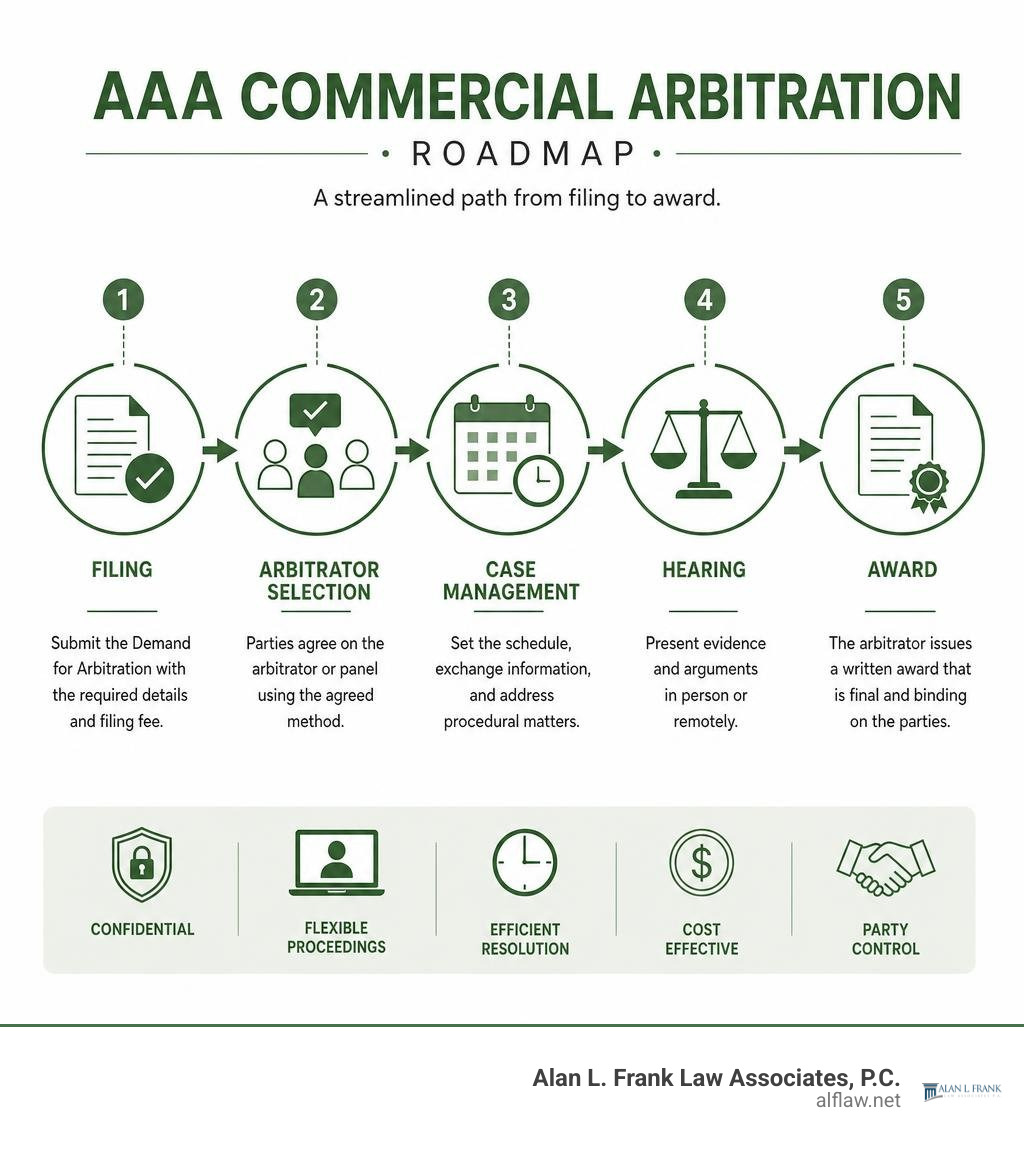
Basic aaa commercial arbitration rules 2025 vocab:
Key Framework of the AAA Commercial Arbitration Rules 2025

The American Arbitration Association (AAA) provides a private, structured forum for resolving business disputes across industries, from technology and manufacturing to commercial finance and real estate. Under Rule R-1, when commercial agreements incorporate AAA rules without naming a specific track, the commercial dispute framework applies by default. Parties retain the autonomy to shape the proceedings by written agreement, though modifications made after the arbitrator’s appointment require the arbitrator’s approval.
A foundational element of this procedural framework is the competence-competence doctrine codified in Rule R-7. Under R-7, the arbitrator has the express authority to rule on their own jurisdiction, including resolving any challenges regarding the existence, validity, scope, or enforceability of the arbitration agreement. Rather than pausing proceedings to seek court determination over arbitrability, parties address threshold jurisdictional challenges directly to the appointed arbitrator.
To review the primary rule repository and current administrative frameworks, parties can consult the official commercial dispute procedures.
Procedural Tracks Under the AAA Commercial Arbitration Rules 2025
The rules divide commercial disputes into three operational tracks based on the total claim value (exclusive of interest, fees, and administrative costs). This tiered structure ensures that the scale of procedure matches the financial stakes involved.
| Procedural Track | Claim Amount Threshold | Key Procedural Characteristics | Hearing & Panel Format |
|---|---|---|---|
| Expedited Procedures (E-1 to E-10) | Claims under $100,000 | Limited discovery, strict timeline extensions, streamlined submissions | Sole arbitrator, single-day hearing target (or document-only) |
| Standard Procedures (R-1 to R-58) | $100,000 to $1,000,000 | Comprehensive discovery management, preliminary hearings, dispositive motion practice | Sole arbitrator (unless clause specifies three), full evidentiary hearings |
| Large, Complex Track (L-1 to L-3) | $1,000,000 and above | Mandatory preliminary hearing, broad arbitrator authority over depositions, block scheduling | Presumption of three-arbitrator panel for claims $\ge \$3\text{M}$ (unless agreed otherwise) |
For claims governed by the Large, Complex Commercial Dispute Procedures (claims of $1 million or more), the rules enforce comprehensive case management. In these matters—where the median claim in 2025 was $3 million and the average claim approached $9.9 million—arbitrators actively establish schedules, order deposition parameters where justified, and implement block hearing schedules to avoid protracted, fragmented trials.
Demand Filing and Answering Requirements
Initiating an arbitration begins by submitting a Demand for Arbitration through AAA WebFile® or by direct electronic filing with the association. The filing party (claimant) must provide:
- Full legal names and contact details for all parties and their legal representatives.
- A clear statement describing the nature of the dispute and the underlying facts.
- The specific financial remedy or equitable relief demanded.
- A copy of the underlying contract containing the dispute resolution clause.
- Payment of the applicable administrative filing fee.
Under Rule R-5, the responding party must file an answering statement and any counterclaims within 14 calendar days from the AAA’s notice of filing. Failure to file an answer does not delay the case; it is treated as a general denial of the claim. If a party files a counterclaim, it must follow the same detail requirements as the initial demand and include the appropriate counterclaim filing fee.
In low-value matters where local statutory criteria are met, parties may retain the right to resolve eligible disputes in small claims court instead of submitting to administration, provided such options are exercised prior to the appointment of the neutral arbitrator.
Evidentiary Standards, Virtual Proceedings, and Dispositive Powers

Modern commercial dispute management under the AAA rules emphasizes speed and targeted discovery, avoiding the protracted motions common in standard court litigation. Rule R-21 mandates a preliminary hearing between the arbitrator and counsel to set strict scheduling parameters, establish exchange dates, and define the scope of testimony.
Under Rule R-22, the arbitrator manages the pre-hearing information exchange, with broad discretion to order the production of documents, electronic data, and witness statements. Litigants must navigate these evidentiary and document exchange rules with precision. Arbitrators can admit witness testimony via written sworn statements or declarations under Rule R-35(a), provided the opposing side receives sufficient written notice to cross-examine the witness live or remotely. If a noticed witness fails to appear, the arbitrator may disregard their statement entirely.
Crafting a focused pre-hearing evidentiary strategy is vital when handling complex commercial litigation within AAA tribunals.
Cybersecurity, Data Privacy, and Confidentiality
Information security is integrated into preliminary proceedings. Under current practice, arbitrators and parties must include cybersecurity, data privacy, and information protection as a standing agenda item during the Rule R-21 preliminary conference. The panel assesses the sensitivity of the commercial information at issue and establishes tailored cybersecurity measures for electronic document exchanges, cloud repositories, and remote video feeds.
Furthermore, Rule R-45 codifies confidentiality protections:
- Arbitrators and AAA administrators are bound to keep all case details, evidence, and proceedings confidential.
- The arbitrator possesses express authority to issue protective orders regarding proprietary commercial information, trade secrets, and confidential financial records upon party request.
- Under Rule R-48, awards may be signed and transmitted electronically, safeguarding digital integrity while eliminating postal delays.
Sanctions, Dispositive Motions, and Case Consolidation
To maintain efficiency and deter dilatory tactics, the rules provide clear enforcement mechanisms:
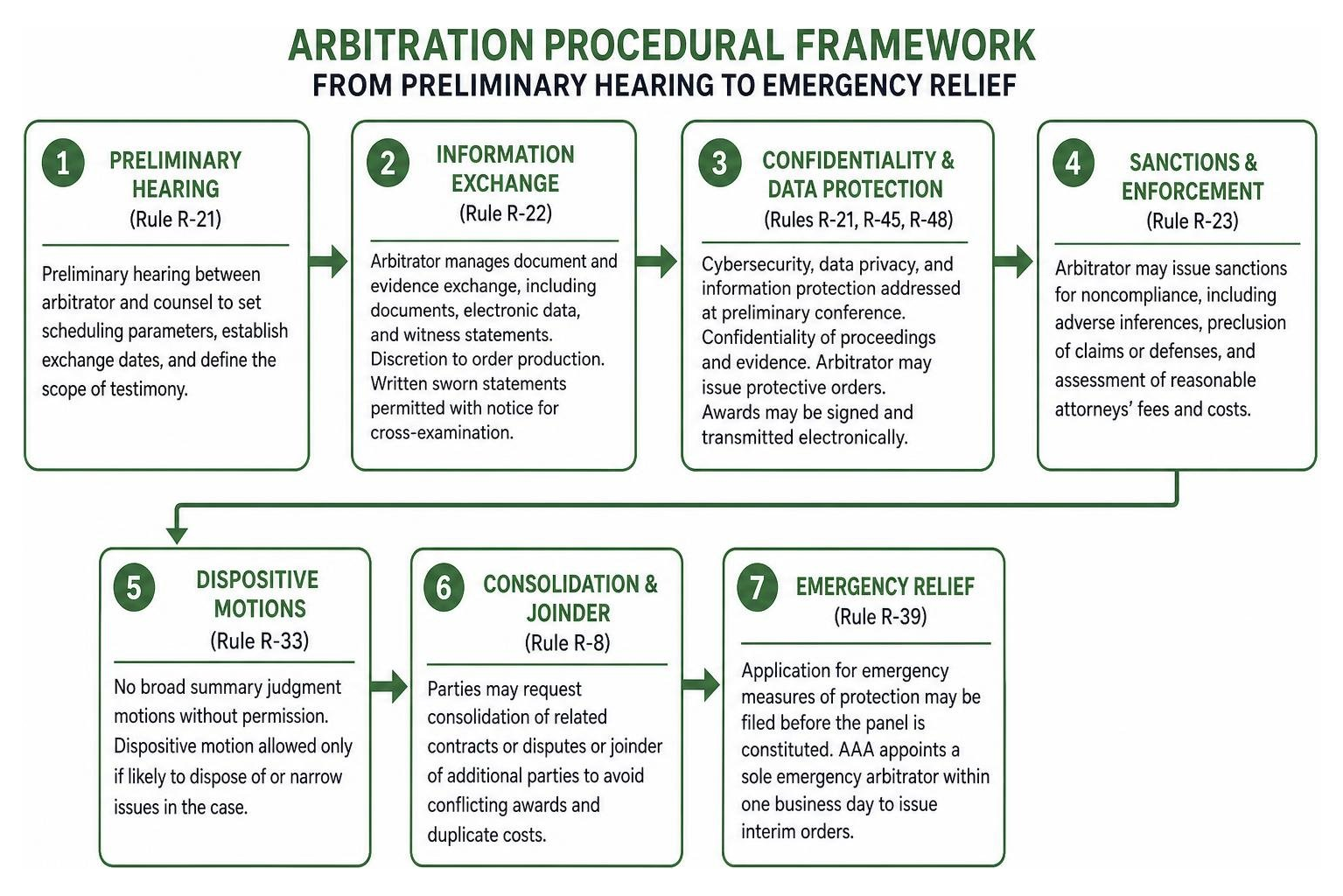
- Sanctions and Enforcement (Rule R-23): If a party fails to comply with procedural orders, document production deadlines, or the rules, the arbitrator can issue corrective sanctions. These powers include drawing adverse evidentiary inferences, precluding specific claims or defenses, and assessing reasonable attorneys’ fees and costs caused by the noncompliance.
- Dispositive Motions (Rule R-33): Parties may not file broad summary judgment motions without permission. An arbitrator will only allow a formal dispositive motion if the moving party demonstrates that the motion is likely to dispose of or narrow issues in the case, conserving party time and resources.
- Consolidation and Joinder (Rule R-8): Where related contracts or multiple commercial disputes involve common legal or factual questions, parties can request administrative consolidation or the joinder of additional parties to avoid conflicting awards and duplicate administrative costs.
- Emergency Measures of Protection (Rule R-39): If a party requires immediate interim injunctive relief before the panel is constituted, they may file an application for emergency relief. The AAA appoints a sole emergency arbitrator within one business day, who can issue interim orders to prevent irreparable commercial harm.
Arbitrator Selection, Fee Schedules, and Administrative Rules
The integrity of the arbitration process depends on the neutrality and industry expertise of the decision-maker. Arbitrators are selected from the AAA National Roster of Neutrals. When the contract does not specify a selection method, the AAA employs its standard “list-and-strike” process: both parties receive an identical list of qualified candidates along with detailed biographies, fee rates, and disclosures. Each party strikes unacceptable names, ranks the remaining candidates in order of preference, and returns the list to the case administrator, who appoints the highest mutually ranked neutral.
All prospective arbitrators must comply with rigorous disclosure requirements, disclosing any past or current professional, personal, or financial relationships that could create an appearance of partiality. If an undisclosed conflict arises, the AAA determines disqualification questions through administrative review.
These selection and disclosure standards are similarly critical in parallel forums; for example, parties navigating broker-dealer or financial disputes often evaluate how panels function under FINRA Attorneys and examine FINRA as a Forum for Claims Involving Stockbroker Misconduct. In commercial matters involving complex capital structures, understanding panel qualifications is just as vital as it is during direct securities litigation.
Administrative and Arbitrator Fee Schedules for the AAA Commercial Arbitration Rules 2025
Administrative fees are calculated based on the total claim value and the fee model selected at the time of filing:
- Standard Fee Schedule: Involves a two-stage payment model: an Initial Filing Fee paid upon filing, followed by a Final Fee billed once the first preliminary hearing is scheduled. This model offers lower total upfront costs if a matter resolves early.
- Flexible Fee Schedule: Provides a three-stage payment structure with a lower initial filing cost, followed by a Proceed Fee and a Final Fee, allowing parties additional flexibility to budget over the life of the dispute.
- Arbitrator Compensation: Arbitrators charge an hourly or daily rate that reflects their market experience and geographic region, which is billed separately from the AAA’s administrative fees. Deposits for arbitrator compensation are collected in advance of preliminary conferences and evidentiary hearings.
For an in-depth breakdown of current administrative rates and industry-specific dispute administration services, visit the AAA Commercial Dispute Resolution Directory.
Integrated Mediation Procedures for Commercial Disputes
Under Rule M-1 of the Commercial Mediation Procedures, mediation is integrated directly into the arbitration track for disputes where claims or counterclaims exceed $100,000. Unless either party opts out in writing, the AAA initiates mediation concurrently with the arbitration timeline.
Because mediation proceeds on a parallel track, it does not delay hearing deadlines or arbitrator appointments. In 2025, 52% of commercial B2B cases filed with the AAA settled prior to the issuance of a final award. Utilizing the integrated mediation option allows businesses in Pennsylvania, New Jersey, and nationwide to explore cost-effective, confidential settlement structures while maintaining their arbitration posture.
Frequently Asked Questions About AAA Commercial Arbitration
How do the Expedited Procedures differ from Large, Complex Case Procedures?
The Expedited Procedures apply to claims under $100,000 and focus on rapid, low-cost resolution. They mandate a sole arbitrator, strictly limit discovery and extensions, encourage single-day hearings or document-only determinations, and feature shortened turnaround times for the final award.
In contrast, the Large, Complex Commercial Dispute Procedures apply to claims of $1,000,000 or more. They feature comprehensive case management, mandatory preliminary conferences (frequently conducted via teleconference or videoconference), broader arbitrator discretion regarding depositions and expert evidence, and a standard expectation of a three-arbitrator panel for claims at or above $3,000,000 unless the parties agree otherwise.
What are the consequences of nonpayment of administrative or arbitrator fees?
Both parties are jointly responsible for hearing fees and arbitrator compensation deposits. If a party fails to pay their assessed share of administrative fees or arbitrator deposits, the AAA issues formal delinquency notices. If nonpayment persists:
- The arbitrator or the AAA may suspend proceedings entirely.
- The non-defaulting party may cover the unpaid deposit to keep the schedule intact, subject to an immediate request for a fee-shifting order or interim award from the arbitrator.
- If fees remain unpaid after final notice, the AAA will cease administration and terminate the arbitration, leaving the defaulting party exposed to potential court motions to compel or immediate sanctions.
How does the AAA manage cybersecurity and virtual hearings?
Under Rules R-22 and R-25, arbitrators hold the discretion to conduct preliminary conferences and full evidentiary hearings remotely via secure videoconferencing platforms, or in a hybrid format. During the preliminary hearing, the arbitrator and parties review a cybersecurity checklist covering data encryption, controlled document access, and witness isolation protocols during testimony. The arbitrator can issue binding confidentiality and data security orders to ensure that all digital exchanges remain protected from unauthorized access.
Navigating Commercial Arbitration with Experienced Counsel
Navigating commercial arbitration under the AAA framework requires clear strategy from the initial drafting of dispute clauses through the final evidentiary hearing. Alan L. Frank Law Associates, P.C. represents corporate clients, partnership entities, and investors in high-stakes business disputes, multi-party contract actions, and commercial matters across Pennsylvania, New Jersey, and nationwide.
Our practice assists businesses with:
- Structuring precise ADR agreements to protect operational interests.
- Managing pre-hearing discovery disputes, preliminary hearings, and dispositive motion practice.
- Pursuing emergency measures of protection and interim commercial relief.
- Representing clients through final evidentiary hearings, awards, and post-award confirmation or vacatur proceedings in state and federal courts.
To discuss an active arbitration demand, contract review, or complex business dispute, explore our focused commercial litigation services or contact our team to schedule a consultation.