
Don’t Let Your Case Crumble Like Your Foundation


Don’t Let Your Case Crumble Like Your Foundation
Understanding Actionable Defects: Patent vs. Latent Deficiencies
Construction defect claims and litigation involve identifying actionable building flaws, complying with mandatory statutory pre-suit notice and right-to-cure procedures, and filing lawsuits within strict statutes of limitations and repose. When property owners discover physical failures, legal liability depends on whether the conditions stem from design errors, substandard workmanship, or defective materials.
The law categorizes flaws based on visibility and timing. Distinguishing between patent and latent defects determines not only which standards of proof apply, but also when statutory filing clocks begin to tick.
- Patent Defects: These are obvious, readily observable flaws that any reasonable inspection would reveal immediately upon completion. Examples include cracked exterior stucco, improperly sloped drainage walkways, visible cosmetic blemishes, or missing structural flashing.
- Latent Defects: These are hidden, concealed deficiencies that cannot be discovered through a standard visual walkthrough. They often lurk beneath drywall, below slab foundations, or inside building envelope assemblies. A latent defect may take months or years of environmental stress to manifest as visible damage.
Building codes and community workmanship standards define whether a condition constitutes an actionable defect. A builder or design professional must adhere to the reasonable standard of care expected within the construction industry. When a contractor cuts corners, uses substandard materials, or ignores architectural blueprints, the resulting failure exposes them to liability.
Identifying Common Structural and Environmental Failures
Construction failures generally stem from poor design, defective manufacturing, improper installation, or uncoordinated mechanical work. Across residential developments, commercial towers, and multi-family communities, specific failure categories consistently drive legal disputes:
- Water Intrusion and Moisture Infiltration: By far the most frequent source of litigation. Inadequate waterproofing membranes, improperly integrated window and door assemblies, defective roof flashing, and failed sealant joints allow water to penetrate exterior cladding. Over time, untreated water intrusion causes timber rot, mold contamination, interior drywall failure, and corroded structural fasteners.
- Soil Settlement and Geotechnical Movement: When contractors build on improperly compacted fill or fail to account for expansive soils, structural distress is inevitable. Excessive soil movement causes foundational cracking, uneven slab settlement, retaining wall rotation, and severe structural distortion throughout the framing.
- Mechanical, Electrical, and Plumbing (MEP) Failures: Poorly executed plumbing layouts can trigger catastrophic pipe bursts behind finished walls. Defective HVAC ductwork installation leads to severe condensation, moisture buildup, and an inability to maintain statutory indoor climate baselines.
- Structural Framing and Load-Bearing Deficiencies: Deflections in load-bearing beams, improper truss spacing, unreinforced masonry, and inadequate shear wall fastening directly threaten life safety and require immediate, invasive remediation.
Navigating Construction Defect Claims and Litigation: Pre-Suit Notice and Right to Cure
Filing a construction defect complaint is rarely as simple as drafting a lawsuit and serving a summons. Many jurisdictions enforce strict non-adversarial dispute frameworks and statutory pre-suit notice requirements designed to encourage early settlements before court dockets get clogged.
Under these procedural models—such as the statutory framework outlined in Washington’s RCW 64.50—a claimant must serve a formal, detailed written notice of claim on the construction professional at least 45 days before filing a lawsuit in court. The notice must specify the nature, location, and observable impact of each claimed defect.
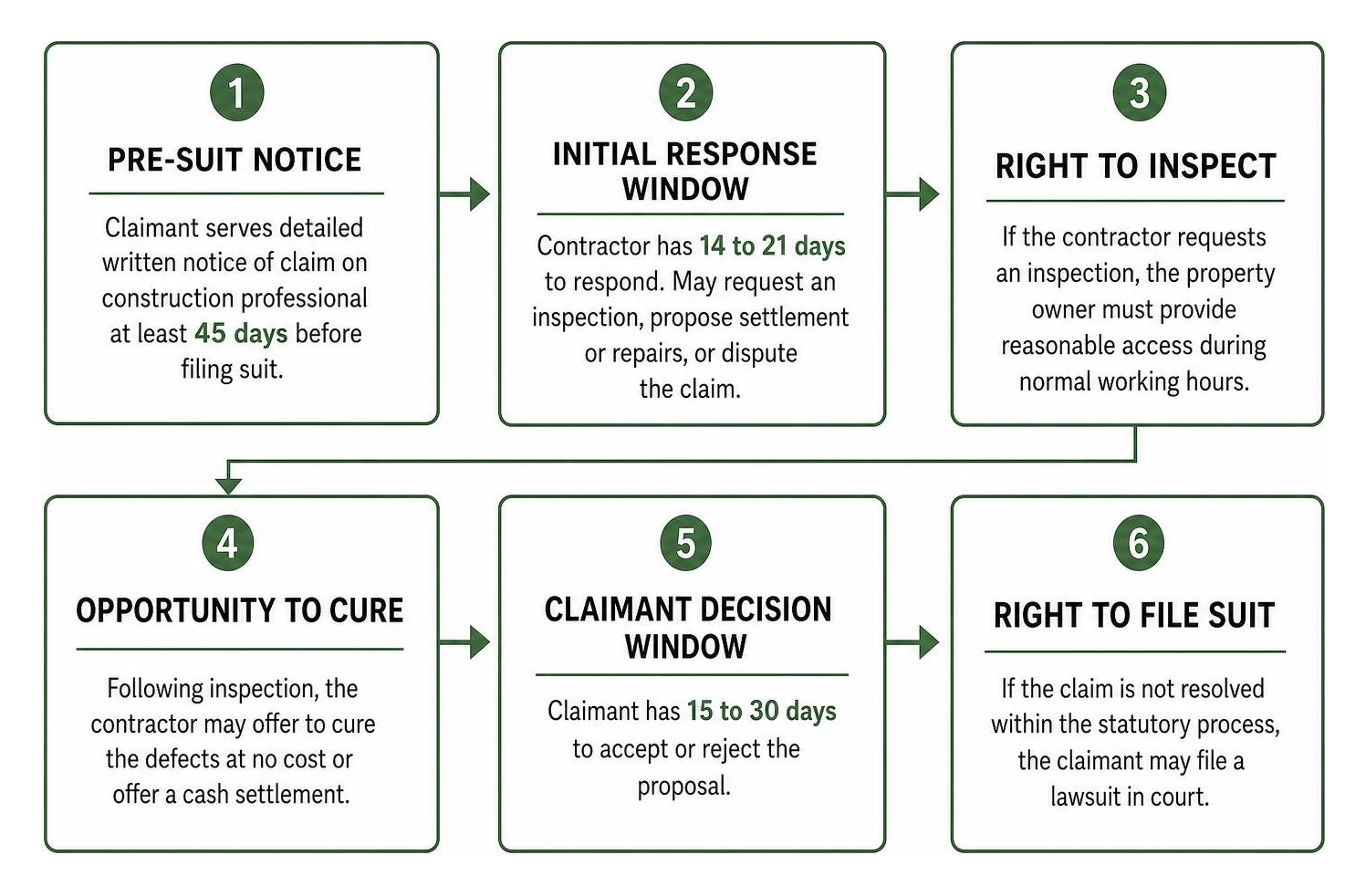
Once served, the statutory process unfolds through a sequence of time-sensitive actions:
- Initial Response Window: The contractor typically has 14 to 21 days to respond. They may demand an on-site inspection, request an expert conference, offer a monetary settlement, propose a scope of repairs, or dispute the claim entirely.
- Right to Inspect: If the builder requests an inspection, the property owner must provide reasonable access during normal working hours.
- The Opportunity to Cure: Following the inspection, the builder may tender an offer to cure the defects at no cost or offer a cash settlement. The claimant then has a defined statutory window (typically 15 to 30 days) to accept or reject the proposal.
- Mandatory Defect Lists: If negotiations fail and litigation ensues, statutes often require the plaintiff to file and serve an itemized list of all known construction defects within 30 to 60 days of commencing the court action.
Failing to comply with these pre-suit procedural requirements carries real consequences. If an owner files a lawsuit prematurely without serving statutory notice or allowing the required inspection window, courts will routinely stay the proceedings or issue a dismissal without prejudice until the statutory notice and cure steps are completed.
Special Requirements for Condominium Associations and HOAs
Multi-family developments and condominium associations face heightened procedural hurdles when pursuing defect claims. Because association boards manage common elements on behalf of dozens or hundreds of individual property owners, governance statutes impose strict pre-litigation conditions.
In many modern statutory frameworks, condominium associations must obtain a formal written inspection report from an independent, licensed construction defect professional before serving a notice of claim. This report must detail the expert’s qualifications, the exact inspection methodology used, and the precise physical location of each identified deficiency.
Furthermore, before serving a summons and complaint for multi-unit claims, the board of directors is often legally mandated to issue formal written notice to all unit owners. This communication outlines:
- The nature and estimated costs of the alleged defects;
- The anticipated legal expenses and expert fees;
- The potential impact on property values and unit refinancing during active commercial litigation; and
- The scheduled board meetings where unit owners can evaluate litigation strategy.
Board members must conduct these proceedings carefully to preserve the attorney-client privilege and work-product protections while fulfilling their fiduciary duties to the community.
Evidentiary Rules and Pre-Suit Repair Negotiations
The pre-suit notice phase is not merely an administrative exercise; it shapes the evidentiary landscape for trial. To understand the statutory mechanics, review these statutory construction defect procedures governing notice, destructive testing, and builder responses.
During property inspections, builders and their forensic engineers often seek permission to perform intrusive or destructive testing—such as cutting exploratory openings into exterior stucco, core-drilling concrete slabs, or taking deep soil borings. While destructive testing can uncover the root cause of latent water intrusion, property owners should insist on clear, written testing protocols. These agreements must specify who pays for repairs, require the builder to return the property to its original condition, and demand proof of liability insurance from any testing contractors.
Another key issue is the admissibility of pre-suit repair offers. Under standard rules of evidence, settlement offers are generally excluded to encourage open compromise. However, under specific statutory dwelling acts, formal pre-litigation repair plans, scope-of-work proposals, and post-inspection contractor admissions may be admissible at trial to prove the contractor had notice of the defect or failed to perform adequate remediation.
Legal Grounds for Recovery and Defenses
Navigating defect litigation requires pairing the physical engineering evidence with the correct cause of action. The strategy often balances contract-based claims against tort liabilities, navigating strict legal doctrines that restrict financial recovery.
One major hurdle in construction defect claims is the Economic Loss Rule. Under this doctrine, a plaintiff cannot recover purely financial or commercial losses through tort theories like negligence if the damage is confined solely to the defective product or structure itself. In short: if a poorly built roof simply leaks and damages nothing other than the roof framing, the remedy generally lies in breach of contract or warranty, not negligence. However, when defective construction causes physical injury to a person or damages “other property” (such as furniture, machinery, or adjacent buildings), tort claims remain fully viable.
| Legal Cause of Action | Basis of the Claim | Typical Statute of Limitations Trigger | Primary Defenses Raised by Builders |
|---|---|---|---|
| Breach of Express Contract | Failure to adhere to written plans, specifications, or architectural schedules. | Date of substantial completion or material breach of contract terms. | Lack of contractual privity, owner-directed change orders, or failure to give timely notice. |
| Breach of Implied Warranty | Violation of common-law warranties of habitability and workmanlike quality. | Discovery of latent defects or first unit sale/closing. | Expired statutory warranty windows, normal wear and tear, or homeowner maintenance neglect. |
| Negligence & Professional Malpractice | Breach of professional standard of care by architects, engineers, or trades. | Date damage manifests or termination of professional relationship. | Economic loss rule, lack of proximate causation, or intervening third-party alterations. |
| Fraud & Misrepresentation | Intentional concealment of known structural defects or false marketing statements. | Discovery of the intentional deceit or active concealment. | “As-is” purchase clauses, lack of justifiable reliance, or expired fraud discovery rules. |
When physical structural failures escalate into hazardous collapses, falling debris, or severe mold-induced respiratory illnesses, the matter extends beyond property damage into significant personal injury wrongful death claims, requiring separate tort actions against the responsible contractors and developers.
Legal Theories in Construction Defect Claims and Litigation
To establish liability against multiple project participants, plaintiffs typically deploy several overlapping legal theories:
- Breach of the Implied Warranty of Habitability: Created to protect residential purchasers, this implied warranty guarantees that a newly built structure is reasonably fit for human occupation. In many jurisdictions, builders cannot contractually disclaim this basic protection, and subsequent purchasers can assert it against original builders upon uncovering hidden, latent structural defects.
- Workmanlike Construction: Contractors are legally presumed to perform their trade in a skilled manner consistent with accepted local building practices. Failing to meet minimum building code requirements serves as direct evidence of unworkmanlike performance.
- Design Professional Malpractice: Architects and structural engineers owe a legal duty to design structures that meet safety codes and structural load calculations. Negligent design claims target errors in the original construction drawings that cause systemic structural or drainage failures.
- Intentional Concealment and Deceit: If a developer covers up active water damage or conceals structural foundation cracks with cosmetic patches prior to closing escrow, the buyer can bypass standard contract disclaimers and pursue direct fraud claims, which may open the door to punitive damages.
Statutes of Limitations and Statutes of Repose
Timing is critical in construction defect matters. Missing a statutory deadline will permanently extinguish an otherwise strong claim. Property owners must navigate two distinct legal clocks: the statute of limitations and the statute of repose.
To analyze how courts determine accrual and project completion triggers, review these statute of limitations accrual standards in modern construction litigation.
- Statute of Limitations: This clock governs how long a plaintiff has to file a lawsuit after discovering (or after they reasonably should have discovered) the defect. Under the common-law “discovery rule,” the limitations period is tolled until a hidden, latent defect becomes apparent. Depending on the jurisdiction and cause of action, limitations periods typically run between 2 and 6 years from the date of discovery.
- Statute of Repose: Unlike the statute of limitations, the statute of repose creates a strict, unyielding outer deadline for filing a lawsuit, regardless of when the defect is actually discovered. The clock starts running automatically on the date of substantial completion, the issuance of the Certificate of Occupancy, or the initial closing date. Repose periods typically range from 6 to 12 years. Once the statute of repose expires, the claim is permanently extinguished—even if the foundation cracks on year eleven of a ten-year repose period.
Determining the exact “completion date” that starts the statute of repose is often heavily disputed. For individual homes, it is usually tied to final inspection or closing. For large condominium developments, courts may measure accrual from the date the master Certificate of Occupancy is issued, the recording of the association declaration, or the closing of the very first unit.
Avoiding Strategic Pitfalls in Construction Defect Claims and Litigation
Construction litigation is legally and technically complex. Without a clear strategy, claimants and developers can quickly make costly errors. Avoiding common pitfalls is essential to keeping a case on track:
- Failing to Retain Qualified Expert Witnesses Early: A defect case cannot survive on homeowner complaints or photos alone. You need credible structural engineers, building envelope consultants, and forensic cost estimators. These experts establish the applicable standard of care, demonstrate causation through scientific testing, and provide defensible repair budgets that withstand cross-examination.
- Misunderstanding Commercial General Liability (CGL) Insurance Triggers: Contractors rarely pay substantial defect verdicts out of pocket; their insurance carriers do. However, standard CGL policies cover “property damage” caused by an “occurrence” (accident)—they generally do not pay to simply replace the contractor’s own defective workmanship. Proving that a subcontractor’s faulty work caused consequential physical damage to other non-defective building components is essential to triggering insurance coverage and settlement funds.
- Suing Every Subcontractor Indiscriminately: Casting too wide a net by naming dozens of minor trade subcontractors drains litigation resources and delays proceedings with endless multi-party cross-claims. A more effective strategy targets the developer, the general contractor, and the key trade contractors responsible for the primary structural or waterproofing failures.
- Underestimating Case Costs and Financial Feasibility: Forensic engineering inspections, intrusive testing, multiple expert depositions, and complex discovery require significant upfront resources. Litigators must assess whether the projected recovery justifies the expense before moving forward. You can review our firm’s track record and past case results to see how careful financial planning and strategic focus lead to successful outcomes.
Frequently Asked Questions About Construction Defects
What is the difference between a statute of limitations and a statute of repose in construction defect cases?
A statute of limitations begins running only when the property owner discovers (or reasonably should have discovered) the defect or resulting physical damage, giving them a set window (typically 2 to 6 years) to file suit. A statute of repose is an absolute cutoff that starts on the date of substantial completion or certificate of occupancy. Once the statute of repose window expires (often 6 to 10 years post-construction), no lawsuit can be filed under any circumstances, even if the defect was completely hidden until that point.
What happens if a homeowner files a lawsuit without providing statutory pre-suit notice?
If a claimant files a construction defect lawsuit in court without complying with mandatory statutory pre-suit notice and right-to-cure laws (such as RCW 64.50), the defendant will move to dismiss or stay the case. In most cases, the court will stay the legal proceedings or dismiss the action without prejudice, forcing the homeowner to serve the proper notice, allow builder inspections, and complete the mandatory statutory negotiation process before refiling.
Can subsequent home purchasers sue the original builder for latent construction defects?
Yes, in many jurisdictions, subsequent home purchasers can sue the original builder for latent (hidden) defects under the implied warranty of habitability and workmanlike construction. Because latent foundation or waterproofing flaws cannot be discovered during a standard purchase inspection, courts often hold that this implied warranty runs with the property, preventing builders from escaping liability simply because the home was resold before the hidden defect manifested.
Conclusion
Construction defect litigation requires a careful balance of engineering evidence, strict procedural compliance, and seasoned courtroom advocacy. From meeting mandatory pre-suit notice deadlines and conducting destructive forensic testing to interpreting CGL insurance coverage and beating statutes of repose, every step demands strategic precision.
At Alan L. Frank Law Associates, P.C., we represent property owners, commercial investors, and developers in high-stakes construction defect disputes across Pennsylvania and New Jersey. We evaluate claims thoroughly from day one, helping clients uncover the true scope of building failures and pursuing maximum recoveries. If your commercial property, multi-family structure, or residential investment is suffering from design or structural failures, review our housing and construction defect legal guidance to understand your legal rights and protect your investment.