
Everything Co-Owners Must Know About Partitioning Real Property


Everything Co-Owners Must Know About Partitioning Real Property
Legal Foundations: What Is Partition of Property and Who Qualifies?
At its core, a partition action terminates concurrent ownership so that each co-owner can hold property independently. Under the legal definition of partition, the law seeks to eliminate concurrent ownership interests, converting shared property into sole ownership, also known as ownership in severalty.
The foundational principle driving partition is the right of alienation. The legal system generally disfavors forcing people to remain perpetual co-owners when personal or business relationships break down. Because of this, courts recognize an almost absolute statutory right for eligible co-owners to petition for partition. A co-owner holding a fractional 1% interest generally has the exact same standing to demand partition as a co-owner holding a 99% interest.
Understanding What Is Partition of Property Across Tenancy Types
To determine who qualifies to petition for partition, one must examine how the title to the real estate is held. Not every type of co-ownership qualifies for statutory partition:
- Tenants in Common (TIC): This is the most common form of co-ownership subject to partition. Tenants in common hold distinct, undivided fractional shares of the real estate. Each co-owner can independently convey, mortgage, or petition the court to partition their interest.
- Joint Tenancy with Right of Survivorship (JTWROS): Joint tenants hold equal, undivided interests created simultaneously with survivorship rights. Filing a partition action severs the joint tenancy, transforming the estate into a tenancy in common and extinguishing the right of survivorship upon final disposition.
- Tenancy by the Entirety: This form of title is reserved exclusively for married couples. Unlike joint tenants or tenants in common, neither spouse can unilaterally petition to partition property held by the entirety while the marriage remains legally intact. Severance occurs only through absolute divorce (which converts title to tenancy in common) or mutual agreement.
- Trusts, LLCs, and Partnerships: Property titled under the name of a business entity (like an LLC or corporation) or held in trust cannot be partitioned via standard real estate partition actions. The internal operating agreement, partnership agreement, or trust document governs the liquidation or distribution of those corporate assets.
- Inherited Estates in Probate: Heirs cannot partition inherited real estate until the underlying probate proceedings conclude and legal title officially vests in the beneficiaries.
| Co-Ownership Structure | Partition Eligible? | Key Legal Requirement / Restriction |
|---|---|---|
| Tenants in Common | Yes | Any fractional co-owner may petition the court |
| Joint Tenancy (JTWROS) | Yes | Filing severs the right of survivorship |
| Tenancy by the Entirety | No | Requires final decree of divorce or mutual spousal consent |
| LLC / Entity Titled | No | Governed by operating agreement and corporate dissolution |
| Unsettled Probate Property | No | Estate administration must finalize before title transfers |
Voluntary Agreements vs. Compulsory Judicial Partition
Partitions fall into two categories: voluntary private settlements and compulsory judicial partitions.
A voluntary partition occurs when co-owners negotiate an out-of-court agreement. The owners draft, sign, and record cross-conveyance deeds or boundary adjustment deeds without court involvement. Our firm regularly assists clients with these corporate and transactional matters to draft clear partition deeds, manage tax-neutral allocations, and resolve co-ownership disputes without litigation expenses.
A compulsory judicial partition becomes necessary when co-owners reach a complete impasse. If one owner refuses to sell, demands an unrealistic price, or halts property maintenance, any co-tenant can file a partition lawsuit. This prompts the court to issue a binding decree that orders the physical division, private buyout, or public sale of the real estate.
Primary Methods of Dividing Co-Owned Real Estate

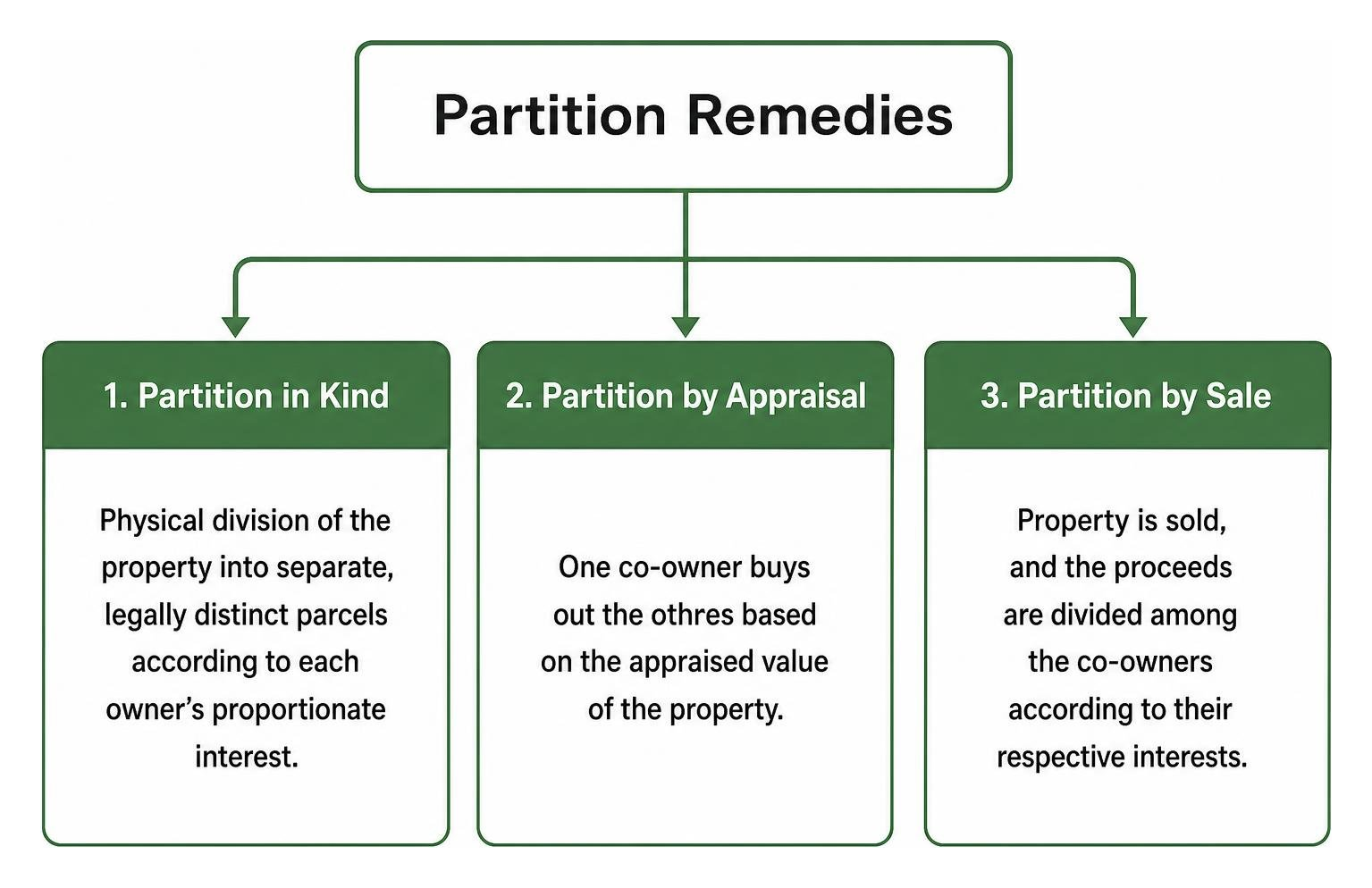
When a court adjudicates a compulsory partition, it selects one of three distinct legal remedies based on physical feasibility and economic impact.
Partition in Kind and the Significant Prejudice Standard
Partition in kind involves the physical division of real property into distinct, legally separate lots according to each owner’s proportionate interest. Historically, partition in kind is the legal system’s preferred remedy because it preserves an owner’s land title without forcing a sale.
However, courts will not order physical division if it creates “significant prejudice” or material injury to the owners. To evaluate significant prejudice, courts weigh multiple economic and non-economic factors:
- Divisibility and Zoning: Can the land be physically subdivided into viable parcels that comply with local municipal zoning, minimum frontage, and utility requirements?
- Economic Value Loss: Would dividing the property result in separate parcels whose aggregate market value is substantially less than the fair market value of the unified parcel sold as a whole?
- Historical and Sentimental Use: How long has the family or co-owner held the parcel, and does an owner use the property for primary residence or farming?
- Owelty Equalization: When physical boundaries cannot be divided into mathematically equal dollar values, courts can order compensatory cash payments (known as owelty) to bridge the financial gap between unequal parcels.
Partition by Sale, Public Auctions, and Private Listings
When physical division is impossible or causes substantial financial harm—such as with a single-family residential home, a high-rise office building, or an indivisible commercial lot—the court orders a partition by sale.
In a partition by sale, the entire property is liquidated and the net proceeds are distributed among the co-owners according to their equitable interests. While traditional statutes historically mandated public sheriff auctions, modern courts prioritize appointing licensed real estate brokers to list the property on the open market. Open-market listings secure fair market values far better than distressed courthouse auctions, maximizing the financial recovery for all parties.
Buyouts, Set-Offs, and What Is Partition of Property by Appraisal
Partition by appraisal (often referred to as an allotment or set-off buyout) occurs when one or more co-owners purchase the fractional shares of the other co-owners.
Under modern statutory frameworks, such as the Uniform Partition of Heirs Property Act (which has been adopted across more than 20 jurisdictions), co-owners who wish to retain family property have a statutory right of first refusal to buy out the shares of owners seeking liquidation at a court-determined fair market appraisal value.
In practice, co-owners frequently accomplish this outside of court by securing cash-out refinancing, paying off the departing owner’s equity, and recording a quitclaim or warranty deed to clear title.
The Judicial Partition Process: Procedure, Commissioners, and Timelines

Navigating a partition lawsuit requires strict adherence to statutory civil procedure, jurisdictional requirements, and court rules.
Step-by-Step Lawsuit Progression and Unlocatable Co-Owners
- Title Search and Plaint Filing: The plaintiff’s attorney conducts an extensive title search to identify every legal owner, mortgagee, judgment creditor, and municipal lienholder. The lawsuit is filed in the county court where the land sits.
- Lis Pendens Registration: Immediately upon filing, the plaintiff records a formal lis pendens (notice of pending litigation) with the local recorder or registry of deeds. This puts prospective buyers, title insurers, and lenders on official notice, preventing any co-owner from secretly selling or encumbering their share.
- Service of Process and Unknown Heirs: All named parties must receive formal service of process. If a co-owner cannot be located after a diligent search, or if there are unknown heirs in an ancestral estate, the court requires constructive notice via certified publication and appoints a guardian ad litem or attorney ad litem to protect the missing party’s legal interests.
- Interlocutory Judgment: The judge examines the pleadings, confirms respective fractional interests, and enters an interlocutory judgment determining whether the property shall be partitioned in kind or sold.
- Final Order and Distribution Decree: Once the survey or sale concludes, the court enters a final decree distributing the net escrow proceeds and recording updated deeds.
A standard contested partition action can take anywhere from six months to two years depending on court calendars, appraisal challenges, and whether title issues must be cured.
The Role of Partition Commissioners and Referees
To assist the bench, the court frequently appoints an independent, neutral third party—termed a Partition Commissioner, Special Master, or Partition Referee.
Under court-issued warrants, the commissioner performs critical administrative functions:
- Hiring licensed land surveyors and certified appraisers.
- Evaluating whether the parcel can be physically divided without destroying its aggregate value.
- Managing the open-market listing, reviewing buyer offers, and executing the referee’s deed at closing.
- Holding proceeds in a dedicated court escrow account and submitting an accounting report to the judge.
The fees earned by the commissioner are treated as administrative costs of the action and are paid directly out of the gross property proceeds prior to distribution.
Financial Accounting: Handling Liens, Mortgages, and Proceeds Distribution
One of the most litigated phases of a partition action is the post-sale financial accounting. Proceeds from a court-ordered sale are never simply divided strictly down the middle without adjusting for debts, maintenance, and carrying costs.
Priority of Debt Payoffs and Mortgage Encumbrances
Before any co-owner receives a single dollar of net equity, sale proceeds must satisfy obligations in strict legal order of priority:
- Court Costs and Commissioner Fees: Legal filing fees, administrative advertising, title search costs, and court referee compensation.
- Municipal Tax Liens and Public Utilities: Outstanding municipal real estate taxes, school taxes, sewer, and water liens.
- Recorded Mortgages and Deeds of Trust: Primary and secondary mortgage balances secured against the property.
- Judgment Liens: Creditor liens attached specifically to an individual co-owner’s fractional interest (deducted exclusively from that individual’s share).
- Net Residual Equity: The remaining cash distributed to co-owners, subject to equitable contribution adjustments.
Contribution Credits, Property Improvements, and Ouster Rent
Courts sitting in equity evaluate individual financial contributions over the entire life of the co-ownership. Co-owners can demand accounting credits for:
- Preservation and Carrying Costs: A co-owner who paid 100% of the real estate taxes, hazard insurance, or necessary structural repairs (such as replacing a failing roof) is entitled to reimbursement credits from the non-paying owners’ shares.
- Capital Improvements: A co-owner who funded capital improvements without financial contribution from others does not automatically get a dollar-for-dollar refund on their receipts. Instead, the court awards a credit equal to the amount the improvement measurably increased the fair market value of the property.
- Ouster and Fair Rental Value: As a general legal rule, a co-owner who occupies the property does not owe rent to non-resident co-owners because every owner has an equal right to possess the whole. However, if an occupying co-owner commits an ouster—meaning they physically or constructively exclude the other co-owners by changing locks, threatening them, or denying access—the excluded owners can claim an offset credit for their share of the property’s fair rental value.
Legal Defenses and Jurisdictional Variations in Partition Law
While the statutory right to partition is strong, co-owners facing a partition petition can raise specific legal defenses or invoke statutory protections.
Contractual Waivers and Equitable Defenses
- Contractual Waiver: Co-owners can explicitly or implicitly waive their right to partition through written co-tenancy agreements, partnership contracts, or buyout options. To be legally binding, a partition restriction must be reasonable in duration and purpose; perpetual prohibitions are struck down by courts as unlawful restraints on alienation.
- Promissory Estoppel: If one co-owner made substantial personal or financial commitments based on another owner’s clear promise not to force a sale, a court may apply equitable estoppel to delay partition.
- Unclean Hands / Bad Faith: Courts sitting in equity may pause or modify partition proceedings if a co-owner acts maliciously to force a fire-sale liquidation targeting a vulnerable family member.
State and International Nuances: From the UPHPA to Civil and Personal Law
Partition practice reflects significant jurisdictional differences across state and international jurisdictions:
- Pennsylvania: Governed by the Pennsylvania Rules of Civil Procedure (Pa. R.C.P. 1551–1574), actions proceed through a two-phase process where the court establishes the parties’ rights before a special master oversees physical subdivision, allotment, or private sale.
- New Jersey: New Jersey courts place heavy emphasis on open-market broker listings over public auctions and frequently implement equitable partition offsets for non-resident owners under strict state case law precedents.
- Texas: Texas strictly protects the absolute statutory right of any co-tenant to demand partition regardless of the size of their fractional stake, utilizing court-appointed commissioners to report on divisibility.
- Louisiana: Operating under a civil code framework, Louisiana recognizes partition in kind and partition by licitation (sale by auction or private transaction under court order), where indivisible assets like houses are sold and proceeds apportioned.
- Sri Lanka: Partition lawsuits involve mandatory preliminary boundary surveys where the plaintiff must deposit court-estimated survey costs within strict statutory deadlines or face suit dismissal.
- Hindu Law (India): Real estate partition distinguishes between de jure partition (severing joint family coparcenary status and fixing shares) and de facto partition (the physical demarcation of property by metes and bounds), protecting the ancestral claims of daughters and unborn conceived children.
Frequently Asked Questions About Property Partition
Can one co-owner stop a partition action if they refuse to sell?
No. An individual co-owner cannot stop or veto a valid partition action simply by withholding consent. Because co-tenants hold an absolute statutory right to exit shared ownership, the court will proceed with physical division, a buyout, or a forced sale despite objections from other owners.
How are partition sale proceeds calculated and divided?
Sale proceeds are placed into a court-supervised escrow account. First, closing expenses, court costs, referee fees, outstanding property taxes, and mortgage balances are paid in full. The remaining net proceeds are then distributed based on fractional ownership percentages, adjusted for court-approved contribution credits (such as taxes, maintenance, or improvements paid disproportionately by one owner).
How long does a typical partition lawsuit take to resolve?
An uncontested partition involving a cooperative buyout or agreed private listing can resolve within three to six months. A fully contested partition lawsuit involving valuation disputes, unlocatable heirs, or extensive accounting hearings can take twelve to twenty-four months to achieve a final distribution decree.
Conclusion
Shared property disputes can quickly compromise real estate value and strain personal or business relationships. Whether dividing inherited real estate among family members or dissolving a commercial real estate partnership, understanding your legal rights under partition law allows you to protect your financial investment.
At Alan L. Frank Law Associates, P.C., our legal team provides experienced counsel to navigate complex real estate disputes, voluntary buyout structures, and court-supervised property partitions. If you are facing a co-ownership deadlock and need to protect your equity, our attorneys provide comprehensive commercial litigation representation to secure an equitable resolution.