
Everything You Need to Know About the Reorganization Plan Shareholder Vote


Everything You Need to Know About the Reorganization Plan Shareholder Vote
Why the Reorganization Plan Shareholder Vote Can Make or Break Your Investment
A reorganization plan shareholder vote is one of the most consequential decisions a stockholder can make. Your vote — or your silence — can directly affect whether a company preserves its value, protects critical tax assets, or collapses under financial pressure.
Here’s what you need to know at a glance:
| Key Question | Quick Answer |
|---|---|
| What is it? | A formal vote where eligible shareholders approve or reject a company’s restructuring plan |
| Who can vote? | Stockholders of record as of the designated record date |
| How do you vote? | Online, by phone, by mail, or through a proxy |
| What if you don’t vote? | In many cases, not voting counts the same as voting against the plan |
| Why does it matter? | Approval can preserve tax assets, company value, and your investment |
Shareholder voting rights exist because you own a piece of the company. Common stockholders typically receive one vote per share, giving them direct influence over decisions that affect company performance — including major restructurings.
The stakes are real. In some reorganizations, existing shares are completely wiped out if a plan fails or is replaced by a court-ordered alternative. In others, a successful vote can protect hundreds of millions in tax assets and keep a company on a major exchange.
A recent example makes this concrete: ContextLogic received approximately 99% support from shares voted ahead of its July 24, 2025 Annual Meeting — a clear signal that when shareholders understand what’s at risk, they act decisively.
Whether you hold shares in a company currently undergoing restructuring or simply want to understand your rights as an investor, knowing how this process works is essential to protecting your financial interests.
What is a Corporate Reorganization Plan?
At its core, a corporate reorganization plan is a blueprint for a company’s survival or evolution. When a business faces significant financial hurdles, shifting market conditions, or the need to protect specific assets like tax credits, it may propose a “reorganization.” This is a formal process designed to restructure the company’s capital, debt, or operational framework to ensure long-term business viability.
In the legal world, we often see these plans arise during a Chapter 11 Plan of Reorganization and Voting Process. The goal of Chapter 11 is generally to restructure a debtor’s monthly debt service, improve cash flow, and maintain a viable business. This might involve reducing the principal on loans, extending payment terms, or lowering interest rates.
However, reorganization isn’t always about bankruptcy. Sometimes, it’s a strategic “recapitalization”—a reshuffling of the capital structure. This can involve shifting asset allocations or issuing new classes of stock to ensure equity preservation. But be warned: if a plan is confirmed in a strict bankruptcy context, the results can be harsh. For instance, in some cases like the Zynex Reorganization Plan Confirmed: Existing Equity to be Extinguished | ZYXI News & Analysis, the court may mandate that all existing common stock be cancelled and released with no recovery for current shareholders.
Why Shareholders Must Approve the Plan
You might wonder why a company can’t just change its structure on its own. The answer lies in fiduciary duty. The board of directors and management have a legal obligation to act in the best interests of the owners—the shareholders.
A reorganization often triggers significant ownership changes or material revisions to the company’s governing documents. Because these changes can dilute your ownership or alter your rights, state laws (like those in Pennsylvania and New Jersey) and federal regulations require a reorganization plan shareholder vote. This process ensures board accountability and gives you a say in whether the proposed “fix” is actually in your best interest.
The Role of the Disclosure Statement
Before you are asked to cast your reorganization plan shareholder vote, the company must provide you with a Disclosure Statement. Under 11 U.S.C. § 1125, this document must contain “adequate information”—enough detail to allow a typical investor to make an informed judgment.
This isn’t just a marketing brochure; it’s a detailed legal filing often seen in SEC documents like EX-99.1. It outlines:
- The history of the company’s financial troubles.
- The specifics of the proposed plan.
- Critical risk factors (what happens if the plan fails?).
- Projections of what creditors and shareholders will receive.
The Mechanics of a Reorganization Plan Shareholder Vote
The actual process of voting is governed by a mix of federal securities laws, exchange rules (NYSE/Nasdaq), and state statutes. For companies incorporated in our region, New Jersey Revised Statutes Section 14A:10-3 (2025) provides specific guidelines on how mergers and reorganizations must be approved by the board and then submitted to a shareholder vote.

How to Cast Your Reorganization Plan Shareholder Vote
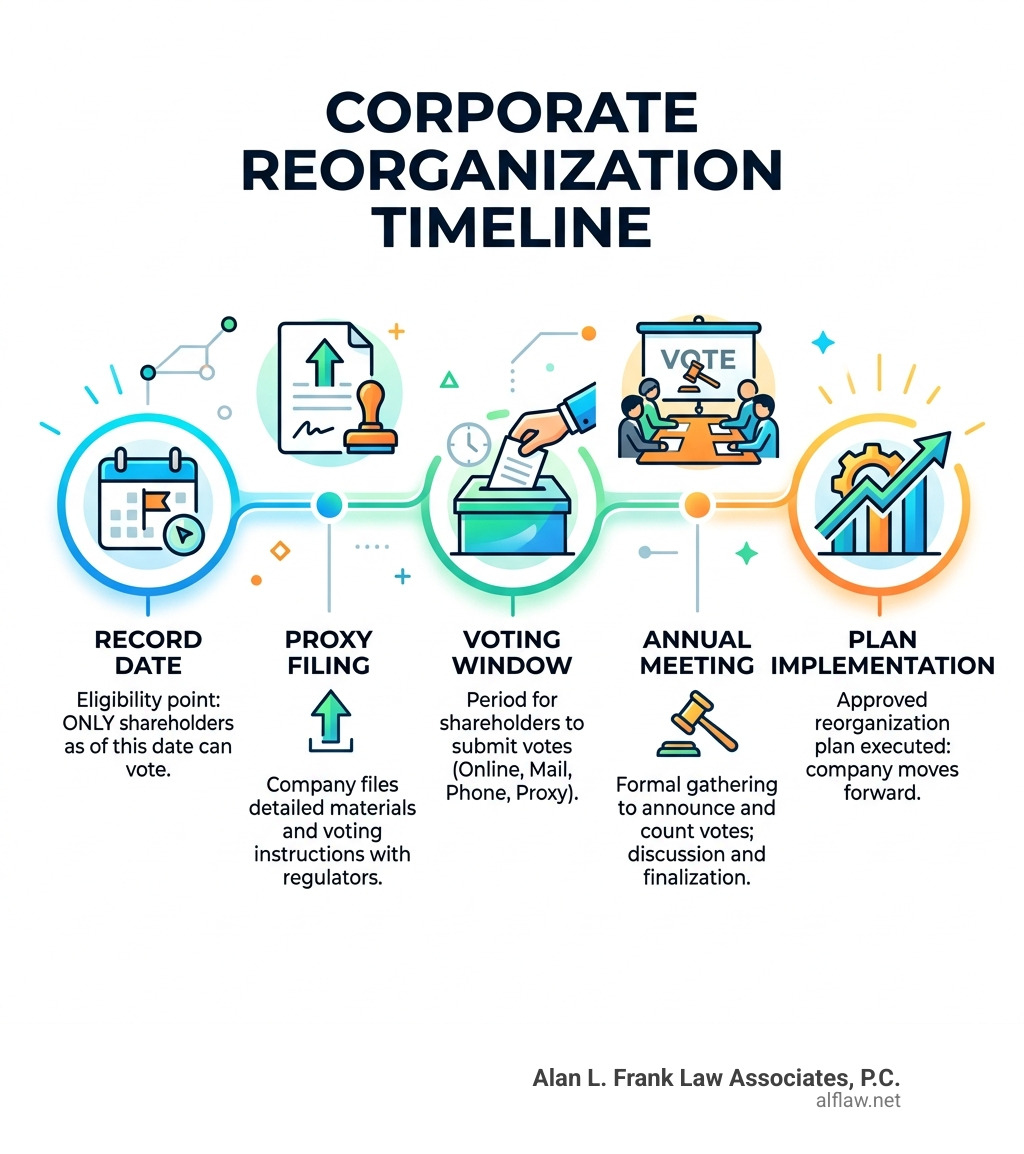
In the modern era, voting is easier than ever. Most companies provide several channels:
- Online Portals: Using a unique control number provided in your proxy materials.
- Phone Voting: Calling a toll-free number to register your choice.
- Mail-in Ballots: The traditional paper proxy card.
- Proxy Solicitors: Sometimes, a company will hire a firm to call you and help you record your vote over the phone.
It is vital to mind the electronic deadlines. For example, many companies set a cutoff (like 11:59 p.m. ET the night before the meeting) for online and phone votes to be tallied.
Understanding the Record Date and Eligibility
You cannot simply buy a stock the day before a meeting and expect to vote. Companies establish a record date. Only stockholders of record on that specific date—for example, May 19, 2025—are eligible to vote.
If you hold your shares through a broker (like SoFi, Robinhood, or Schwab), you are a beneficial owner. Your broker will send you voting instructions, and they will ultimately cast the vote on your behalf based on your direction. If you hold the certificates directly in your name, you are a registered holder and will deal directly with the company’s transfer agent.
Case Study: ContextLogic’s Strategy to Preserve NOLs
A fascinating real-world application of the reorganization plan shareholder vote is the recent move by ContextLogic. Their plan wasn’t about traditional debt; it was about protecting Net Operating Losses (NOLs).
NOLs are valuable tax assets. If a company loses money in one year, it can often use those losses to offset future taxable income, potentially saving millions in taxes. However, under IRC Section 382, if a company undergoes an “ownership change” (usually defined as a more than 50 percentage point change by major shareholders over three years), those NOLs can be severely limited or lost entirely.
ContextLogic proposed a plan of merger and reorganization specifically to implement transfer restrictions that prevent such an ownership change, maximizing the value of their tax assets for all shareholders.
Analyzing the 99% Support for the Proposal
As of mid-July 2025, ContextLogic reported that approximately 99% of shares voted were in favor of the plan. This overwhelming support indicates strong shareholder alignment. When management clearly communicates that a plan is designed to protect “hidden” value like tax assets, both institutional and retail investors tend to follow management’s recommendation.
Risks of Non-Approval and Potential Wipeouts
What if the ContextLogic vote—or any similar vote—fails? The risks are steep:
- Tax Asset Forfeiture: The loss of millions in NOL value.
- Delisting Risks: Failure to reorganize can lead to a drop in stock price, causing the company to fall below exchange requirements.
- OTC Trading: The stock may be moved to the “Pink Sheets” or Over-the-Counter markets, where liquidity is low and volatility is high.
- Investment Loss: In the worst-case scenario, the company may be forced into a liquidation where common shareholders are the last in line and often receive nothing.
Legal and Tax Implications of Reorganization
The legal framework behind these moves is dense. A common tool used in these votes is a “recapitalization” under IRC Section 368(a)(1)(E).
This section allows for a tax-free exchange of stock. For example, if a company wants to trade old voting common stock for a new mix of common and preferred stock, it can often do so without triggering a tax bill for the shareholders, provided there is a bona fide business purpose. State laws, such as Title 15 of the Pennsylvania General Assembly, provide the corporate machinery to execute these exchanges.
Continuity of Business Enterprise (COBE)
For a reorganization to be valid in the eyes of the IRS, it must satisfy the Continuity of Business Enterprise (COBE) requirement. This means the issuing corporation must either:
- Continue the target company’s “historic business.”
- Use a significant portion of the target’s “historic business assets” in its operations.
There are exceptions for certain types of reorganizations, but generally, the IRS wants to see that the reorganization isn’t just a “disguised sale” or a tax avoidance scheme.
Equity Compensation and Exchange Rules
If you are an employee or director with stock options, a reorganization plan shareholder vote might also impact your equity compensation. NYSE and Nasdaq rules generally require shareholder approval for any “material amendments” to equity plans. This includes repricing underwater options or creating new “inducement awards” for new hires during a merger.
Protecting Your Rights in a Reorganization Plan Shareholder Vote
As a minority shareholder, you might feel like your small number of shares doesn’t matter. We disagree. At Alan L. Frank Law Associates, P.C., we have seen how minority shareholders can be squeezed out or unfairly diluted during corporate maneuvers.
We have successfully handled high-stakes disputes, including a NJ state court minority shareholder dispute resulting in a $1,300,000 verdict and a PA state court minority shareholder dispute with a $4,300,000 verdict. These cases prove that the law provides protections, such as dissenters’ rights or appraisal remedies, if a reorganization is fundamentally unfair to certain owners.
Why Failing to Vote is Equivalent to a “No”
In many corporate bylaws and state statutes, a reorganization must be approved by a majority of all outstanding shares, not just a majority of the shares that show up to vote.
This means if you abstain or simply forget to vote, your shares are counted as a “No.” This can lead to a quorum failure, where the meeting cannot even proceed, or a default rejection of a plan that might have actually saved the company. Participation is not just a right; it’s an act of self-preservation for your portfolio.
Evaluating the Reorganization Plan Shareholder Vote
Before you check that “FOR” box, ask yourself:
- Proportionate Interest: Is my percentage of ownership staying roughly the same, or am I being heavily diluted?
- Dilution Risks: Is the company issuing massive amounts of new stock to creditors?
- Long-Term Value: Does the plan actually fix the underlying business problem?
- Board Transparency: Has the board been open about alternative plans, or is this the only option they presented?
Frequently Asked Questions about Reorganization Votes
What happens if the reorganization plan is rejected?
If the reorganization plan shareholder vote fails, the company may be forced to seek alternative (and often more painful) financing, file for Chapter 7 liquidation, or sell off assets at fire-sale prices. In some cases, the board may adjourn the meeting to a later date to continue soliciting votes.
Can a reorganization plan extinguish my existing shares?
Yes. In a “cramdown” bankruptcy scenario, if the court determines that the company’s liabilities far exceed its assets, it can confirm a plan that cancels all existing equity without any compensation to the shareholders. This is why voting on the plan before it reaches that terminal stage is so important.
How do I change my vote after submitting a proxy?
You generally have the right to change your vote at any time before the polls close at the annual meeting. You can do this by submitting a new proxy with a later date, or by attending the meeting (virtually or in person) and voting there, which automatically revokes your previous proxy.
Conclusion
A reorganization plan shareholder vote is a pivotal moment in the life of a corporation and its investors. Whether it’s a strategic move to save tax assets or a last-ditch effort to avoid liquidation, your participation is the only way to ensure your voice is heard in the boardroom.
If you believe a reorganization plan is being handled unfairly, or if you are a minority shareholder facing dilution without proper compensation in Pennsylvania or New Jersey, you don’t have to face it alone. Alan L. Frank Law Associates, P.C. brings nationwide experience and a track record of multi-million dollar recoveries to the table. We specialize in protecting investors and resolving complex business disputes.
For more information on how we can help you navigate these complex waters, visit our page for more info about commercial litigation services. Don’t let your investment be restructured without your input—stay informed and exercise your right to vote.