
Critical Deadlines and Triggers for Disputing Your Property Tax Bill


Critical Deadlines and Triggers for Disputing Your Property Tax Bill
When to Dispute Property Taxes: Act When the Assessment Is Wrong
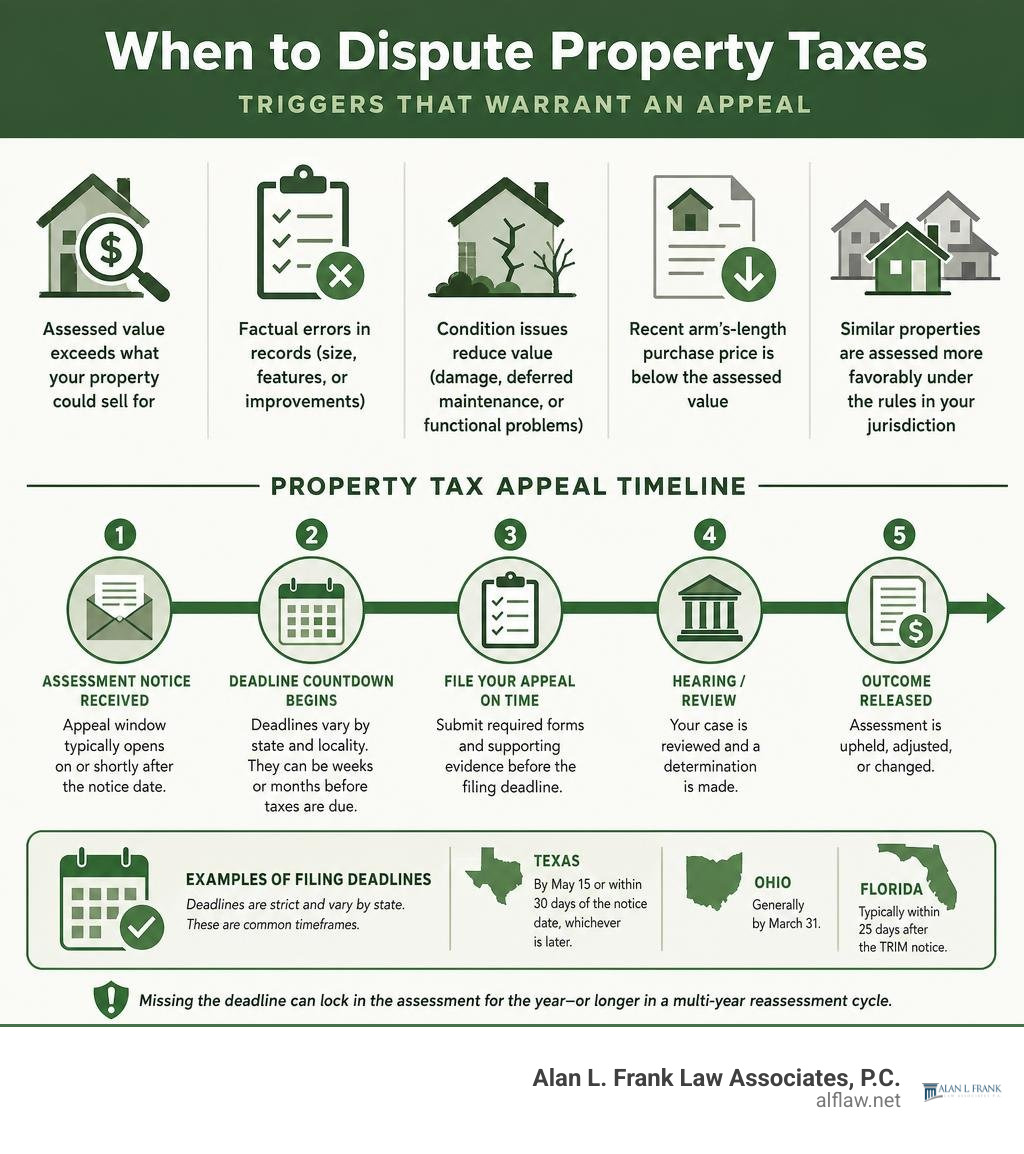
Dispute your property taxes as soon as you receive an assessment or valuation notice if the government’s estimated value is higher than what your property could realistically sell for, its records contain factual errors, or it has the wrong classification or exemption status.
A challenge is usually worth considering when you can show:
- Recent comparable sales support a lower market value.
- Your property record lists incorrect square footage, features, or improvements.
- Damage, deferred maintenance, or functional problems reduce value.
- A recent arm’s-length purchase price is below the assessed value.
- Similar properties are assessed more favorably under the rules in your jurisdiction.
Do not wait for the tax bill. In many places, the appeal window opens after the assessment notice and may close weeks or months before taxes are due. You generally cannot appeal simply because the tax rate increased or because you dislike how local governments spend tax revenue. The legal issue is usually the property’s value, assessment ratio, classification, or exemption.
Deadlines are strict and vary widely. For example, Texas generally requires a protest by May 15 or within 30 days of the notice date, whichever is later; Ohio complaints are generally due by March 31; and Florida owners typically have only 25 days after the TRIM notice. Missing the deadline can lock in the assessment for the year – or longer in a multi-year reassessment cycle.
I am Alan L. Frank, managing attorney at Alan L. Frank Law Associates, P.C., with more than 20 years of experience in complex litigation and tax controversies, supported by a law degree, a Master’s in Tax Law, and CPA training. Knowing when to dispute property taxes can help property owners and investors protect against an inaccurate valuation before a short filing window closes.
Key Triggers: When to Dispute Property Taxes for Maximum Savings

American property owners pay hundreds of billions of dollars in real estate levies each year. Studies consistently indicate that somewhere between 30% and 60% of taxable properties are overassessed. County assessors rely heavily on computerized mass appraisal models rather than walking through individual front doors. These algorithms apply broad statistical adjustments across entire zip codes, completely missing property-specific defects, awkward lot layouts, or changing micro-neighborhood dynamics.
Whenever mass appraisal estimates diverge from real-world market values, a tax dispute becomes necessary. In jurisdictions like New Jersey, administrative oversight and strict statutory guidelines govern how assessments must reflect true value; taxpayers can review guidelines published by the NJ Division of Taxation – Assessment and Appeals to understand standard valuation protocols. The goal is to identify the underlying administrative error and challenge the assessment during the designated statutory filing window.
Factual Assessment Errors and Unrecorded Property Flaws
The easiest and most indisputable grounds for an assessment appeal involve clerical mistakes on your property record card. Assessors maintain internal files listing every parcel’s square footage, bedroom and bathroom counts, finished basement areas, construction grade, and exterior amenities.
Assessors occasionally make errors that inflate assessments. Common mistakes include:
- Counting an unfinished attic or open patio as climate-controlled living space
- Listing four full bathrooms when the home only has two and a half
- Crediting your parcel with a finished basement or in-ground swimming pool that was never constructed
- Inaccurate lot boundaries or incorrect zoning classifications

Severe structural damage and deferred maintenance also reduce property value. Mass appraisal systems assume every structure in a neighborhood is in average condition. If your roof has reached the end of its lifespan, your foundation has major settlement cracks, or an aging HVAC system requires immediate replacement, your property’s actual market value drops. Documenting these flaws with clear photographs, licensed contractor repair quotes, and itemized remediation estimates provides tangible proof that your parcel cannot command the assessor’s estimated market value.
Market Value Discrepancies and Recent Arms-Length Purchases
An assessment is inherently flawed when the municipal valuation exceeds the price your property would achieve in an open, competitive real estate market. In standard property tax disputes, recent arm’s-length transactions serve as primary evidence. If you purchased your property within the past twelve to twenty-four months on the open market for $450,000, but the county assessor pegs its market value at $550,000, your closing disclosure or settlement statement serves as direct evidence of overvaluation.
For owners who have held property long-term, comparable sales (comps) form the foundation of a valuation dispute. The assessor’s calculations frequently suffer from an appraisal lag, relying on historical sales data from peak market cycles that may not reflect recent market corrections. By isolating three to five recent sales of properties with similar square footage, age, architectural style, and parcel size within your immediate neighborhood, you can calculate the prevailing market price per square foot and show that your assessment is out of line with actual local sales.
Knowing When to Dispute Property Taxes vs. Accepting the Assessment
Not every property tax increase warrants a legal appeal. Understanding when to dispute property taxes requires distinguishing between tax rate hikes and property overvaluations. Local municipal councils, school districts, and county boards set annual millage rates and budget levies. If your assessment remained constant at $300,000, but your tax bill climbed by 8% due to a voter-approved municipal bond or school budget hike, an assessment appeal cannot reduce that rate. Boards of revision and tax assessment panels are statutorily restricted to adjusting the assessed market value, not municipal tax rates.
A formal appeal is generally worthwhile when:
- The estimated market value on the assessment notice exceeds actual market value by at least 5% to 10%.
- Factual errors on the property record artificially inflate total square footage or physical amenities.
- Unaddressed structural defects or environmental factors impair the property’s utility.
- The potential annual tax savings comfortably exceed filing fees and the cost of obtaining evidence.
Conversely, challenging an assessment is rarely worthwhile when the increase stems purely from statutory inflationary adjustments, or when the overall valuation difference would yield negligible annual savings that are easily erased by independent appraisal fees.
Understanding Statutory Filing Deadlines and Reassessment Cycles

Property tax appeal deadlines are strict jurisdictional cutoffs. Unlike civil litigation rules that occasionally allow grace periods or late excusals for clerical delays, assessment appeal boards possess zero statutory discretion to accept late petitions. If a filing window closes at 5:00 PM on a specified date, an appeal postmarked or submitted one business day late is subject to immediate dismissal. In regional venues like Montgomery County, Pennsylvania, the local Board of Assessment Appeals | Montgomery County, PA strictly enforces annual August cutoffs for the subsequent tax year.
Fixed Deadlines and Reassessment Cycle Variations
Filing windows fall into four broad categories across municipal jurisdictions:
- Fixed-Date Deadlines: Specific calendar cutoffs established by state statute that occur on the exact same date each calendar year regardless of notice delivery.
- Rolling Notice Deadlines: Statutory windows triggered by the official postmark date on the valuation notice, usually providing property owners 25, 30, or 45 days to file an objection.
- Variable County/Township Deadlines: Windows established at the municipal level that open and close based on localized publication schedules and reassessment completions.
- Board Session Deadlines: Dates tied to the formal sitting calendar of municipal review panels.
| Jurisdiction / Type | Typical Appeal Window / Deadline | Cycle Frequency | Notice Trigger Type |
|---|---|---|---|
| Pennsylvania Counties | August 1 or September 1 (prior year) | Annual / Periodic Countywide | Fixed Annual Calendar Date |
| New Jersey (Standard) | April 1 of the tax year | Annual Assessment Roll | Fixed Calendar Date |
| New Jersey (Revalued) | May 1 (in revaluation districts) | Scheduled Revaluation | Post-Notice Delivery |
| New York Towns | 4th Tuesday in May (Grievance Day) | Annual Tentative Roll | Fixed Annual Calendar Date |
| Texas Appraisal Districts | May 15 or 30 days post-notice | Annual Notice of Appraised Value | Rolling Notice Postmark |
| Cook County, Illinois | 30–35 days post-township notice | Triennial Reassessment Cycle | Variable Township Publication |
| Florida Counties | 25 days following TRIM Notice | Annual TRIM Issuance | Rolling TRIM Postmark |
| Ohio Counties | March 31 of the following year | 6-Year Reappraisal / 3-Year Update | Fixed Annual Calendar Date |
Evaluating When to Dispute Property Taxes Across Key States
Procedures for property disputes vary by region:
- Pennsylvania: Reassessments are maintained at the county level. In places like Philadelphia and suburban counties, annual appeal deadlines typically fall on the first business day of August or October for taxes payable the following year.
- New Jersey: Real property assessments are adjusted annually, with a standard filing deadline of April 1 with the County Board of Taxation, extending to May 1 for taxing districts undergoing municipal-wide revaluations.
- New York: Municipalities establish assessment grievances around standardized dates. Property owners follow statutory Grievance procedures to submit Form RP-524 on or before Grievance Day, which falls on the fourth Tuesday in May across most communities.
- Cook County, Illinois: Properties are evaluated on a triennial cycle rotating through the City of Chicago, North Suburbs, and South/West Suburbs. Appeals open in 30-day windows per township.
- Texas: Appraisal districts send notices in early spring. Taxpayers file written protests by May 15 or within 30 days of the notice postmark.
Jurisdictional Cutoffs: What Happens If You Miss the Deadline?
If you miss your jurisdiction’s statutory filing cutoff, your appeal rights for that tax year are extinguished. The tentative assessment rolls become certified, the municipal tax rate applies directly to that unprotested market value, and you are legally obligated to pay the resulting tax bill in full.
In triennial or multi-year assessment cycles, missing a deadline can lock in an inflated assessment for the remainder of the valuation cycle, compounding your tax liability. While narrow administrative mechanisms such as statutory tax abatements, clerical error corrections, or refund petitions exist, they apply almost exclusively to objective computational errors (such as mathematical mistakes on tax extensions) rather than subjective disputes over fair market value.
Step-by-Step Property Assessment Dispute Process
Successfully appealing a property tax assessment requires an organized approach. You must review your records, compile market evidence, file within statutory deadlines, and present your case before an administrative panel.

Reviewing Valuation Notices and Property Record Cards
The dispute process begins the moment your Valuation Notice arrives. Examine the document carefully to confirm your parcel’s Property Index Number (PIN), legal description, recorded classification (residential, commercial, or mixed-use), and the net taxable value relative to any homestead exemptions.
Next, obtain your official property record card from the county assessor’s office or online portal. Scrutinize the data for factual inaccuracies regarding finished interior dimensions, construction quality grades, number of plumbing fixtures, and detached structures. If you spot an error, document it immediately. An uncorrected record card that overstates square footage will continue to inflate your taxes year after year until formally corrected.
Gathering Market Comps and Appraisal Evidence
Administrative appeal boards and state review courts evaluate property disputes based on documentation. Judicial guidance from entities like the Minnesota Tax Court underscores that the legal burden of proof rests entirely on the property owner to overcome the legal presumption that the assessor’s valuation is correct.
Key documentation to assemble includes:
- Comparable Sales Analysis: Pull three to five arm’s-length sales of similar homes within your immediate market area sold within the past twelve months. Calculate the adjusted price per square foot.
- Independent Certified Fee Appraisal: An appraisal performed by a licensed state-certified appraiser reflecting the valuation as of the statutory lien date provides strong evidence before review boards.
- Condition Evidence: Gather date-stamped photographs showing structural issues, foundational shifting, roof deterioration, or outdated mechanical systems, alongside binding contractor estimates for necessary repairs.
- Equalization and Sales Ratio Data: Analyze county assessment rolls to show that your parcel is assessed at a higher ratio of true market value than similar neighboring properties.
Navigating Informal Reviews and Formal Appeals Boards
In many jurisdictions, the dispute begins with an informal conference with an appraisal district staff appraiser. Roughly 85% of standard protests in states like Texas are resolved at this informal stage, where presenting clear comps or repair estimates can result in a quick settlement.
If an informal resolution cannot be reached, the dispute moves to a formal administrative hearing before a county panel, such as a Board of Assessment Appeals, Appraisal Review Board, or Board of Assessment Review. At this stage, formal guidelines must be followed; in Pennsylvania, property owners can review state-level options to File a Tax Appeal | Commonwealth of Pennsylvania if local board determinations are unsatisfactory. Hearings usually last 15 to 30 minutes, during which you present your evidence, respond to questions from the board, and address counter-arguments from the assessor or intervening school district representatives.
Frequently Asked Questions About Property Tax Disputes
Can I dispute my property assessment if my property value did not increase?
Yes. You have the statutory right to challenge your property assessment even if the valuation remained unchanged from the prior tax year. If local market conditions softened, comparable neighborhood home values declined, or your property suffered physical deterioration that reduced its value, the static assessment may now exceed the property’s fair market value.
Appeals can also be filed on the grounds of unequal assessment or lack of uniformity. If the assessor left your property value unchanged at $400,000 while reducing assessments on similar homes nearby to $340,000, you have valid grounds to seek an assessment reduction to maintain uniformity.
Does filing an appeal risk increasing my property tax bill?
In the vast majority of residential assessment appeals, filing a dispute does not result in an increased valuation. Review boards focus on determining whether the evidence supports a reduction, leaving the assessment unchanged if the taxpayer fails to meet the burden of proof.
However, in complex commercial real estate disputes, or situations where an intervening party (such as a local school board) actively participates to protect tax revenue, a formal reassessment could reveal unpermitted square footage or major unrecorded renovations. In these cases, review panels have the legal authority to adjust the valuation upward to reflect true market conditions. Reviewing all property records before filing helps avoid unexpected adjustments.
Do I still have to pay my property taxes while an appeal is pending?
Yes. You must pay your property taxes in full and on schedule even while an administrative or judicial appeal is pending. Administrative and court appeals can take anywhere from two to twelve months to reach a final decision.
Failing to pay your tax bill on time triggers delinquency penalties, statutory interest accruals, and potential tax liens against the title. If your appeal succeeds, the taxing authority will issue a direct refund check with statutory interest or apply a credit toward your future property tax installments.
Conclusion
Challenging an inflated property assessment protects your real estate assets from unnecessary municipal costs. Because mass appraisal systems frequently generate valuation discrepancies, staying alert during reassessment cycles ensures you pay only your fair share. By monitoring your assessment notices, auditing property record cards for errors, gathering market comps, and filing before statutory deadlines close, you can correct overvaluations that would otherwise cost thousands of dollars over multi-year cycles.
For high-value residential estates, commercial facilities, multi-family portfolios, and industrial real estate, assessment disputes often involve complex valuation methodologies, capitalization rate arguments, and active opposition from local school districts. The seasoned commercial litigation attorneys at Alan L. Frank Law Associates, P.C. provide comprehensive legal counsel for complex property tax litigation and tax controversies throughout Pennsylvania and New Jersey. Contact our team to ensure your property rights, valuation metrics, and statutory appeal deadlines are effectively managed.