
Everything You Need to Know About the SB800 Manual


Everything You Need to Know About the SB800 Manual
Understanding California SB 800: Legislative Intent and Standards
An SB 800 California manual is a property-specific maintenance guideline provided by residential builders to buyers at the close of escrow under California’s Right to Repair Act (Civil Code §§ 895-945.5). The manual establishes mandatory homeowner maintenance schedules, clarifies component warranty standards, and preserves a builder’s statutory affirmative defense against construction defect claims when damage results from a homeowner’s failure to follow recommended upkeep.
Although SB 800 is a California statute, it is critically important for property owners, institutional investors, developers, lenders, and corporate entities based in Pennsylvania, New Jersey, Philadelphia, Jenkintown, and nationwide who invest in, develop, or manage residential real estate assets across state lines. Alan L. Frank Law Associates, P.C. maintains offices in Philadelphia, PA, Jenkintown, PA, and New Jersey, bringing nationwide litigation experience to complex real estate and construction defect matters, including multi-jurisdictional matters where coordination with local counsel is required.
Enacted in 2002 and taking effect on January 1, 2003, Senate Bill 800 fundamentally restructured residential defect law. Before its passage, unrestrained defect litigation severely strained the state’s housing market, reducing new condominium construction by roughly 90 percent as insurance carriers exited the market. SB 800 resolved this crisis by establishing clear functionality standards, creating an express pre-litigation resolution framework, and granting builders an absolute “right to repair” prior to formal court action.
The cornerstone of the statutory framework is California Civil Code § 896, which delineates 45 specific functionality standards across seven building categories:
- Water Intrusion: 18 separate performance benchmarks governing roofs, windows, patio doors, foundation slabs, exterior walls, decks, and stucco assemblies to prevent moisture penetration.
- Structural Integrity: Mandates that foundations, load-bearing walls, and framing components prevent significant cracking or structural failure.
- Soils and Geotechnical Systems: Requirements ensuring engineered fill and soil movement do not cause structural distress.
- Fire Protection: Demands proper installation of fire-resistive assemblies and draft stops.
- Plumbing and Sewer: Prohibits leaks and unintended sewer gas entry.
- Electrical Systems: Standards preventing thermal hazards and power distribution failures.
- Other Systems: Regulates heating systems (mandating that units sustain 70°F measured three feet above the living floor), dryer ducts, pathways, and hardscapes.
Complementing these specific standards is Civil Code § 897, a statutory catch-all provision. Under § 897, any component not specifically addressed in § 896 remains actionable if it fails to function and causes damage.
Crucially, SB 800 functions as a statutory exception to the traditional Economic Loss Rule. Under prior tort doctrine, plaintiffs were generally barred from recovering in negligence or strict liability unless a defect caused actual physical property damage or personal injury. SB 800 allows homeowners to pursue claims for violations of statutory functionality standards even if those deficiencies represent pure economic loss and have not yet resulted in secondary damage.
When evaluating potential housing and construction defects, understanding the exact statutory threshold is crucial. Comprehensive reference materials, such as an SB 800 compliance guide, demonstrate that each system carries specific timelines that govern liability.
| Building System / Component | Statutory Reference | Limitation Period |
|---|---|---|
| Fit and Finish Components (cabinets, trim, paint) | Civil Code § 900 | 1 Year from Close of Escrow |
| Inter-unit Noise Transmission | Civil Code § 896(g)(6) | 1 Year from Original Occupancy |
| Irrigation Systems and Drainage | Civil Code § 896(g)(7) | 1 Year from Close of Escrow |
| Landscaping Survival and Dryer Ducts | Civil Code § 896(g)(12), (14) | 2 Years from Close of Escrow |
| Untreated Wood Posts Decay | Civil Code § 896(g)(8) | 2 Years from Close of Escrow |
| Plumbing, Sewer, and Electrical Systems | Civil Code § 896(e), (f) | 4 Years from Close of Escrow |
| Exterior Hardscape Displacement & Corrosion | Civil Code § 896(g)(1) | 4 Years from Close of Escrow |
| Paint and Exterior Stain Deterioration | Civil Code § 896(g)(2) | 5 Years from Close of Escrow |
| General Latent Defects (Structural, Water Intrusion) | Civil Code § 941 | 10 Years from Substantial Completion |
| General Patent Defects (Readily Apparent) | Civil Code § 941 | 4 Years from Substantial Completion |
Statutory Timeframes and Fit and Finish Warranties
Beyond long-term structural requirements, Civil Code § 900 obligates builders to provide an express written limited warranty of at least one year covering “fit and finish” items. This mandatory warranty applies to cabinets, mirrors, interior and exterior flooring, wall surfaces, countertops, paint finishes, and trim. If a builder fails to provide an express written warranty at the close of escrow, the statute defaults to a standard one-year term.
For other systems, SB 800 departs from the universal ten-year statute of repose by implementing the shortened, component-specific deadlines outlined in the table above. Once these specific periods expire, claims regarding those particular elements are barred. However, builders also have the option to execute an Enhanced Protection Agreement (EPA) at the time of sale. Under an EPA, the builder provides contractual quality standards that meet or exceed statutory baselines, offering an alternative framework recorded on title or delivered in writing to the buyer.
Applicability: HOAs, Subsequent Owners, and Custom Homes
SB 800 applies comprehensively to new residential construction where the original purchase agreement was executed on or after January 1, 2003. Its reach extends beyond the initial buyer:
- Subsequent Homeowners: Civil Code § 945 confirms that the standards, rights, and pre-litigation procedures bind subsequent purchasers within the applicable statutory timeframe.
- Homeowners Associations (HOAs): Community associations managing common areas in condominium developments or planned communities are fully subject to SB 800 procedures when asserting claims for common property defects.
- Custom Homes: SB 800 applies to custom homebuilders when the builder sells both the underlying real estate and the completed residential structure. Conversely, when a general contractor builds on land already owned by the property owner under a pure construction contract, common-law contract and tort principles govern rather than SB 800.
- Exclusions: The Act expressly excludes condominium conversions, apartment buildings, and standard residential remodels, which remain subject to traditional California common law.
Requirements for an SB800 California Manual Under the Right to Repair Act
A compliant sb800 california manual serves as an indispensable risk-management instrument. When complex construction disputes escalate, early documentation often determines whether a claim can be resolved swiftly or becomes protracted commercial litigation.
Drafting an SB800 California Manual for HOAs and Single-Family Homes
A well-crafted manual cannot be an off-the-shelf, generic template. To protect developers and inform buyers, an SB 800 manual must be customized to the precise specifications of the community:
- Integration of Manufacturer Specifications: The manual must incorporate specific maintenance protocols, operational parameters, and warranty terms from individual component manufacturers (e.g., roofing membranes, HVAC systems, and water proofing assemblies).
- Statutory Component Mapping: Every building assembly should map directly to its corresponding Civil Code § 896 functionality standard, clarifying performance baselines and associated warranty periods.
- Actionable Checklists and Schedules: Detailed monthly, seasonal, and annual schedules must provide clear operational checklists for common area managers and individual homeowners.
- Distinction of Cosmetic Behaviors: The manual should educate owners on normal settling behaviors—such as hairline stucco curing fissures—to distinguish non-actionable cosmetic changes from actual structural defects.
How an SB800 California Manual Supports Builder Affirmative Defenses
Under California Civil Code § 945.5, builders can raise seven statutory affirmative defenses to mitigate or bar liability entirely. The most critical defense is found in § 945.5(a): a homeowner or association’s failure to follow reasonable, documented maintenance schedules.
To successfully assert this defense, the builder must prove that detailed maintenance guidelines were provided to the buyer or association in writing at the close of escrow. If a developer fails to deliver an adequate manual, they effectively forfeit this statutory affirmative defense.
Other key affirmative defenses under Civil Code § 945.5 include:
- Unforeseen Acts of Nature: Events exceeding regulatory design criteria (e.g., severe earthquakes or unprecedented weather).
- Failure to Mitigate: The homeowner’s unreasonable delay in reporting a defect, causing avoidable secondary damage.
- Third-Party Alterations and Misuse: Unauthorized modifications or repairs performed by third parties.
- Statute of Limitations Expiry: Claims brought after the component-specific or 10-year statutory period has elapsed.
- Valid Written Release: Prior settlement of the claim under Civil Code § 929.
- Successful Prior Repair: Timely and adequate correction of the identified defect.
The Statutory Pre-Litigation Dispute Process and Builder Deadlines

The pre-litigation process outlined in Chapter 4 of SB 800 (Civil Code §§ 910–938) is mandatory. Homeowners cannot file a lawsuit for actionable defects without first completing this structured procedure.
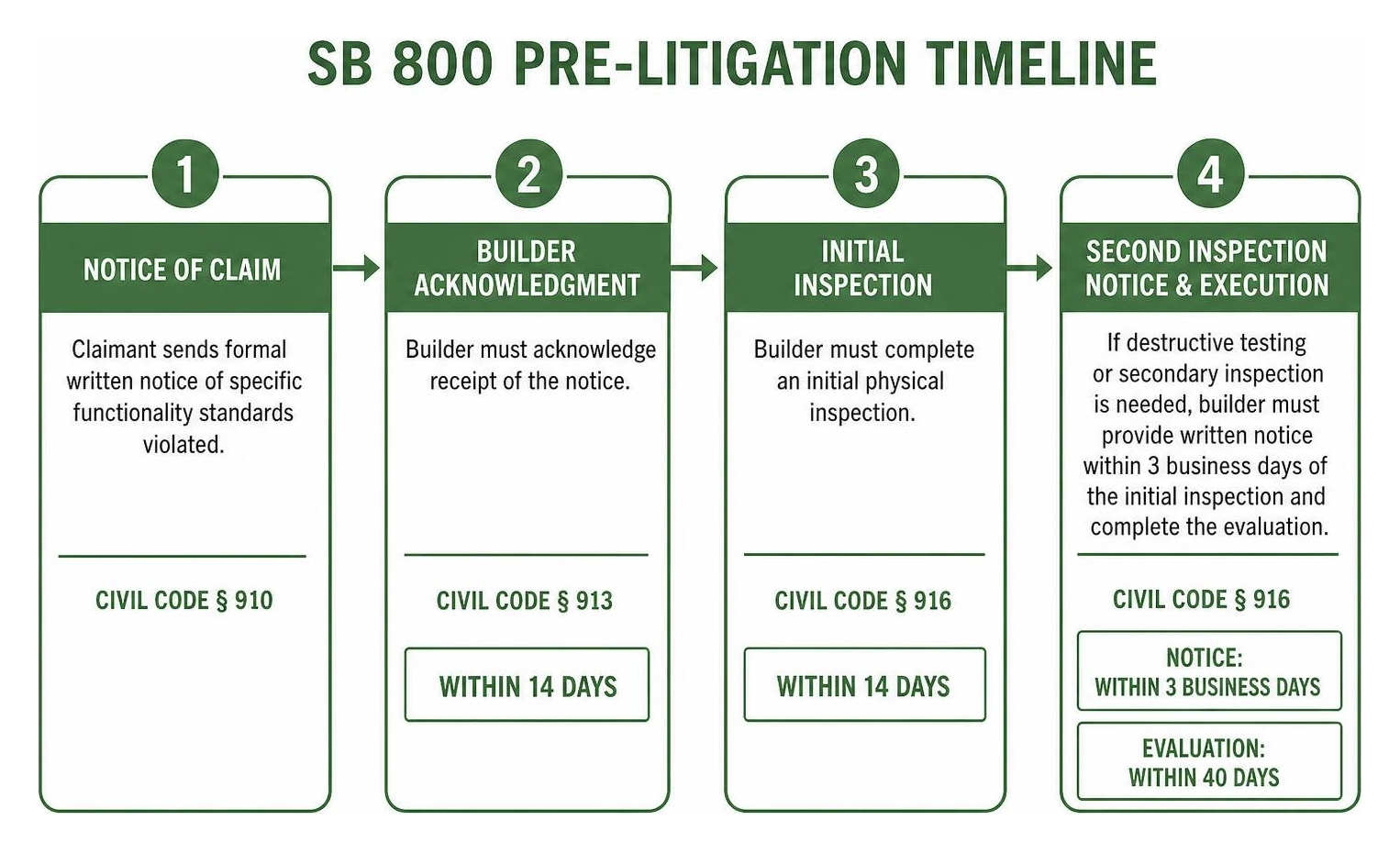
The pre-litigation workflow follows strict statutory deadlines:
- Notice of Claim (Civil Code § 910): The claimant issues a formal written notice via certified mail detailing the specific functionality standards violated.
- Builder Acknowledgment (Civil Code § 913): The builder must acknowledge receipt of the notice within 14 days.
- Initial Inspection (Civil Code § 916): The builder must complete an initial physical inspection within 14 days of acknowledging the claim.
- Second Inspection Notice & Execution: If destructive testing or secondary inspection is needed, the builder must provide written notice within 3 business days of the initial inspection and complete the evaluation within 40 days.
- Property Restoration: The builder must restore the property to its pre-testing condition within 48 hours of testing.
- Document Disclosures (Civil Code § 912): Within 30 days of a written request, the builder must provide plans, engineering reports, specifications, and warranty manuals.
- Offer to Repair (Civil Code § 917): Within 30 days of the final inspection, the builder may present a written offer to repair, including a schedule targeting completion within 120 days and an option to select from up to three alternative contractors.
- Mediation Option: If the claimant rejects the repair offer, they may demand non-binding mediation before filing a formal lawsuit.
Reviewing the formal statutory pre-litigation procedures underscores that a builder’s failure to meet these exact response deadlines releases the homeowner from the pre-litigation process, permitting an immediate lawsuit.
Section 929 Cash Settlements and Reasonable Release Provisions
Under California Civil Code § 929, a builder is not required to perform physical repairs; they may make a cash offer in lieu of repair. In exchange for compensation, the builder may obtain a “reasonable release” from the homeowner.
The scope of a reasonable release was examined in Belasco v. Wells (2015). In that case, a homeowner settled an initial construction defect dispute with a cash payment that included a broad general waiver under California Civil Code § 1542 (waiving unknown and future claims). Years later, the homeowner filed a new suit over roof defects. The California Court of Appeal affirmed that because the release resulted from arm’s-length negotiations where the homeowner had independent legal counsel, the Section 1542 waiver barred all subsequent defect actions.
Successfully negotiating cash settlements or enforcing broad releases requires careful handling of construction defect claims to ensure settlement agreements withstand subsequent judicial review.
Procedural Pitfalls and Contractual Opt-Outs
Both claimants and builders must navigate significant procedural hurdles under SB 800:
- Contractual Opt-Out Risks: Builders can establish alternative non-adversarial contractual dispute resolution procedures in initial purchase contracts. However, if a court determines the contractual procedure is unconscionable or unenforceable, the builder cannot fall back on SB 800’s statutory protections, and the claimant can proceed directly to litigation.
- Forfeiture of Repair Rights: A builder who misses statutory response windows forfeits the right to inspect or repair, opening the door to civil litigation.
- Expert Costs: Evaluating complex defects often requires hiring licensed engineers and inspectors early in the pre-litigation process, creating upfront costs for claimants.
Frequently Asked Questions About California SB 800
What property types are covered under California Civil Code Section 895?
SB 800 applies to original residential construction intended to be sold as individual units—including single-family detached homes, townhouses, and condominiums—where the initial purchase contract was executed on or after January 1, 2003. It excludes condominium conversions, apartment complexes, and standard residential home remodels.
How does SB 800 modify the Economic Loss Rule for homeowners?
SB 800 acts as a direct legislative exception to the Economic Loss Rule. Under the precedent established in cases such as The McCaffrey Group, Inc. v. Superior Court, homeowners can pursue pre-litigation claims and damages for construction components that violate statutory functionality standards, even before those defects cause resultant physical damage to other parts of the structure.
Can a builder opt out of statutory SB 800 procedures?
Yes. Under Civil Code § 914, a builder may elect to enforce contractual non-adversarial dispute resolution procedures instead of the statutory Chapter 4 process. However, this election must be made in the original purchase agreement, and if the alternative procedure is invalidated by a court, the builder cannot retroactively invoke statutory Right to Repair protections.
Conclusion
California’s SB 800 framework and property-specific maintenance manuals balance the interests of homebuilders and homeowners. For builders, providing a thorough maintenance manual and strictly adhering to statutory timelines preserves vital affirmative defenses and protects against protracted litigation. For homeowners, investors, developers, and HOAs with interests in California residential property, understanding statutory functionality standards and pre-litigation notice requirements helps protect rights within applicable limitation periods.
Alan L. Frank Law Associates, P.C. represents clients from its offices in Philadelphia, PA, Jenkintown, PA, and New Jersey, offering nationwide experience in complex construction and commercial litigation. Whether navigating pre-litigation inspections, evaluating maintenance manuals, or resolving multi-party defect disputes across state boundaries, working with experienced construction defect litigation attorneys can help ensure that statutory procedures are managed effectively, including through coordination with appropriate local counsel when needed. Contact Alan L. Frank Law Associates, P.C. for guidance on complex real estate and construction defect matters.