
How to Appeal Zoning Board Decisions Without Costly Mistakes


How to Appeal Zoning Board Decisions Without Costly Mistakes
Protect Your Property Rights After a Zoning Board Decision
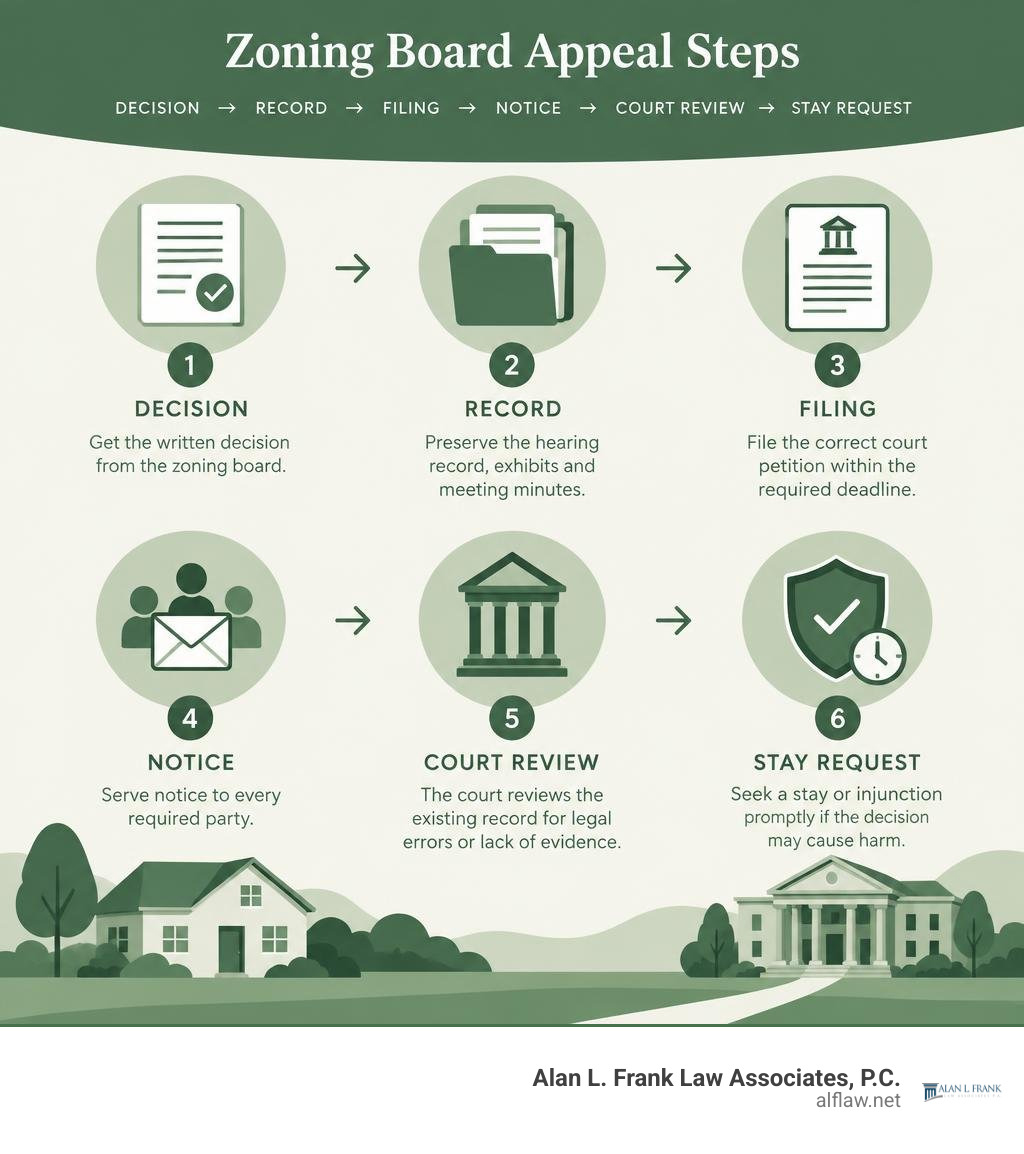
To appeal a zoning board decision, act before the deadline, preserve the board record, and file the correct court petition with proper notice to every required party. In many Pennsylvania matters, an appeal from a zoning board ruling must be filed in the Court of Common Pleas within 30 days. Missing that deadline or failing to serve required parties can end the case before a judge considers whether the board was wrong.
Start with these steps:
- Get the written decision, hearing record, exhibits, and meeting minutes.
- Confirm that you are aggrieved – meaning the ruling directly harms your property, financial, or legal interests.
- Identify the strongest ground for appeal, such as a legal error, lack of substantial evidence, flawed notice, or missing findings of fact.
- File and serve the appeal exactly as the controlling state law and local rules require.
- Seek a stay or injunction promptly if the decision may allow construction, enforcement, or other harm before the court rules.
A court appeal is usually not a new hearing on your project. The court commonly reviews the existing record to decide whether the board committed an error of law, abused its discretion, or made findings unsupported by substantial evidence. A separate challenge to an unconstitutional or exclusionary zoning ordinance may require a different tool, such as a curative amendment or site-specific rezoning request.
I am Alan L. Frank, Managing Attorney of Alan L. Frank Law Associates, P.C., with more than 20 years of experience leading complex commercial litigation. This guide explains how to appeal zoning board decision rulings while avoiding deadline, notice, evidence, and strategy mistakes that can put valuable property interests at risk.
Terms related to how to appeal zoning board decision:
Understanding Legal Grounds and Standing for a Zoning Appeal
Navigating a zoning dispute requires understanding the critical difference between who can challenge a ruling and the specific legal vehicle used to do so. In our regional practice across Pennsylvania and New Jersey, we regularly see valid claims dismissed prematurely simply because the challenger lacked legal standing or confused procedural defects with substantive constitutional claims.
To challenge a board’s determination, you must satisfy statutory standing rules by demonstrating you are an aggrieved party. Furthermore, your challenge must be cleanly categorized into either a procedural appeal (alleging defects in process, notice, or administrative discretion) or a substantive validity challenge (alleging that the ordinance itself violates constitutional protections or state planning laws). Reviewing comprehensive guidelines for applicants to the zoning board of appeals helps highlight how administrative bodies distinguish between administrative requests and formal validity disputes.
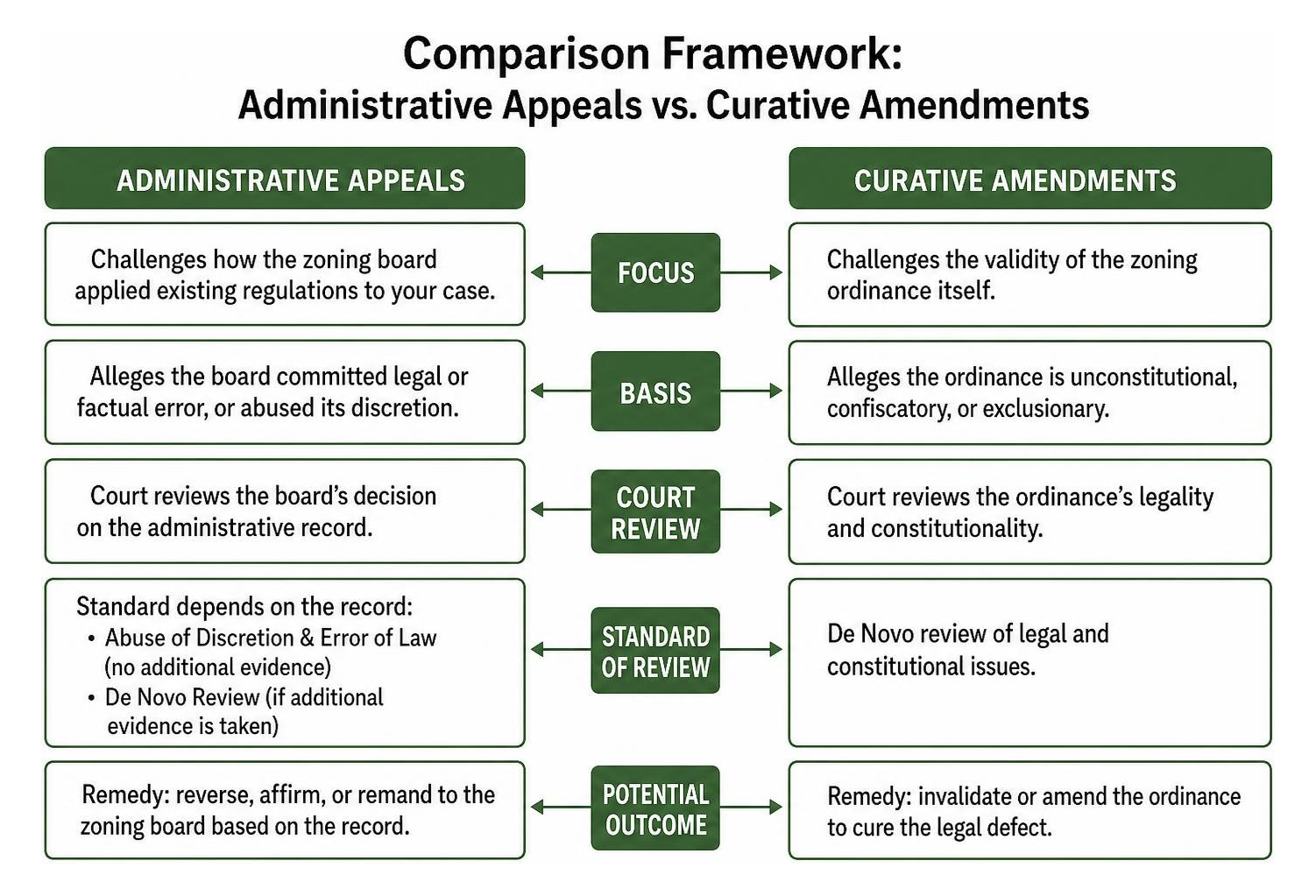
| Feature | Procedural Appeals | Substantive Validity Challenges |
|---|---|---|
| Primary Target | Administrative actions, variance denials, misinterpretation of bylaws | Ordinance constitutionality, exclusionary zoning, confiscatory rules |
| Forum | Zoning Board of Adjustment / Court of Common Pleas | Governing Body (Curative Amendment) or Court of Common Pleas |
| Standard of Review | Abuse of discretion or error of law | De novo review on constitutional and statutory validity |
| Remedy Sought | Reversal of permit denial, granting of variance/special exception | Ordinance invalidation, site-specific rezoning, mandatory amendment |
Establishing Aggrievement and Party Status
To maintain an appeal, an appellant must possess legal standing as an “aggrieved person.” General civic interest or abstract concerns about community growth do not confer standing. Instead, a party must establish a direct, immediate, and substantial pecuniary or property interest that has been adversely affected by the zoning board’s determination.
- Direct Impact: The harm must be caused directly by the zoning decision, rather than being an indirect or speculative future consequence.
- Immediate Interest: The interest must fall within the zone of interests protected by land use statutes, demonstrating specific damage distinct from that experienced by the general public.
- Substantial Harm: Demonstrable negative impacts include adjacent property devaluation, localized traffic hazards, drainage runoff, or direct denial of development rights.
Adjacent and immediate neighboring landowners who participate in the zoning board hearing generally establish standing due to physical proximity. Conversely, non-adjacent civic associations or remote commercial competitors must establish specific operational or financial injury to avoid dismissal.
Procedural Errors vs. Substantive Validity Challenges
Appeals turn on distinct legal theories that dictate the scope of judicial review:
- Procedural Errors: These claims involve defective administrative processes. Examples include failure to comply with open meeting statutes, inadequate public advertising, defective property posting, arbitrary bias by board members, or failure to render a decision within statutory deadlines.
- Substantive Challenges: These claims challenge the underlying application of the law or the ordinance’s constitutionality. Examples include arbitrary denials unsupported by evidence, unconstitutional taking of private property without just compensation, or exclusionary zoning schemes that impermissibly prohibit legitimate land uses across a municipality.
How to Appeal Zoning Board Decision Rulings in Court
When administrative remedies before a local board are exhausted, the dispute transitions to the judicial system. Under the Pennsylvania Municipalities Planning Code, appeals from municipal zoning boards are directed to the Court of Common Pleas in the county where the real estate is located.
Step-by-Step Procedure: How to Appeal Zoning Board Decision Filings
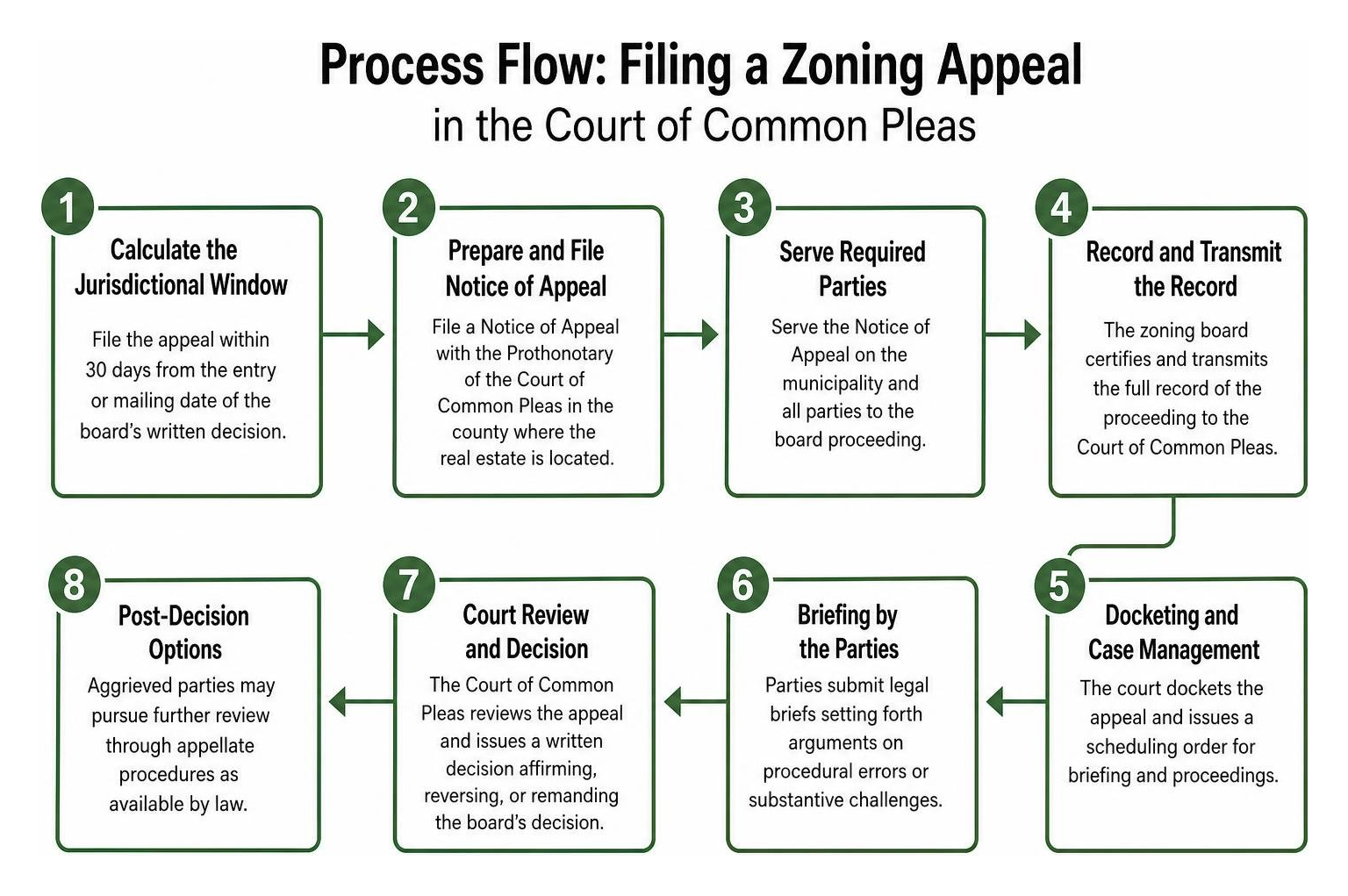
Taking an appeal from a board decision requires strict adherence to statutory protocol. Here is the operational sequence required:
- Calculate the Jurisdictional Window: The appeal must be filed within 30 days from the entry or mailing date of the board’s written decision. This timeline is mandatory; courts lack authority to extend it.
- Draft the Land Use Appeal Notice: Prepare a verified Land Use Appeal Petition specifying the factual background, property description, procedural history, and explicit legal errors committed by the board.
- File in the Court of Common Pleas: Submit the petition to the Prothonotary or Clerk of Courts, pay required filing fees, and obtain a formal court docket number.
- Issue the Writ of Certiorari: Serve the writ or notice upon the municipal zoning board, compelling them to certify and transmit the complete administrative record to the court. For example, appellants in major cities must follow designated local zoning board of adjustment appeal procedures through specialized portals like eCLIPSE and municipal appeals divisions.
- Serve All Named Parties: Serve stamped copies upon the municipality, the property owner/applicant, and any party granted intervenor status below.
Notice Requirements and Consequences of Procedural Failure
Strict statutory notice is essential in land use litigation. An appellant must serve written notice of the appeal within the precise statutory timeframe (commonly within 7 to 14 days of filing, depending on local rules) upon:
- The municipal governing body and its solicitor;
- The zoning board secretary or counsel;
- The record owner of the subject property;
- The original permit applicant or developer.
Failure to serve a necessary party, such as the permit applicant who secured the approval, can result in the immediate and unappealable dismissal of the entire action for lack of jurisdiction. Service must be executed via certified mail with return receipt requested or through personal service by a process server to establish proof on the court docket.
Requesting a Stay of Proceedings Pending Appeal
Filing an appeal does not automatically halt construction or enforcement. If a developer receives zoning relief and intends to build immediately, the appellant must file a formal Petition for Stay (also known as a Petition for Supersedeas) or seek a preliminary injunction to maintain the status quo.
In reviewing stay petitions, courts apply established principles of judicial review standards under state code and common law equity tests. The petitioner must prove:
- A strong likelihood of success on the merits of the appeal;
- Immediate and irreparable harm absent the stay (such as permanent tree clearing, demolition of historic structures, or unrecoverable construction impacts);
- That the stay will not substantially harm other interested parties;
- That the stay serves the public interest.
Courts routinely require the party seeking a supersedeas to post a financial bond to secure the opposing party against damages resulting from the delay if the appeal ultimately fails.
Standards of Judicial Review and Evidentiary Rules
A land use appeal in the Court of Common Pleas is fundamentally an administrative review rather than an automatic re-trial of the case. The court’s role depends entirely on whether it takes additional evidence or relies solely on the record created before the zoning hearing board.
When Courts Apply Abuse of Discretion vs. De Novo Review
When the Court of Common Pleas takes no additional evidence, its scope of review is strictly limited:
- Abuse of Discretion: The court determines whether the board’s factual findings are supported by substantial evidence—defined as relevant evidence that a reasonable mind might accept as adequate to support a conclusion. The court cannot substitute its judgment for that of the board simply because it would have decided the facts differently.
- Error of Law: The court reviews legal conclusions, statutory interpretation, and ordinance applications with no deference to the board. If the board misapplied the law or misconstrued an ordinance definition, the court will reverse.
However, if the trial court determines that the record is incomplete and agrees to take additional evidence, the standard changes completely: the court hears the matter de novo, making its own findings of fact and legal conclusions without deference to the administrative board.
Effect of Inadequate Board Findings of Fact and Written Decisions
Under regional statutory frameworks, zoning boards are legally mandated to issue written decisions accompanied by explicit findings of fact and reasoned conclusions of law.
When a board issues a summary denial or approval without factual findings, it commits a reversible error. Adhering to professional standards for written zoning board determinations ensures an administrative record that can withstand appellate scrutiny. When faced with an unreasoned decision, a reviewing court will typically vacate the determination and remand the matter back to the board with orders to issue proper findings, significantly prolonging the litigation timeline.
Presenting Additional Evidence and Record Expansion in Court
Because judicial review is generally restricted to the administrative record, parties cannot freely introduce new witness testimony or expert reports on appeal. To present new evidence in court, an appellant must file a formal Motion to Supplement the Record or Request an Evidentiary Hearing, establishing one of the following grounds:
- The zoning board refused to allow relevant, non-cumulative testimony or excluded critical documents during the hearing;
- The administrative record prepared by the municipality is incomplete, defective, or missing exhibits;
- Board members exhibited impermissible bias or committed procedural due process violations that were not captured in the hearing transcript.
If the court grants the motion, it may either hear the evidence directly or remand the case to the zoning board with instructions to reopen the record for supplemental proceedings.
Strategic Alternatives: Curative Amendments and Ordinance Challenges
Not every land use barrier can be resolved through an administrative variance or traditional zoning appeal. When a zoning ordinance itself is defective, restrictive, or unconstitutional, property owners must pursue broader legislative remedies.
Curative Amendments vs. Merits Appeals: How to Appeal Zoning Board Decision Restrictions
A traditional merits appeal argues that the zoning board erred in applying existing local regulations. In contrast, a Landowner Curative Amendment directly attacks the validity of the zoning ordinance itself, asserting that the local law is unconstitutional, confiscatory, or exclusionary.
Curative amendment procedures operate as follows:
- De Jure Exclusion: The ordinance completely prohibits a legitimate, lawful land use (such as multi-family housing, quarries, or industrial warehousing) anywhere within the municipal borders.
- De Facto Exclusion: The ordinance appears to permit the use on paper, but imposes technical, dimensional, or density restrictions that make the use practically impossible to construct anywhere in the municipality.
- Filing Process: The landowner submits a formal challenge along with a proposed curative amendment and specific site development plans directly to the municipal governing body (e.g., Board of Commissioners or Borough Council) rather than the zoning hearing board.
- Judicial Relief: If the governing body rejects the challenge, the landowner appeals to the Court of Common Pleas. If successful, the court can grant definitive site-specific relief, ordering the municipality to approve the proposed development.
Frequently Asked Questions About Zoning Board Appeals
What is the strict deadline to appeal a zoning board decision?
In Pennsylvania and comparable jurisdictions, the strict deadline to file an appeal from a zoning board decision to the Court of Common Pleas is 30 days from the date the written decision is mailed or issued to the applicant. This deadline is jurisdictional; missing it by even a single day results in the permanent loss of appeal rights, as courts possess no statutory authority to extend this filing window.
Can I present new expert testimony or exhibits during a court appeal?
Generally, no. The Court of Common Pleas functions as an appellate body reviewing the record created before the zoning board. You can only present new expert testimony or exhibits if you successfully petition the court to open the record, proving that the board improperly excluded your evidence or that procedural due process violations prevented a full hearing.
What happens if the zoning board failed to issue written findings of fact?
If a zoning board fails to issue required written findings of fact and conclusions of law, the reviewing court cannot effectively evaluate the decision. The court will typically vacate the ruling and remand the case back to the zoning board, ordering the board to draft formal findings based on the existing record or hold a supplemental hearing.
Conclusion
Challenging an unfavorable zoning board determination requires speed, procedural precision, and trial-tested litigation strategy. From meeting strict 30-day jurisdictional deadlines and executing flawless party service to obtaining stays and building a comprehensive evidentiary record, land use disputes are won on technical accuracy and substantive advocacy.
At Alan L. Frank Law Associates, P.C., our attorneys leverage decades of commercial litigation experience to protect property rights, overcome regulatory barriers, and secure multi-million dollar real estate investments across Pennsylvania and New Jersey. If your commercial or residential property rights have been compromised by an improper zoning ruling, contact our experienced commercial litigation attorneys today for a strategic case evaluation.