
The Secret Life of Latent Defects in Your New Home


The Secret Life of Latent Defects in Your New Home
Understanding Latent Defect Real Estate Principles and Legal Standards
In real estate, a latent defect is a hidden or concealed flaw in a property that could not be discovered through a customary, reasonable inspection before the completion of the sale. Under the latent defect legal definition, because these issues exist beneath surface finishes or within internal components, buyers cannot observe them during standard walkthroughs. When these flaws impair property valuation or undermine basic habitability standards, they trigger serious legal disputes over disclosure duties, warranty terms, and contractual integrity.
Purchasing residential or commercial property is often the single largest investment an individual or business entity will make. When a property harbors serious, undisclosed structural or physical flaws, that exciting transaction can transform into an expensive nightmare.
| Defect Characteristic | Patent Defect | Latent Defect |
|---|---|---|
| Visibility | Open, visible, and readily observable | Concealed behind finishes, beneath slabs, or inside cavities |
| Discovery Standard | Discoverable during an ordinary visual home inspection | Undetectable without specialized diagnostics or destructive testing |
| Caveat Emptor Application | Strongly applies; buyer assumes risk if not negotiated | Does not apply if the seller engaged in active concealment or fraud |
| Seller Duty to Disclose | Minimal duty if openly visible to any reasonable person | Mandatory duty if known, material, and dangerous or damaging |
| Typical Examples | Broken window panes, water-stained ceilings, worn roof shingles | Compromised load-bearing footers, unpermitted wiring, toxic mold behind drywall |
Identifying a Latent Defect Real Estate Issue vs. a Patent Defect
The legal distinction between patent and latent defects dictates who ultimately bears the financial burden of repairs. A patent defect is an obvious condition discoverable through ordinary visual observation or standard non-invasive home inspection procedures. If a property features broken window frames, cracked exterior steps, or noticeable water staining on an exposed ceiling, the flaw is patent. Under normal circumstances, buyers possess an obligation to exercise ordinary diligence; if they fail to observe open defects, they cannot typically hold the seller liable later.
Conversely, establishing that an issue meets the material defects standard requires demonstrating that the problem has an objective, significant impact on the property’s value, structural safety, or intended habitability. Latent defects frequently involve concealed damage—such as compromised floor joists covered by brand-new subflooring or a cracked furnace heat exchanger tucked deep within an HVAC cabinet. Because home inspectors do not perform invasive or destructive testing (such as knocking holes in finished walls or unsealing concrete slabs), these defects remain hidden until post-closing occupancy reveals them.
The Caveat Emptor Doctrine and Statutory Exceptions
Historically, property sales operated under the strict common law doctrine of caveat emptor—a Latin phrase meaning “let the buyer beware.” Under pure caveat emptor, buyers bore the sole responsibility for examining the property. Unless the seller offered express contractual warranties, buyers assumed all risks regarding the property’s physical condition upon closing.
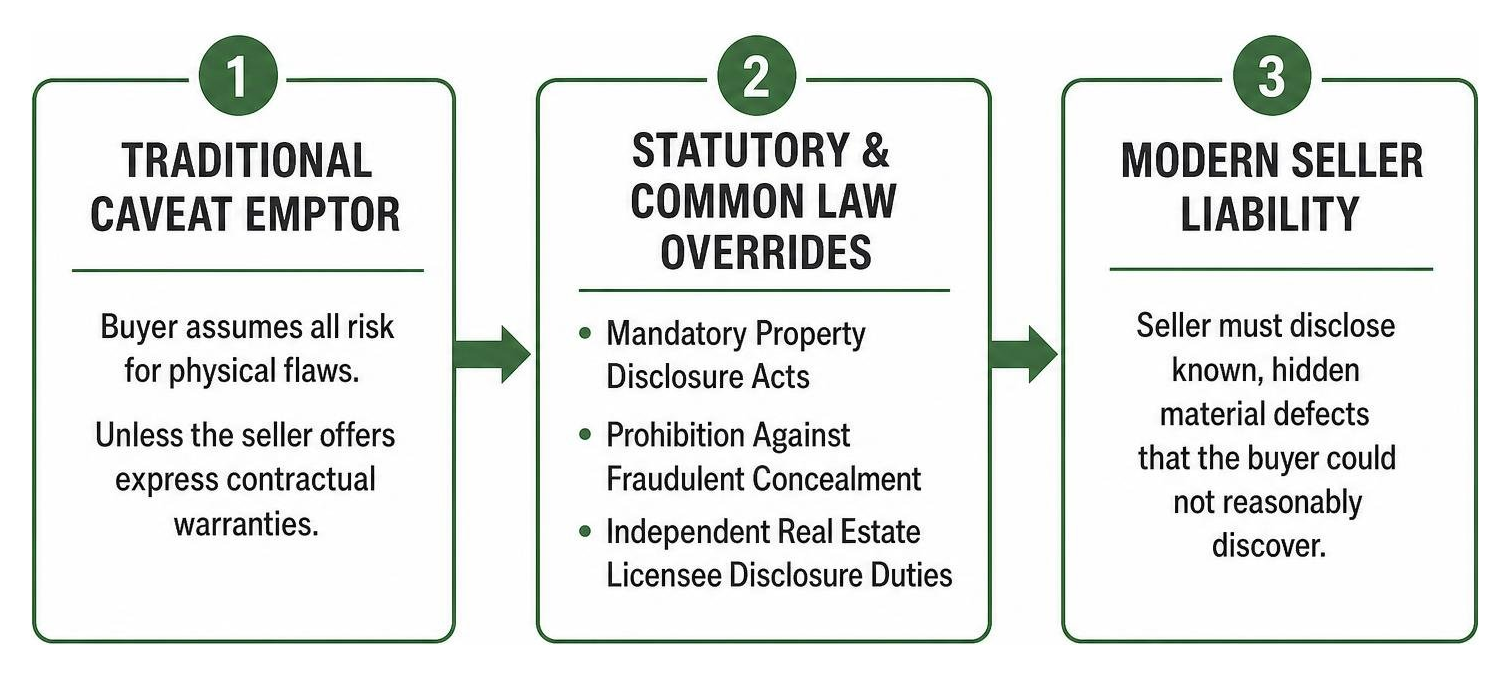
Modern real estate jurisprudence has enacted significant statutory overrides to protect property purchasers. While buyers remain responsible for identifying patent flaws, courts and state legislatures consistently reject caveat emptor when sellers engage in fraudulent concealment, intentional misrepresentation, or deliberate nondisclosure of known material defects.
Modern consumer protection acts and mandatory seller disclosure laws establish an affirmative legal duty: sellers must disclose known hidden hazards that a purchaser could not reasonably discover.
Common Material Latent Defects in Residential and Commercial Properties
When latent problems emerge, they routinely compromise both the physical safety and the market value of the property. Professional standards, such as the defects and rectifications guidance published by the Royal Institution of Chartered Surveyors, emphasize that physical failures must be classified based on whether they were discoverable using ordinary professional care during initial turnover or inspection.
Structural and Foundation Failures
Structural failures are among the most dangerous and financially devastating latent issues a property owner can face. In residential and commercial buildings, structural stability relies on the integrity of hidden footings, load-bearing framing, and subsurface soils.
Common structural latent defects include:
- Foundation Wall Settlement and Shearing: Deep, horizontal foundation cracks caused by hydrostatic soil pressure that are deliberately painted over or hidden behind drywall partition walls.
- Subsidence and Soil Instability: Inadequate soil compaction or shifting subterranean strata that cause the building to slowly twist, crack slabs, and misalign load-bearing posts over time.
- Framing and Joist Degradation: Hidden framing rot, cracked support beams, or extensive internal termite damage that hollows out primary floor joists while leaving the exterior surface wood appearing intact.
- Sub-Slab Plumbing Failures: Corroded cast-iron pipes or cracked drain lines embedded within concrete foundations, leading to hidden soil erosion and compromised structural slabs.
When structural components fail, property owners must understand their legal options; as we emphasize in don’t let your case crumble like your foundation, structural damage requires prompt evidentiary documentation before critical proof of prior seller knowledge is altered during emergency shoring.
Hidden Environmental Hazards and Unpermitted Renovations
Environmental contamination and unauthorized building alterations represent another major category of latent real estate defects. These conditions present direct health and safety risks to occupants while exposing owners to significant municipal liabilities.
- Toxic Mold Growth: Hidden colonies of Stachybotrys chartarum or other hazardous molds thriving inside insulated wall cavities, under basement flooring, or within drop ceilings due to ongoing, unaddressed plumbing or building envelope leaks.
- Radon Gas Infiltration: Elevated levels of colorless, odorless radioactive radon gas seeping through foundation cracks from underlying rock formations, which can only be identified via specialized testing.
- Asbestos and Lead-Based Paint Encapsulation: Decaying asbestos insulation wrapped around hidden ductwork or buried lead paint layers that were improperly disturbed or covered without legal abatement protocols.
- Unpermitted Electrical and Gas Renovations: Do-it-yourself wiring splices hidden in ceilings, undersized service panels, or unvented gas lines installed without required municipal permits or safety inspections.
Seller Disclosure Duties and the “As-Is” Misconception
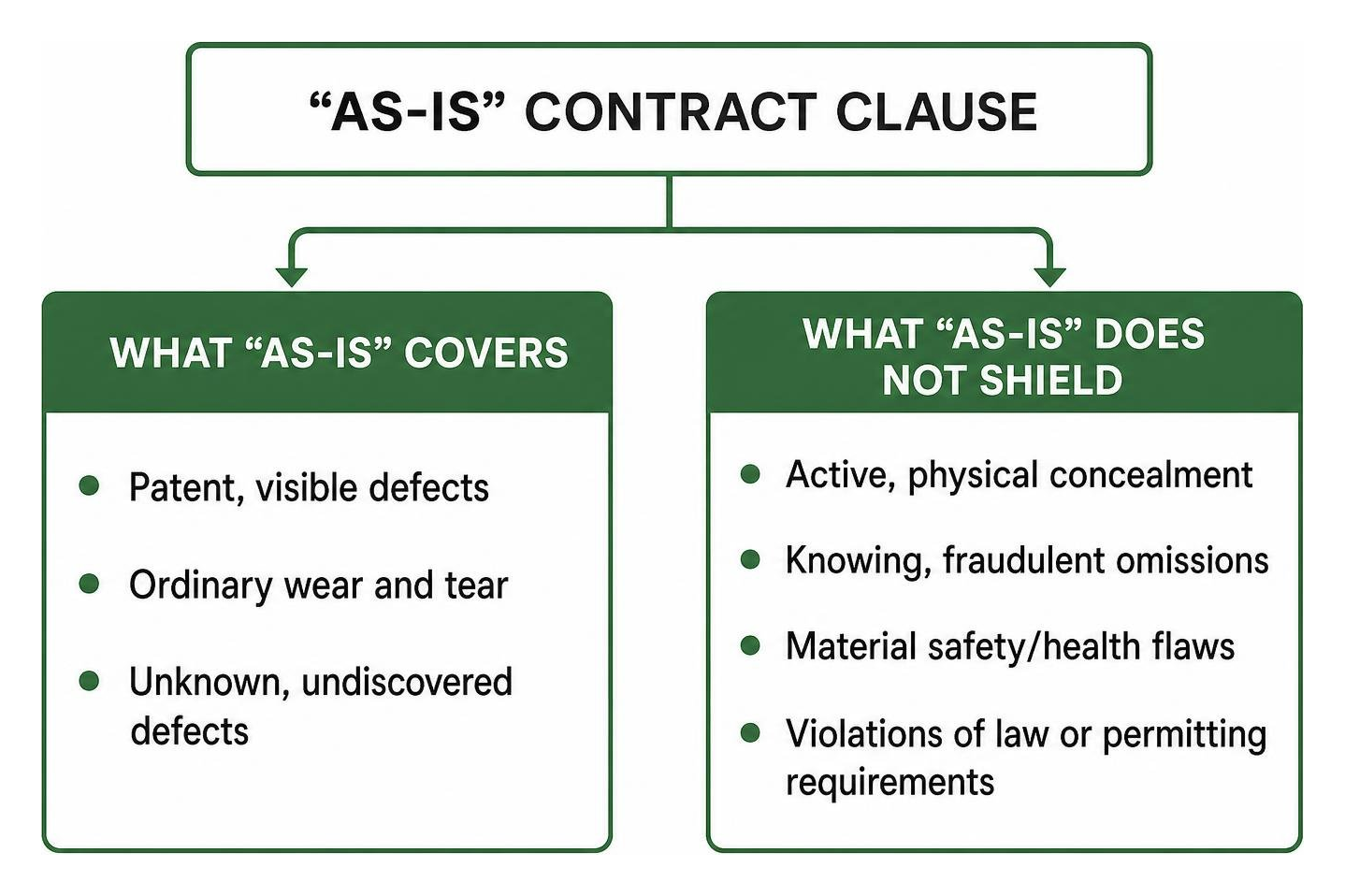
A widespread myth in real estate transactions is that listing or purchasing a property “as-is” completely insulates the seller from future litigation. In reality, an “as-is” clause only signifies that the seller will not perform repairs or provide monetary credits for patent defects discoverable during the buyer’s inspection period. It does not provide legal immunity for fraud, intentional nondisclosure, or the active concealment of known material defects. When handling complex corporate and transactional matters, structured representations and warranties must always be harmonized with statutory disclosure obligations.
Mandatory Seller Property Disclosures
State statutory disclosure frameworks require sellers of residential real estate to complete detailed disclosure statements before executing a sales agreement. These statutory questionnaires compel the seller to disclose their actual knowledge regarding material aspects of the property, including:
- Prior or ongoing water intrusion in basements, crawlspaces, or roofs.
- Structural modifications, wall removals, or additions completed without building permits.
- Plumbing, electrical, heating, and cooling system malfunctions.
- Soil instability, sinkhole activity, or environmental hazards like buried fuel tanks.
A seller cannot shield themselves by claiming lack of knowledge if they were “willfully blind” to an issue—such as experiencing recurring basement flooding, pumping out the water, painting the walls, and then marking “No” on the disclosure form regarding past water intrusion. While sellers are generally not required to perform forensic diagnostic testing to fill out disclosure forms, they must provide truthful answers regarding conditions of which they possess actual or constructive awareness.
Real Estate Agent Independent Disclosure Obligations
Real estate licensees and brokers operate under distinct professional and statutory disclosure rules. If an agent possesses actual knowledge of a material latent defect affecting a property’s value or safety, they generally have an independent legal duty to disclose that fact to prospective buyers—even if their client, the seller, explicitly instructs them to stay silent.
For instance, if a previous buyer terminates an agreement because a specialized engineering report uncovered severe structural deflection, the listing agent acquires direct knowledge of that material defect. If the property is returned to the market, the agent cannot withhold that report’s findings from subsequent prospective purchasers. A licensee who conceals known latent material defects risks civil tort liability and professional regulatory sanctions.
Legal Remedies: Contract Claims, Tort Actions, and Dispute Resolution

When a buyer discovers an undisclosed latent defect post-closing, multiple legal pathways exist to recover financial compensation or rescind the transaction entirely. At Alan L. Frank Law Associates, P.C., our experience in complex commercial litigation allows us to aggressively pursue recovery against deceptive sellers, negligent inspectors, and responsible third parties.
Contract Breach vs. Fraudulent Concealment in Tort Law
Latent defect claims typically proceed under two distinct legal theories: contract law and tort law. Understanding the differences between these claims is essential for structuring damages and complying with statutory deadlines.
- Breach of Contract: Arises when the seller violates express representations, warranties, or covenants contained in the purchase agreement or formal disclosure attachments that survive closing. Contractual claims focus on placing the buyer in the financial position they would have occupied had the seller performed honestly.
- Fraudulent Concealment and Intentional Misrepresentation (Tort): Occurs when a seller knew of a material latent defect, intentionally concealed it or made false representations, intended for the buyer to rely on the omission, and the buyer suffered measurable financial harm. Tort actions allow plaintiffs to seek compensatory repair damages and, in egregious circumstances involving intentional fraud, punitive damages.
- Negligent Nondisclosure (Tort): Applies when a seller or professional failed to exercise reasonable care in discovering or communicating material defects when they possessed a clear legal duty to do so.
Mediation, Arbitration, and Civil Litigation Routes
Most standard residential real estate agreements include dispute resolution clauses that dictate how claims must proceed before a formal court trial.
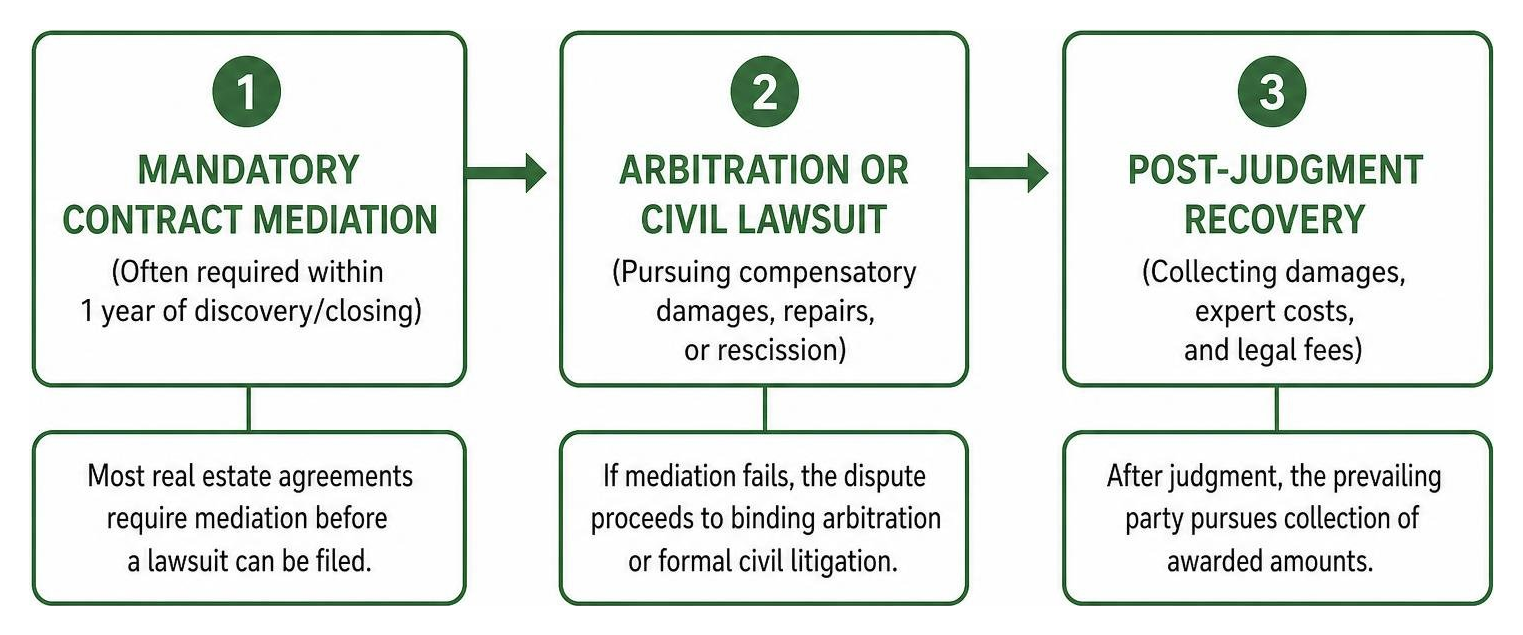
Many standard contracts contain mandatory mediation provisions requiring parties to submit disputes to a formal mediation process before initiating a lawsuit. Bypassing mandatory contractual mediation to file a lawsuit directly in civil court can carry severe financial consequences: standard agreements often contain fee-shifting clauses that penalize a party who files in court without mediating by forfeiting their right to recover attorney fees even if they win the lawsuit.
If mediation proves unsuccessful, the dispute moves into binding arbitration or formal civil litigation. During litigation, plaintiffs introduce forensic engineering assessments, contractor estimates, and historical records to establish liability and secure monetary judgments.
What to Do When Hidden Defects Surface: Preserving Evidence and Proving Liability
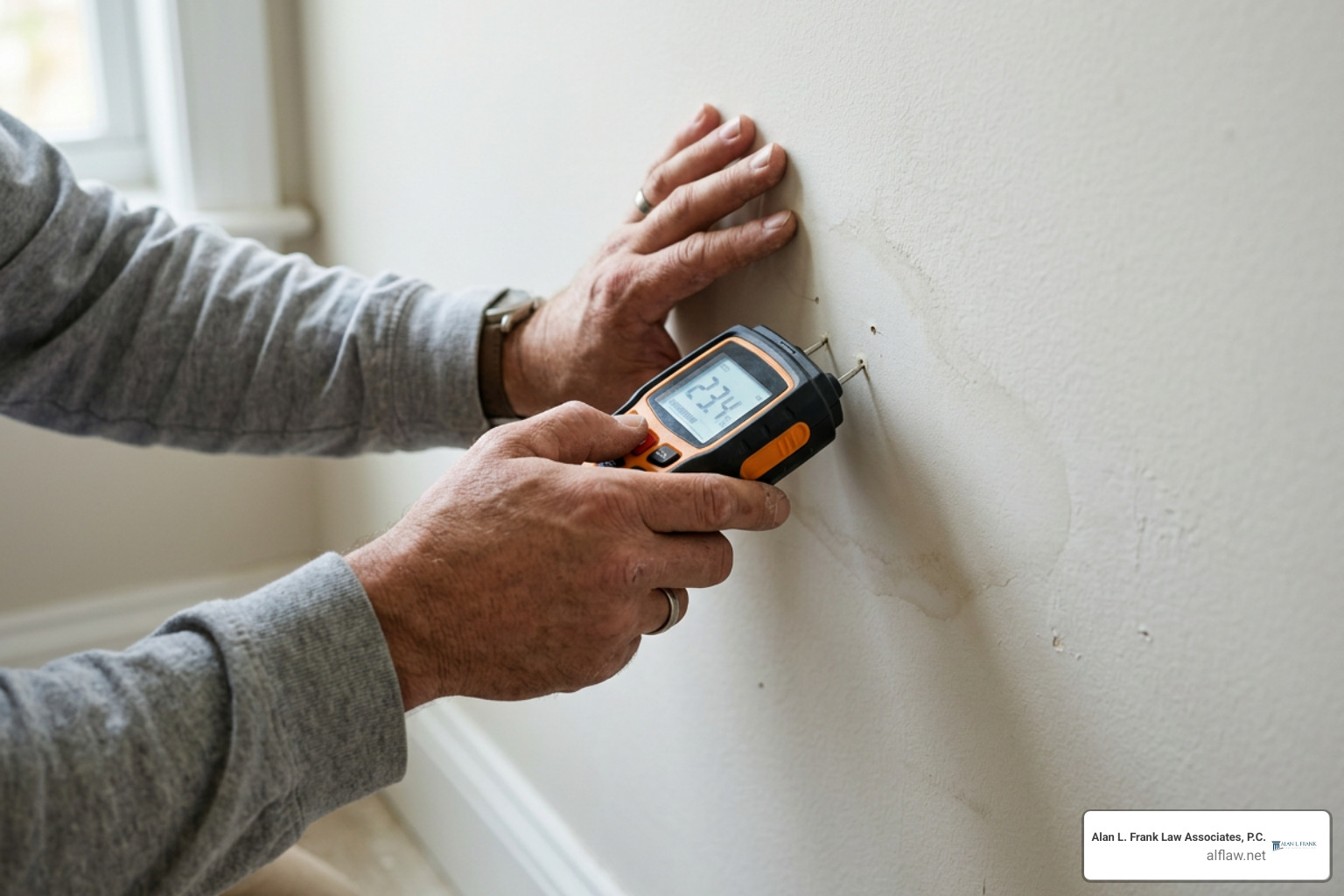
The moments immediately following the discovery of a hidden property defect are critical. Actions taken by the homeowner directly influence whether a subsequent claim will succeed in arbitration or court.
Critical First Steps to Protect Legal Rights
If you uncover a serious hidden defect in your property, follow these crucial steps to preserve your legal remedies:
- Halt Non-Emergency Renovations: Do not perform major permanent repairs or demolition immediately, except for necessary emergency mitigation (such as turning off a burst main water valve). Altering the site prematurely destroys physical evidence of prior concealment.
- Log and Document Thoroughly: Capture high-resolution, dated photographs and clear video recordings of the defect from multiple angles. Maintain a written discovery log recording dates, weather conditions, water levels, and operational failures.
- Retain Independent Diagnostic Experts: Hire licensed, independent professionals—such as a structural engineer, geotechnical specialist, or industrial hygienist—to conduct forensic diagnostics and author written findings detailing the cause, age, and severity of the defect.
- Preserve Damaged Physical Materials: If damaged components must be removed for emergency safety purposes, store the removed materials (e.g., rotted framing sections, severed pipes, deteriorated drywall) in a clean, dry location for forensic examination.
- Gather Transactional Documentation: Collect the original sales contract, property disclosure statements, marketing brochures, MLS listings, home inspection reports, and closing settlement statements.
- Consult Qualified Real Estate Litigation Counsel: Speak with an attorney experienced in latent defect litigation before communicating directly with the seller or their insurance carrier.
Proving Seller Knowledge in Latent Defect Real Estate Disputes
Winning a latent defect claim requires proving by a preponderance of the evidence that the seller had actual or constructive knowledge of the defect and failed to disclose it. Because sellers rarely admit to concealing defects, establishing liability relies on assembling compelling circumstantial and documentary evidence:
- Prior Repair Records and Invoices: Subpoenaing local service contractors (plumbers, roofers, waterproofers, HVAC technicians) often reveals that the previous owner received repair estimates for the exact issue years earlier and declined permanent remediation.
- Municipal Permit and Code Histories: Reviewing municipal building department files to uncover prior code violations, stop-work orders, or rejected permit applications associated with unpermitted additions.
- Physical Indicators of Concealment: Identifying cosmetic cover-ups, such as fresh coats of paint applied exclusively over localized basement water stains, brand-new wood paneling hiding cracked foundation footers, or newly laid rugs concealing cracked floor joists.
- Neighbor and HOA Testimonies: Securing affidavits from neighboring homeowners or HOA board members detailing past flood events, repair activities, or long-standing property issues known throughout the community.
Frequently Asked Questions About Real Estate Defects
How Long Do I Have to Sue a Seller for Undisclosed Hidden Defects?
The timeframe for initiating legal action against a seller is governed by state-specific statutes of limitations and the contractual terms of your purchase agreement. Most general civil fraud and contract claims carry limitations periods ranging from two to six years.
However, many jurisdictions apply the discovery rule to latent defect claims. Under the discovery rule, the statutory clock does not begin ticking on the date the transaction closed; rather, it starts when the buyer actually discovered, or through the exercise of reasonable diligence should have discovered, the hidden defect. Conversely, construction-related claims against builders or developers may also be subject to a statute of repose, which establishes an absolute outer deadline (often 10 to 12 years from construction completion) after which no claims can be filed regardless of discovery date. Always consult legal counsel immediately, as contract mediation clauses may require dispute initiation within one year of closing.
Does a Home Inspection Protect Me From Undiscovered Defects?
A standard pre-purchase home inspection is a non-invasive, visual examination of accessible property components. Home inspectors examine visible mechanical systems, surface finishes, and open roof structures; they do not dismantle equipment, drill into finished drywall, or perform destructive structural testing.
Because standard inspection agreements specifically exclude hidden or inaccessible areas, an inspector is generally not liable for missing a truly latent defect if they executed their visual inspection within professional standards of care. If a standard home inspector spots warning signs—such as minor step cracking or subtle moisture stains—they will recommend specialized evaluations by structural engineers or plumbing specialists. Buyers should always follow up on these recommendations during the contract contingency period.
Can I Undo the Purchase of a Home If a Major Defect Is Discovered?
Yes, in extraordinary cases involving substantial fraud or catastrophic hidden damage, a buyer may seek the equitable legal remedy of contract rescission.
Rescission completely unwinds the real estate transaction. The court orders the seller to take back title to the real property and refund the complete purchase price to the buyer, along with closing fees and associated transaction costs. Because rescission represents an extreme legal remedy, courts generally award it only when monetary compensation cannot adequately repair the damage or when the property is entirely unsafe and unfit for human habitation.
Conclusion
Uncovering an undisclosed latent defect after purchasing real estate can threaten your physical safety and cause catastrophic financial loss. When sellers conceal known material defects behind fresh cosmetic repairs or hide behind “as-is” contract provisions, buyers possess enforceable legal rights under state disclosure statutes, contract terms, and tort law.
Successfully pursuing recovery requires immediate evidence preservation, thorough forensic engineering evaluations, and skilled litigation counsel. For detailed answers to common client questions regarding structural claims, contractor liability, and evidence collection, explore our FAQs housing and construction defects resource page.
At Alan L. Frank Law Associates, P.C., we draw on decades of courtroom experience and a track record of multi-million dollar recoveries to protect the financial interests of residential and commercial property owners. If you have uncovered hidden, costly property defects following a purchase in Pennsylvania or New Jersey, contact our team to evaluate your legal options and pursue full financial recovery.