
High Yield Investment Scams: Unmasking Modern Ponzi Schemes and Fake Funds


High Yield Investment Scams: Unmasking Modern Ponzi Schemes and Fake Funds
How to Spot a High Yield Investment Scam Before You Lose Money
A high yield investment scam promises unusually large, often guaranteed returns with little or no risk. To protect yourself, do not send money until you have verified the firm and seller with securities regulators, reviewed real audited records, and confirmed that the claimed investment actually exists.
Watch for these immediate warning signs:
- Returns such as 1% to 5% per day, or “guaranteed” double-digit yields
- Crypto-only deposits, offshore payment routes, or pressure to act today
- Referral rewards for bringing in friends, family, or business contacts
- No verifiable registration, audited financial statements, or named fund custodian
- Excuses for delayed withdrawals, often described as “maintenance” or compliance reviews
These programs, often called HYIPs, commonly use new deposits to make early payouts look real. That temporary success creates screenshots, testimonials, and confidence – until new money slows and withdrawals stop.
I am Alan L. Frank, a CPA and attorney with more than 20 years of experience handling complex commercial disputes, securities matters, and investment-loss claims. When a high yield investment scam causes serious financial harm, prompt evidence preservation and a careful review of available legal options can matter.
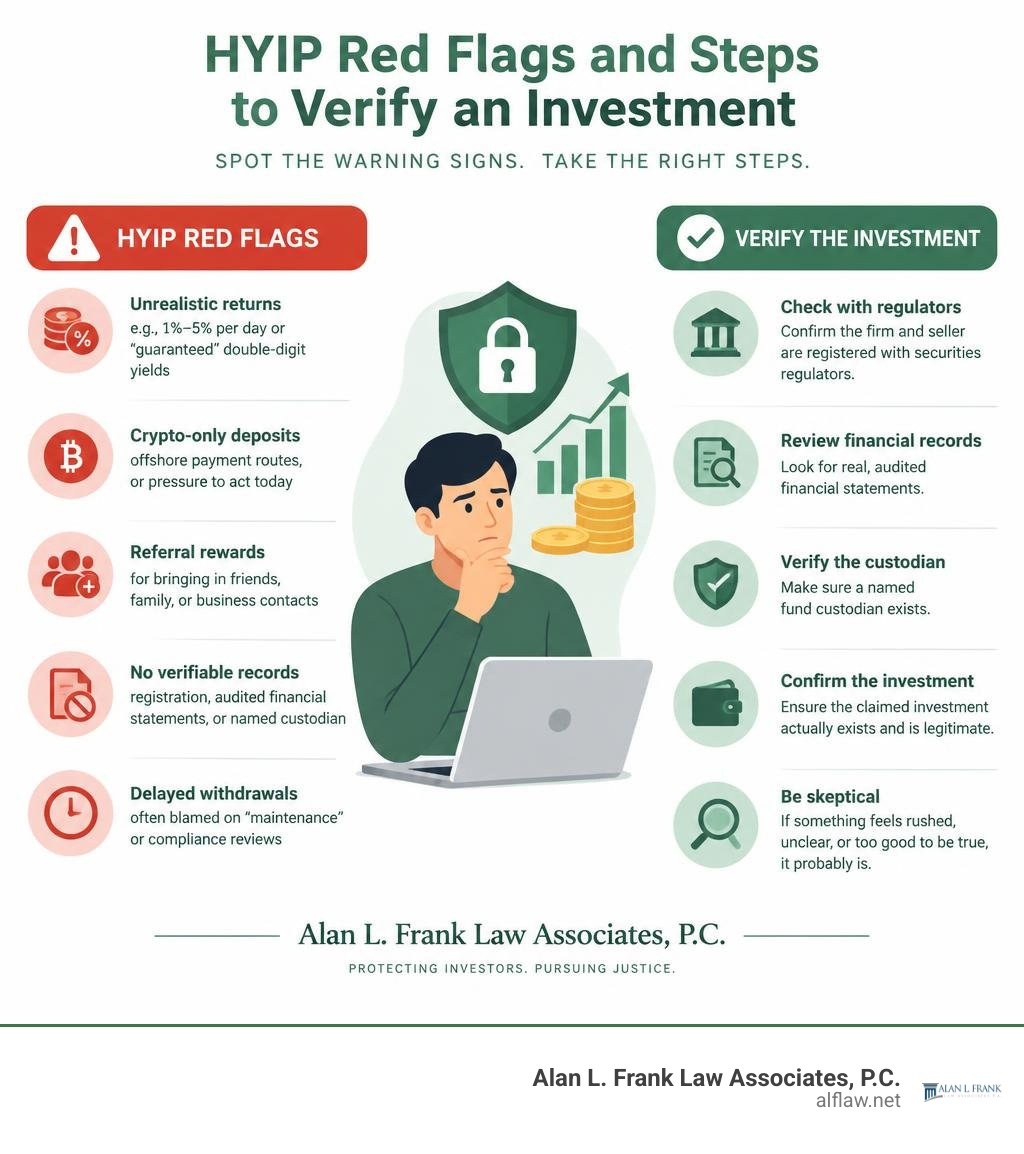
Simple high yield investment scam word guide:
Anatomy of a High Yield Investment Scam: Mechanics and Mathematical Traps

At its core, a high yield investment program (HYIP) is an unsustainable Ponzi scheme wrapped in sleek digital marketing. Promoters lure prospective victims with the promise of extraordinary, passive profits, often advertising daily returns ranging from 1% to 5%. While a 1% daily return may sound modest to an inexperienced investor, basic mathematics reveals the deception. Compounded daily, a 1% daily return equates to an annual percentage yield (APY) of approximately 3,678%. Claiming that any fund can reliably generate over 3,600% per year without risk is pure financial fiction.
In reality, legitimate institutional fund managers consider an annual return of 10% to 15% to be an outstanding performance. Classic High-yield investment program structures generate no real economic profits through trading, lending, or commercial production. Instead, they rely strictly on a Ponzi cash flow model:
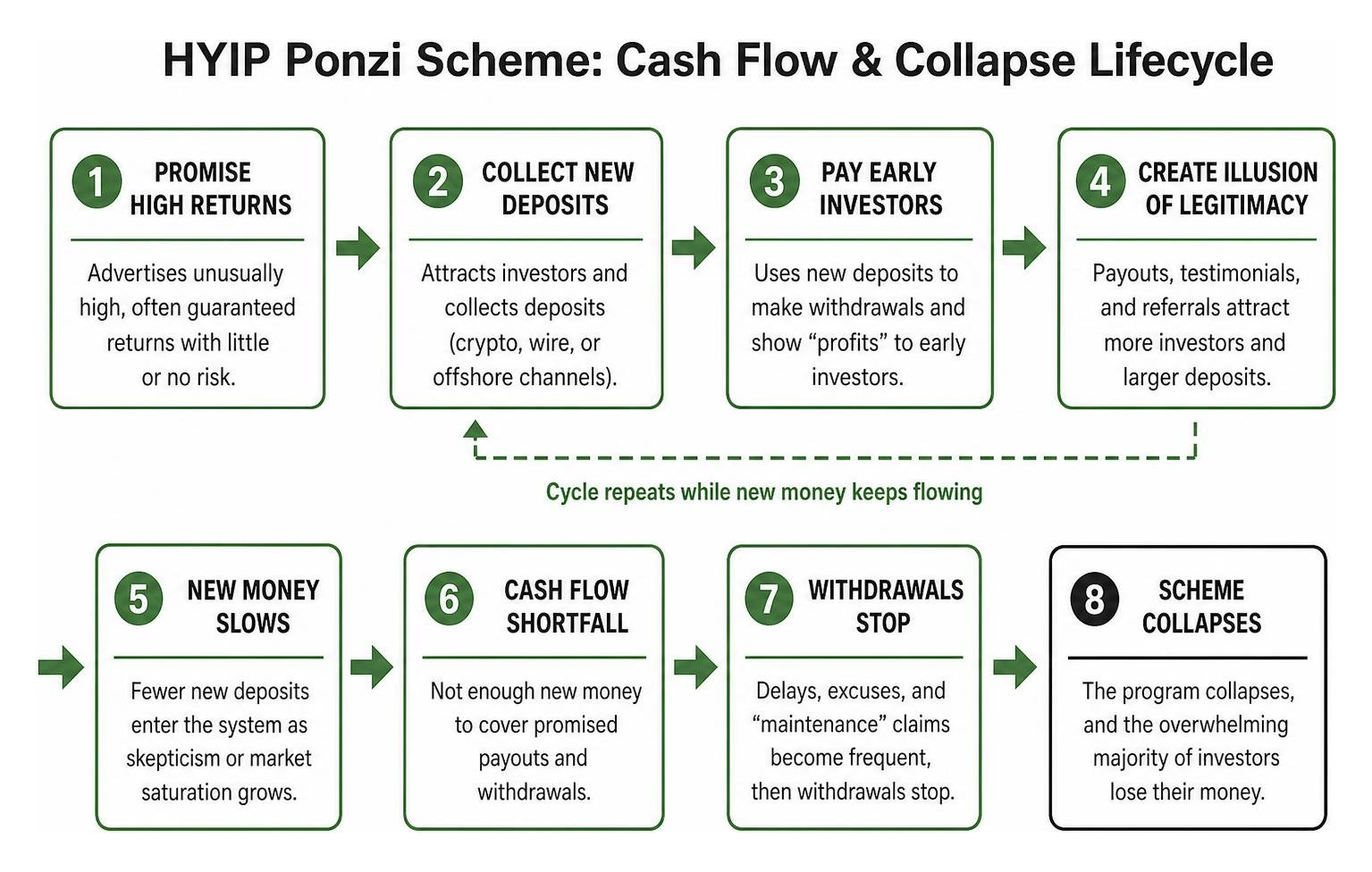
The scheme survives solely on the velocity of new deposits. Early participants often receive initial payouts on schedule, which creates a powerful illusion of solvency. However, as soon as the pool of new incoming capital flattens or market skepticism increases, the velocity stalls. Because the fund generates no genuine yield, the entire structure inevitably collapses within weeks or months, leaving the overwhelming majority of participants with total losses.
The Role of Prime-Bank Terminology and Fictitious Assets
To justify their implausible returns, operators construct sophisticated cover stories. Fraudsters frequently claim to possess proprietary trading algorithms, high-frequency arbitrage software, or exclusive access to private offshore markets. A pervasive tactic involves the misuse of “prime bank” terminology. Promoters tell investors that their capital is pooled to purchase secret, discounted debt instruments from top-tier European banks or global financial institutions, which are then supposedly flipped on private secondary markets for immense profits.
As highlighted in regulatory warnings on High-Yield Investment Programs, these prime-bank financial instruments simply do not exist. Legitimate global banks do not issue secret high-yield discount notes to retail pooling operations. Con artists deliberately deploy dense, institutional-sounding jargon to intimidate investors and discourage them from asking basic due diligence questions.
Crypto Assets, Offshore Routing, and Withdrawal Freezes
Modern high-yield scams have migrated heavily toward cryptocurrency. Digital assets provide operators with cross-border reach, pseudo-anonymity, and irreversible transactions. When an investor deposits Bitcoin, Ethereum, or Tether (USDT), the funds are instantly routed through automated tumbling scripts, centralized mixing services, or nested offshore shell accounts.
The investor is given access to a personalized web dashboard that displays an artificially compounding account balance. These figures are entirely decorative. When an investor ultimately attempts to withdraw their principal or accumulated earnings, the platform activates stall tactics. Fraudsters issue blanket notices claiming the system is undergoing “routine server maintenance,” undergoing urgent blockchain upgrades, or requiring secondary tax deposits or compliance fees before funds can be released. In the digital asset space, a sudden maintenance notice is almost always the prelude to an exit scam.
Red Flags, Social Proof, and Recruitment Networks
Understanding the structural indicators of fraudulent programs allows investors to identify dangers before transferring capital. The table below outlines key operational differences between lawful investment entities and fraudulent operations:
| Feature | Legitimate Registered Investment Funds | Fraudulent High-Yield Schemes (HYIPs) |
|---|---|---|
| Regulatory Status | Registered with the SEC, state regulators, or under strict statutory exemptions | Unregistered entities operating outside regulatory oversight |
| Projected Returns | Market-correlated, fluctuating, realistic (e.g., 7%–15% annually) | Guaranteed, fixed, daily or weekly double-digit returns (1%–5% daily) |
| Financial Transparency | Audited financial statements prepared by independent CPA firms | Unaudited internal dashboards with decorative balances |
| Asset Custody | Qualified third-party custodians and chartered depository institutions | Unhosted crypto wallets, private keys held by operators, offshore shells |
| Risk Disclosures | Detailed Private Placement Memorandums (PPM) detailing loss risks | Claims of “zero-risk,” capital insurance guarantees, or full backing |
| Withdrawal Terms | Defined redemption windows, formal notices, standard banking transfers | Arbitrary freezes, “maintenance” delays, upfront release fees |
Psychological Tactics Behind a High Yield Investment Scam
Perpetrators of high-yield fraud exploit predictable cognitive biases. They introduce artificial urgency to disable critical thinking, deploying dynamic countdown timers on web portals that offer short-term “bonus tiers” or claiming that enrollment windows for proprietary arbitrage pools are closing within hours.
This manufactured urgency induces a powerful fear of missing out (FOMO). To reinforce the psychological trap, operators construct artificial social consensus. They create closed groups where early participants post screenshots of completed micro-withdrawals. Seeing peers seemingly profit in real time leads prospective victims to abandon standard risk assessments, mistaking short-term Ponzi distributions for commercial legitimacy.
HYIP Monitor Sites, Referral Matrices, and Affiliate Collusion
The proliferation of online high-yield scams is sustained by a predatory ecosystem of tracking websites and affiliate networks. Independent-looking “HYIP Monitor” or “HYIP Tracker” portals display lists of active programs, assigning them bright green “PAYING” tags. In reality, these platforms rarely perform financial due diligence. They receive direct promotional fees and priority payouts from scam operators in exchange for maintaining positive status ratings.
Furthermore, these programs operate on aggressive multi-level referral matrices. Participants are promised 5% to 20% direct commissions for bringing in friends, family, and online followers. This structure transforms victims into unwitting promoters who champion the scheme across digital channels. When the underlying platform ceases operations, the monitor site abruptly changes the status tag to “SCAM” or “CLOSED,” leaving affiliate-recruited retail investors with unrecoverable balances.
Notable Enforcement Actions: From Historic Schemes to Modern Prosecutions
High-yield investment scams have adapted across decades while preserving identical underlying mechanics. Historical enforcement highlights the massive scale these operations can achieve:
- Zeek Rewards (2012): Defrauded approximately 1 million retail investors worldwide of more than $600 million by masquerading as a penny-auction profit-sharing pool promising 1.5% daily returns.
- OSGold (2001–2002): An early digital currency Ponzi scheme that lured over 60,000 account holders with promises of 30% to 45% monthly returns, ultimately vanishing with an estimated $250 million.
- Colonyinvest (2008): Defrauded roughly 50,000 investors in Thailand out of approximately 5 billion baht (around $150 million) through fraudulent high-yield enterprise investment contracts.
- SEC Litigation against Unregistered Operators: Major regulatory actions, such as the SEC action involving Donald Matthew Greth and Brenda Melton, demonstrate how federal authorities continuously intervene to halt unregistered offerings and hold fraudulent fund promoters accountable.
The Next Level Holdings and Yield Wealth Multi-Million Dollar Fraud
A prominent recent prosecution involves financier Paul Regan and his associated entities, Next Level Holdings and Yield Wealth Ltd. Marketed to retail investors as guaranteed, high-yield deposit notes with double-digit annual returns, the program raised over $60 million from more than 300 investors, culminating in over $50 million in investor losses.
Regan falsely assured investors that their principal was fully protected by multi-million-dollar insurance policies from prominent syndicates such as Lloyd’s of London. In reality, the insurance policies were forged or nonexistent, and investor capital was routinely diverted to sustain Ponzi payouts and personal expenditures. Regulators moved aggressively, as seen when state authorities intervened; for example, the Michigan LARA Cease and Desist Order imposed statutory civil fines and halted the unlawful sale of unregistered securities tied to related high-yield deposit structures.
Financial Intermediary Liability and Broker Misconduct
While primary scam operators frequently operate anonymously or outside domestic borders, retail investors are sometimes introduced to high-yield programs by licensed financial professionals, wealth managers, or registered brokers. When a licensed broker facilitates, recommends, or receives selling compensation for an unapproved outside investment, they engage in an industry violation known as “selling away.”
Brokerage firms are legally obligated under securities regulations to maintain robust supervisory systems to protect clients from unvetted instruments. When supervisory failures enable a broker to direct client capital into fraudulent funds, the brokerage firm itself may be held legally liable. Defrauded investors can utilize FINRA as a forum for claims involving stockbroker misconduct to pursue full recovery of their losses. Retaining experienced legal counsel familiar with how a private placement fraud attorney holds dishonest issuers accountable provides an avenue for holding both issuers and negligent intermediaries responsible.
Due Diligence and Legal Action for Defrauded Investors

When an investor realizes they have been ensnared by a fraudulent high-yield platform, quick and systematic action is necessary. Preserving critical evidence before the platform completely deletes its infrastructure is vital:
- Capture Digital Records: Take clear, full-screen captures of account dashboards, deposit histories, internal messaging logs, and current balances.
- Document Financial Trails: Preserve bank wire confirmations, credit card statements, and complete cryptocurrency transaction hashes showing wallet deposit addresses.
- Archive Promotional Solicitations: Save copies of whitepapers, private placement summaries, marketing emails, referral link structures, and chat transcripts from platforms like Telegram or WhatsApp.
- File Regulatory Complaints: Submit detailed fraud reports to the SEC Office of the Whistleblower, the FBI Internet Crime Complaint Center (IC3), and your state securities bureau.
- Seek Securities Counsel: Engaging qualified counsel explains why smart investors trust stock fraud attorneys to reclaim stolen capital through structured civil litigation rather than chasing fraudulent recovery services.
How to Identify a High Yield Investment Scam Before Depositing Funds
Conducting thorough due diligence before transferring capital prevents catastrophic losses. Legitimate investment opportunities are verifiable through official channels:
- Check SEC EDGAR Filings: All public securities offerings and lawful private placement exemptions (such as Regulation D) must file registration statements or Form D notices with the SEC’s EDGAR database.
- Verify Professional Licenses: Use FINRA BrokerCheck and the SEC’s Investment Adviser Public Disclosure (IAPD) database to confirm that the individual offering the investment holds an active, unblemished license.
- Inspect Domain Registration Data: Fraudulent portals rarely have long operating histories. Perform a WHOIS lookup on the fund’s web domain; domains registered within the preceding 12 months that claim decades of institutional trading success are fraudulent.
- Benchmark Against Market Realities: Any program promising risk-free returns exceeding standard commercial benchmarks (10% to 15% annually) warrants immediate skepticism.
Legal Pathways: Arbitration, Receiverships, and Securities Litigation
Victims of high-yield investment fraud have multiple legal mechanisms to pursue financial recovery depending on how the investment was structured and marketed. When court-appointed federal equity receivers take control of collapsed schemes, they initiate clawback lawsuits to recover fictitious profits and excessive referral commissions paid to early promoters, redistributing those funds equitably among net-losing investors.
Furthermore, investors can pursue formal dispute resolution against solvent third parties. If a registered financial representative or brokerage house participated in the distribution of the fraudulent product, defrauded parties can retain dedicated FINRA attorneys to initiate binding arbitration. When institutional facilitators, escrow agents, or dishonest issuers enable large-scale fraud, comprehensive securities litigation serves as an effective mechanism to compel financial accountability and recover misappropriated assets.
Frequently Asked Questions About High Yield Investment Scams
Can cryptocurrency lost in a high-yield investment scheme ever be recovered?
Recovering digital assets sent to a high-yield scam is complex, but it is not impossible. Because public blockchain ledgers are transparent, specialized forensic investigators can trace the movement of deposited tokens through intermediate addresses directly to centralized crypto exchanges. If the stolen assets hit an exchange that enforces Know-Your-Customer (KYC) identity compliance, court-ordered subpoenas and emergency asset freezes can lock those accounts, enabling subsequent recovery through civil judgments or government forfeiture actions.
Are online HYIP monitoring and tracking websites reliable?
No. Online HYIP monitor sites operate as affiliate marketers rather than objective consumer watchdogs. These sites receive direct financial compensation, advertising fees, and preferential withdrawal treatment from the scheme operators in exchange for publishing green “PAYING” status badges. Once an operator stops paying the monitor site itself, the status changes, but by then, ordinary retail investors have already suffered catastrophic losses.
What legal liability do investors face if they referred others to a collapsed fund?
Retail investors who introduced acquaintances to a program in good faith—genuinely believing the platform was legitimate—generally do not face criminal charges. However, they may face civil liability. Court-appointed receivers and bankruptcy trustees routinely file clawback actions against net-winning participants to recover referral bonuses and early profits paid out of other victims’ capital. Individuals who actively marketed the scheme while receiving substantial multi-level commissions can face statutory claims for offering unregistered securities.
Conclusion: Protecting Capital and Pursuing Recovery
High-yield investment scams continue to evolve alongside modern financial technology, using cryptocurrency, deceptive dashboards, and psychological pressure to divert capital from unwary investors. Recognizing unrealistic daily returns, unverified assets, and aggressive referral matrices is the most effective way to protect your capital.
At Alan L. Frank Law Associates, P.C., we represent investors across Pennsylvania, New Jersey, and nationwide who have suffered significant financial harm due to fraudulent funds, broker misconduct, and deceptive financial offerings. Our firm delivers rigorous analysis and determined advocacy to hold dishonest issuers and supervisory institutions accountable. If you or your organization has suffered substantial losses in an unregistered investment scheme, we invite you to evaluate your legal options for securities litigation investment losses and take decisive action to pursue capital recovery.