
Protect Your Project Before the Roof Caves In


Protect Your Project Before the Roof Caves In
Introduction
Builders risk insurance—often referred to as course of construction insurance—is specialized first-party property coverage that protects buildings, structures, fixtures, and materials from direct physical loss or damage while under active construction, renovation, or expansion. Standard permanent property policies typically exclude structures under construction, and commercial general liability forms protect only against third-party bodily injury and property damage. Builders risk bridges this critical gap by indemnifying property owners, developers, and general contractors against hazards such as fire, lightning, windstorms, theft, vandalism, and structural collapse.
Between groundbreaking and the final ribbon-cutting, uninstalled materials and exposed framing face ongoing hazards. Rooted historically in inland marine cargo insurance, securing tailored builders risk protection—and understanding how to enforce policy terms when catastrophic losses or claim disputes arise—is a vital foundation for project financing and risk management across Pennsylvania and New Jersey as we navigate 2026 industry standards.
What Is Builders Risk Insurance and How Does It Work?
At its legal foundation, builders risk insurance is a specialized form of property indemnity designed to shield buildings, structures, fixtures, and materials while they are being built, remodeled, or expanded. Operating under standardized language such as the ISO CP 00 20 form or proprietary inland marine wordings, these policies protect any party with a demonstrable financial or insurable interest in the ongoing work.
Under an “open perils” (or “all-risk”) policy form, the insurer agrees to pay for direct physical loss or damage to covered property from any cause, unless that specific cause is explicitly excluded in the policy declarations. Conversely, “named perils” policies only indemnify against enumerated events. In modern construction, standard course of construction inland marine standards favor open-perils forms to ensure comprehensive protection across all phases of development.
Core Coverage Scope and Covered Perils
A standard course of construction policy covers physical losses arising from the most prevalent jobsite hazards:
- Fire, Arson, and Lightning: Protection against blazes ignited by electrical faults, hot work operations, or deliberate arson.
- Windstorm and Hail: Structural damage caused by severe convective storms, gale-force winds, or tornadic activity.
- Theft and Vandalism: Loss of uninstalled construction materials, copper piping, HVAC units, and structural components stolen directly from the jobsite, as well as malicious property damage.
- Structural Collapse: Sudden structural failure during active framing, concrete curing, or masonry installation.
- Transit and Temporary Storage: Up to $100,000 or more in dedicated limits for raw materials while in transit from suppliers or staged in off-site warehouses.
- Debris Removal and Scaffolding: Essential post-loss cleanup costs—typically structured between $50,000 and $100,000 depending on project value—along with specialized allowances up to $50,000 to repair or re-erect damaged scaffolding, falsework, and temporary fencing.
Key Exclusions and Faulty Workmanship Gaps
Despite broad open-peril terms, builders risk policies contain vital exclusions that frequently generate legal disputes:
- Faulty Workmanship and Design Defects: Insurers explicitly exclude the direct cost to repair, replace, or redesign defective construction or engineering errors.
- Defective Materials, Wear and Tear, and Gradual Deterioration: Normal degradation, rust, rot, and inherently defective supplies are not covered.
- Mechanical or Electrical Breakdown: Internal mechanical failure during system testing prior to final commissioning, unless an appropriate endorsement is added.
- Flood and Earth Movement: Standard policies exclude flooding, surface water backup, mudslides, and earthquakes. High-risk zones require specialized catastrophic peril endorsements.
- Employee Theft and Inventory Shortages: Unexplained disappearance of inventory or losses caused by the dishonest acts of employees.
- Third-Party Liability and Bodily Injury: Builders risk policies are strictly first-party property forms. They do not defend against worker injury claims or third-party property damage.
Policy Structures, Eligible Projects, and Pricing Benchmarks
The legal structure of a builders risk policy must reflect the volume, duration, and nature of the construction activity. While single-project policies serve one-off builds, high-volume builders often utilize annual reporting forms or blanket master programs with pre-established terms across entire portfolios.
| Policy / Project Category | Core Valuation Method | Typical Scope & Coverage Thresholds | Standard Market Premium Range |
|---|---|---|---|
| New Residential / Commercial Construction | 100% Completed Replacement Cost | Full structural build, site staging, transit, and temporary works up to $75M+ capacity | 0.10% – 0.55% of completed project value ($100 – $550 per $100k value) |
| Major Remodeling & Structural Additions | Existing Structure Value + New Work Value | Renovation-only or inclusive of baseline dwelling; strict occupancy controls | 0.50% – 1.50% of total project value (higher baseline risk) |
| Trade Installation Floaters | Total Installed Equipment / Material Value | Dedicated coverage for specialized mechanical, electrical, HVAC, or elevator trades | Fixed short-term flat premiums or minimum earned deposits |
Eligible Project Types from Groundbreaking to Remodeling
Virtually every stage and format of structural development is eligible for builders risk coverage:
- Ground-Up Residential Builds: Single-family custom homes, tract developments, modular home installations, and multi-family residential structures up to 4 units.
- Commercial Complexes: Multi-family properties with 5+ units, office buildings, retail centers, sports arenas, industrial warehouses, and healthcare facilities.
- Capital Improvements and Historic Renovations: Extensive structural alterations, gut rehabilitations, and interior fit-outs where existing buildings (typically under 75 years of age) require careful separation between existing property and new improvements.
- Tenant Improvements and Installation Floaters: Specialized trade projects encompassing cabinetry, commercial HVAC installations, exterior signage, roofing, or specialized plumbing.
Pricing Factors and Premium Benchmarks
The cost of builders risk coverage is driven by actuarial risk factors rather than standard property flat rates. As noted in market data on project value benchmarks, standard pricing typically falls between 0.1% and 0.55% of the total completed project value for new builds, with minimum policy premiums starting around $375 in most jurisdictions.
Key underwriting variables include:
- Construction Materials: Fire-resistive and non-combustible steel or masonry structures secure significantly lower premium rates than wood-frame builds.
- Geographic and Environmental Hazards: Sites situated in high-crime municipal sectors, coastal wind corridors, or designated flood zones carry specialized sub-limits and elevated base rates.
- Project Duration and Timeline: A standard 12-month policy term represents the industry baseline. Short-term 3-to-6-month renovation terms or multi-year commercial schedules adjust rates accordingly.
- Deductible Thresholds: Standard commercial deductibles typically range from $1,000 to $25,000, while catastrophic perils (wind, flood, earth movement) carry percentage-based deductibles calculated against total completed value.
Contractual Mandates, Critical Endorsements, and Policy Timelines
Construction loans and commercial agreements virtually always mandate builders risk coverage as a condition precedent to financial disbursement. Under standard American Institute of Architects (AIA) contract agreements (such as AIA A201 and related exhibits), the parties must explicitly assign procurement duties to either the owner or the general contractor. In managing these complex transactions, parties navigating corporate and transactional matters must ensure that loan covenants, draw schedules, and contract terms seamlessly align with policy language.
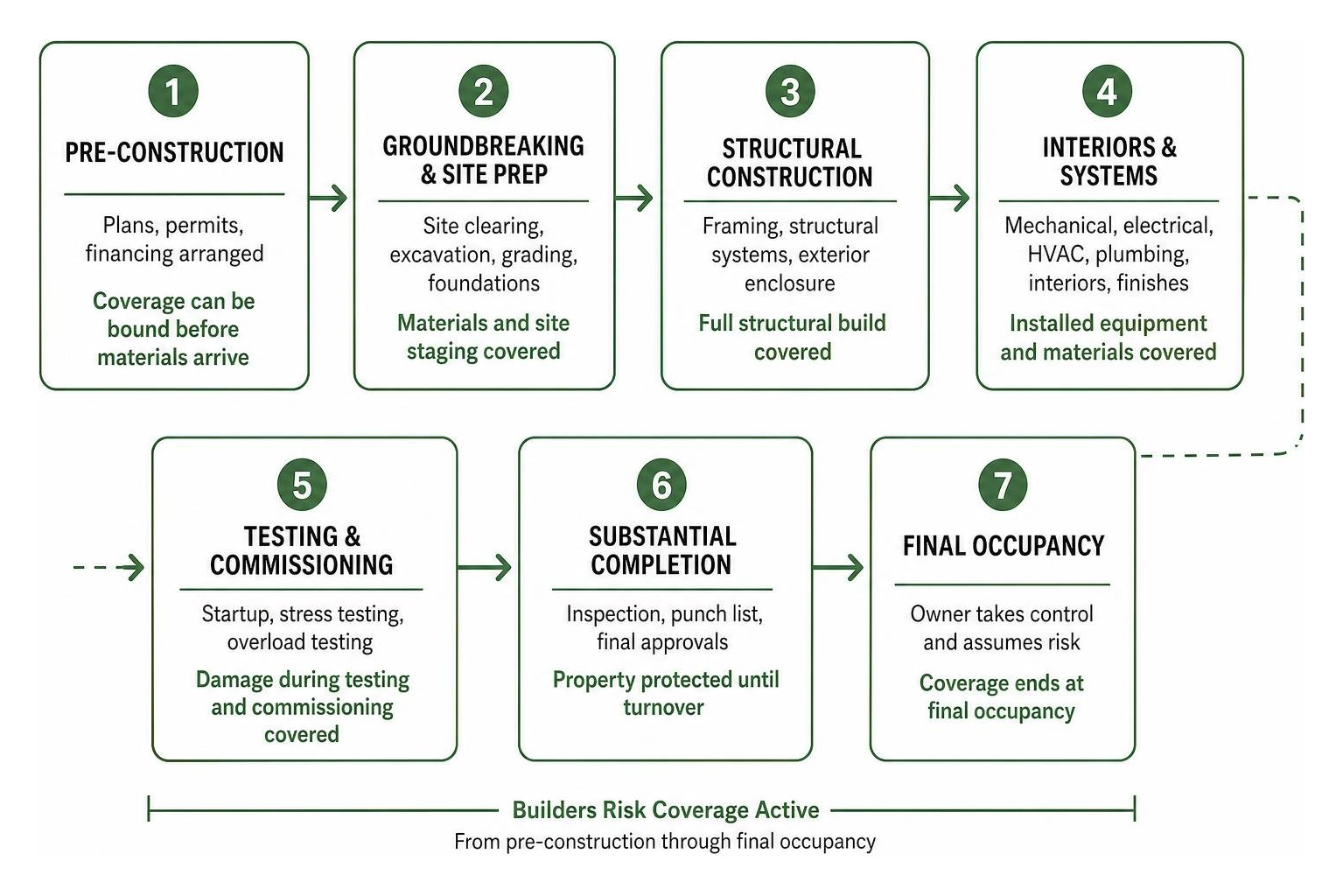
Timing is equally paramount: coverage should ideally be bound before the first load of lumber or steel reaches the jobsite. Attempting to purchase coverage when a project is greater than 30% complete triggers rigorous underwriting scrutiny, pre-loss photo affidavits, or direct declinations from standard carriers.
Essential Endorsements for Builders Risk Insurance
To avoid crippling financial gaps, construction professionals should integrate vital coverage endorsements:
- Soft Costs and Delay in Startup: Reimburses secondary financial losses resulting from a covered property delay, including ongoing construction loan interest, municipal permit re-issuance fees, legal/accounting fees, and additional architectural consulting.
- Contract Change Orders: Automatically increases the total policy limit by 10% to 30% to account for scope modifications and material upgrades without requiring mid-term policy rewrites.
- Testing and Commissioning: Provides coverage for physical damage arising during startup, stress, pressure, and overload testing of mechanical, electrical, and HVAC equipment.
- Ordinance or Law: Covers the additional 15% to 30% in reconstruction costs required to bring undamaged portions of the building up to modern municipal building codes following a major loss.
- Green Building Certification Standards: Reimburses the expenses required to replace materials with certified eco-friendly alternatives and cover indoor air quality testing to maintain LEED or similar environmental standards.
- Water and Sewer Backup: Extends coverage for damages caused by the failure or backup of municipal sewers, drain networks, or sumps on the construction site.
Coverage Triggers, Substantial Completion, and Occupancy Clauses
Builders risk coverage begins on the effective date of the policy (or the initial delivery of materials) and automatically terminates upon specific milestones:
- Issuance of the Certificate of Occupancy: Once local building officials deem the property fit for full habitation.
- Substantial Completion and Acceptance: When the project owner takes legal possession of the completed work under contract terms.
- Partial or Phased Occupancy: Moving furniture into a completed wing or allowing commercial tenants to operate early will trigger immediate policy termination unless a formal Permission to Occupy endorsement is negotiated in advance.
- Work Abandonment or Idle Jobsite Triggers: If active construction ceases and the site remains idle for a continuous period of 60 to 90 days, coverage is typically suspended or voided entirely by policy conditions.
Managing Denials and Construction Defect Disputes
When a catastrophic loss occurs, insurance carriers frequently conduct aggressive forensic investigations aimed at limiting their indemnity obligations. Insurers routinely issue a Reservation of Rights letter while searching for policy exclusion triggers, such as pre-existing design defects or improper construction techniques. If an adjuster undervalues or wrongfully denies a legitimate claim, resolving the matter requires disciplined commercial litigation experience to hold the carrier to its contractual obligations.
Waivers of Subrogation and Multi-Party Liabilities
A central pillar of construction risk management is the contractual waiver of subrogation. When properly structured across AIA contract agreements, the property owner, general contractor, and all tiers of subcontractors agree to waive all rights of recovery against one another for damages covered by the builders risk policy.
To maintain total risk transfer and avoid contentious cross-claims:
- Every active party must be designated as a named insured or additional insured on the policy.
- The insurer cannot subrogate against its own insureds, effectively preventing destructive intra-project litigation following a covered loss.
- Third-party bodily injury and non-project property damage must remain strictly segregated under standard commercial general liability (CGL) coverage.
When to Challenge a Builders Risk Insurance Denial
Policyholders should aggressively challenge carrier claim denials under several well-established legal principles:
- The Ensuing Loss Doctrine: Even if an initial event involves an excluded cause (such as faulty workmanship), any subsequent, distinct covered peril that results from it—such as a resultant fire, collapse, or major water intrusion—must be indemnified by the carrier under established resulting damage precedent.
- Ambiguous Policy Exclusions: Under Pennsylvania and New Jersey insurance law, exclusions are construed strictly against the insurer (contra proferentem). If an exclusion for “wear and tear” or “defective design” is vaguely drafted, the policyholder is entitled to coverage.
- Improper Valuation and Delay Penalties: Carriers frequently attempt to settle on an Actual Cash Value (ACV) basis or apply severe depreciation to recently delivered materials. Enforcing replacement cost valuation and holding insurers liable for unreasonable claim delays preserves critical project solvency.
Frequently Asked Questions
Who is responsible for purchasing the policy—the property owner or general contractor?
Responsibility is determined by the construction contract. On major commercial projects, the property owner or developer typically purchases an owner-controlled policy to maintain unified limits and streamlined control over post-loss claims. On residential additions or smaller commercial builds, the general contractor often procures coverage and factors the premium directly into the project bid. In all cases, both the owner and contractor should be listed as named insureds.
How does course of construction coverage differ from commercial general liability?
Builders risk is first-party property insurance that pays to repair or rebuild the physical structure, materials, and fixtures damaged by covered perils during construction. Commercial General Liability (CGL) is third-party liability coverage that protects the insured against legal claims and lawsuits arising from bodily injury or property damage caused to unrelated third parties.
Can you secure coverage if a construction project is already underway?
Yes, but securing coverage mid-construction is significantly more complex. Insurers maintain strict underwriting guidelines for mid-project placements. When a project is greater than 30% complete, underwriters typically require certified progress reports, jobsite inspections, dated photographs, and signed affidavits confirming that no pre-existing damage or unrecorded losses exist prior to binding.
Conclusion
A catastrophic construction site loss does not have to derail your development or destroy your business. From the moment architectural plans are drafted to the final municipal sign-off, protecting your capital requires a comprehensive understanding of builders risk coverage, rigorous contract review, and proactive endorsement integration.
When insurers issue wrongful claim denials, undervalue replacement costs, or misapply faulty workmanship exclusions, you need a proven legal advocate in your corner. At Alan L. Frank Law Associates, P.C., our seasoned attorneys combine nationwide commercial litigation prowess with deep knowledge of construction insurance to secure multi-million dollar recoveries for our clients across Pennsylvania and New Jersey. If your project is facing an insurance coverage dispute or construction failure, review our faqs on housing and construction defects and contact our team today to enforce your policy rights and protect your bottom line.