
How Oil Investment Fraud Attorneys Uncover Energy Scams and Recover Funds


How Oil Investment Fraud Attorneys Uncover Energy Scams and Recover Funds
How Oil Investment Fraud Attorneys Help Recover Energy Investment Losses
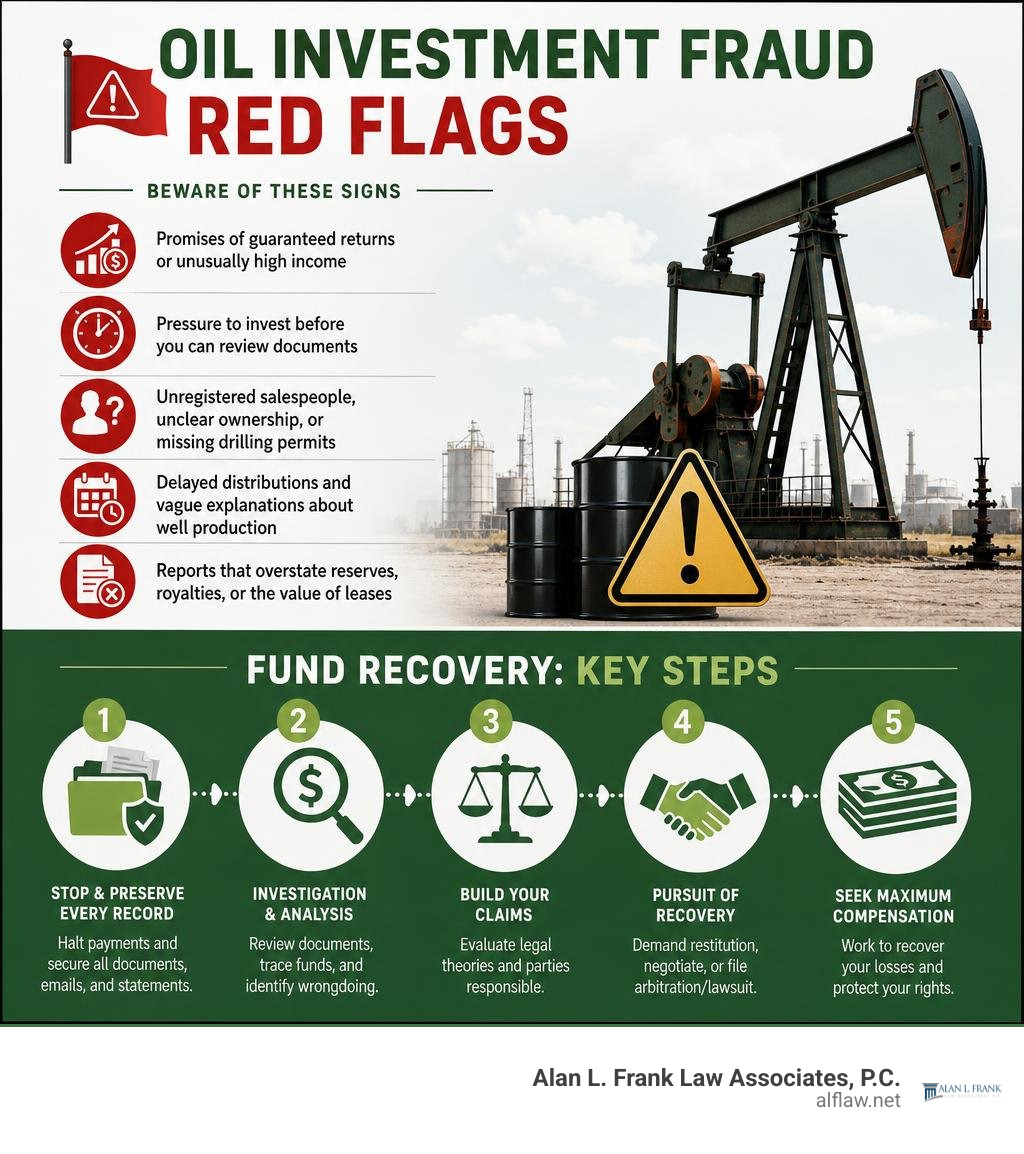
If you suspect an oil or gas investment scam, stop sending money, preserve every record, and speak with an attorney promptly. Oil investment fraud attorneys can review offering documents, trace where invested funds went, assess claims against promoters, operators, and brokerage firms, and pursue recovery through arbitration or litigation.
Common warning signs include:
- Promises of guaranteed returns or unusually high monthly income.
- Pressure to invest before you can review documents.
- Unregistered salespeople, unclear ownership, or missing drilling permits.
- Delayed distributions and vague explanations about well production.
- Reports that overstate reserves, royalties, or the value of leases.
Oil and gas deals can involve real wells, leases, and complex tax language. That does not make a fraudulent offering legitimate. The key question is whether the people selling the investment told the truth about the risks, use of investor funds, ownership interests, and expected production.
I am Alan L. Frank, Managing Attorney at Alan L. Frank Law Associates, P.C., and I handle complex commercial litigation and investment-loss matters backed by more than 20 years of legal experience, along with training in tax law and accounting as a CPA. This guide explains how oil investment fraud attorneys investigate energy scams and the practical legal options investors may use to seek recovery.
Common Energy Scams and Red Flags in Oil and Gas Investments
Energy markets naturally attract capital because of their potential for substantial returns and attractive depletion allowances. However, deceptive promoters frequently weaponize this industry’s natural volatility and technical jargon to camouflage outright theft. Oil and gas investment fraud has resulted in over $1.8 billion in losses to investors since 2010, according to Securities and Exchange Commission (SEC) enforcement actions. Furthermore, the Federal Bureau of Investigation (FBI) reports that energy-related ventures account for roughly 10% of all securities fraud cases investigated annually.
A critical vulnerability in this sector stems from the lack of standard market transparency. According to research from the University of Texas School of Law, approximately 70% of oil and gas investment fraud cases involve unregistered securities. When offerings operate outside standard public exchange disclosures, unscrupulous promoters find it far easier to mischaracterize their assets.
Major warning signs in private placement energy offerings include:
- High-pressure cold calls or unsolicited digital campaigns urging immediate wire transfers.
- Guaranteed annual returns exceeding 20% to 50% with claims of “zero geological risk.”
- Offering materials that omit standard private placement memorandums (PPMs) or subscription agreements.
- Use of investor capital to pay early investors their promised “yields” rather than funding actual drilling.
- Operators refusing to provide audited financial statements or verified drilling logs.
Deceptive Well Schemes and Dry-Hole Rigs
Fraudulent energy offerings take many shapes, but they typically share common deceptive mechanics:
- Phantom Wells and Fake Leases: Promoters create slick brochures showing producing oil fields, complete with falsified aerial photographs and forged lease agreements, while having no actual mineral rights or operational footprints.
- Misrepresented Royalties and Working Interests: Promoters sell fractional working interests in genuine wells to hundreds of individual investors, vastly overselling the available 100% working interest. Investors end up holding an unenforceable title to revenue that has already been pledged elsewhere.
- Dry-Hole Rigs and Re-Entry Scams: Operators acquire capped or depleted “dry holes” for pennies on the dollar, rebrand the equipment, and solicit capital under the pretense that modern hydraulic fracturing or secondary recovery methods will generate millions in crude production.
- Wildcatting Misrepresentations: Promoters advertise speculative exploratory wells (“wildcats”) as proven, low-risk development fields, falsely claiming that adjacent high-producing acreage guarantees identical success on their unproven parcels.
Warning Signs of Fraudulent Energy Offerings
Legitimate oil exploration carries substantial, unavoidable risk. When an offering sounds too safe to fail, it is almost certainly a scam.
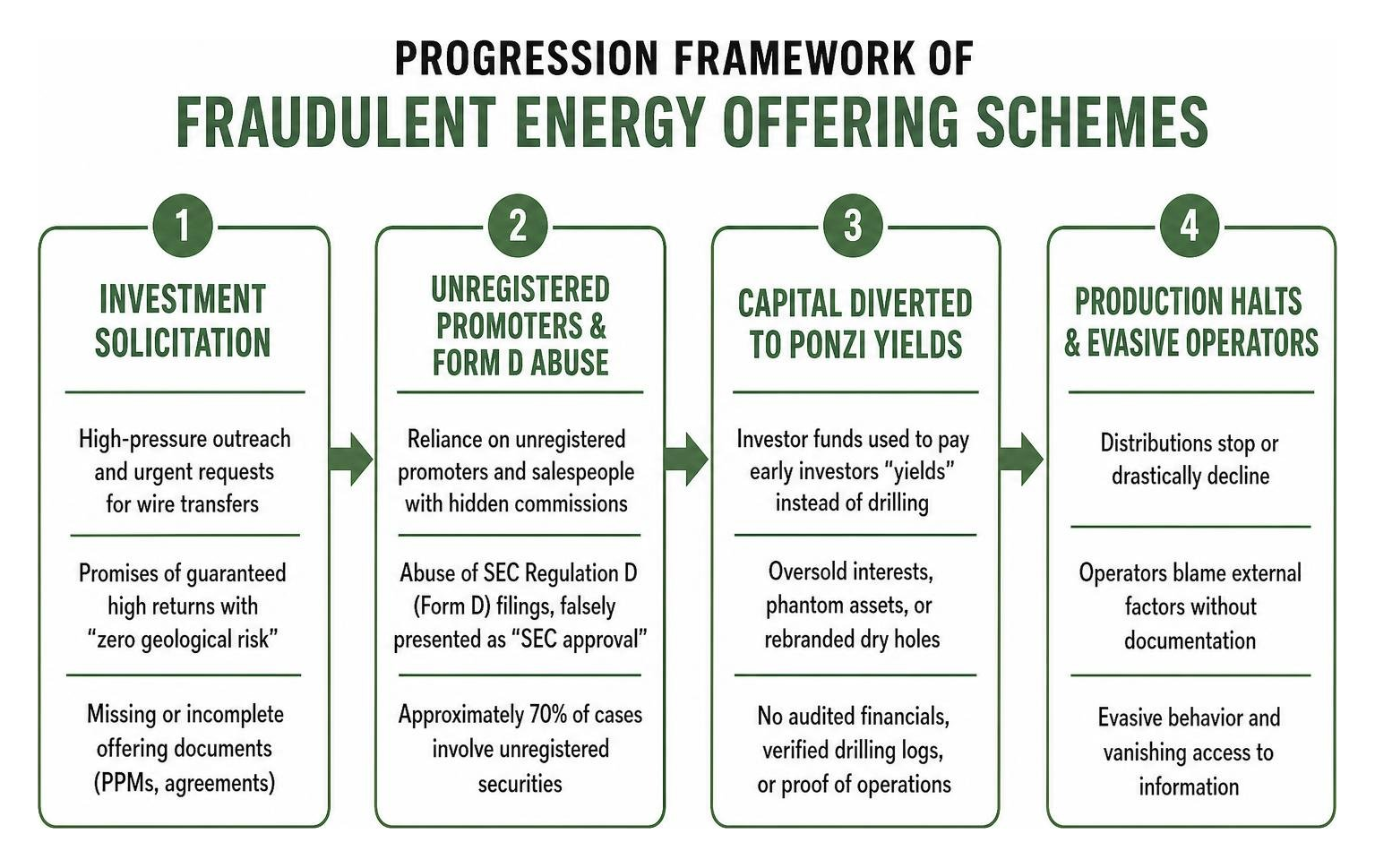
Promoters frequently abuse SEC Regulation D (specifically Form D filings), presenting a basic notice of exempt offering as an official “SEC approval.” In reality, the SEC does not verify, approve, or endorse private placements filed under Regulation D. Additionally, fraudulent syndicates often rely on unregistered salespeople who receive exorbitant, undisclosed commissions—sometimes up to 40% of the gross capital raised—which is a direct violation of federal securities laws.
When distributions mysteriously cease and operators become evasive, blaming weather, broken drill bits, or local pipeline delays without documentation, investors must act decisively. According to data from the North American Securities Administrators Association (NASAA), the average loss per victim in energy fraud cases reached $125,000, underscoring the severe financial harm these deceptive practices cause.
How Oil Investment Fraud Attorneys Investigate and Prove Deception
Energy fraud litigation requires bridging two distinct domains: complex securities regulations and technical petroleum engineering practices. When uncovering illicit conduct, our team at Alan L. Frank Law Associates, P.C. initiates rigorous formal inquiries through commercial litigation channels to hold bad actors accountable.
The Investigative Process by Oil Investment Fraud Attorneys

Uncovering fraud in an energy deal requires peeling back layers of shell entities, misleading operational reports, and diverted capital flows. To uncover the full picture, legal teams follow an intensive investigative framework:
- Forensic Capital Tracing: We audit bank records, wire transfers, and corporate ledgers to follow where investor capital actually went. In fraudulent operations, funds are frequently diverted to personal luxury expenditures, unrelated projects, or Ponzi-style distributions to earlier investors.
- Land Title and Leasehold Audits: We verify county recording offices and state land registries to establish whether the promoter actually owned or leased the mineral rights advertised in the offering materials.
- Permit and Regulatory Verification: Legitimate drilling requires state permits, environmental filings, and regular production reporting. We cross-examine the promoter’s claims against official state regulatory databases.
- Geological and Engineering Analysis: In coordination with independent petroleum engineers, we scrutinize initial reserve reports to identify whether promoters fabricated production estimates, falsified well logs, or forged signatures of certified geologists.
- Promoter and Broker Background Checks: We investigate the regulatory history of the promoters, searching for prior SEC sanctions, state cease-and-desist orders, or undisclosed criminal backgrounds.
Building Evidentiary Proof Under Federal and State Securities Laws
Proving liability in an oil fraud matter requires establishing statutory violations under both federal acts and state specific “blue sky” statutes.
Under Section 10(b) of the Securities Exchange Act of 1934 and SEC Rule 10b-5, a successful claim requires demonstrating:
- Material Misrepresentation or Omission: The promoter lied about crucial facts (e.g., mineral ownership, past production, or the use of proceeds) or omitted facts that a reasonable investor would consider essential.
- Scienter: The promoter acted with intent to deceive, manipulate, or defraud, or demonstrated severe recklessness regarding the truth.
- Reliance and Causation: The investor relied on those misrepresentations, and the deceptive conduct directly caused the financial loss.
Additionally, Section 12 of the Securities Act of 1933 provides strict liability remedies for selling unregistered securities through false prospectuses. State blue sky laws—such as those in Pennsylvania and New Jersey—often provide broader protections, permitting recovery without requiring the heightened burden of proving intentional scienter.
Legal Strategies to Recover Losses in Energy Scams
Recovering losses requires pinpointing every party that enabled the fraud. In many situations, the fraudulent promoter may be insolvent or may have hidden assets overseas. However, broker-dealers, registered investment advisers (RIAs), clearing firms, and legal or accounting professionals who facilitated the offering may bear significant secondary liability. When financial advisers recommend speculative oil programs without conducting adequate due diligence, our FINRA attorneys step in to hold those financial institutions directly responsible.

According to data from the Securities Investor Protection Corporation (SIPC), investors who hire specialized legal counsel recover an average of 40% of their losses, compared to just 15% for those who attempt to navigate recovery unrepresented.
Working with Oil Investment Fraud Attorneys in FINRA Arbitration vs Court
When an investor purchases an oil and gas private placement or Direct Participation Program (DPP) through a brokerage firm, the account agreement almost universally requires resolving disputes via Financial Industry Regulatory Authority (FINRA) arbitration rather than public court trials.
Understanding the differences between these legal avenues is vital for maximizing financial recovery:
| Feature | FINRA Arbitration | State or Federal Court Litigation |
|---|---|---|
| Primary Target | Broker-dealers, registered representatives, clearing firms | Promoters, operators, unregistered sellers, third-party facilitators |
| Key Claims | Unsuitability (Rule 2111), failure to supervise, misrepresentation | Common law fraud, breach of contract, Rule 10b-5, blue sky violations |
| Timeline | Typically 12 to 18 months | 2 to 4+ years through trial and appeals |
| Discovery Scope | Streamlined document production based on FINRA discovery guides | Extensive depositions, broad subpoenas, and lengthy motion practice |
| Finality | Final and binding; extremely narrow grounds for appeal | Subject to multiple levels of appellate review |
Under FINRA Rule 2111, brokerage firms have a non-negotiable duty to recommend only investments that are suitable for their client’s risk profile, age, tax status, and liquidity needs. High-risk, illiquid oil and gas private placements are inherently unsuitable for conservative investors, retirees, or those needing ready access to their capital. Broker-dealers also owe a strict duty under FINRA Rule 3110 to supervise their associated brokers and independently verify the claims made in offering prospectuses. Utilizing FINRA as a forum for claims involving stockbroker misconduct often provides an efficient, cost-effective mechanism for recovering capital directly from solvent, insured brokerage firms.
Key Statutes of Limitations and Immediate Investor Action Steps
Time is a critical factor in securities fraud litigation. Under federal securities laws, claims generally must be filed within two years of discovering the fraud, but no later than five years from the date the transaction occurred (the statute of repose). State statutes of limitations vary:
- Pennsylvania: Common law fraud and statutory securities claims under the Pennsylvania Securities Act generally carry a two-year to five-year window depending on the exact statutory cause of action and the discovery rule.
- New Jersey: Claims under the New Jersey Uniform Securities Law carry a strict statutory period, often requiring action within two years of discovery or within five years of the illegal purchase.
- FINRA Eligibility Rule: Under FINRA Rule 12206, no claim is eligible for arbitration where six years have elapsed from the occurrence or event giving rise to the claim.
If you suspect you have been defrauded:
- Halt all communications with the promoter regarding further investments.
- Gather and preserve all records, including subscription agreements, PPMs, wire transfer receipts, emails, text messages, and promotional brochures.
- Document a detailed timeline of every conversation and promised return.
- Seek seasoned legal counsel to evaluate your legal claims before statutory deadlines expire.
Frequently Asked Questions About Oil and Gas Investment Fraud
How do oil investment fraud cases differ from other securities fraud?
Oil and gas fraud cases feature unique technical and structural layers that set them apart from standard stock or corporate fraud. These programs are often structured as Direct Participation Programs (DPPs), general partnerships, or fractional joint ventures rather than common shares. Promoters exploit complex depletion allowances, intangible drilling cost (IDC) tax deductions, and geological terminology to confuse investors. Because oil operations occur in remote locations, verifying whether a well has actually been spudded, completed, or tied into a sales pipeline requires specialized technical analysis that standard stock fraud cases do not demand.
What fee structures do attorneys use for energy fraud recovery?
Our firm generally handles investment loss claims on a contingency fee basis, meaning our clients pay no upfront legal fees and we only collect attorney fees if we successfully recover money on your behalf through settlement, award, or judgment. In certain complex commercial litigation disputes, hybrid or hourly fee structures may be utilized depending on the operational structure of the dispute and client preferences. All fee arrangements and litigation cost terms are discussed transparently during the initial case evaluation.
What should I do immediately if I suspect energy fraud?
First, cease sending any additional funds, even if the promoter claims that an additional “completion fee” or “pipeline fee” is mandatory to release your accrued royalties. Second, download and print all electronic communications, bank confirmations, and investor portal data before the promoter shuts down their systems. Third, contact an experienced attorney who can evaluate the solvency of the targets, trace diverted assets, and determine whether immediate emergency actions, such as seeking an asset freeze or filing a FINRA arbitration claim, are warranted.
Conclusion
Energy investments should be grounded in legitimate geological potential, sound engineering, and transparent corporate operations. When deceptive operators and negligent brokerages betray investor trust, victims face devastating financial consequences. Our legal team at Alan L. Frank Law Associates, P.C. applies extensive commercial litigation, tax, and accounting insight to cut through complex corporate veils and pursue maximum financial recoveries.
If you have suffered significant financial losses from a deceptive oil and gas scheme or an unsuitable energy placement, explore our dedicated services in securities litigation & investment losses and contact us today to evaluate your recovery options.