
Everything Investors Must Know About Hiring FINRA Attorneys Today


Everything Investors Must Know About Hiring FINRA Attorneys Today
The Role of FINRA Attorneys in Dispute Resolution and Investor Recovery
When you open a brokerage account, you almost certainly sign a customer agreement that includes a mandatory arbitration clause. This clause waives your right to sue your brokerage firm in state or federal court, routing all future disputes directly to FINRA Dispute Resolution Services. In this private forum, legal representation is not merely an option—it is often the deciding factor in whether you recover your lost savings.
FINRA attorneys step in to evaluate the misconduct that led to your financial losses. Whether you were subjected to broker negligence, improper asset allocation, or an outright breach of fiduciary duty, your lawyer investigates the paper trail, quantifies your actual damages, and drafts a formal Statement of Claim to initiate binding arbitration. Utilizing FINRA as a forum for claims involving stockbroker misconduct requires navigating distinct procedural requirements that differ dramatically from standard civil litigation.
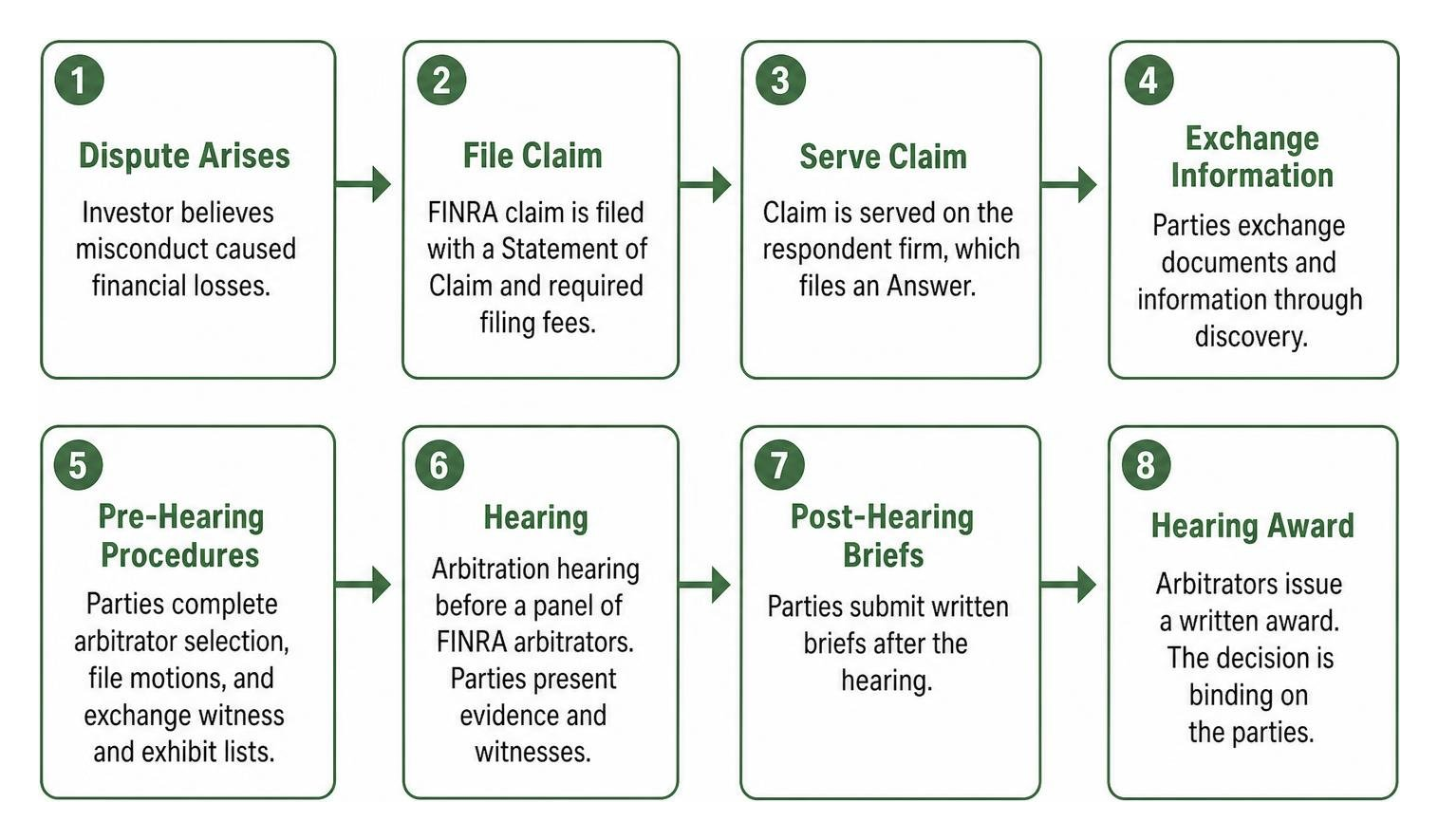
Throughout the proceeding, your attorney handles everything from discovery requests and arbitrator selection to pre-hearing motions, direct examination of expert witnesses, and settlement negotiations in mediation. Their goal is singularly focused: proving firm liability and securing financial compensation for your losses.
How Qualified FINRA Attorneys Differ From General Counsel
Not all litigators possess the specialized background needed to handle securities disputes. A general civil attorney may excel at personal injury or local contract claims, but FINRA arbitration operates under its own distinct set of rules: the FINRA Code of Arbitration Procedure.
Qualified securities lawyers understand the regulatory intricacies governing broker-dealers, including FINRA rules, SEC regulations, and state “Blue Sky” laws. They know how to extract critical internal documents from brokerage houses—such as exception reports, branch manager supervisory notes, and correspondence logs—that general practitioners might not even know exist. When handling complex allegations of broker malpractice, you need a dedicated securities lawyer stock market broker malpractice negligence advocate who can properly interpret complex trading strategies, dissect profit-and-loss statements, and effectively cross-examine industry experts.
When Aggrieved Investors Should Hire FINRA Attorneys
If you notice unexplained drops in your portfolio, trades you never authorized, or concentrated investments in speculative products that clash with your conservative risk profile, you should seek legal counsel immediately.
Brokerage firms and major financial institutions never enter arbitration unrepresented. They deploy sophisticated legal defense teams whose primary goal is to minimize firm liability and deny your payout. Attempting to represent yourself against institutional defense attorneys creates an immediate disadvantage.
Investors routinely retain counsel for disputes involving:
- Churning and Excessive Trading: Generating excessive commissions by buying and selling securities with disregard for your investment goals.
- Unauthorized Trading: Executing transactions without your prior consent or discretionary authority.
- Unsuitability and Reg BI Violations: Recommending high-risk products or strategies that fail to align with your investment profile or best interests.
- Breach of Fiduciary Duty: Placing the firm’s financial incentives above the client’s financial well-being.
Our firm has secured substantial results in these exact scenarios, such as obtaining a FINRA award in the amount of $310,000 against Morgan Stanley for breach of fiduciary duty and professional negligence. When institutional misconduct threatens your financial future, retaining an advocate ensures that your claim is presented with the evidentiary rigor required to win.
Navigating Regulatory Frameworks: FINRA Legal Structure and In-House Enforcement
To understand how disputes are resolved, it helps to understand what FINRA is—and what it is not. FINRA is a non-governmental, nonprofit self-regulatory organization (SRO) authorized by Congress to oversee U.S. broker-dealers. Operating with an annual budget in the $500M to $600M range and a workforce of 3,000 to 4,000 employees across offices in Washington, D.C., New York, Jersey City, Chicago, and other financial hubs, FINRA maintains a comprehensive internal legal apparatus.
Within FINRA’s corporate structure, the Office of General Counsel (OGC) develops regulatory policy and drafts rule proposals that are submitted to the SEC for approval. Internal legal officers, such as Assistant General Counsel Kathryn Moore, focus on regulatory compliance and rule interpretations. Simultaneously, enforcement leaders like Vice President and Chief Counsel Alex White oversee litigation teams that investigate market structure violations and prosecute disciplinary matters against member firms.
It is critical for investors to recognize that FINRA’s in-house attorneys do not represent individual retail investors. Their job is to enforce rules and police the broader marketplace.
| Feature | FINRA In-House / Enforcement Counsel | Private FINRA Investor Counsel |
|---|---|---|
| Primary Client | The regulatory authority (FINRA) | The individual investor / claimant |
| Main Objective | Market integrity, rule enforcement, industry fines | Direct financial recovery of investment losses |
| Forum | FINRA Disciplinary Proceedings & SEC Appeals | FINRA Dispute Resolution (Arbitration/Mediation) |
| Restitution | Discretionary; regulatory fines go to FINRA | Direct awards and settlement payouts to client |
| Representation | Cannot represent private retail investors | Hired directly by investors on fee/contingency basis |
Enforcement Division Investigations and Broker-Dealer Penalties
FINRA Enforcement actively investigates member firms and registered representatives accused of violating federal securities laws and self-regulatory rules. Enforcement leaders like Matthew Minerva manage legal teams that examine severe misconduct, ranging from Regulation Best Interest (Reg BI) breaches and excessive trading in vulnerable accounts to fraudulent misrepresentations in pre-IPO private placements.
When FINRA Enforcement proves a violation, it can levy serious sanctions, including:
- Fines and Disgorgement: Ordering firms to pay millions in civil penalties.
- Suspensions and Statutory Bars: Temporarily or permanently barring unethical brokers from associating with any member firm.
- Firm Expulsions: Revoking a broker-dealer’s registration entirely, shutting down predatory operations.
While regulatory enforcement helps remove bad actors from the financial industry, enforcement fines typically flow back to FINRA, not to your pocket. If you want to recover your specific financial losses, you must file your own claim through FINRA arbitration with private legal counsel.
Resources for Finding and Evaluating Securities Counsel
Finding the right securities litigator requires looking through reputable, specialized organizations rather than general legal ads. When you begin your search, use authoritative resources to evaluate prospective attorneys:
- Public Investors Advocate Bar Association (PIABA): An international bar association of attorneys dedicated to representing public investors in securities disputes. PIABA members focus on investor recovery and share resources regarding emerging broker-dealer schemes.
- American Bar Association (ABA) & State Bar Associations: Use the ABA directory and your state bar association to verify that an attorney is in good standing and free of disciplinary history.
- Legal Directories: Platforms like Martindale-Hubbell offer peer-reviewed ratings and background information on attorneys’ litigation experience.
- FINRA’s Directory Resources: While FINRA maintains strict neutrality and cannot endorse specific counsel, its official Find an Attorney portal provides direct links to verified national bar directories and legal aid projects.

Law School Securities Arbitration Clinics for Low-Income Investors
For individuals who have suffered modest losses and cannot afford private legal representation, university-based securities arbitration clinics provide vital pro bono assistance. Under the direct supervision of experienced securities law faculty and practicing attorneys, law students help retail investors evaluate claims, negotiate with brokerage firms, and conduct arbitration hearings.
Clinics are currently active across ten law schools, including:
- Cornell Law School
- Howard University School of Law
- St. John’s University School of Law
- Seton Hall School of Law
- Cardozo School of Law
- University of Miami School of Law
- Northwestern Pritzker School of Law
- Fordham Law School
- University of Pittsburgh School of Law
- Pace University (Elisabeth Haub School of Law)
Clinic Eligibility Requirements and Limitations:
- Income and Claim Caps: Clinics prioritize individuals with limited household income and claims generally below specific monetary thresholds (often under $50,000 to $100,000).
- No Industry Employment Claims: Law school clinics strictly handle customer disputes against broker-dealers; they do not take on intra-industry or employment disputes between brokers and firms.
Multi-Jurisdictional Rules and Out-of-State Legal Representation
Because FINRA arbitration is a nationwide dispute resolution forum, investors often consider retaining experienced out-of-state securities litigators. However, legal representation across state lines is subject to specific state bar rules and American Bar Association (ABA) Model Rule 5.5, which governs the unauthorized practice of law.
While many states allow out-of-state attorneys to represent clients in arbitration under temporary practice provisions, certain jurisdictions enforce strict local procedural requirements:
- California: Requires out-of-state attorneys to submit formal documentation and pay fees to the State Bar of California to appear in arbitration proceedings.
- Florida, Michigan, and Oregon: Maintain specific multi-jurisdictional practice rules and procedural guidelines that non-admitted lawyers must follow before filing or participating in arbitration hearings within their borders.
Before retaining counsel, confirm that your legal team is admitted in your jurisdiction or fully compliant with local multi-jurisdictional practice provisions so you can smoothly recover your investment without procedural delays.
Frequently Asked Questions About Securities Representation
Can FINRA Dispute Resolution staff recommend a specific lawyer for my claim?
No. FINRA Dispute Resolution Services staff members are bound by strict neutrality policies. They administer the arbitration forum impartially and are legally prohibited from recommending, endorsing, or evaluating any specific attorney, law firm, or referral service. You must use independent directories like PIABA or state bar referral services to select your counsel.
What fee structures do securities lawyers typically offer to investors?
Most securities arbitration attorneys representing aggrieved investors work on a contingency fee basis. Under this arrangement, you pay no upfront hourly fees; the attorney receives an agreed-upon percentage of the recovery only if your case results in a settlement or an arbitration award. Some firms also offer traditional hourly billing or hybrid arrangements depending on the complexity and scope of the claim.
Can out-of-state lawyers handle my arbitration hearing?
Yes, provided they comply with the multi-jurisdictional practice rules of the state where the arbitration hearing is seated. Many states permit out-of-state lawyers to appear in private arbitration under rules modeled on ABA Model Rule 5.5. However, states like California, Florida, Michigan, and Oregon impose specific notification, fee, or pro hac vice-style requirements that counsel must complete.
Conclusion
When investment losses stem from broker misconduct, excessive trading, or unsuitable investment advice, taking immediate legal action is essential. Brokerage firms rely on experienced legal teams to protect their bottom line, and investors need equally skilled representation to defend their rights.
At Alan L. Frank Law Associates, P.C., we bring experience in securities arbitration and commercial litigation to every case we handle. If you have suffered significant financial harm due to stockbroker malpractice, explore our legal services in Securities Litigation & Investment Losses to evaluate your claim and begin the recovery process today.