
Is Your Warranty Worth the Paper It’s Printed On?


Is Your Warranty Worth the Paper It’s Printed On?
Protect Your Rights Before a Construction Warranty Deadline Passes
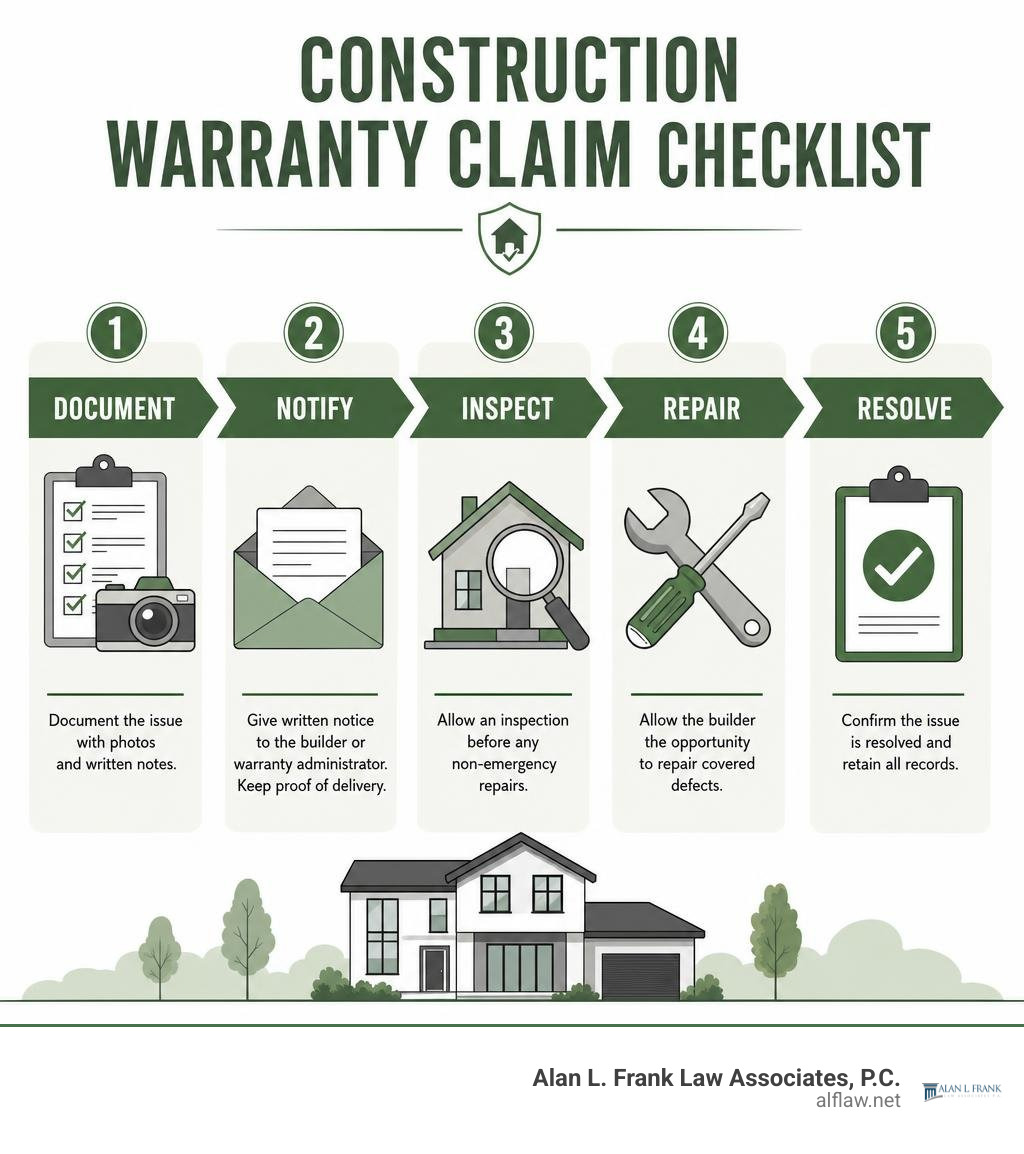
If you find cracking, leaks, faulty systems, or other problems in a new property, act fast. For a warranty claim construction defects matter, document the condition with photos and written notes, review the builder’s warranty, give written notice to the builder or warranty administrator, and avoid non-emergency repairs before an inspection. Keep proof that your notice was delivered.
In Florida, new-home protections may include a one-year mandatory builder warranty for certain material Florida Building Code violations. Private warranties can offer longer periods for workmanship, systems, or major structural failures, but they also often impose strict notice rules, exclusions, repair rights, and arbitration requirements.
A warranty is only valuable if the defect falls within its terms and you follow its claim process. Deadlines can be short, while Florida construction-defect lawsuits generally involve separate limitation and repose deadlines. If litigation is necessary, Chapter 558 normally requires advance written notice and an opportunity for the contractor to inspect and respond before suit.
I am Alan L. Frank, Managing Attorney at Alan L. Frank Law Associates, P.C., with more than 20 years leading complex commercial litigation and high-stakes recovery matters. My experience evaluating financial and property-related disputes helps clients understand the evidence, deadlines, and legal options that can shape warranty claim construction defects cases.
Understanding Express vs. Implied Warranties in New Construction
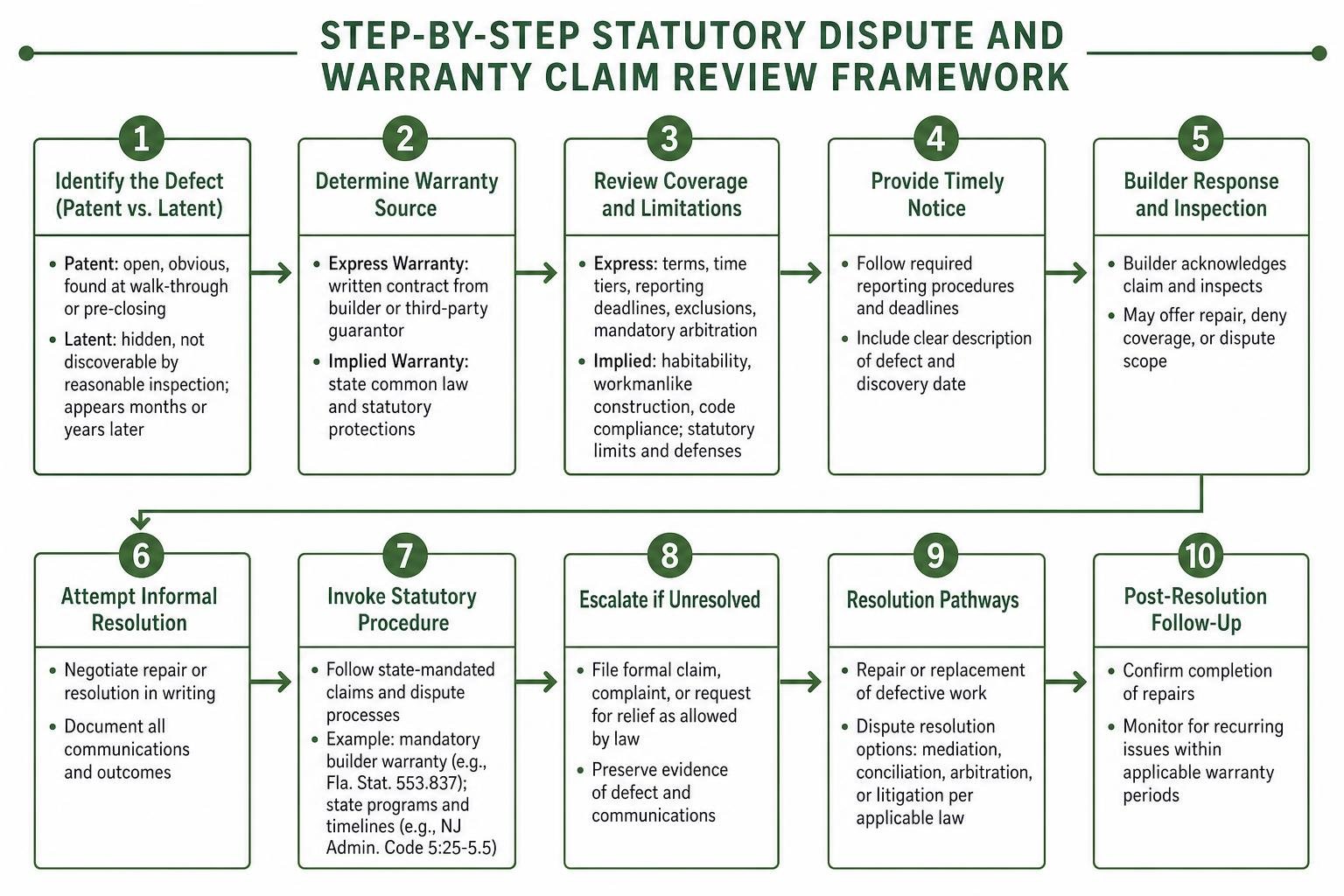
When you close on a newly constructed home, you are handed a stack of paperwork often wrapped in glossy brochures promising total peace of mind. But from a legal standpoint, what guarantees do you actually have? In construction law, warranties break down into two main buckets: express warranties and implied warranties.
An express warranty is an explicit contractual promise made by the builder or an affiliated warranty company. It outlines specific standards, repair obligations, and coverage terms in writing. These documents define what the builder will fix, how long they will cover it, and what procedures you must follow to get them to open their toolbox.
By contrast, implied warranties are created by operation of law rather than written contract. Courts recognize that a homebuyer cannot reasonably see behind freshly painted drywall or underneath a concrete foundation slab. As a result, the law provides an implied warranty of habitability and an implied warranty of workmanlike construction. These legal protections ensure that a residential property is structurally sound, safe to inhabit, and constructed in accordance with standard trade practices—even if the builder never gave you a single sheet of paper promising as much.
Navigating the friction between written contracts and state-mandated protections frequently requires Commercial Litigation experience to ensure builders are held to their fundamental legal obligations.
| Warranty Type | How It Is Established | Key Coverage Focus | Standard Limitations |
|---|---|---|---|
| Express Warranty | Written contract from builder or third-party guarantor | Specific components across defined time tiers (workmanship, systems, structure) | Strict reporting deadlines, detailed exclusions, mandatory arbitration |
| Implied Warranty | State common law and statutory standards | Latent defects, basic habitability, structural integrity, code compliance | Subject to statutory limitation and repose periods; disclaimers heavily litigated |
Latent vs. Patent Failures in a Warranty Claim: Construction Defects Analysis
Understanding the nature of a defect is critical to knowing whether your warranty covers it and when your legal clock starts ticking.
- Patent Defects: These are open, obvious flaws discoverable during a standard walk-through or pre-closing home inspection. Examples include scratched flooring, missing trim, broken window latches, or uneven paint. Patent defects must typically be flagged on your initial punch list before closing.
- Latent Defects: These are hidden, concealed deficiencies that cannot be uncovered through reasonable visual inspection at closing. They manifest months or years down the road. Examples include improperly tied foundation footings, hidden plumbing leaks inside interior walls, unsealed building envelopes leading to internal wood rot, or missing structural roof trusses.
Builders often draft written agreements, such as a formal BUILDERS WARRANTY, that attempt to limit post-closing claims strictly to narrow express terms while disclaiming liability for latent damage. However, state laws and court precedents frequently prevent builders from disclaiming fundamental protections against hidden, serious defects that jeopardize the integrity of your home.
Statutory Baseline Protections Under State Law
Many jurisdictions establish baseline protections that set a statutory floor builders cannot contract around.
For instance, statutory provisions such as Fla. Stat. 553.837 – Mandatory builder warranty mandate that builders warrant newly constructed homes for at least one year against defects in equipment, material, or workmanship resulting in a material violation of the applicable building code. Importantly, this statutory baseline automatically transfers to subsequent purchasers if the home is sold during that initial one-year window.
Similarly, states like New Jersey maintain comprehensive administrative frameworks such as N.J. Admin. Code § 5:25-5.5 – Claims procedure | State Regulations | US Law | LII / Legal Information Institute, which establish strict dispute resolution timelines, builder conciliation, and access to a state-administered warranty security fund when a builder refuses to honor their repair obligations.
The 1-2-10 Tiered Warranty Structure and Common Exclusions
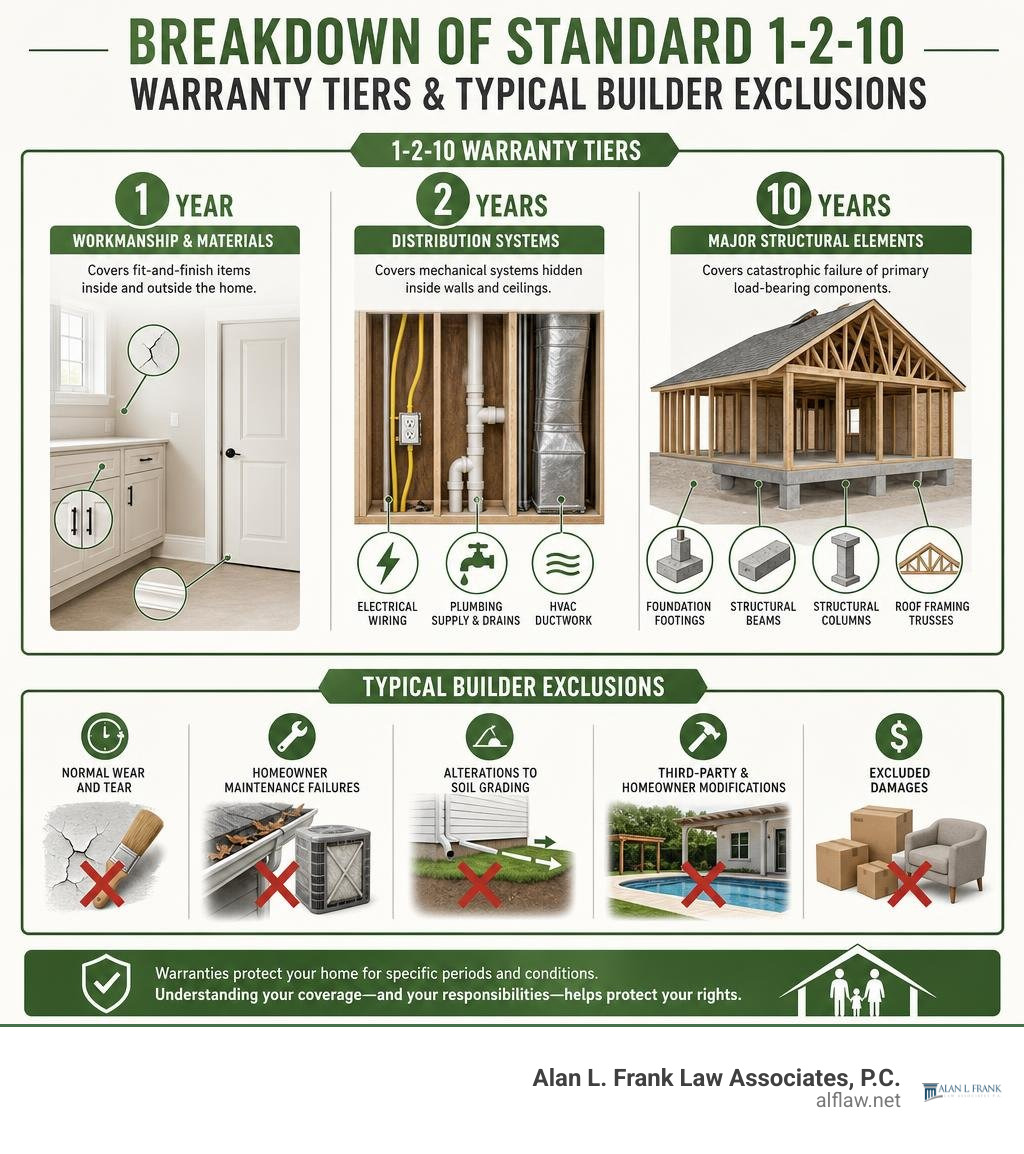
Most modern residential construction warranties follow a standardized “1-2-10” tiered coverage structure. Third-party warranty administrators, such as those detailed in the QUALITY BUILT booklet, break coverage down into distinct phases:
- Year 1 (Workmanship and Materials): Covers fit-and-finish items, including siding, drywall cracking beyond tolerance, cabinet alignment, interior trim, and exterior paint.
- Years 1–2 (Distribution Systems): Covers the mechanical delivery components hidden inside walls and ceilings, including electrical wiring, plumbing supply lines, drain pipes, and HVAC ductwork.
- Years 1–10 (Major Structural Elements): Covers catastrophic failures of primary load-bearing components, such as foundation footings, beams, structural columns, and roof framing trusses.
What Qualifies as a Major Structural Defect?
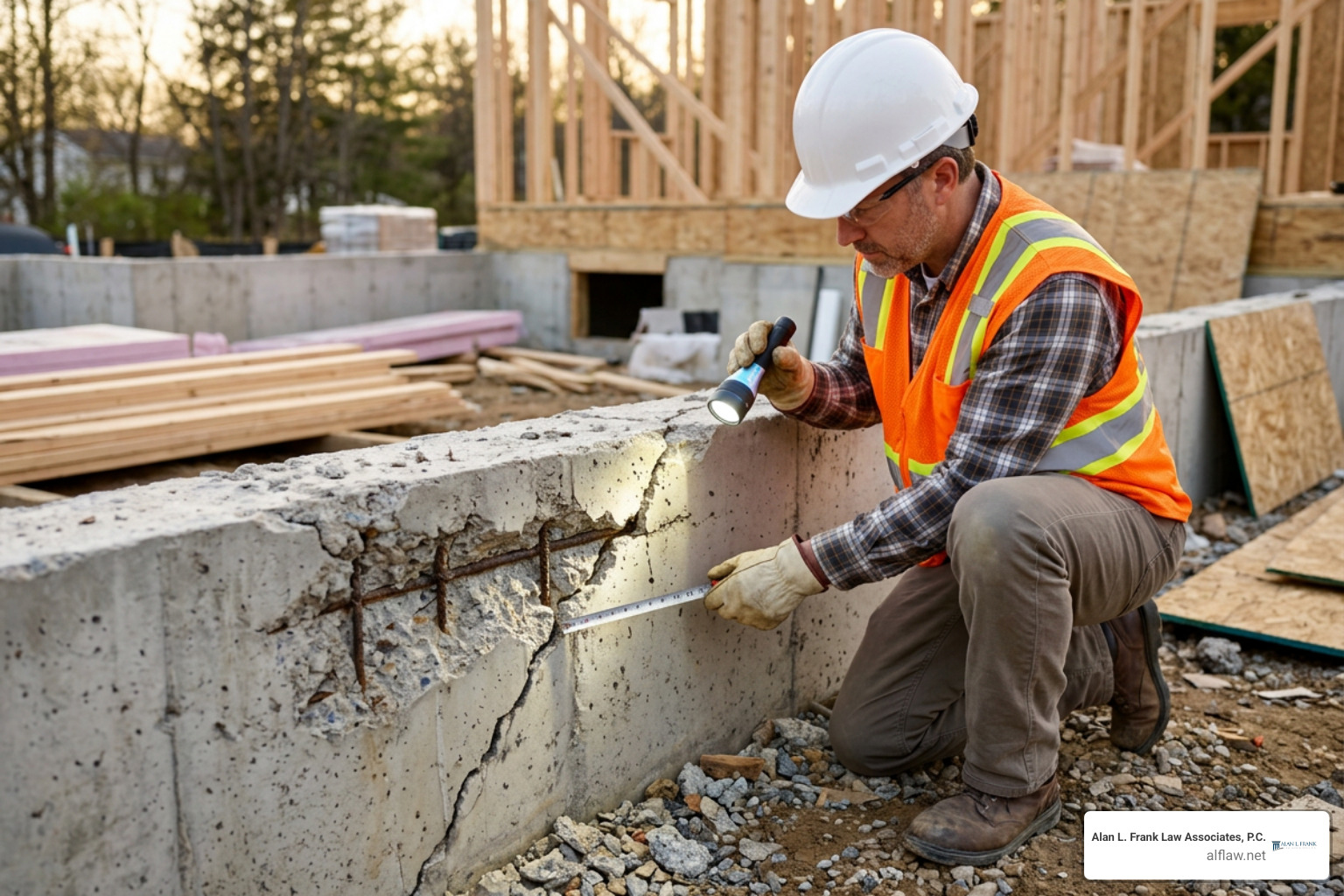
Homeowners are often shocked to learn that not every crack in a foundation qualifies as a covered structural defect under a 10-year policy. Third-party warranty agreements typically impose a stringent, four-part qualification standard:
- Actual Physical Damage: There must be visible, measurable physical failure.
- Designated Load-Bearing Component: The damage must occur in a primary load-bearing element (e.g., footings, foundation walls, structural beams).
- Failure of Load-Bearing Function: The component must have failed to the point that it can no longer support its engineered load.
- Safety or Habitability Threat: The failure must render the home unsafe, unsanitary, or otherwise unlivable.
If your foundation moves and causes hairline cracks in an interior partition wall, the warranty administrator may classify it as non-structural cosmetic settlement. If you are experiencing serious structural movement, our guide on Don’t Let Your Case Crumble Like Your Foundation explains how to document severe structural failures before they compromise your entire property.
Key Exclusions That Can Void a Warranty Claim: Construction Defects Overview
Builder warranty contracts are filled with exclusions designed to shield the builder and their insurer from liability. Comprehensive policy books, like the Pulte National Warranty Book 032720F, list numerous conditions that will result in an immediate claim denial:
- Normal Wear and Tear: Everyday aging, fading of paint, and minor shrinkage of caulking.
- Homeowner Maintenance Failures: Neglecting to clean gutters, failing to service HVAC equipment, or failing to maintain proper soil moisture levels around foundation slabs.
- Alterations to Soil Grading: Changing the landscape grading within 10 feet of your foundation, building unapproved retaining walls, or directing downspouts toward the slab.
- Third-Party and Homeowner Modifications: Installing aftermarket additions, swimming pools, patio slabs, or unpermitted structural alterations.
- Excluded Damages: Express warranties almost universally exclude consequential damages, loss of property use, storage costs, moving expenses, emotional distress, and diminished market value.
How to File a Warranty Claim Construction Defects Notice Under State Law

Filing a warranty claim requires strict adherence to contractual and statutory procedures. Making a casual phone call to your project superintendent does not protect your legal rights. Follow these critical steps to preserve your claim:
- Review the Exact Claim Reporting Deadlines: Many express warranties require notice within 15 to 30 days after a specific coverage tier expires. Missing this window can result in a total waiver of your rights under the policy.
- Submit Formal Written Notice: Send a detailed claim letter via certified mail with return receipt requested or through the warranty company’s designated online portal. Document the defect thoroughly with dates, descriptions, photographs, and independent inspection reports.
- Fulfill Your Mitigation Duties: Homeowners have an affirmative legal duty to mitigate damages. If a pipe bursts or a roof leaks, take immediate temporary steps (e.g., tarping the roof or shutting off the main water valve) to prevent further destruction. Document all emergency repairs and keep every receipt.
- Allow Reasonable Access for Inspections: Builders and warranty insurers are legally entitled to inspect the alleged defect during normal business hours. Unreasonably refusing access can void the builder’s repair obligations.
Pre-Suit Notice and the Statutory Opportunity to Cure
Before a homeowner can initiate a construction defect lawsuit, state statutes generally require a formal pre-suit notice and opportunity to cure. Under statutory frameworks like Florida’s Chapter 558, an owner must provide at least 60 days’ written notice to the contractor, subcontractor, or builder before filing an action in court.
During this 60-day window:
- The contractor has the right to inspect the property and conduct non-destructive testing.
- The contractor can forward the notice to responsible subcontractors and material suppliers.
- The builder must provide a written response offering to repair the defect at no cost, settle the claim for a monetary payment, dispute the claim entirely, or combine repairs and financial compensation.
Understanding these detailed pre-suit mandates across diverse Practice Areas is essential to avoid having your legal complaint stayed or dismissed by the court for procedural non-compliance.
Alternative Dispute Resolution vs. Courtroom Litigation
Almost all builder warranty contracts contain mandatory Alternative Dispute Resolution (ADR) clauses. These provisions typically require homeowners to navigate multiple stages of dispute resolution before ever seeing the inside of a courtroom:
- Conciliation / Informal Review: An informal meeting between the homeowner, builder, and warranty administrator to assess the disputed defect.
- Non-Binding Mediation: A structured negotiation facilitated by a neutral third-party mediator to reach an agreed repair plan.
- Mandatory Binding Arbitration: A formal, binding hearing conducted by an arbitrator (often through the American Arbitration Association) rather than a judge and jury. The arbitrator’s ruling is final and enforceable in court.
In states with regulated warranty programs or specialized builder risk pools, such as those involving Pennsylvania Builder Warranty Insurance, claims that cannot be resolved directly with a defaulting builder may be submitted to dedicated warranty security funds or insurance underwriters for independent claims resolution.
Statutory Deadlines: Statutes of Limitations and Repose
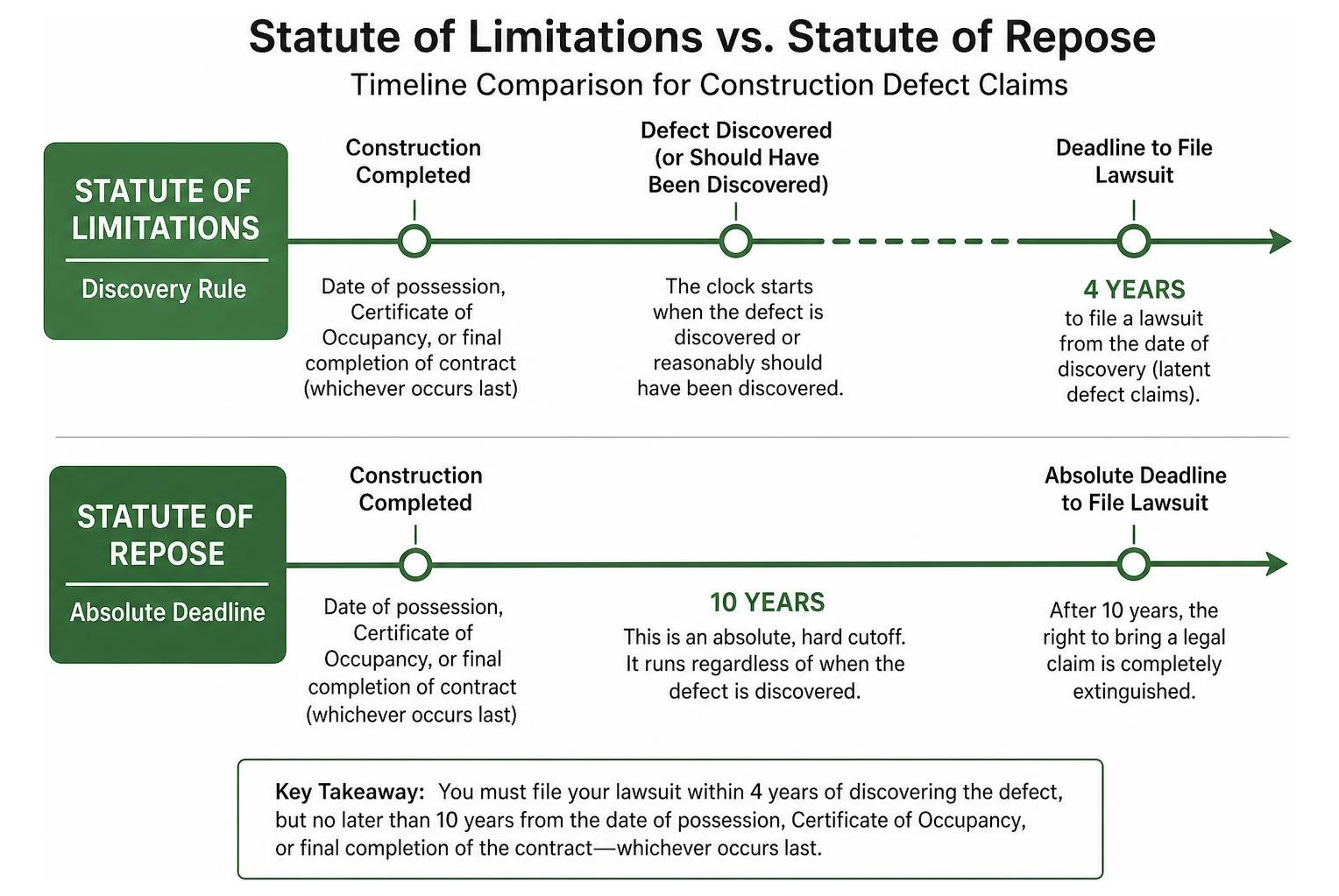
When pursuing legal action beyond an express warranty policy, you must keep two critical legal deadlines in mind: the statute of limitations and the statute of repose.
- Statute of Limitations: This is the deadline to file a lawsuit after you actually discover (or reasonably should have discovered) the construction defect. For latent defect claims, statutory frameworks (such as Florida Section 95.11(3)(c)) typically enforce a 4-year statute of limitations starting from the date the latent defect is uncovered.
- Statute of Repose: This serves as an absolute, hard cutoff date for filing a defect lawsuit, regardless of when you discovered the problem. In most jurisdictions, the statute of repose runs for 10 years from the date of actual possession, the issuance of the Certificate of Occupancy, or the date of final completion of the contract—whichever occurs last.
Once the 10-year statute of repose expires, your right to bring a legal claim against the builder is completely extinguished, even if a latent structural defect only becomes visible in year eleven.
Frequently Asked Questions About Construction Defect Warranties
Does a builder warranty transfer if I buy a home within the first year?
Yes. Under statutory frameworks like Florida Statute § 553.837, the mandatory one-year builder warranty automatically transfers to subsequent purchasers if the property is conveyed within that first year. For multi-year express warranties (such as 10-year structural plans), coverage typically transfers to subsequent owners as well, though you may need to file a formal change-of-ownership registration form with the third-party warranty administrator.
What should I do if the builder refuses to honor the warranty?
If a builder drags their feet, denies a valid claim, or offers superficial cosmetic patches instead of structural repairs:
- Hire an independent structural engineer or licensed contractor to conduct an unbiased inspection and provide a detailed forensic report.
- Preserve all written communications, inspection logs, and photos of the defect.
- Consult an experienced construction defect attorney to issue formal statutory pre-suit notices, demand arbitration, or pursue civil litigation.
Can a builder’s express warranty take away my statutory rights?
Generally, no. While builders frequently insert broad disclaimer clauses stating that their written warranty supersedes all other express or implied warranties, courts strictly regulate these provisions. A builder cannot contract around statutory baselines established by state law or building codes. If an express warranty provides fewer protections than statutory minimums or violates public policy, those disclaimer clauses can often be challenged and invalidated in court.
Conclusion
A home is one of the largest financial investments you will ever make. When serious construction defects arise, you should not have to accept builder delays, evasive warranty representatives, or cosmetic band-aids on major structural failures. Understanding your legal rights under both your written warranty agreement and state statutory law is the key to protecting your home’s safety, longevity, and market value.
At Alan L. Frank Law Associates, P.C., we provide thorough legal evaluations, strategic pre-suit advocacy, and aggressive courtroom representation to ensure homeowners receive the repair remedies and financial recoveries they deserve.
For more answers to complex building and property dispute questions, explore our FAQs Housing and Construction Defects resource center or reach out to our legal team today to review your claim.