
Pennsylvania FMLA Maternity Leave Explained for Growing Families


Pennsylvania FMLA Maternity Leave Explained for Growing Families
Pennsylvania FMLA Maternity Leave: What Rights Do You Have?
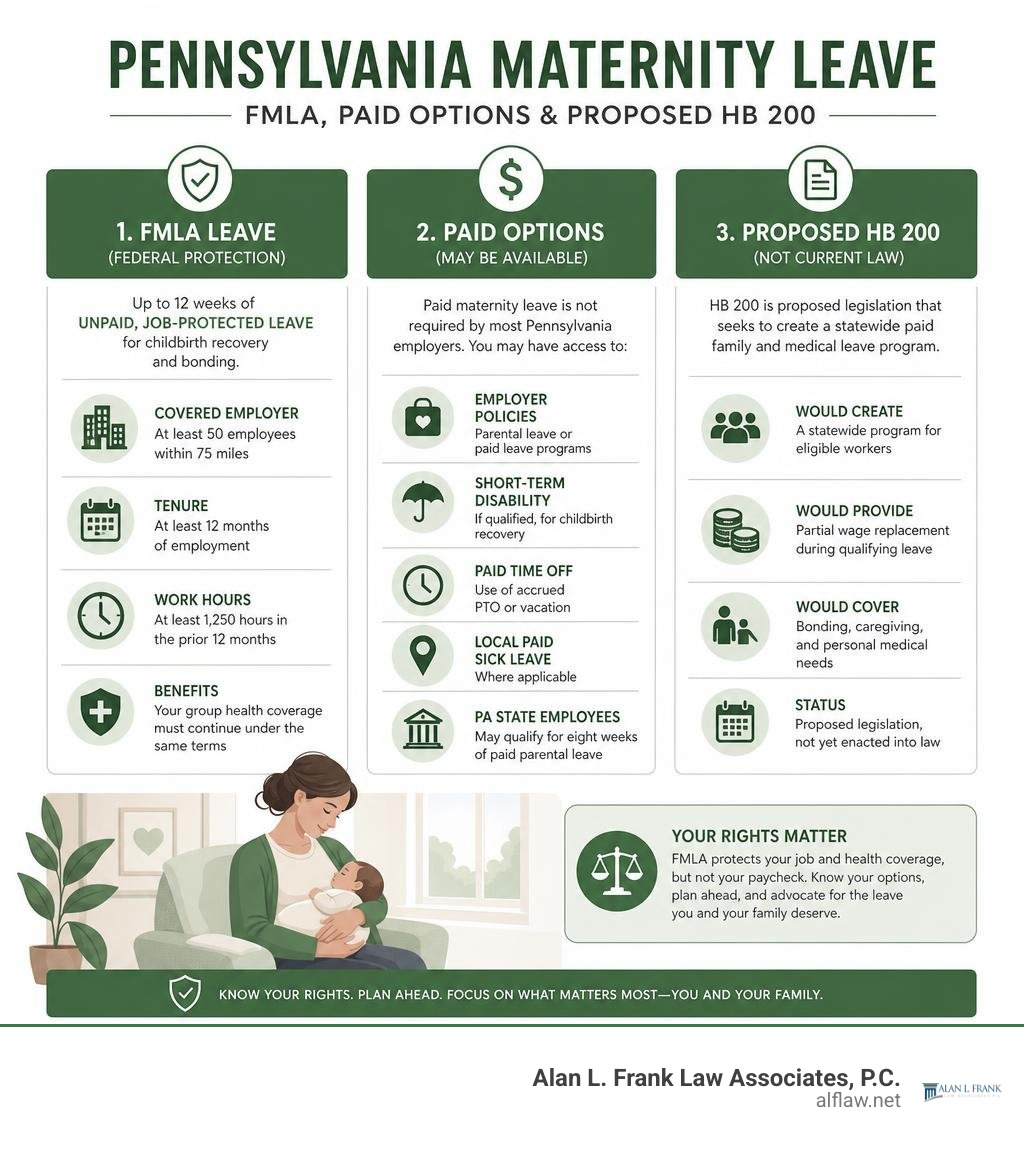
Pennsylvania does not require most private employers to provide paid maternity leave. For eligible workers, the main protection is the federal Family and Medical Leave Act (FMLA): up to 12 weeks of unpaid, job-protected leave for childbirth recovery and bonding with a new child.
To qualify for Pennsylvania FMLA maternity leave, you generally must:
- Work for a covered employer with at least 50 employees within 75 miles of your worksite.
- Have worked for that employer for at least 12 months.
- Have completed at least 1,250 work hours in the prior 12 months.
FMLA can protect your job and continued group health coverage, but it does not replace your paycheck. Paid time may be available through an employer’s parental-leave policy, short-term disability coverage, accrued PTO, or limited local paid sick leave rules. Pennsylvania state employees may qualify for eight weeks of paid parental leave, while broader paid-leave proposals, including HB 200, remain proposed legislation rather than current statewide law.
I am Alan L. Frank, Managing Attorney at Alan L. Frank Law Associates, P.C., with more than 20 years of legal experience handling complex disputes and wrongful-employer-action matters. This guide explains the rules behind Pennsylvania FMLA maternity leave, how other protections may apply, and what to do when an employer denies or interferes with valid leave.
Understanding Pennsylvania FMLA Maternity Leave and Federal Rights
Navigating family expansion while balancing your career can feel overwhelming. When preparing for childbirth or adoption in the Commonwealth, understanding your core legal rights is vital. Under the federal framework, the Family and Medical Leave Act provides up to 12 workweeks of unpaid, job-protected leave per 12-month period.
The cornerstone of the FMLA is job restoration. When you return from leave, your employer must reinstate you to your original position or an equivalent role with identical pay, benefits, responsibilities, and working conditions. Furthermore, your employer must maintain your group health insurance under the exact terms you had prior to taking leave.
However, federal FMLA does not apply to every workplace. An employer is covered only if they employ 50 or more workers within a 75-mile radius of the employee’s work location. Nationwide, only about 56% of workers qualify for FMLA coverage, leaving many employees at smaller companies to navigate separate state and federal statutory frameworks. When an employer refuses to honor these statutory guarantees, pursuing FMLA litigation can help enforce your workplace rights and recover financial losses.
| Statute / Policy | Employer Threshold | Primary Employee Benefit | Paid or Unpaid? |
|---|---|---|---|
| Federal FMLA | 50+ employees within 75 miles | 12 weeks of job-protected bonding and medical leave | Unpaid |
| Pregnant Workers Fairness Act (PWFA) | 15+ employees | Reasonable accommodations for pregnancy, childbirth, and recovery | Job accommodation / Unpaid leave |
| PA Human Relations Act (PHRA) | 4+ employees | Anti-discrimination; equal treatment compared to temporary disabilities | Unpaid (unless employer pays for other medical leaves) |
| PUMP Act | All covered employers (narrow small-business exemptions) | Reasonable break time and private, non-bathroom lactation space | Break time rules apply |
Eligibility Criteria for Pennsylvania FMLA Maternity Leave
To determine if you qualify for statutory protection under federal rules, you must meet three distinct criteria established by the Department of Labor:
- Length of Employment: You must have worked for your employer for a minimum of 12 months. These months do not need to be consecutive, provided any break in service does not exceed seven years.
- Hours Worked: You must have accumulated at least 1,250 actual hours of service during the 12-month period immediately preceding the start of your leave.
- Employer Headcount: Your company must employ 50 or more personnel within 75 miles of your primary reporting worksite.
Qualifying events include the birth of a newborn child, placement of an adopted child or foster child, prenatal medical appointments, and medical complications arising from pregnancy or physical recovery from childbirth.
There is an important statutory nuance regarding married couples: if both spouses work for the same employer, the employer may restrict them to a shared, combined total of 12 workweeks of FMLA leave for new child bonding. However, this limitation applies strictly to bonding time; medical recovery from childbirth is treated as the birth mother’s personal serious health condition and draws from her individual 12-week medical allowance.
Intermittent Options and Pennsylvania FMLA Maternity Leave Rules
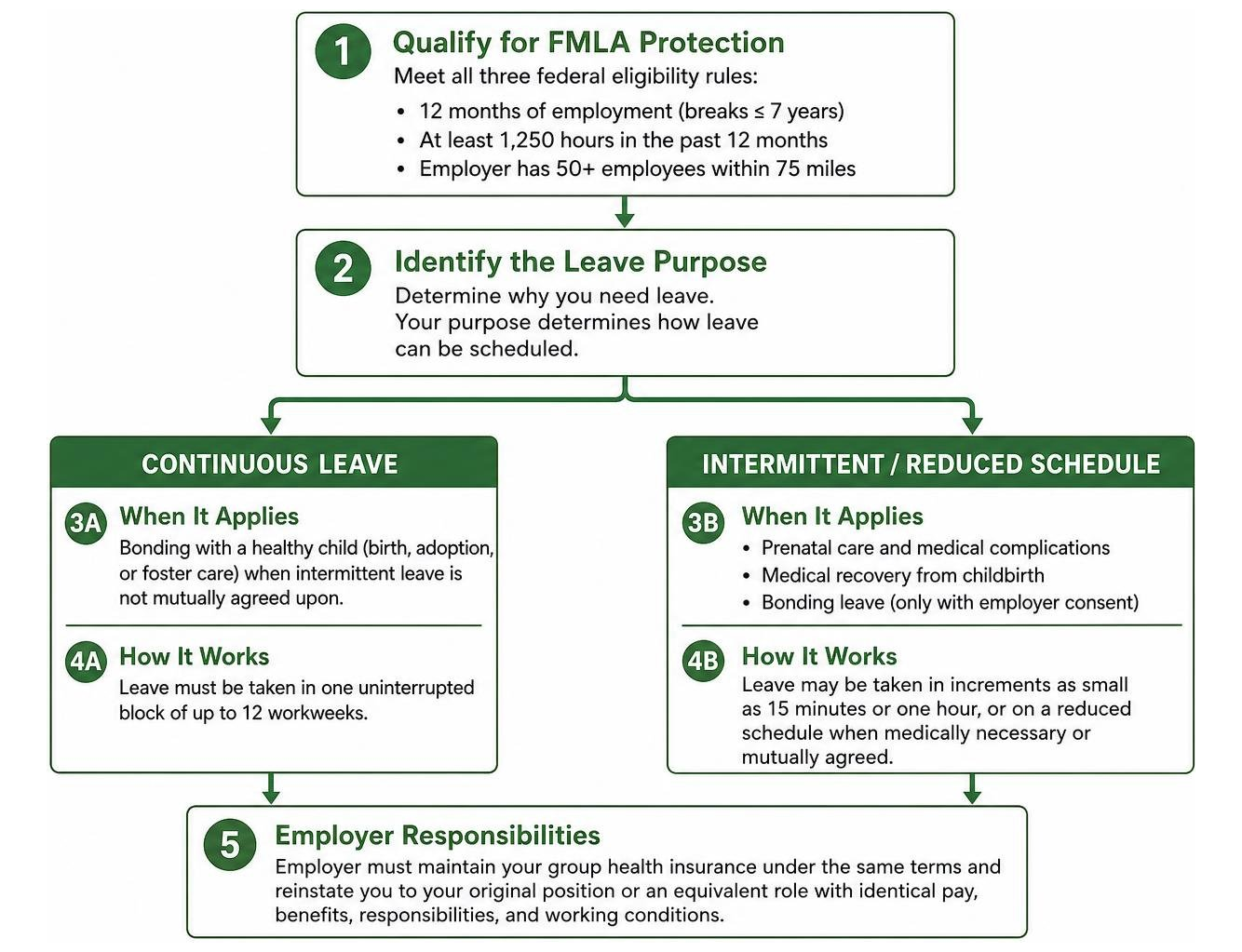
Leave does not always need to be taken in a single, continuous block. The FMLA allows for intermittent leave or a reduced schedule when medically necessary.
- Prenatal Care and Medical Complications: If you suffer from severe morning sickness, gestational diabetes, or require regular prenatal doctor appointments, you can take intermittent FMLA leave in increments as small as 15 minutes or one hour (depending on how your employer tracks payroll intervals).
- Postpartum Bonding: Unlike leave taken for a serious medical condition, intermittent leave taken purely for bonding with a healthy newborn, adopted child, or foster child requires mutual employer consent. Unless your employer agrees to a part-time bonding schedule, bonding leave must be taken in one uninterrupted block.
State and Local Protections for Expectant Parents in Pennsylvania

Because Pennsylvania does not operate a universal paid family leave program for private-sector workers, expectant parents must understand how state anti-discrimination statutes and federal accommodations complement the FMLA.
The Pennsylvania Human Relations Act (PHRA) applies to employers with four or more workers across the Commonwealth. The PHRA prohibits pregnancy discrimination by requiring employers to treat pregnancy-related medical conditions the same as any other temporary physical disability. If an employer offers modified duties or short-term medical leave to a worker recovering from a broken limb or surgery, they cannot deny comparable leave or duty adjustments to a pregnant worker.
At the federal level, the Pregnant Workers Fairness Act (PWFA) applies to employers with 15 or more employees. It requires employers to provide reasonable accommodations for pregnancy, childbirth, and related medical conditions—such as light duty, seating, water access, or additional bathroom breaks—unless doing so imposes an undue hardship. Crucially, employers cannot force a pregnant employee onto unpaid leave if a workable on-the-job accommodation exists.
Additionally, the PUMP Act guarantees nursing parents reasonable break times and a private space (shielded from view and distinct from a bathroom) to pump breast milk during work hours for up to one year following a child’s birth. Municipal rules reinforce these rights: employers within Philadelphia city limits must follow specific municipal requirements, including posting the City of Philadelphia pregnancy leave notice requirements.
Commonwealth State Employee Paid Parental Leave
While private-sector workers rely primarily on unpaid statutory leaves, public servants employed by the Commonwealth of Pennsylvania receive dedicated paid benefits.
According to the official Commonwealth Paid Parental Leave Resource Guide, eligible state employees qualify for up to eight weeks (300 hours for 37.5-hour schedules or 320 hours for 40-hour schedules) of fully paid parental leave for qualifying births, adoptions, or foster placements occurring on or after February 15, 2024.
Key administrative rules for Commonwealth employees include:
- Eligibility requires 12 continuous months of service and 1,250 hours worked (900 hours for permanent part-time workers) in the preceding 12 months.
- The paid parental leave allocation runs concurrently with federal FMLA leave entitlements.
- Leave quota must be utilized within 180 calendar days (six months) of the qualifying event, after which unused hours expire.
- Paid parental leave absences maintain seniority and standard leave accruals, though employees should review specific State Employees’ Retirement System (SERS) rules regarding non-retirement covered hours.
Municipal and Employer-Sponsored Wage Replacement
For private-sector employees seeking income replacement while on maternity leave, benefits generally depend on municipal ordinances or private employer policies:
- Municipal Paid Sick Leave: Both the City of Philadelphia and Allegheny County enforce local paid sick leave ordinances. In Philadelphia, eligible employees at companies with 10 or more workers accrue up to 40 hours of paid sick leave annually, which can be applied toward prenatal care appointments or used alongside FMLA time off.
- Short-Term Disability (STD) Insurance: Many private employers offer employer-paid or voluntary STD policies. These plans typically replace 50% to 70% of pre-leave wages for a recovery period of six weeks following a standard vaginal delivery or eight weeks following a cesarean section, usually subject to a 7- to 14-day elimination waiting period.
- Accrued Paid Time Off (PTO): Employees can elect (or employers may require) the substitution of accrued paid vacation, personal, or sick days to receive regular pay during an otherwise unpaid FMLA leave period.
Proposed Pennsylvania Paid Family Leave: HB 200 and Senate Initiatives

Over four million workers across Pennsylvania currently lack access to comprehensive paid family leave. Public support remains strong: polling from the PA Department of Labor and Industry indicates that 78% of Pennsylvanians, including 56% of employers, support establishing a statewide paid family and medical leave program.
In response, state lawmakers have introduced bipartisan legislation aimed at modernizing worker protections. The primary legislative vehicle in the House is the Family Care Act, detailed in Pennsylvania House Bill 200.
HB 200 seeks to create a state-administered Family and Medical Leave Fund overseen by the Department of Labor and Industry. Rather than imposing direct benefit payout costs onto employers, the program is structured around a modest employee payroll deduction capped at no more than 1% of gross wages.
Comparing HB 200 and SB 580 Frameworks
Legislative efforts in the Pennsylvania General Assembly include complementary proposals between the House and Senate chambers. Both HB 200 and Senate Bill 580 offer substantial expansions over federal FMLA baselines:
- Leave Duration: Under proposed state frameworks, eligible parents could receive up to 20 weeks of paid leave per application year for childbirth recovery, pregnancy conditions, or bonding with a new child. Family caregiving leave to care for a seriously ill relative or manage qualifying family emergencies would provide up to 12 weeks of paid benefits.
- Expanded Eligibility Standards: Unlike the restrictive 50-employee threshold under federal FMLA, the state proposals cover employees who have worked at least 18 weeks and earned a minimum of $2,718 in Pennsylvania during the preceding 12 months.
- Broad Family Inclusivity: The proposed bills expand family definitions to include domestic partners, grandparents, grandchildren, siblings, and individuals with a mutual expectation of care.
- Independent Workers: Sole proprietors and self-employed individuals could elect into the state leave system.
Economic and Health Impacts for Families and Employers
Research shows that establishing structured paid family leave yields substantial benefits for both households and businesses:
- Maternal and Infant Health: Access to 12 or more weeks of paid leave correlates directly with lower rates of postpartum depression, higher rates of infant immunization, and extended breastfeeding duration.
- Worker Retention: Companies offering paid leave experience significantly lower employee turnover, reducing the substantial recruitment and training costs associated with replacing experienced personnel.
- Small Business Equity: A state-administered risk pool allows smaller enterprises to offer competitive family leave benefits without carrying the entire direct wage liability on their own balance sheets.
How to Request Leave, Coordinate Benefits, and Protect Your Job
Taking maternity leave requires proactive planning and clear, documented communication with your employer’s human resources department.
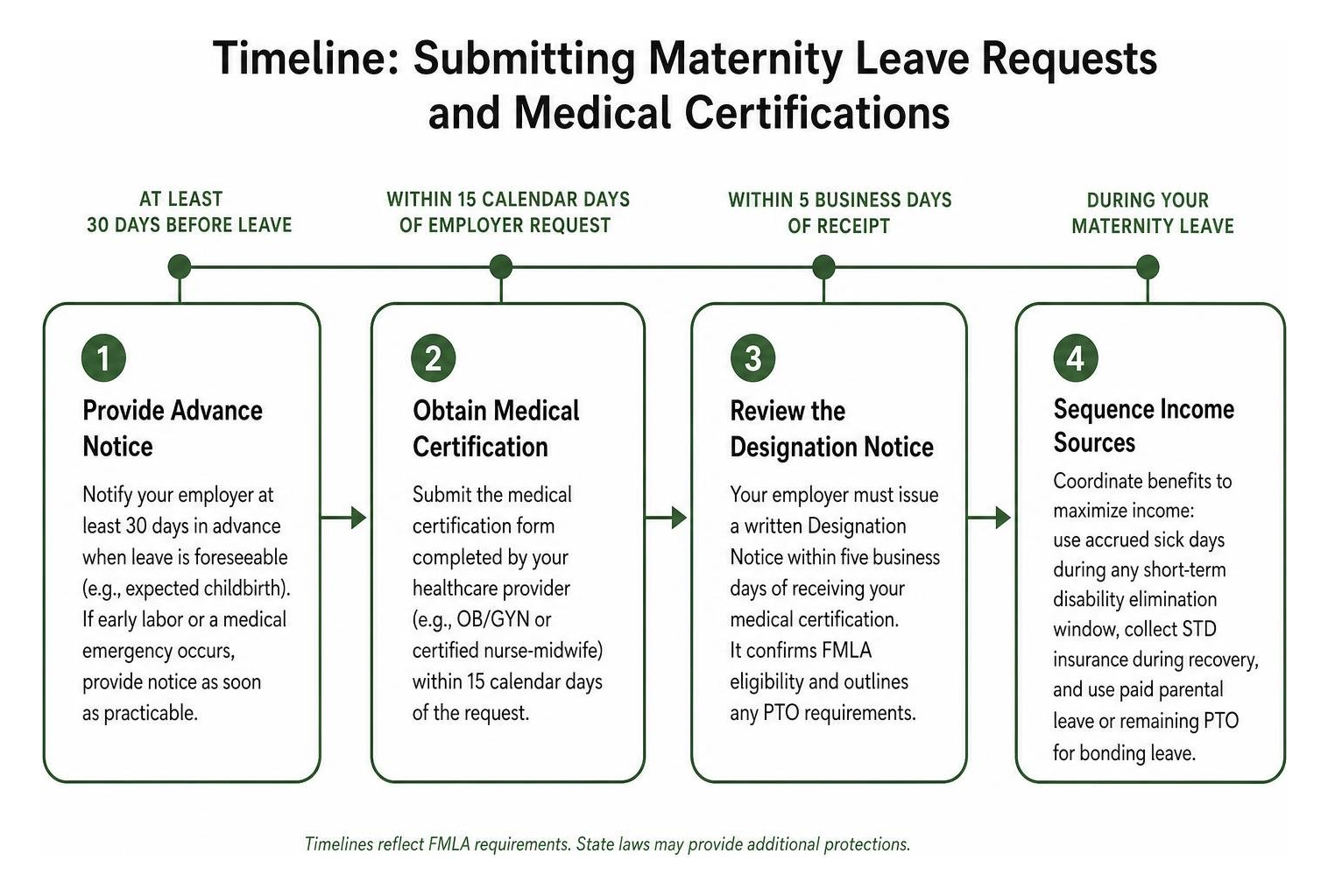
- Provide Timely Advance Notice: Under FMLA rules, you must provide your employer with at least 30 days’ advance notice when the need for leave is foreseeable (such as an expected childbirth date). If labor occurs early or a medical emergency arises, notice must be given as soon as practicable.
- Obtain Medical Certification: Your employer may require you to submit an official medical certification form completed by your healthcare provider (such as an OB/GYN or certified nurse-midwife). Under federal law, you have 15 calendar days to provide this documentation once requested.
- Review the Designation Notice: Within five business days of receiving your medical certification, your employer must issue a written Designation Notice confirming whether your leave qualifies under the FMLA and outlining any requirements to use accrued PTO.
- Sequence Income Sources Methodically: To maximize income, coordinate your benefits sequentially: use accrued sick days during any short-term disability elimination window, collect STD insurance during your medical recovery period, and utilize employer paid parental leave or remaining PTO for the rest of your bonding leave.
For broader analysis of workplace rights, you can consult our employment law blog for ongoing coverage of employee protections.
Recognizing FMLA Violations and Retaliation
Federal and state laws strictly prohibit employers from interfering with, restraining, or denying your right to exercise family and medical leave. Common unlawful practices include:
- Pressuring an expectant parent to delay necessary leave or perform work tasks while on approved leave.
- Counting approved FMLA absences against an employee under “no-fault” attendance policies.
- Refusing to restore an employee to their prior position or transferring them to a downgraded role with less pay, diminished title, or unfavorable shift schedules.
- Canceling group health coverage during leave without proper notice.
- Retaliating against an employee through disciplinary write-ups, negative performance evaluations, or wrongful termination after they request or take leave.
If your employer violates your statutory rights or retaliates against you for taking leave, our experienced legal team can evaluate your circumstances, preserve crucial workplace evidence, and pursue appropriate legal remedies.
Frequently Asked Questions About Maternity Leave in Pennsylvania
Does Pennsylvania provide state-mandated paid maternity leave?
No. Pennsylvania does not currently have a mandatory, statewide paid family leave program for private-sector workers. Private employees must rely on unpaid job protection under the federal FMLA, local paid sick leave ordinances (such as those in Philadelphia or Allegheny County), employer-provided parental benefits, or short-term disability insurance policies. Commonwealth state government employees, however, receive eight weeks of paid parental leave.
Can both parents take full leave if they work for the same employer in PA?
Under current federal FMLA regulations, if a legally married couple works for the exact same employer, the employer may limit them to a combined total of 12 workweeks of leave for bonding with a newborn or newly adopted child. However, any leave taken by the birth mother for medical recovery from pregnancy or childbirth counts as personal medical leave and is not restricted by this shared bonding limitation.
What should you do if an employer denies valid maternity leave in Pennsylvania?
If an employer improperly denies your leave request, follow these steps immediately:
- Request the formal denial and underlying reasoning in writing from your HR department.
- Maintain a personal log containing copies of all leave applications, doctor certifications, emails, and performance evaluations.
- File an inquiry or complaint with the U.S. Department of Labor’s Wage and Hour Division or the Pennsylvania Human Relations Commission (PHRC) where applicable.
- Contact an experienced employment law attorney to protect your career, assert your rights, and seek monetary damages for lost compensation or wrongful termination.
Conclusion
Planning for a new child should be a time of celebration, not legal distress or career uncertainty. While Pennsylvania workers continue to rely on the federal FMLA as the baseline for job-protected maternity leave, knowing your exact coverage thresholds, sequencing wage-replacement options, and asserting your workplace rights ensures you can focus on your growing family.
When employers fail to comply with federal or state leave laws—whether through improper denials, discriminatory actions, or retaliatory terminations—legal intervention is essential. At Alan L. Frank Law Associates, P.C., we provide seasoned counsel and vigorous FMLA litigation representation across Pennsylvania and New Jersey to hold non-compliant employers accountable. If your family leave rights have been violated, reach out to our office to schedule a confidential legal consultation.