
Take Immediate Legal Action Against Negligent Financial Advisors


Take Immediate Legal Action Against Negligent Financial Advisors
How to Find an Investment Loss Attorney Near Me
If you’re searching for an investment loss attorney near me, save your account statements, trade confirmations, and messages with your advisor first. Then look for a lawyer with experience in securities disputes and FINRA arbitration. Ask whether your losses may involve unauthorized trades, hidden risks, or investments that did not fit your goals. Discuss fees and filing deadlines before you decide what to do next.
A loss alone does not mean your advisor did something wrong. But if you suspect misconduct, getting advice early can help you preserve evidence and understand your options.
I’m Alan L. Frank, managing attorney at Alan L. Frank Law Associates, P.C., and a CPA with more than 20 years leading the firm. If you’re looking for an investment loss attorney near me, my experience with investment loss and securities disputes nationwide can help you know what to ask before pursuing a claim.
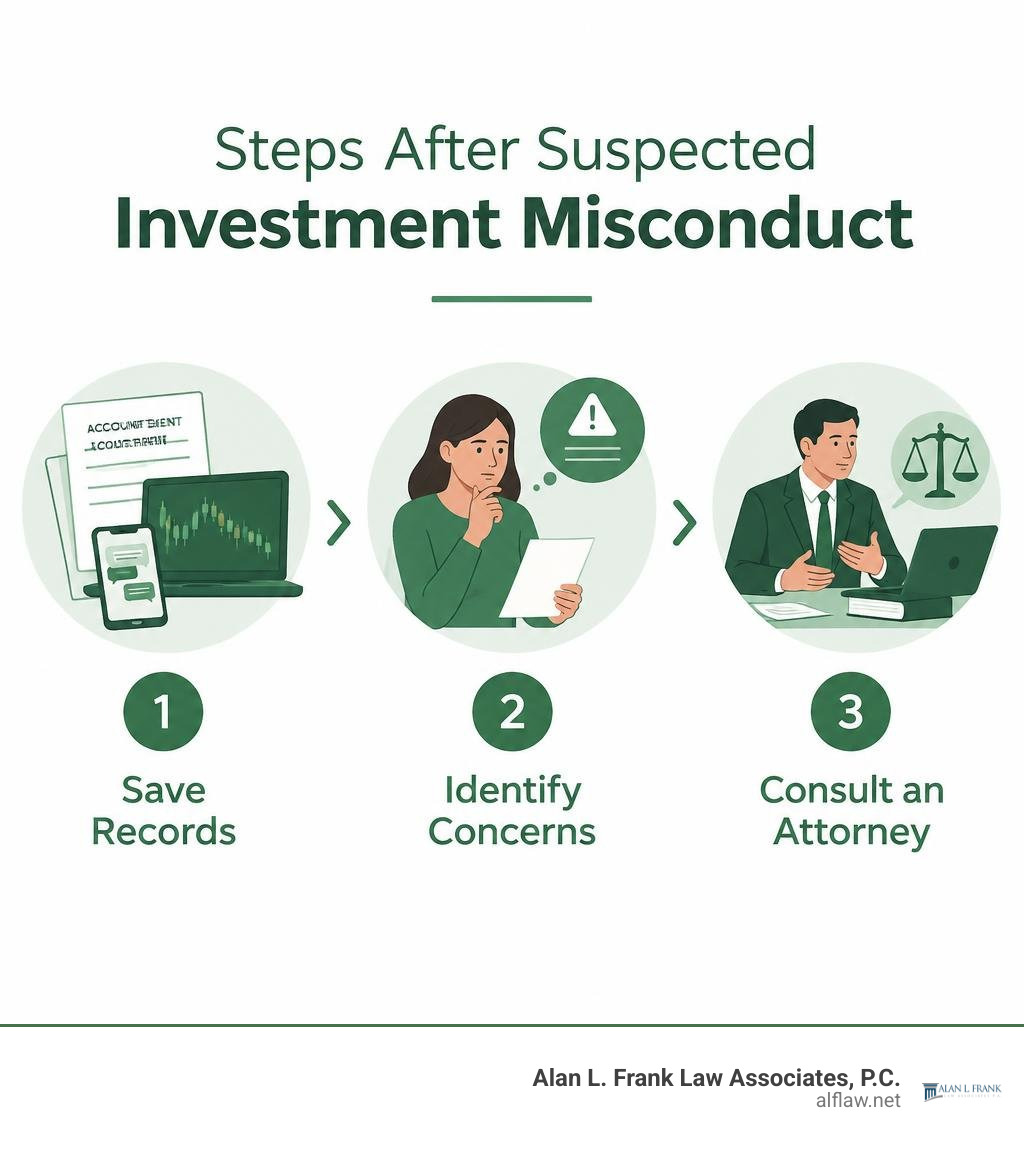
Key investment loss attorney near me vocabulary:
Understanding Broker Misconduct and Grounds for Legal Action

When stock markets dip, every portfolio experiences volatility. However, market downturns are fundamentally different from financial harm caused by bad advice, negligence, or deliberate deceit. Financial advisors and registered broker-dealers carry strict legal and professional responsibilities to act in their clients’ best interests. When they breach these duties, affected investors have legal options.
According to a study by the Securities and Exchange Commission (SEC), approximately 7% of U.S. households have experienced investment losses resulting from fraud or advisor misconduct. Despite the prevalence of these abuses, many victims simply assume their losses were unavoidable market swings.
To take effective action, you must distinguish between an honest drop in share price and unlawful broker conduct. Regulators and courts look at specific prohibited actions, such as:
- Breach of Fiduciary Duty: Failing to place the client’s financial wellbeing above the advisor’s personal commissions or firm incentives.
- Unauthorized Trading: Buying or selling securities without the investor’s prior knowledge or explicit consent (unless discretionary authority was lawfully granted in writing).
- Failure to Supervise: Brokerage firms neglecting their legal obligation to oversee advisors, allowing predatory practices to go unchecked.
- Theft and Conversion: Outright misappropriation of customer funds for personal use or unauthorized ventures.
When pursuing these claims, navigating investment loss litigation without getting burned twice requires a clear understanding of the evidence needed to prove your broker crossed the line from poor market timing into actionable negligence. Investors can also consult guidance from official regulatory channels, including the Legitimate Avenues for Recovery of Investment Losses | FINRA.org resource, to see how regulatory frameworks enforce these broker standards.
Unsuitable Investments, Churning, and Misrepresentation
Two of the most frequent grounds for legal claims against advisors involve suitability violations and excessive account trading:
- Unsuitability Violations: Financial advisors must follow regulatory suitability rules (including the SEC’s Regulation Best Interest). Before recommending a stock, bond, or fund, a broker must evaluate your age, income, tax status, investment objectives, and tolerance for risk. Placing a retiree’s life savings into high-risk leveraged exchange-traded funds or volatile derivatives directly violates these standards.
- Churning and Excessive Trading: Advisors paid on commission have a perverse incentive to buy and sell constantly. Churning occurs when a broker conducts frequent, unnecessary trades primarily to generate commissions for themselves rather than returns for you.
- Misrepresentation and Material Omissions: Brokers cannot downplay risks, omit essential details about liquidity restrictions, or guarantee returns on speculative products.
Understanding these nuances is why smart investors trust stock fraud attorneys to reclaim stolen capital rather than accepting their advisor’s excuses at face value.
Complex Investment Disputes and Ponzi Schemes
Broker misconduct often extends into non-traditional and illiquid financial vehicles. Because alternative investments frequently offer higher commissions to selling agents, advisors may push them onto clients without revealing structural dangers.
For instance, investors frequently encounter hedge fund headaches your guide to investor disputes when managers deploy unannounced leverage or lock up redemption windows during market stress. Similarly, bad actors run high yield investment scams unmasking modern ponzi schemes and fake funds that promise steady double-digit returns while using new capital to pay off early participants.
In other cases, brokers improperly solicit private placements (Regulation D offerings) without conducting adequate due diligence on the underlying issuer. Discovering how a private placement fraud attorney holds dishonest issuers accountable gives defrauded individuals a realistic path toward recovering principal from both the issuers and the brokerage firms that endorsed them.
How to Find a Qualified Investment Loss Attorney Near Me
A survey by the North American Securities Administrators Association (NASAA) found that 1 in 5 investors who suffered losses from broker misconduct never sought legal help, often simply because they did not know how to find a qualified attorney. Google search data shows that online queries for local securities representation have climbed over 40% year-over-year, reflecting how important it has become to secure knowledgeable, accessible counsel.
When your life savings are on the line, selecting general civil litigation counsel is rarely enough. Securities law is a specialized field governed by federal statutes, state “Blue Sky” laws, and Financial Industry Regulatory Authority (FINRA) arbitration rules. Knowing that securities losses demand the right investment fraud attorneys near me helps you focus your search on firms with specific experience in financial arbitration and regulatory forums across Pennsylvania, New Jersey, and nationwide.
Key Qualifications to Demand in an Investment Loss Attorney Near Me
When vetting potential legal representation for a financial recovery case, look for specific credentials and procedural track records:
- Extensive FINRA Arbitration Experience: Because nearly all brokerage account agreements include mandatory arbitration clauses, your lawyer should spend significant time trying cases before FINRA panels rather than just handling standard courtroom trials.
- Demonstrated Track Record in Complex Securities Litigation: Look for multi-million dollar recoveries and experience taking on major Wall Street brokerage houses, independent registered investment advisors (RIAs), and deceptive issuers.
- Financial and Accounting Insight: Attorneys with dual credentials—such as background in CPA accounting or forensic finance—can dissect complex brokerage statements, calculate net out-of-pocket losses, and quantify “well-managed portfolio” benchmarks far more effectively.
- Impeccable Standing with State Bar Associations: Verify that the attorney has active licenses and an unblemished record with the state bars where they practice, such as Pennsylvania or New Jersey.
Essential Questions to Ask During Your Initial Case Evaluation
Your initial consultation should be a rigorous two-way assessment. Use these essential questions to evaluate the attorney’s qualifications:
- What is your assessment of my claim’s legal viability under FINRA or state securities rules?
- How many FINRA arbitration cases or securities lawsuits have you taken to a final award or verdict?
- Do you handle these claims on a contingency fee basis, and what out-of-pocket expenses am I responsible for?
- Who in your office will manage my file on a day-to-day basis, and how often will I receive updates?
- Are there any conflicts of interest between your firm and the brokerage house involved?
The Legal Process: From FINRA Arbitration to Financial Recovery

Unlike standard personal injury or contract disputes that head straight to county or federal courthouses, most investor-broker disputes proceed through FINRA Dispute Resolution Services. When you open a brokerage account, the fine print almost always contains a pre-dispute arbitration agreement.
The recovery process follows a structured timeline:
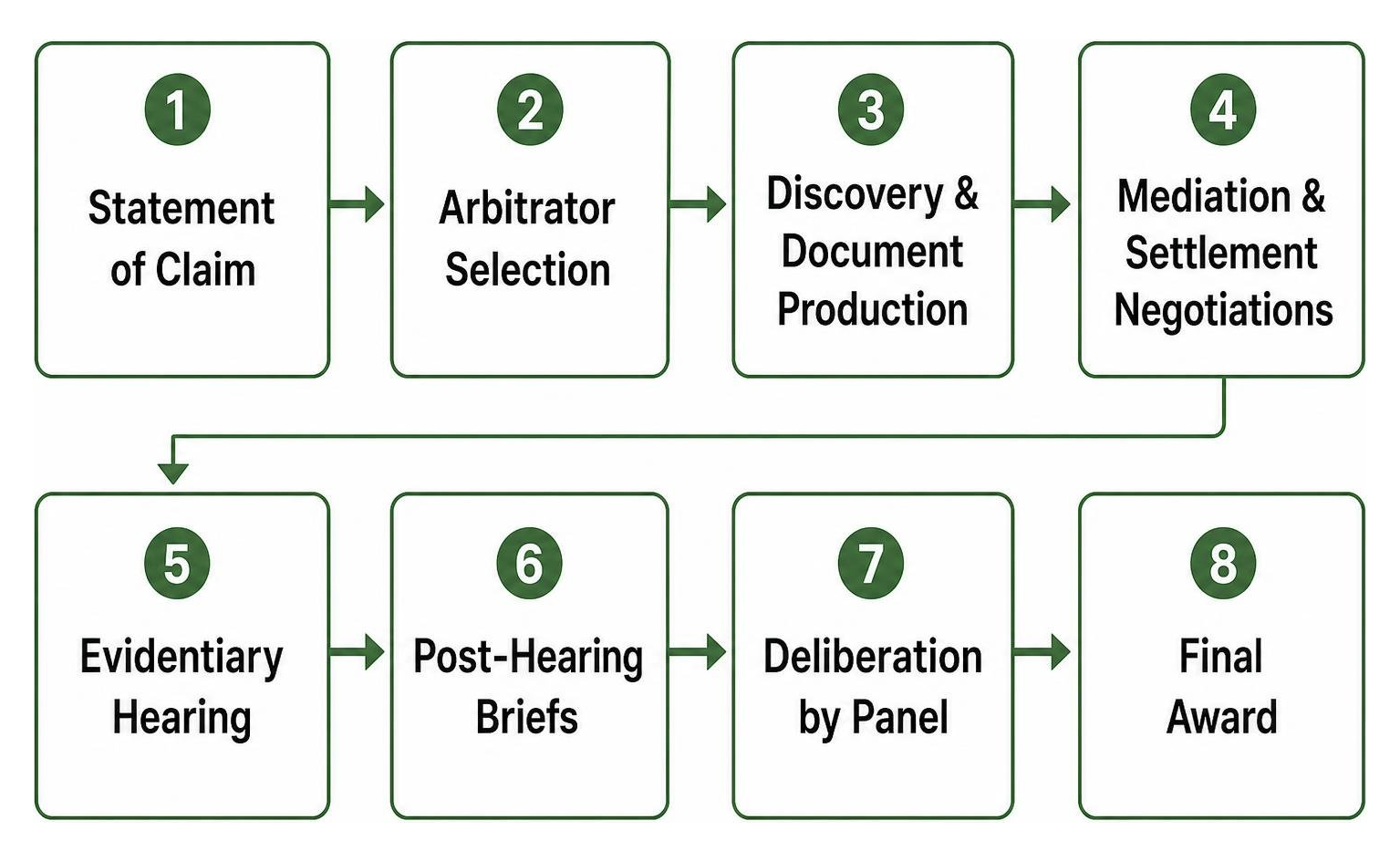
- Initial Case Evaluation and Forensic Audit: Counsel reviews your customer agreements, monthly statements, tax returns, and correspondence to quantify your true financial damages and identify specific regulatory breaches.
- Filing the Statement of Claim: Your legal team drafts and submits a formal Statement of Claim with FINRA, detailing the facts, the broker’s misconduct, and the damages requested.
- Arbitrator Selection: Both sides review a computer-generated list of potential arbitrators, ranking and striking candidates to seat a neutral panel (typically one or three arbitrators depending on claim size).
- Discovery and Document Production: Unlike civil court discovery, FINRA provides standard Discovery Guides that mandate both sides exchange specific categories of financial documents without extensive depositions.
- Mediation and Settlement Negotiations: Many cases settle during voluntary mediation before an evidentiary hearing takes place.
- The Arbitration Hearing and Award: If no settlement is reached, your attorneys present witness testimony, cross-examine the advisor, introduce exhibits, and argue your case before the panel, which issues a binding written award.
Successfully navigating wall streets private court to reclaim your invested capital requires an attorney who knows how arbitration panels evaluate broker testimony and damages models.
When to Hire an Investment Loss Attorney Near Me for FINRA Arbitration
Retaining dedicated FINRA attorneys should happen as soon as you notice unauthorized portfolio changes, unexplained margin calls, or sudden drop-offs in communication from your advisor.
Brokerage firms maintain teams of in-house and outside defense lawyers whose primary objective is to deflect blame onto “market conditions” or claim that you, the customer, willingly assumed all risks. Engaging experienced legal representation early prevents you from making inadvertent admissions during informal firm “investigations” that could compromise your claim later.
Timelines, Legal Costs, and Contingency Fee Agreements
Understanding the financial commitments and timeframes of recovery helps investors plan their legal strategy:
| Factor | FINRA Arbitration | Traditional Court Litigation |
|---|---|---|
| Typical Duration | 12 to 18 months | 24 to 36+ months |
| Primary Fee Structure | Contingency (no recovery, no legal fee) | Hourly rates or hybrid billing |
| Appeals Process | Extremely limited grounds (awards are final) | Frequent, lengthy appellate delays |
| Public Disclosure | Case details private; awards public | All filings and hearings public record |
| Deciding Authority | Selected panel of industry/public arbitrators | Judge and civil jury |
Most investor loss attorneys represent clients on a contingency fee basis. Under this arrangement, the law firm collects an agreed-upon percentage of the financial recovery only if they successfully win an award or negotiate a settlement. If no recovery is achieved, the client owes no attorney fees.
Potential Outcomes, Damages, and Compensation Recoveries
When pursuing legal action against a negligent broker or fraudulent firm, the primary objective is to make you financially whole. FINRA data shows that thousands of investors file arbitration claims each year, with panels awarding hundreds of millions of dollars in damages, and the Public Investors Arbitration Bar Association (PIABA) reports that the average settlement for claims involving unsuitability or churning reaches approximately $200,000.
Depending on the facts of your case, compensable damages may include:
- Net Out-of-Pocket Losses: The direct dollar difference between what you invested and what you withdrew, factoring in remaining asset values.
- Well-Managed Portfolio Damages: Compensation representing what your portfolio would have earned had it been invested prudently in accordance with your actual risk profile (e.g., matching a conservative 60/40 benchmark instead of high-risk speculative equities).
- Statutory Interest: Pre-judgment and post-judgment interest calculated under state securities acts.
- Disgorgement of Commissions: Forcing the broker and firm to refund all fees, markups, and trading commissions generated through their wrongful conduct.
- Attorney Fees and Costs: In cases involving explicit statutory violations or egregious bad faith, arbitration panels may order the brokerage firm to pay your legal fees.
- Punitive Damages: Imposed in cases of willful, wanton fraud or intentional theft to punish the wrongdoer and deter future industry misconduct.
Frequently Asked Questions About Investment Loss Recovery
How long do I have to file a legal claim against a negligent broker?
Under FINRA Rule 12206, no claim is eligible for arbitration where six years have elapsed from the occurrence or event giving rise to the claim. In addition, underlying state and federal statutes of limitations (such as those in Pennsylvania or New Jersey) often mandate much shorter deadlines—frequently between two and five years from when you discovered or should have discovered the wrongdoing. Because waiting can permanently extinguish your legal rights, you should have your account records audited as soon as misconduct is suspected.
Can I recover investment losses if I signed a pre-dispute arbitration agreement?
Yes. Signing a pre-dispute arbitration clause does not mean you gave up your right to recover losses; it simply specifies where your claim must be heard. Instead of filing in county or federal court, your dispute proceeds through FINRA Dispute Resolution Services. Arbitration is a legally binding, enforceable forum specifically designed to resolve disputes between customers and brokerage firms.
What is the average financial recovery in broker misconduct disputes?
Recovery amounts vary significantly depending on the nature of the misconduct, total capital at risk, and the solvency of the respondent firm. According to FINRA reporting, investors file over 5,000 arbitration claims annually, yielding average awards near $150,000, while PIABA industry analyses show average settlements for churning and unsuitability claims hovering around $200,000. Catastrophic fraud and private placement cases frequently reach multi-million dollar outcomes.
Conclusion
Losing your hard-earned retirement savings, business proceeds, or family inheritance to advisor negligence is stressful, but you do not have to accept financial mistreatment as routine bad luck. When advisors breach their fiduciary duties, violate suitability rules, or conceal critical risks, the law provides robust avenues for restitution.
At Alan L. Frank Law Associates, P.C., we combine deep financial knowledge with aggressive trial advocacy to hold deceptive advisors and Wall Street institutions accountable. With offices in Philadelphia and Jenkintown, Pennsylvania, as well as New Jersey, we represent harmed clients locally and nationwide, bringing multi-million dollar recovery experience to every case we handle.
If you suspect your financial losses were caused by bad advice or broker misconduct, take action today. Contact our team to schedule a comprehensive evaluation of your securities litigation investment losses and take the first step toward recovering your capital.