
Arbitration Claim Against Broker: Navigating Dispute Resolution Efficiently


Arbitration Claim Against Broker: Navigating Dispute Resolution Efficiently
How to File an Arbitration Claim Against a Broker
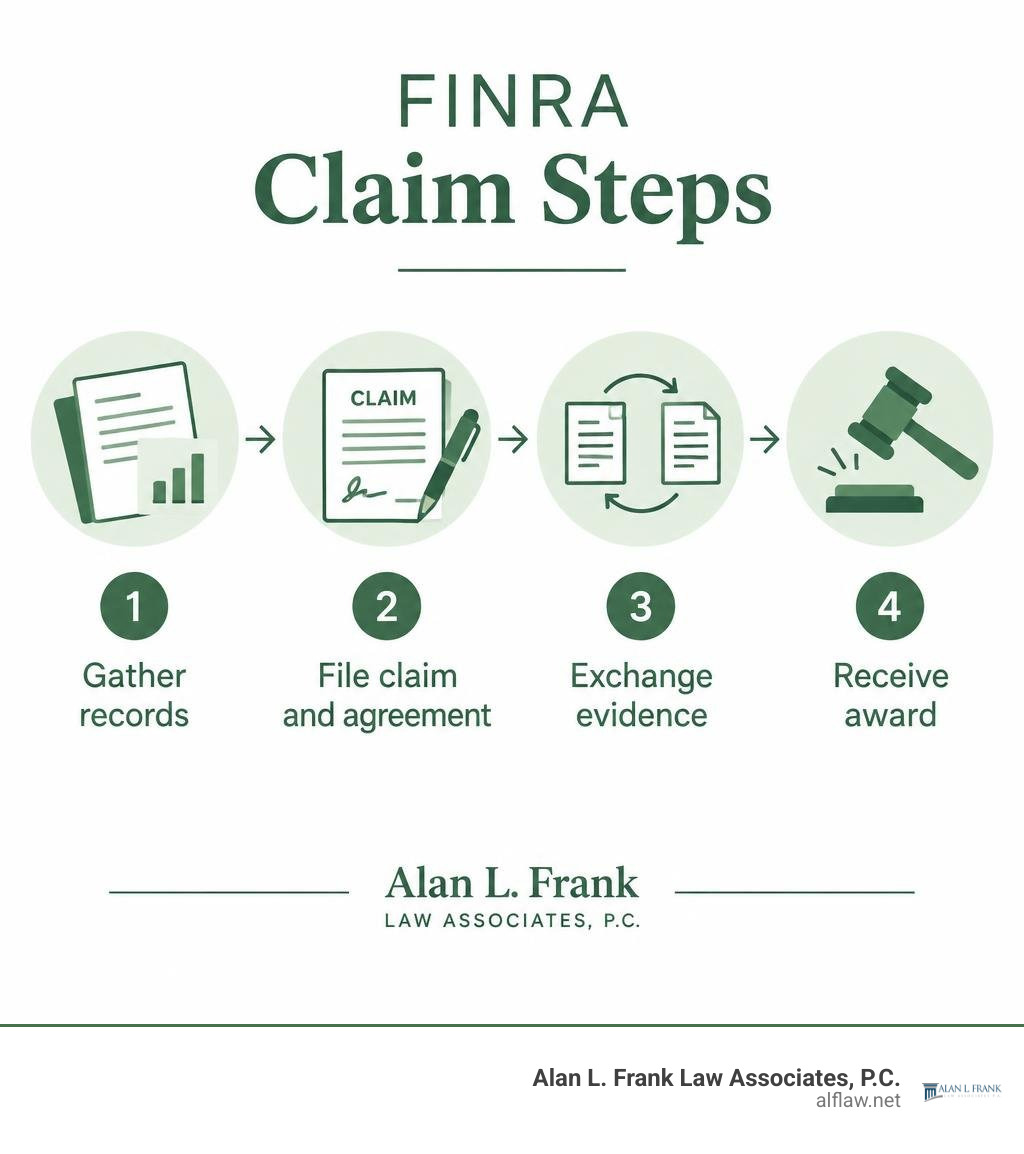
To file an arbitration claim against a broker, gather your account records, write a Statement of Claim explaining what happened and what you want to recover, and sign FINRA’s Submission Agreement. Submit them with the required filing fee through FINRA’s filing portal. Act promptly: FINRA generally requires claims to be filed within six years of the event at issue, and shorter legal deadlines may apply.
FINRA serves the initial claim on the broker or firm. The parties then select arbitrators, exchange relevant documents, and present their cases before a binding decision.
I’m Alan L. Frank, managing attorney at Alan L. Frank Law Associates, P.C., with more than 20 years of litigation experience. My work on securities disputes and investment losses informs how I approach an arbitration claim against broker misconduct, from evaluating the evidence to seeking recovery.
Quick arbitration claim against broker terms:
Understanding FINRA Dispute Resolution and Eligibility Rules
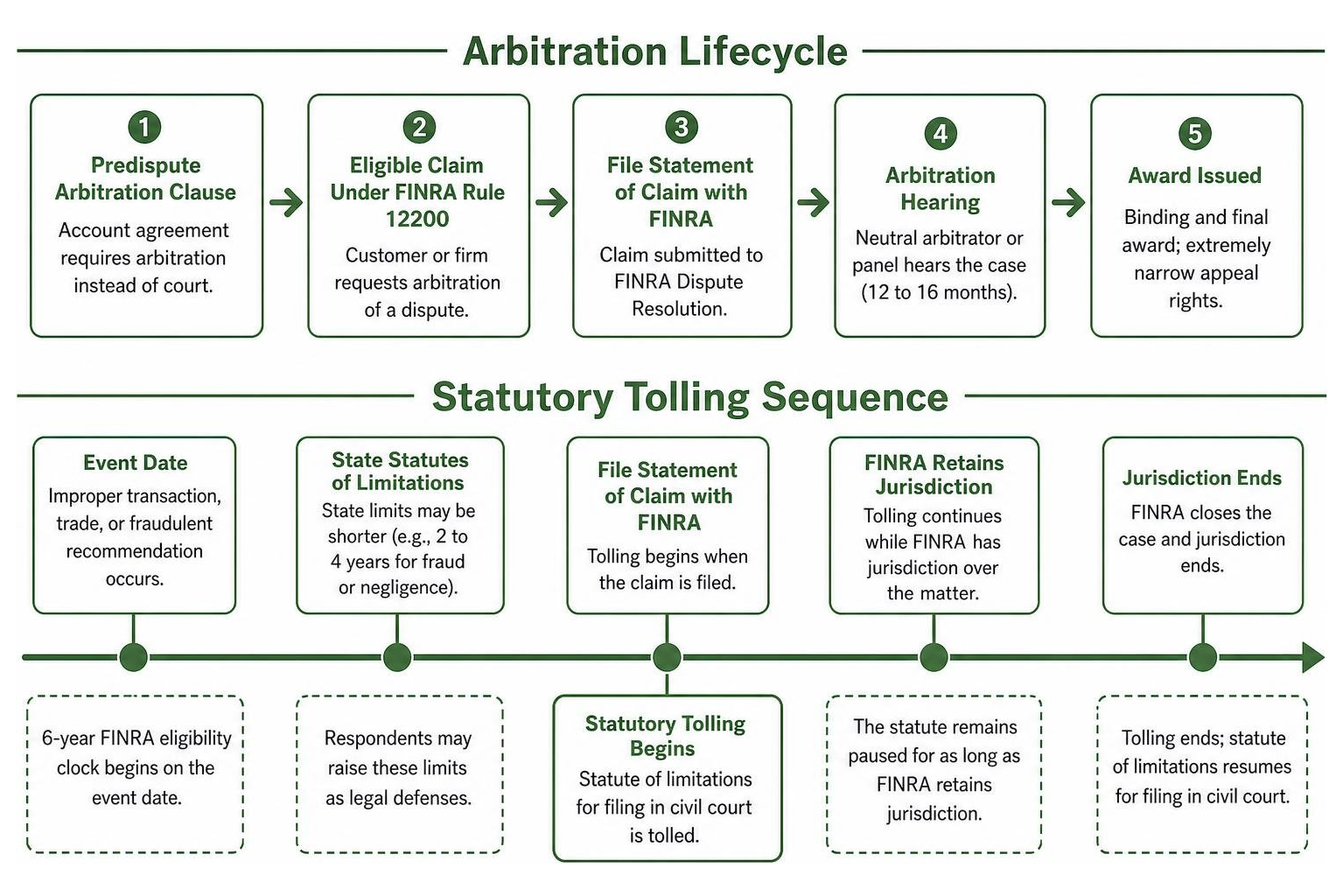
When an investor opens a brokerage account, the standard account agreement almost always includes a predispute arbitration clause. This provision requires that any controversy arising out of business dealings between the customer and the brokerage firm must be submitted to binding arbitration rather than litigated in a public courtroom.
The primary regulatory forum for these proceedings is Financial Industry Regulatory Authority (FINRA) Dispute Resolution Services. Under FINRA Rule 12200, member brokerage firms and their associated brokers are legally mandated to arbitrate disputes with a customer if required by a written agreement or if requested by the customer. Understanding FINRA as a forum for claims involving stockbroker misconduct helps investors identify whether claims such as unsuitability, churning, unauthorized trading, or misrepresentation are eligible for recovery.
FINRA Arbitration vs. Mediation and Court Litigation
Before initiating a formal claim, investors often wonder how arbitration compares to alternative paths like mediation or court litigation. The investor’s guide to resolving disputes with your broker details the operational differences between these options:
| Feature | FINRA Arbitration | Voluntary Mediation | Court Litigation |
|---|---|---|---|
| Decision Maker | Neutral single arbitrator or panel of three | Impartial mediator (facilitator only) | Judge and jury |
| Binding Outcome | Yes; award is final and legally enforceable | Only if parties reach mutual settlement | Yes; subject to standard appeal procedures |
| Rules of Evidence | Flexible; strict evidentiary rules do not apply | Informal discussions; evidentiary rules waived | Formal state or federal rules of evidence apply |
| Typical Duration | 12 to 16 months | 1 to 3 months | 2 to 4+ years |
| Appeal Rights | Extremely narrow grounds (e.g., manifest bias) | None (non-binding process) | Full statutory appeal rights |
While mediation boasts an 80% resolution rate when parties voluntarily consent, it cannot compel a settlement. Arbitration delivers a definitive, binding decision without the multi-year delays often encountered in state or federal courtrooms.
The 6-Year Eligibility Rule and Statute of Limitations Tolling
Under FINRA Code of Arbitration Procedure Rule 12206, no claim is eligible for submission to arbitration where six years have elapsed from the occurrence or event giving rise to the cause of action.
Key considerations regarding time limits include:
- Event Date vs. Discovery: The six-year eligibility clock generally begins on the date the improper transaction, trade, or fraudulent recommendation occurred.
- State Statutes of Limitations: State-level statutes of limitations (such as those in Pennsylvania or New Jersey) may be shorter than six years (e.g., two to four years for fraud or negligence) and can be raised by respondents as legal defenses.
- Statutory Tolling: Filing a Statement of Claim with FINRA tolls (pauses) the applicable statute of limitations for filing that claim in civil court for as long as FINRA retains jurisdiction over the matter.
Step-by-Step Guide to Filing an Arbitration Claim Against a Broker

Initiating a claim requires thorough preparation, accurate document assembly, and strict compliance with FINRA intake requirements.
Preparing the Statement of Claim and Required Documents for an Arbitration Claim Against Broker
The Statement of Claim is your primary pleading setting forth the factual narrative, legal violations, and financial remedies sought. According to filing and serving an initial Statement of Claim under FINRA Rule 12302, a complete filing package must include:
- The Statement of Claim: A clear, chronological summary outlining all customer interactions, broker recommendations, specific rule breaches (such as Regulation Best Interest or breach of fiduciary duty), and an itemized breakdown of net out-of-pocket losses.
- Executed FINRA Submission Agreement: A mandatory document signed by all claimants agreeing to submit the dispute to FINRA and abide by the arbitrators’ final decision.
- Relevant Exhibits: Account statements, trade confirmations, promotional brochures, emails, and handwritten notes.
- Data Redaction: In compliance with privacy standards, all sensitive personal identifying numbers (full Social Security numbers, taxpayer identification numbers, and financial account numbers) must be redacted to show only the last four digits.
Submitting Through the DR Portal, Paying Fees, and Fee Waivers
Claimants submit their documentation online via the FINRA Dispute Resolution (DR) Portal. When you file an arbitration or mediation claim on FINRA.org, the filing fee is calculated based on the total claim amount under FINRA Rule 12900:
- Filing Fee Schedule: Fees operate on a sliding scale based on damages claimed, ranging from $50 for small claims up to $2,300+ for large complex disputes.
- Pro Se Exception: Self-represented retail investors who lack digital access have the specific right to opt out of the DR Portal and mail their claim package directly to FINRA Dispute Resolution Services in New York.
- Hardship Fee Waivers: Claimants experiencing financial hardship (typically documenting annual income under $50,000 alongside tax returns or debt records) may apply for a temporary or permanent waiver of filing fees.
- Deficiency Notices: If a filing lacks required components or correct fees, FINRA issues a deficiency notice granting 30 calendar days to cure the defect before the case is administratively closed.
Service of Process and Responding to Statements of Answer
Once the claim is accepted, FINRA Dispute Resolution Services officially serves the Statement of Claim upon the named broker and brokerage firm respondents.
The respondents have 45 calendar days from receipt of the claim to serve and file a formal Statement of Answer. In their answer, respondents must specify all available defenses and relevant facts. Respondents may also assert counterclaims against the claimant, cross-claims against co-respondents, or third-party claims against other entities. If a respondent fails to file an answer or appear after proper service, the case may proceed to default proceedings under FINRA Rule 12801.
Arbitrator Selection, Discovery, and Case Hearings
Once responsive pleadings are entered, the dispute transitions into panel appointment and formal case preparation.
Arbitrator Selection and the $100,000 Threshold for Single vs. Three-Person Panels
Arbitrators are selected through FINRA’s Neutral List Selection System (NLSS), an algorithm that generates randomized rosters of qualified public (independent) and non-public (industry-affiliated) arbitrators.
The composition of the panel depends directly on the claimed damages:
- Claims of $50,000 or Less: Handled by a single public arbitrator through simplified arbitration procedures.
- Claims from $50,001 to $100,000: Decided by one public arbitrator unless all parties agree in writing to a panel of three.
- Claims Exceeding $100,000 or Unspecified Claims: Decided by a panel of three arbitrators.
- All-Public Panel Right: Under FINRA Rule 12403, customer claimants have the right to strike all non-public arbitrators on the roster to ensure an entirely independent, all-public panel.
Per the arbitration claim filing guide and panel rules, specified punitive damages combined with compensatory damages are aggregated to determine whether the $100,000 threshold is met. Counterclaims are evaluated independently: a $75,000 claim paired with a $60,000 counterclaim remains with a single arbitrator, whereas a counterclaim exceeding $100,000 automatically triggers a three-arbitrator panel.
Prehearing Procedures, Discovery Rules, and Simplified Arbitration
Case management is governed by the 12000 Code of Arbitration Procedure for Customer Disputes. The process includes several structured stages:
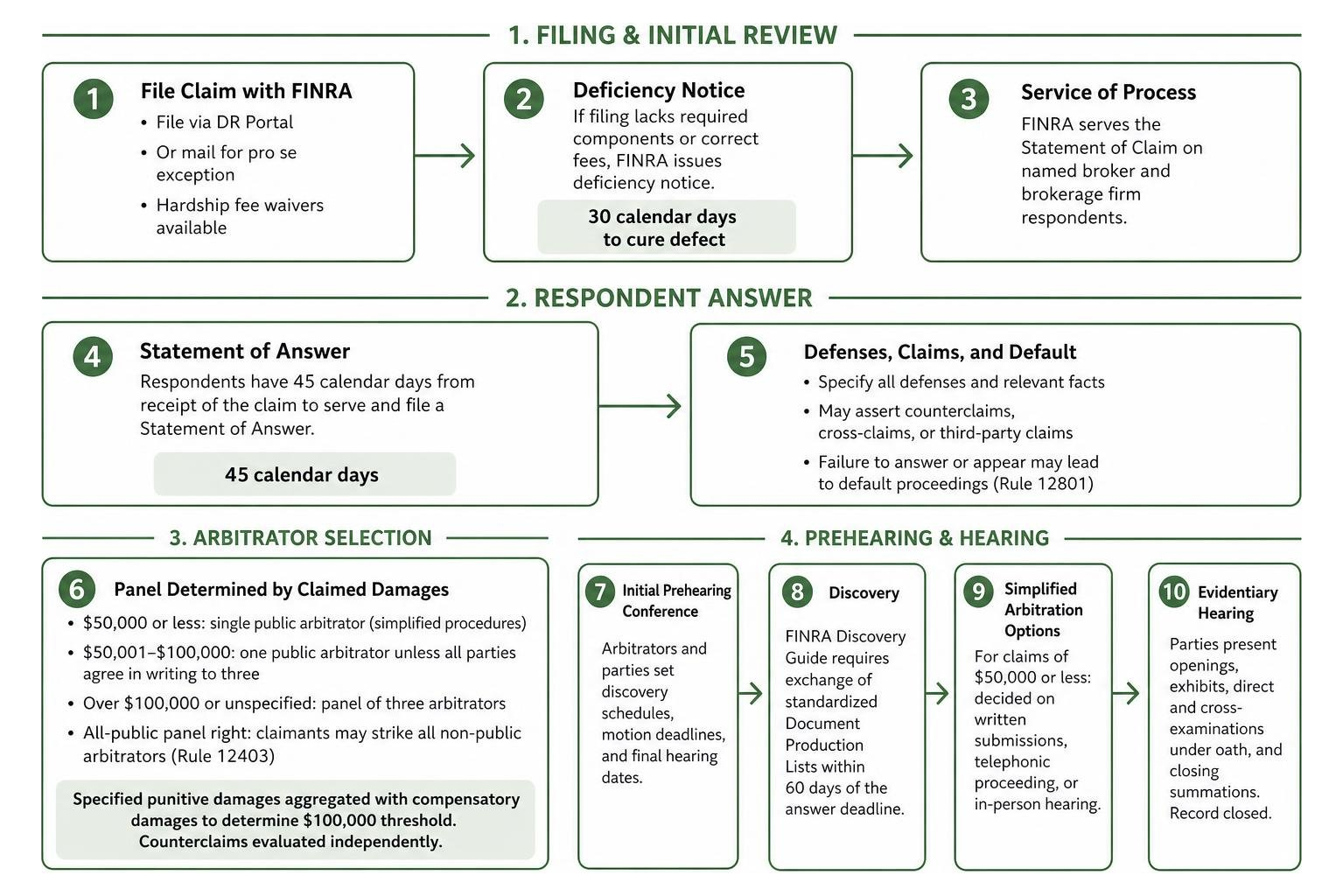
- Initial Prehearing Conference (IPHC): The appointed arbitrators and parties establish discovery schedules, motion deadlines, and final hearing dates.
- The FINRA Discovery Guide: Outlines standardized Document Production Lists that customer claimants and brokerage firms must exchange within 60 days of the answer deadline without waiting for specific discovery requests.
- Simplified Arbitration Options: For claims of $50,000 or less, claimants can choose to have the dispute decided solely on written submissions, via a telephonic Special Proceeding (two hours per side for presentations), or through a standard in-person hearing.
- Evidentiary Hearing: At the final hearing, parties present opening remarks, introduce exhibits, conduct direct and cross-examinations under oath, and offer closing summations before the panel closes the record.
Legal Strategies, Damage Recovery, and Industry Disputes

Successfully navigating FINRA arbitration requires understanding legal liabilities, damages structures, and industry-specific counterclaims.
When to Hire Legal Counsel for an Arbitration Claim Against Broker
While FINRA permits individuals to represent themselves pro se, published dispute history shows that unrepresented claimants face severe disadvantages against experienced brokerage defense counsel. Our team of experienced FINRA attorneys levels the playing field against well-resourced financial institutions.
For claimants evaluating representation options, consider:
- Contingency Fee Structures: Many securities litigation claims are handled on a contingency basis, aligning attorney compensation with successful monetary recovery.
- Law School Arbitration Clinics: Investors with smaller disputes and limited means can explore university-sponsored securities arbitration clinics for low-cost legal assistance.
- Defending Pro Se Exposure: Broker-dealer legal teams routinely file motions to dismiss, assert complex statutory defenses, and aggressively dispute damage methodologies that pro se investors struggle to counter.
Requesting Compensatory, Punitive Damages, and Attorney Fees
A well-pleaded claim articulates specific measures of damages:
- Compensatory Damages: Calculated using net out-of-pocket losses or well-managed portfolio benchmark comparisons (recovering what the account would have gained in a suitable asset allocation).
- Punitive Damages: Permissible where malicious, egregious, or fraudulent conduct occurred under applicable state law standards.
- Attorneys’ Fees and Forum Costs: Arbitrators can award legal fees if authorized by statute, customer contracts, or bad-faith conduct during the proceeding, alongside allocating hearing session fees between the parties.
Post-Award Enforcement and Form U-5 Defamation Counterclaims
According to the SEC investor bulletin on broker-dealer arbitration, respondents must honor monetary arbitration awards in cash within 30 calendar days of receipt. Failure to pay triggers expedited FINRA suspension proceedings under IM-12000, barring the broker or firm from the securities industry.
In intra-industry disputes between brokers and former employers, terminated financial advisors frequently utilize FINRA arbitration to assert Form U-5 defamation counterclaims. These claims seek financial damages and the expungement or modification of inaccurate, defamatory termination disclosures that harm professional reputations on FINRA BrokerCheck.
Frequently Asked Questions About Broker Arbitration Claims
Can I file an arbitration claim against a broker after six years?
Under FINRA Rule 12206, claims filed more than six years from the triggering event are ineligible for arbitration. If an arbitrator dismisses a claim under this rule, the claimant may pursue the matter in civil court if permitted under applicable court statutes of limitations and tolling provisions.
What happens if a broker or firm fails to pay an arbitration award?
If a respondent fails to pay within 30 days, FINRA initiates regulatory proceedings to suspend their license. The prevailing party can also file a motion in state or federal court to confirm the award into an enforceable civil judgment, allowing asset garnishment and bank levies. However, if a defunct brokerage firm enters bankruptcy, recovery through SIPC may not cover unpaid arbitration awards.
Can I represent myself pro se in a FINRA arbitration proceeding?
Yes, FINRA rules allow self-representation, and pro se claimants may opt out of the electronic DR Portal. However, because broker-dealers retain seasoned defense counsel, self-represented parties face significant procedural hurdles during discovery, motion practice, and cross-examination.
Conclusion
Successfully filing and resolving an arbitration claim against a broker requires rigorous evidentiary documentation, adherence to strict statutory timelines, and strategic execution throughout discovery and final hearings. Navigating Wall Street’s private dispute forum demands thorough preparation to secure the recovery you are owed.
At Alan L. Frank Law Associates, P.C., we draw upon multi-million dollar recovery experience to protect retail investors, business owners, and financial professionals across Pennsylvania, New Jersey, and nationwide. If you have suffered significant financial losses due to broker misconduct or unauthorized trading, consult our legal counsel for securities litigation and investment losses to evaluate your claim and seek full financial recovery.