
Everything Shareholders Need to Know About the Canopy Growth Class Action


Everything Shareholders Need to Know About the Canopy Growth Class Action
Canopy Growth Securities Litigation: Where the Cases Stand
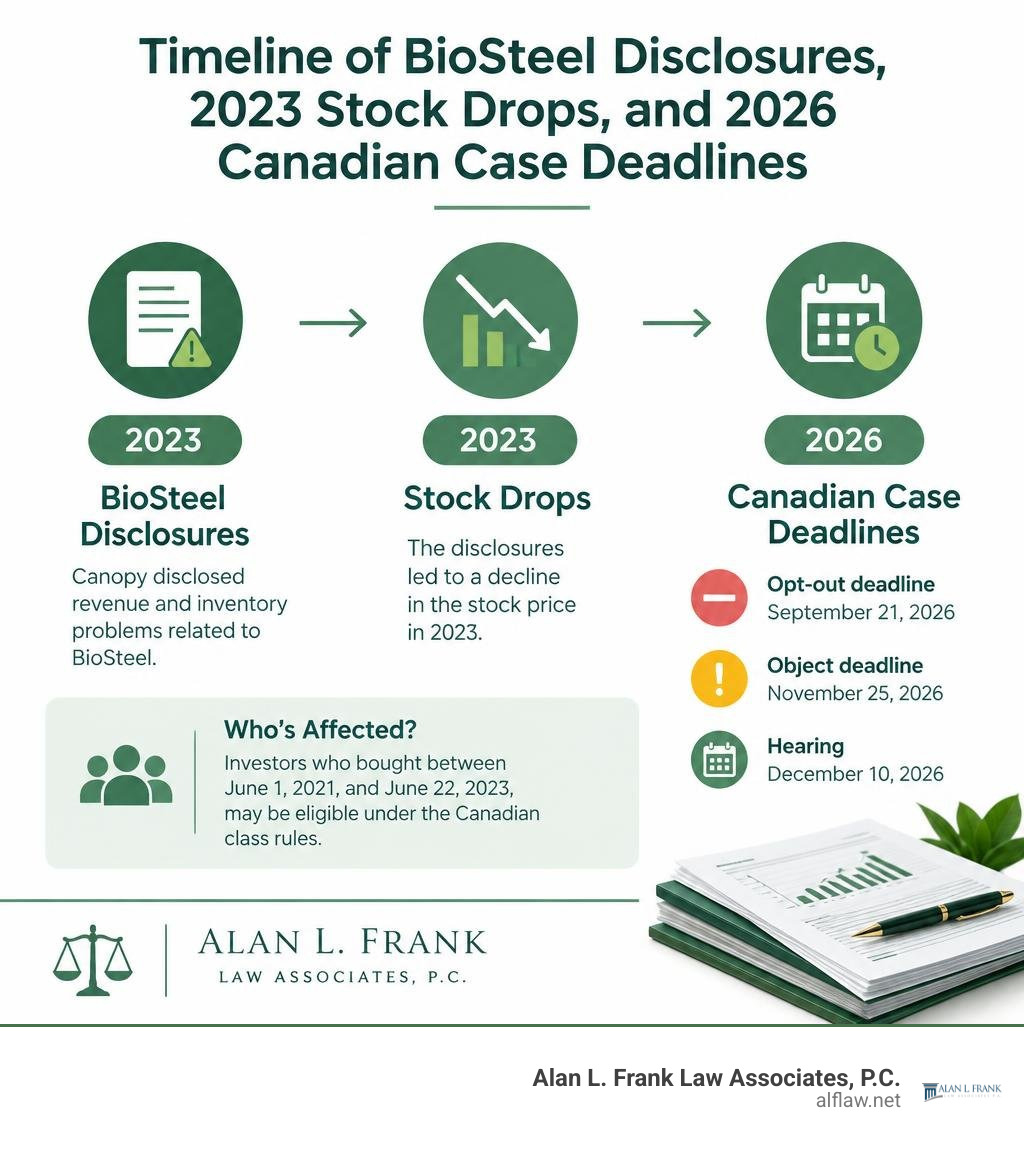
The securities litigation involving Canopy Growth Corp. has two different outcomes. A U.S. class action was dismissed with prejudice in 2024, but a Canadian class action is continuing. Former auditor KPMG has proposed a CAD $3.5 million partial settlement, which still needs court approval. The deadline to opt out passed on September 21, 2026. Eligible investors who want to object have until November 25, 2026, ahead of a December 10 hearing.
The claims stem from BioSteel revenue and inventory problems that Canopy disclosed in 2023. If you bought Canopy securities between June 1, 2021, and June 22, 2023, check your trade and holding records against the Canadian class rules. The KPMG settlement does not end the claims against Canopy and its former executives.
I’m Alan L. Frank, a lawyer and CPA with more than 20 years of experience leading complex commercial and investment-loss cases. That background informs this guide to canopy growth corp securities litigation and the decisions shareholders may face next.
Canopy growth corp securities litigation terms at a glance:
Core Allegations: BioSteel Revenue Overstatement and Inventory Control Failures
To understand how Canopy Growth Corporation landed in legal hot water, we have to look back to its acquisition of BioSteel Sports Nutrition Inc. Canopy acquired an initial 72% majority stake in BioSteel in October 2019 for approximately C$47.7 million (around $35.8 million USD), eventually increasing its ownership to roughly 90% by October 2022. BioSteel was marketed as a high-growth pillar that would diversify Canopy away from pure-play cannabis into mainstream sports hydration and ready-to-drink (RTD) beverages.
During the class period, BioSteel generated between 7% and 17% of Canopy’s consolidated net revenue. However, beneath the double-digit growth figures lay significant accounting and operational breakdowns.

Plaintiffs in both the U.S. and Canadian lawsuits alleged that BioSteel engaged in improper revenue recognition, premature billing, and aggressive channel stuffing. Wholesalers and international distribution partners were shipped substantial volumes of RTD beverages without binding, enforceable sales contracts. Ready-to-drink beverages typically carry an unyielding wholesaler shelf-life limit of 2 to 2.5 years. Because inventory sat stagnant in distributor warehouses, products began rapidly aging toward expiration.
When distributors pushed back or refused payment on unwritten agreements, internal accounting controls failed to capture the growing uncollectibility and inventory obsolescence. Instead, revenues were booked prematurely, artificially inflating Canopy’s public top-line performance. When navigating these situations, pursuing investment loss litigation becomes a necessary step for institutional and individual shareholders caught in the fallout.
The house of cards collapsed across a sequence of three major corrective disclosures during the first half of 2023:
| Date | Disclosed Accounting and Operational Issue | Stock Price Decline |
|---|---|---|
| February 9, 2023 | Canopy announced significant inventory write-downs and gross margin compression tied to BioSteel’s aging product lines. | -17.15% |
| May 10, 2023 | The company announced an internal review into BioSteel’s historical financial reporting and identified material weaknesses in internal controls over financial reporting. | -20.31% |
| June 22, 2023 | Canopy filed restated financial statements, formally wiping out C$26.6 million (approx. $20.2 million USD) in artificially inflated BioSteel revenue, resulting in a 4% net reduction in consolidated net revenue for April–December 2022. | -13.81% |
In total, these successive disclosures eliminated hundreds of millions of dollars in shareholder value, leading investors to seek legal recourse across both sides of the border.
Overview and Procedural History of the Canopy Growth Corp Securities Litigation
Dual-listed companies present unique legal dynamics because cross-border shareholders are governed by distinct statutory regimes. Canopy Growth traded concurrently on both the Toronto Stock Exchange (TSX) and the Nasdaq. When the BioSteel restatements came to light, parallel class action lawsuits were launched in the United States and Canada against Canopy Growth, former CEO David Klein, former CFO Judy Hong, and former independent auditor KPMG LLP.
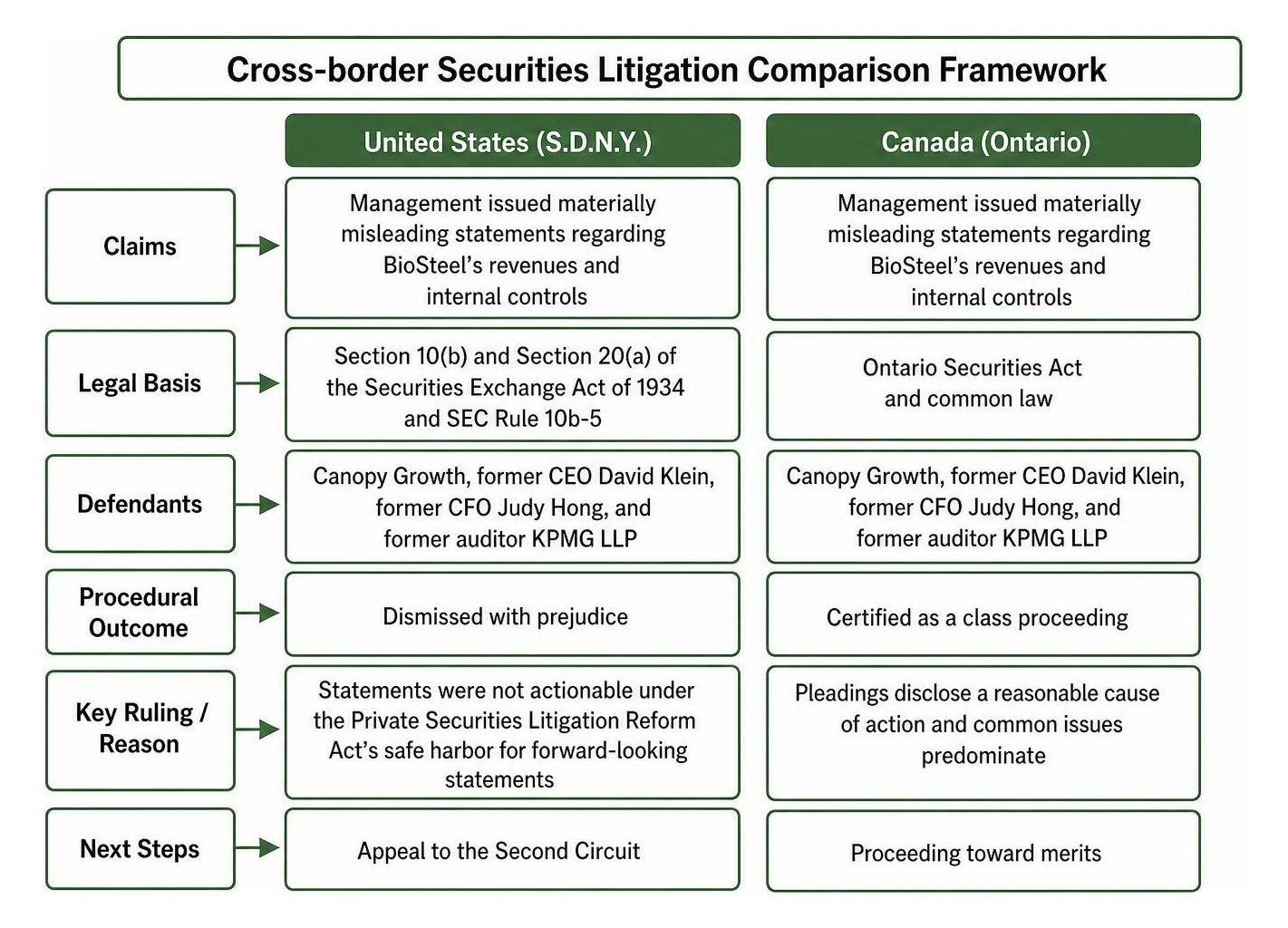
While both lawsuits alleged that management issued materially misleading statements regarding BioSteel’s revenues and internal controls, the procedural outcomes in the two jurisdictions diverged completely.
S.D.N.Y. Dismissal of the Canopy Growth Corp Securities Litigation
In the United States, plaintiffs filed a consolidated putative class action in the U.S. District Court for the Southern District of New York. The case asserted claims under Section 10(b) and Section 20(a) of the Securities Exchange Act of 1934 and SEC Rule 10b-5.
On July 17, 2024, U.S. District Judge Paul A. Engelmayer granted the defendants’ motion to dismiss the First Amended Complaint with prejudice. The court’s ruling turned on the heightened pleading standards imposed by the Private Securities Litigation Reform Act (PSLRA) and Federal Rule of Civil Procedure 9(b). Under U.S. law, plaintiffs must establish a strong inference of scienter—meaning intent to deceive, manipulate, or defraud, or at least severe recklessness.
As detailed in the S.D.N.Y. dismissal opinion and order, the plaintiffs relied heavily on statements from six confidential witnesses (CWs). However, the court found critical deficiencies:
- Five of the six confidential witnesses had zero alleged contact with senior management (Klein or Hong).
- None of the witnesses could demonstrate that senior executives possessed contradictory internal financial reports when making public statements.
- The revenue restatement of C$26.6 million (a 4% consolidated adjustment) was deemed insufficient on its own to generate an inference of fraudulent intent.
Because the underlying Section 10(b) claims failed, the derivative Section 20(a) control-person claims against the individual officers were dismissed as well. Further legal analysis of scienter pleading deficiencies confirmed that without direct proof of executive knowledge, federal fraud claims cannot survive a motion to dismiss.
Canadian Class Certification in the Canopy Growth Corp Securities Litigation
While the U.S. courthouse doors closed, the Ontario Superior Court of Justice took a markedly different approach. On December 22, 2025, Justice Morgan granted class certification under the Ontario Class Proceedings Act, 1992 and granted leave to proceed with statutory secondary market misrepresentation claims under Section 138.3 and Section 138.8 of the Ontario Securities Act (OSA).
The Canadian court also certified a corporate oppression claim under the Canada Business Corporations Act (CBCA). Section 138.8 of the OSA serves as a statutory gatekeeper, requiring plaintiffs to establish that the action is brought in good faith and has a “reasonable possibility” of succeeding at trial—a threshold significantly lower than the PSLRA’s scienter standard.
Defendants argued that BioSteel’s accounting adjustments were statistically immaterial, offering extensive econometric modeling. Justice Morgan famously rejected these defenses with colorful skepticism, comparing expert statistical debates over materiality to organic chemists analyzing the molecular interactions of pineapple and dairy in a petri dish to determine if Hawaiian pizza tastes good. As noted in the Ontario class action certification ruling, the court emphasized that “the market speaks louder than the experts.” The sharp stock price plunges following each disclosure provided objective evidence of materiality.
For Canadian and non-U.S. secondary market buyers, this ruling kept the path alive for recovering capital from stock fraud.
The CAD $3.5 Million KPMG Auditor Partial Settlement
A major milestone in the Canadian action is the proposed CAD $3,500,000 partial settlement reached with Canopy’s former independent auditor, KPMG LLP.

In class action litigation, claims against third-party auditing firms are notoriously complex. KPMG agreed to the CAD $3.5 million settlement to resolve claims arising from its audit reports for the fiscal year ended March 31, 2022, without admitting any liability or wrongdoing.
Key elements of the settlement structure include:
- Gross Settlement Amount: CAD $3,500,000, inclusive of all interest, administrative expenses, and legal fees.
- Class Counsel Fee Request: Class Counsel has requested court approval for 30% of the settlement fund (CAD $1,050,000), plus reimbursement for litigation disbursements and applicable taxes.
- Deferred Trust Distribution: Crucially, the net settlement funds will not be distributed to class members immediately. Instead, the net proceeds will be held in an interest-bearing trust account until the ongoing litigation against the primary defendants—Canopy Growth Corporation, David Klein, and Judy Hong—is either settled or adjudicated at trial.
Investors can review full KPMG partial settlement details through official notice portals.
Class Eligibility, Key Deadlines, and Rights to Opt Out or Object
Class eligibility for the certified action and the KPMG partial settlement is governed by specific criteria.
Who is an Eligible Class Member? You are included in the certified class if you:
- Acquired Canopy Growth Corporation securities on the secondary market between June 1, 2021, and June 22, 2023;
- Held some or all of those securities until the close of trading on May 10, 2023, or June 22, 2023; and
- Are a resident of Canada, or purchased your securities on a non-U.S. exchange (such as the TSX).
Critical Litigation Dates and Deadlines:
- Opt-Out Deadline (Passed): September 21, 2026, at 11:59 p.m. ET. Investors who wished to pursue individual lawsuits against KPMG or the remaining defendants were required to submit an official opt-out form by this date.
- Objection Deadline: November 25, 2026, at 11:59 p.m. ET. Eligible class members who disagree with the settlement terms or Class Counsel’s 30% fee request must file formal written objections before this deadline.
- Settlement Approval Hearing: Scheduled for December 10, 2026, where the Ontario Superior Court of Justice will evaluate whether the partial settlement is fair, reasonable, and in the best interests of the class.
For investors who experienced substantial portfolio harm, seeking compensation for securities litigation investment losses requires watching these administrative milestones.
Governance and Reporting Implications for Cannabis and CPG Issuers
The Canopy Growth litigation offers vital corporate governance lessons for emerging consumer packaged goods (CPG) and cannabis issuers.
Rapid expansion via mergers and acquisitions often creates severe operational blind spots. When a parent company acquires a subsidiary like BioSteel, executive leadership and the Board Audit Committee must implement rigorous Sarbanes-Oxley internal control standards immediately upon closing.
Key risk factors highlighted by this case include:
- Contract Enforcement Before Revenue Booking: Management cannot recognize revenue on verbal understandings or informal distributor relationships. Rigorous controls must ensure executed, binding contracts exist before recording top-line numbers.
- Perishable Inventory Aging Controls: In RTD beverage and consumer goods sectors, audit committees must monitor warehouse holding periods to prevent sudden multi-million-dollar inventory write-downs.
- Subsidiary Financial Integration: Rapid growth does not excuse lax internal controls over financial reporting (ICFR). Material weaknesses identified at the subsidiary level inevitably trigger enterprise-wide restatements and securities liability.
Frequently Asked Questions About the Canopy Growth Securities Lawsuit
What caused the securities class action lawsuits against Canopy Growth?
The lawsuits were triggered by improper revenue recognition, unwritten distribution arrangements, and severe inventory aging at Canopy’s BioSteel subsidiary. These control failures forced Canopy to issue a C$26.6 million revenue restatement in June 2023, causing sequential stock price drops of 17.15%, 20.31%, and 13.81%.
Why was the U.S. class action dismissed while the Canadian case was certified?
The U.S. action was dismissed with prejudice in the Southern District of New York because the plaintiffs failed to meet the strict scienter pleading standards of the PSLRA; confidential witness statements failed to show that senior management acted with deliberate fraudulent intent. In contrast, the Ontario Superior Court certified the Canadian action because Section 138.8 of the Ontario Securities Act and the CBCA oppression provisions apply a “reasonable possibility of success” standard and credit objective market price declines over statistical defense arguments.
What actions should affected investors take regarding the KPMG partial settlement?
Investors should audit their trade confirmations between June 1, 2021, and June 22, 2023, to verify their class membership. While the opt-out window closed on September 21, 2026, class members have until November 25, 2026, to file any objections to the settlement terms or legal fees ahead of the December 10, 2026 approval hearing.
Conclusion
The cross-border litigation surrounding Canopy Growth Corporation underscores the contrasting legal protections available to investors in North American capital markets. While U.S. federal courts enforce stringent pleading bars for scienter, Canadian courts remain a viable forum for secondary market misrepresentation and shareholder oppression claims.
As the CAD $3.5 million KPMG partial settlement moves toward its final approval hearing in December 2026, the ongoing litigation against Canopy Growth and its former executives will continue to shape cross-border securities jurisprudence.
At Alan L. Frank Law Associates, P.C., we draw upon decades of CPA and legal experience to help institutional investors, family offices, and individual shareholders navigate complex fraud recovery. If you suffered significant investment losses resulting from corporate misrepresentations or accounting irregularities, explore our comprehensive securities litigation representation to protect your financial rights.