
Why Your NFTs Need a Tax Attorney Before the IRS Knocks


Why Your NFTs Need a Tax Attorney Before the IRS Knocks
How the IRS Taxes NFTs and Digital Assets as Property
When the IRS looks at your non-fungible tokens (NFTs), Bitcoin Ordinals, or governance tokens, it does not see money. It sees property.
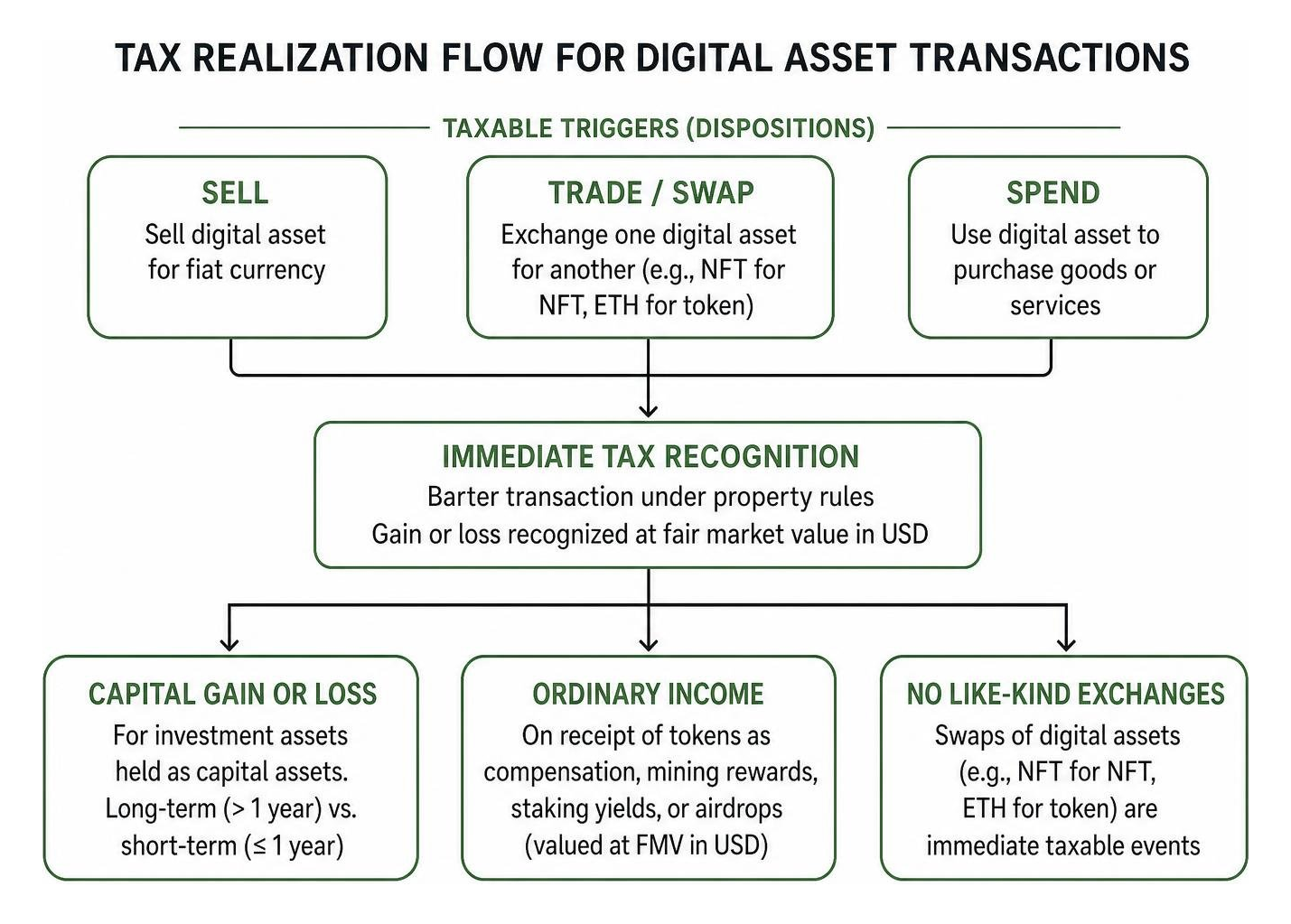
Under IRS Notice 2014-21, virtual currencies and digital assets are treated as property for federal tax purposes. Because digital tokens are not classified as legal tender, general tax principles applicable to property transactions govern every single move you make. If you sell, trade, or spend a digital asset, you are engaged in a barter transaction.
This property classification fundamentally changes how profits and losses operate:
- Capital Asset Treatment: If you hold digital assets for investment, dispositions yield capital gains or capital losses. Holding an asset for more than one year unlocks long-term capital gains rates (0%, 15%, or 20%), whereas assets held for one year or less face short-term capital gains rates taxed at ordinary income levels.
- Ordinary Income Events: Receiving tokens as compensation for services, mining rewards, staking yields, or airdrops generates ordinary income immediately upon receipt, valued at fair market value (FMV) in U.S. dollars on that date.
- No Like-Kind Exchanges: The Tax Cuts and Jobs Act explicitly limited Internal Revenue Code (IRC) Section 1031 like-kind exchanges exclusively to real estate. Swapping one NFT for another, or trading Ethereum for a token on a decentralized exchange, is an immediate, taxable realization event.
Navigating these mechanics often feels counterintuitive. If you minted an NFT for $200 worth of crypto that is now worth $5,000, and you trade it directly for another artwork, you owe tax on the $4,800 gain at the moment of the trade—even if your bank account did not see a single dollar. For businesses, developers, and creators structuring digital ventures, navigating these transactions requires careful coordination under corporate and transactional matters to avoid severe structural tax liabilities.
The 28% Collectibles Question and Property Classification
A major trap for NFT investors is the threat of the 28% maximum capital gains tax rate on collectibles under IRC Section 408(m).
In Notice 2023-27, the IRS established a “look-through analysis” for NFTs. Rather than applying a blanket label across the entire sector, the IRS examines the underlying right or asset associated with the token. If an NFT certifies ownership or rights to an underlying asset that constitutes a collectible under Section 408(m)—such as fine art, gems, stamps, or historical artifacts—the long-term capital gain on the disposition of that NFT may be taxed at the higher 28% collectible rate rather than the standard 20% capital gains ceiling.
This look-through rule creates serious questions across modern ecosystems:
- Digital Art & PFP Projects: Does pure digital artwork meet the traditional statutory definition of “work of art” under Section 408(m)? While final formal guidance remains pending, an aggressive IRS audit stance could categorize generative art profiles and 1-of-1 digital illustrations as collectibles.
- Utility & Membership Tokens: NFTs granting exclusive software access, decentralized governance votes, or event ticketing generally lack underlying collectible property and should qualify for standard capital gains rates.
- Bitcoin Ordinals and Rare Sats: When collectors isolate “rare satoshis” from historic transaction blocks (often referred to as digital numismatics) or inscribe data onto individual satoshis, tax treatment becomes layered. While extracting a rare satoshi is not a taxable realization event, selling it at a premium raises classification questions. Detailed insights on Bitcoin Ordinals and Inscription taxes show that the IRS may view historical satoshis through a numismatic lens similar to rare coins under Section 408(m).
Applying inconsistent tax classifications across different tax years is an immediate audit trigger. Working with counsel to document and defend your position before filing protects you against retroactive reclassifications.
Multi-Leg Disposals in Minting, Gas, and Swaps
The most common compliance mistake among active digital asset users is ignoring the “currency leg” of a transaction. Because digital assets are treated as property, spending a token to acquire something else is legally treated as selling that token.
Every time you interact with a smart contract, you trigger multi-leg tax events:
- Minting an NFT: When you spend 0.5 ETH to mint an NFT, you are not merely purchasing an asset; you are disposing of 0.5 ETH. If you acquired that ETH for $800 and it is worth $1,500 at the moment of minting, you realize a taxable capital gain of $700 on the ETH, while establishing a starting cost basis of $1,500 in the newly minted NFT.
- Paying Gas Fees: Network transaction fees paid in native cryptocurrencies (such as ETH or SOL) represent separate micro-disposals of appreciated property. If you spend $40 in ETH on gas to execute a transaction, and that ETH has a cost basis of $15, you must recognize a $25 capital gain on the network fee disposal.
- Crypto-to-Crypto Swaps: Trading an NFT for another NFT or converting tokens through automated market makers constitutes a simultaneous disposal and acquisition. Both legs must be calculated against their respective fair market values at that exact timestamp.
Failing to log the basis of tokens spent on fees and mints causes massive discrepancies when aggregating annual capital gains.
Critical Digital Asset Tax Issues Facing NFT and Crypto Investors
With over 60 million Americans holding digital assets, the IRS has escalated compliance enforcement. The federal tax revenue gap is estimated at approximately $688 billion, and federal authorities attribute at least $50 billion of that gap directly to unreported virtual currency and NFT transactions.
To bridge this shortfall, the IRS has moved from passive guidance to aggressive algorithmic matching.
| Cost Basis Method | Description | Primary Advantage | IRS Compliance Rule |
|---|---|---|---|
| FIFO (First-In, First-Out) | Disposes of the oldest acquired assets first. | IRS default method; easy to track. | Default applied when specific records are missing. |
| LIFO (Last-In, First-Out) | Disposes of the most recently acquired assets first. | Useful in rising markets to minimize short-term gains. | Requires detailed transactional logs. |
| HIFO (Highest-In, First-Out) | Disposes of highest-cost lots first. | Minimizes immediate taxable gains across trades. | Requires contemporaneous lot tracking. |
| Specific Identification | Taxpayer identifies exact units sold by lot, date, and basis. | Maximum tax efficiency and tailored gain management. | Mandatory: Must be identified at or before execution. |
| Rev. Proc. 2024-28 Rules | Requires wallet-by-wallet basis segregation. | Eliminates cross-wallet pooling errors. | Universal pooling across separate wallets is prohibited. |
Resolving High-Risk Digital Asset Tax Issues Before an IRS Audit
A major area of vulnerability on federal returns is the mandatory digital asset disclosure at the top of Form 1040, Form 1040-SR, and Form 1040-NR.
The question asks whether, at any time during the tax year, you received, sold, exchanged, or disposed of a digital asset (or a financial interest in a digital asset).
Leaving this box blank or falsely checking “No” when you executed crypto-to-crypto swaps, received staking income, or minted NFTs is viewed by the IRS as an intentional misrepresentation. Under IRC Section 6662, accuracy-related negligence carries a 20% penalty on underpayments, while civil fraud penalties under Section 6663 reach 75%.
More critically, intentional omission can trigger criminal exposure or allow the IRS to bypass the standard three-year statute of limitations under IRC Section 6501(c), leaving your tax returns open to audit indefinitely. If you have unfiled returns or historical inaccuracies, entering an IRS voluntary disclosure framework with legal counsel allows you to rectify past errors while mitigating severe fraud penalties.
Staking, DeFi Yields, and Wallet-by-Wallet Tracking Rules
Income generated from decentralized protocols introduces strict timing and accounting requirements:
- Staking Rewards: Under Revenue Ruling 2023-14, staking rewards are taxable as ordinary income in the tax year the taxpayer acquires “dominion and control” over the validation rewards. If rewards are unlocked and claimable, they represent gross income based on FMV at that date, regardless of whether you cash them out into U.S. dollars.
- DeFi Lending and Liquidity Pools: Depositing assets into automated market makers or DeFi lending protocols often results in receiving liquidity provider (LP) tokens or receipt tokens (like cTokens or aTokens). The IRS views this transaction as an exchange of underlying assets for a new property interest, triggering a capital gain or loss at deposit unless statutory non-recognition rules apply. Traditional securities lending rules under IRC Section 1058 do not currently apply to digital assets, making protocol deposits taxable events under general property rules.
- Wallet-by-Wallet Accounting (Rev. Proc. 2024-28): Historically, many investors relied on “universal pooling,” calculating FIFO across every private hardware wallet, exchange, and DeFi address as if they were a single account. IRS Revenue Procedure 2024-28 formally ended universal pooling. Taxpayers must maintain separate, segregated cost-basis tracking for each distinct wallet and exchange account. Moving an asset between personal wallets is non-taxable, but the receiving wallet must accurately inherit the historical cost basis and acquisition date from the sending wallet.
Form 1099-DA, Broker Reporting, and the 2026 IRS Enforcement Push

The era of anonymous, unmonitored digital asset trading has ended. Enacted under the Infrastructure Investment and Jobs Act and codified under Treasury regulations, Form 1099-DA gives the IRS direct, third-party visibility into digital asset transactions.
Gross proceeds reporting on Form 1099-DA took effect for dispositions on or after January 1, 2025. Mandatory cost-basis reporting for covered digital assets applies to transactions on or after January 1, 2026.
Custodial platforms, hosted wallet providers, payment processors, and crypto kiosks must now submit transaction records directly to both taxpayers and the IRS.
Mandatory Basis Reporting and Form 1099-DA Discrepancies
The implementation of Form 1099-DA creates an immediate compliance trap centered on “covered” versus “noncovered” assets:
- Covered Assets: Digital assets acquired on a custodial exchange on or after January 1, 2026, that remain continuously on that specific platform. The broker tracks both gross proceeds and acquisition cost basis.
- Noncovered Assets: Assets acquired prior to 2026, or assets transferred onto an exchange from an external self-custody wallet, private cold-storage device, or DeFi protocol.
When you sell a noncovered asset on a centralized platform, the broker lacks historical provenance data. Consequently, the broker reports the gross proceeds on Form 1099-DA while leaving the cost-basis box blank.
If your tax preparation software imports this blank field without manual adjustment, automated IRS matching systems will default the cost basis to $0.00, treating the entire gross proceeds as taxable capital gain. This software error results in massive “phantom gains” and triggers automated IRS CP2000 underreporting notices.
Furthermore, under IRS Notice 2024-57, decentralized finance protocols, peer-to-peer non-custodial swaps, staking pools, and unhosted wallets are temporarily exempt from issuing Form 1099-DA. However, an exemption for brokers does not exempt taxpayers. You remain legally obligated to calculate and report all off-exchange disposals, swaps, and staking income on IRS Form 8949 and Schedule D. For detailed analysis on navigating broker compliance issues, read about IRS broker reporting challenges and review practical Form 1099-DA compliance guidance.
Legislative Parity and Modernizing Crypto Tax Codes
Congress has actively moved to resolve structural mismatches between traditional securities and digital property. Key legislative initiatives, including the draft crypto tax modernization proposals from the House Ways & Means Committee and statutory frameworks like H.R.8899 Digital Asset PARITY Act, aim to modernize the Internal Revenue Code:
- Wash Sale Rules (IRC Section 1091): Historically, wash sale rules—which disallow tax loss deductions if an identical security is purchased within 30 days before or after a sale—applied only to stocks and securities. Because crypto is classified as property, investors could harvest tax losses and repurchase assets immediately. Proposed legislation explicitly extends Section 1091 wash sale and Section 1259 constructive sale rules to digital assets.
- Stablecoin De Minimis Safe Harbors: Under current law, paying for everyday items with dollar-pegged stablecoins triggers a technical barter calculation on fractional peg fluctuations. Legislative proposals establish non-recognition rules for qualifying stablecoins trading within 99% to 101% of par value.
- De Minimis Network Fee Exemptions: Proposed measures seek to exempt small gas fee disposals (e.g., transactions under $10) from separate capital gains calculations, reducing micro-transaction paperwork burdens.
Resolving Complex Tax Disputes, Audit Defenses, and Legal Recourse

When the IRS issues an audit notice, a formal Information Document Request (IDR), or a John Doe summons to an exchange where you hold accounts, the technical complexity of blockchain data requires an aggressive legal defense.
Unlike traditional bank audits, digital asset audits involve reconstructing deterministic cryptographic ledgers, reconciling API logs, matching internal wallet transfers, and defending against arbitrary IRS zero-basis assumptions.
When facing disputes involving platform liquidations, frozen accounts, or counterparty fraud, our firm coordinates tax strategies alongside securities litigation investment losses to ensure clients pursue maximum financial and tax recovery.
Cross-Border and State-Level Digital Asset Tax Issues in 2026
Enforcement extends beyond federal boundaries to international tax treaties and state revenue departments:
- International CARF & FBAR Compliance: The IRS is actively deploying the OECD’s Crypto-Asset Reporting Framework (CARF), facilitating automated tax data exchanges with foreign tax authorities. If you hold accounts on offshore exchanges, you face strict Foreign Bank and Financial Accounts (FBAR / FinCEN Form 114) reporting requirements if aggregate balances exceed $10,000 at any point during the calendar year, alongside FATCA Form 8938 disclosures. Willful FBAR non-compliance carries penalties reaching 50% of the account balance or $100,000 per violation, whichever is greater.
- State Tax Conformity in Pennsylvania and New Jersey: State revenue departments do not treat digital assets identically. In Pennsylvania, digital asset gains are subject to PA Personal Income Tax (PIT) at a flat 3.07%, with strict rules prohibiting the offsetting of losses between different income classes. In New Jersey, crypto gains face New Jersey Gross Income Tax (GIT) rates reaching up to 10.75%. Furthermore, while pure digital property is generally not subject to PA or NJ sales tax, sales of NFTs linked to taxable physical goods or specific digital services within Pennsylvania or New Jersey can create unexpected state sales tax nexus and collection liabilities.
Fiduciary Liability, Estate Planning, and Investment Loss Recovery
Managing digital assets involves unique fiduciary responsibilities and loss write-off rules:
- Digital Estate Planning & RUFADAA: Under the Revised Uniform Fiduciary Access to Digital Assets Act (RUFADAA) in jurisdictions like Pennsylvania, fiduciaries cannot legally access private keys, exchange accounts, or digital wallets without explicit testamentary authorization. Without tailored estate documents and secure key-custody succession protocols, digital wealth risks permanent abandonment or severe probate delays.
- Deducting Platform Insolvencies and Theft Losses: Following major platform bankruptcies, many investors hold frozen accounts. Under IRC Section 165, a tax loss cannot be claimed while bankruptcy proceedings remain active because a “closed and completed transaction” has not occurred. Furthermore, under the Tax Cuts and Jobs Act, miscellaneous itemized deductions for worthless or abandoned property remain suspended. However, if investment assets are lost due to fraudulent schemes, criminal theft, or unauthorized account compromises, taxpayers may qualify for ordinary theft loss deductions under Section 165(c)(2) if local statutory theft standards are proven.
- Broker Misconduct and FINRA Arbitration: If your digital asset losses or crypto-linked exchange-traded products stemmed from unauthorized trading, unsuitability, or misrepresentations by registered broker-dealers, our experienced FINRA attorneys represent investors in formal FINRA arbitration proceedings to recover damages while establishing proper tax treatment for any resulting settlement awards.
Frequently Asked Questions About Digital Asset Taxation
Why is buying an NFT with cryptocurrency considered a dual taxable event?
Because the IRS classifies cryptocurrency as property rather than currency, using tokens to purchase an NFT is treated as a barter transaction consisting of two distinct tax events. First, you are disposing of your cryptocurrency, which triggers a taxable capital gain or loss equal to the difference between the fair market value of the crypto at the time of the purchase and your original cost basis in those tokens. Second, you are acquiring the NFT, which establishes a new starting cost basis equal to the fair market value of the cryptocurrency spent at the exact moment of execution.
What should I do if my Form 1099-DA shows an incorrect or zero cost basis?
Do not simply report the zero basis on your tax return, as this will artificially inflate your capital gains and result in substantial tax overpayments. Instead, review your independent wallet transaction histories, exchange API exports, and blockchain explorer records to reconstruct the actual historical acquisition date and cost basis. Report the gross proceeds and corrected cost basis on IRS Form 8949 (using Part I or Part II with the appropriate adjustment code in Column f), and summarize the adjusted gain or loss on Schedule D to reconcile the discrepancy before the IRS issues an automated CP2000 mismatch notice.
How can a tax attorney help if the IRS audits my crypto or NFT trading history?
A tax attorney provides crucial legal protections that accountants and commercial software cannot offer, most notably formal attorney-client privilege. An attorney can reconstruct complex multi-wallet transaction ledgers into audit-grade legal evidence, defend against arbitrary IRS zero-basis defaults, negotiate penalty abatements under IRC Section 6664 reasonable cause provisions, and represent you directly in IRS Appeals or the U.S. Tax Court. If past tax returns contained significant omissions, counsel can guide you through formal voluntary disclosure channels to resolve liabilities without facing criminal referral.
Conclusion
The taxation of NFTs and digital assets has transitioned from an ambiguous regulatory frontier into an aggressive, automated IRS enforcement regime. Between mandatory Form 1099-DA broker reporting, wallet-by-wallet basis tracking mandates, and the look-through rule for collectible assets, taking a casual approach to your crypto filings creates immense civil and financial exposure.
At Alan L. Frank Law Associates, P.C., we combine deep tax litigation experience with sophisticated blockchain transactional analysis. Whether you are navigating an active IRS audit, resolving complex multi-year basis discrepancies, or structuring your digital wealth across tax matters, probate and estate planning matters, our attorneys provide the strategic counsel required to protect your assets.
Contact our offices in Philadelphia, PA, Jenkintown, PA, or New Jersey today to schedule a confidential legal consultation and resolve your digital asset tax liabilities before the IRS knocks on your door.