
Protecting Your Future After ERISA Retaliation


Protecting Your Future After ERISA Retaliation
Introduction
When an employer discharges a worker to avoid funding retirement obligations, dodge high medical claims, or punish someone for asserting statutory rights, federal law steps in. Enacted by Congress in 1974, the Employee Retirement Income Security Act (ERISA) sets nationwide standards for private-sector employee benefit plans. While many workers recognize ERISA as the framework governing their retirement accounts or health insurance, fewer realize that the statute contains strong protections against wrongful discharge.
Specifically, Section 510 of ERISA serves as a federal shield against employer retaliation and benefit interference. Whether an employer orchestrates a sudden termination months before a pension cliff-vesting date or targets a worker utilizing expensive medical care under a self-insured healthcare plan, Section 510 makes such actions unlawful.
Understanding your legal rights following an adverse employment decision is critical. Navigating federal court requirements, proving unlawful intent, and pursuing make-whole restitution demands focused legal analysis under federal benefits law.
Understanding Section 510 and Benefit Interference
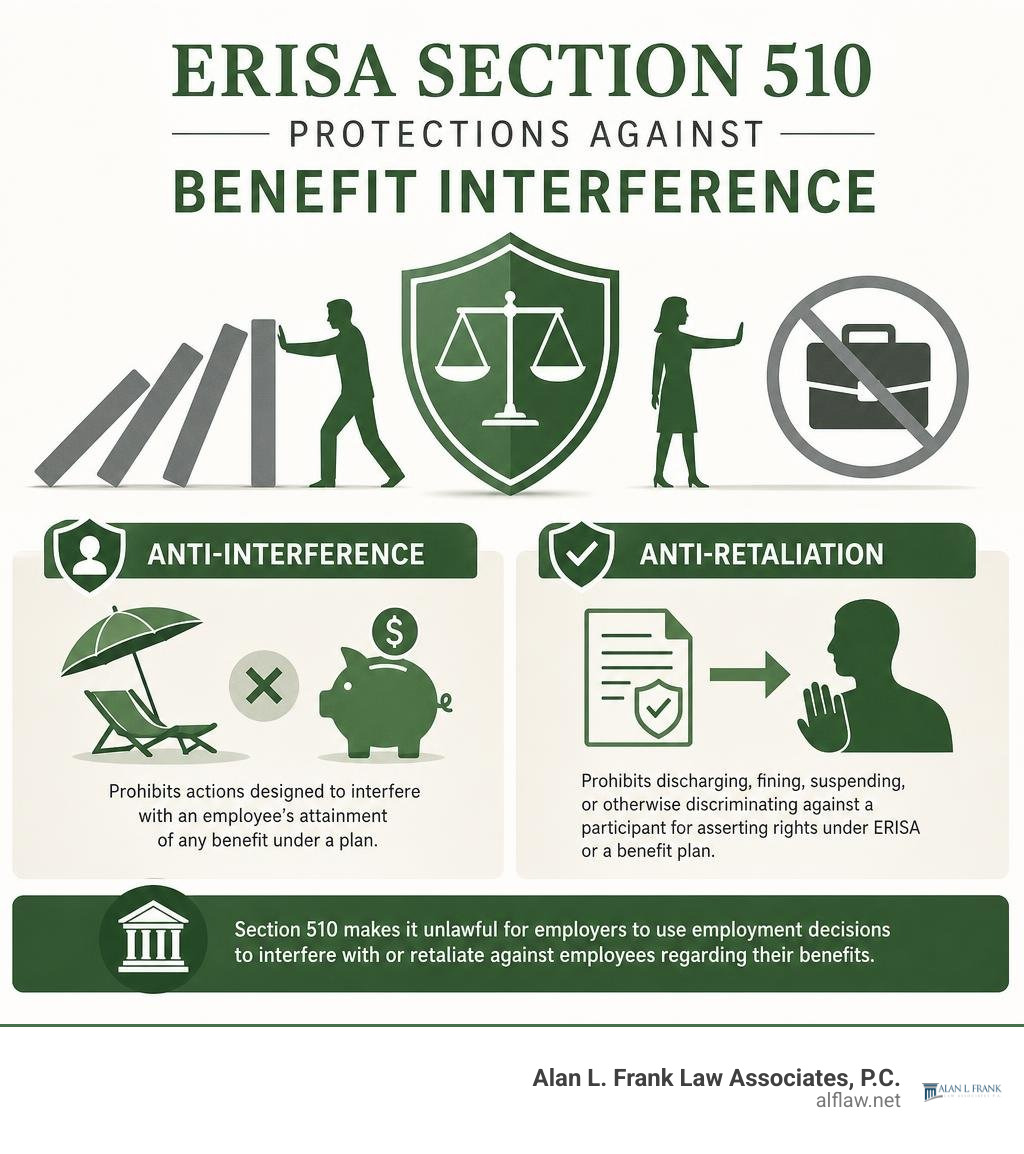
Section 510 of ERISA (codified at 29 U.S.C. § 1140) provides two distinct categories of employee protection: anti-interference and anti-retaliation.
The statute makes it unlawful for any person to discharge, fine, suspend, expel, discipline, or discriminate against a plan participant or beneficiary for exercising any right to which they are entitled under the provisions of an employee benefit plan, or for the purpose of interfering with the attainment of any right to which such participant may become entitled.
As demonstrated in cases like Reighard v. Limbach Co., Inc., employers cannot bypass these federal mandates through clever contractual drafting. The court in Reighard held that prospective waivers and pre-dispute covenants not to sue regarding future, unknown ERISA claims are void and unenforceable as against public policy. Permitting employers to enforce prospective waivers would effectively grant them a license to violate federal benefits law with impunity.
Prohibited Employer Conduct Under Federal Law
Congress designed Section 510 to prevent employers from manipulating the employment relationship to evade benefit obligations. Prohibited conduct extends well beyond explicit firings. It includes:
- Involuntary termination or pretextual “for cause” dismissals designed to eliminate benefit eligibility
- Disciplinary write-ups or demotions intended to force an employee to resign before benefits vest
- Retaliatory discharge against workers who testify, give information, or participate in formal inquiries regarding ERISA compliance
- Selective reductions in force (RIFs) targeting employees with substantial medical claims or significant accrued service
The U.S. Department of Labor (DOL) maintains active enforcement oversight through the Employee Benefits Security Administration (EBSA). Federal regulatory guidelines emphasize that when an employer terminates workers nearing major vesting milestones while retaining less experienced, less productive staff, an inference of unlawful discrimination arises.
Covered Benefit Plans and Protected Participant Rights
Section 510 protects participants and beneficiaries across a wide spectrum of private-sector plans:
- Defined Benefit and Pension Plans: Shielding workers against terminations intended to prevent them from reaching cliff-vesting thresholds (such as 3-year or 5-year vesting milestones) or accruing higher benefit tiers.
- 401(k) and Profit-Sharing Plans: Prohibiting adverse actions intended to block profit-sharing contributions or mandatory employer matching.
- Group Health Plans: Protecting employees and covered dependents from termination driven by an employer’s desire to cut high medical claims, especially under self-insured or partially self-insured arrangements where the employer pays claims directly.
- Short-Term and Long-Term Disability Plans: Barring discriminatory actions taken against employees who file claims or are likely to require extended medical leave benefits.
Legal Grounds for an ERISA Violation Termination Claim

Prevailing on an ERISA termination claim requires establishing that the employer acted with the specific intent to interfere with protected benefit rights or retaliate against the employee. An incidental loss of benefits resulting from a routine, business-motivated layoff does not violate Section 510. The employee must demonstrate that the desire to prevent benefit attainment or retaliate for benefit usage was a motivating factor in the termination decision.
Because employers rarely leave a paper trail admitting they fired someone to save on healthcare costs or pension liabilities, courts rely on established evidentiary frameworks to evaluate circumstantial proof.
| Evidentiary Framework | Burden of Proof Standard | Application in Section 510 Litigation |
|---|---|---|
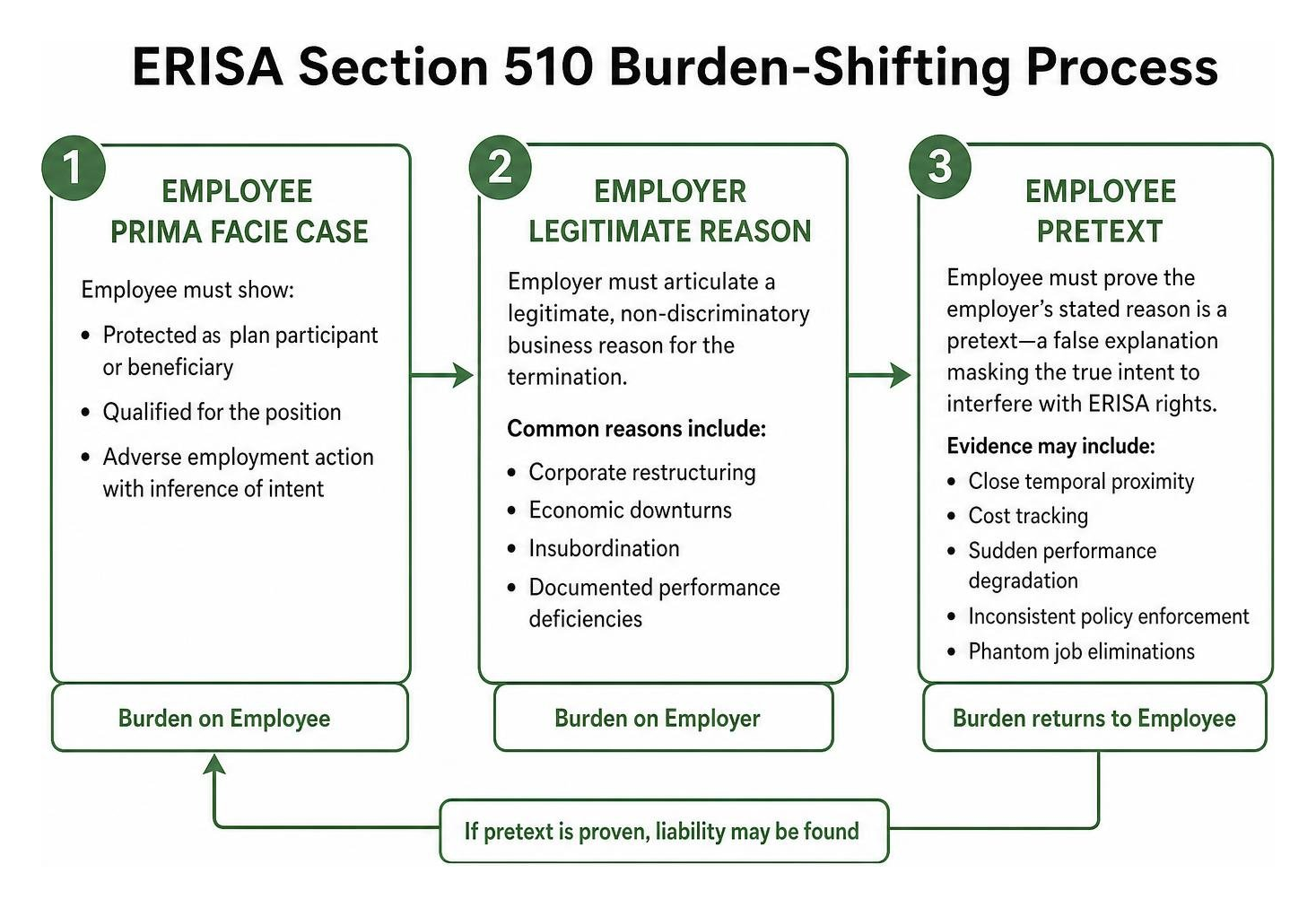
| McDonnell Douglas (Pretext Standard) | Three-stage burden-shifting framework | Used when relying on circumstantial evidence. The employee proves a prima facie case, the employer offers a legitimate non-discriminatory reason, and the employee proves that reason is a pretext. |
| Price Waterhouse (Mixed-Motives Standard) | Direct evidence of discriminatory intent | Used when direct statements or documentary evidence show benefit interference was a substantial motivating factor, shifting the burden to the employer to prove it would have made the same decision anyway. |
Establishing a Prima Facie ERISA Violation Termination Claim
To survive summary judgment under the McDonnell Douglas standard, a plaintiff must first establish a prima facie case by showing:
- They belong to a protected class (as an ERISA plan participant or beneficiary);
- They were qualified for the job position held; and
- They suffered an adverse employment action (such as discharge) under circumstances giving rise to an inference of prohibited intent.
Key circumstantial evidence showing specific intent includes:
- Close Temporal Proximity: Being fired weeks or months before a vesting milestone or right before the start of a new plan benefit year.
- Cost Tracking: Proof that management actively tracked high-dollar medical invoices or pension liabilities associated with specific employees.
- Sudden Performance Degradation: Receiving abrupt negative performance evaluations after years of consistently positive appraisals.
- Inconsistent Policy Enforcement: Strict disciplinary action applied to the plaintiff while unvested or low-cost peers were excused for identical conduct.
- Phantom Job Eliminations: Being told a position was eliminated, only to have the exact job duties reassigned to a replacement shortly thereafter.
Evidentiary Burdens in an ERISA Violation Termination Claim
Once the employee establishes a prima facie case, the burden shifts to the employer to articulate a legitimate, non-discriminatory business reason for the termination. Common employer justifications include corporate restructuring, economic downturns, insubordination, or documented performance deficiencies.
The burden then returns to the employee to demonstrate that the employer’s stated rationale is a mere pretext—a false explanation masking the underlying motive to interfere with ERISA rights. In complex federal matters involving substantial corporate documentation, handling these disputes often intersects with strategies utilized in broader commercial litigation, requiring thorough discovery of financial records, internal communications, and benefits billing data.
Temporal Proximity and Pretextual Employer Defenses
Temporal proximity between an employment decision and a benefit milestone provides potent circumstantial evidence. Federal courts scrutinize timing closely. For instance, terminating an employee with 4 years and 10 months of service under a 5-year pension plan—or firing a worker with high healthcare expenses right before a new annual deductible and plan cycle renews—raises strong red flags.
When an employer argues that an employee was dismissed for performance issues, courts examine employment records spanning several years. If an employee maintained satisfactory or exemplary ratings for a decade, an employer’s claim of sudden incompetence right before vesting invites strict judicial skepticism.
Available Remedies for Wrongful Termination Under ERISA

ERISA civil enforcement is governed strictly by Section 502(a)(3) [29 U.S.C. § 1132(a)(3)], which permits participants to bring civil actions to enjoin unlawful practices or obtain “appropriate equitable relief” to redress statutory violations.
Unlike general employment discrimination statutes or state tort claims, ERISA does not authorize punitive damages or compensation for pain and suffering. However, federal courts possess broad authority to craft equitable remedies that restore injured workers to the position they would have occupied absent the unlawful conduct.
Equitable Relief and Job Reinstatement
Job reinstatement is the preferred equitable remedy under ERISA Section 502(a)(3). When feasible, a court may order the employer to:
- Rehire the employee into their former position or a substantially equivalent role
- Restore all lost service credits and retroactively adjust pension vesting records
- Reinstate retroactive coverage under health, life, and disability benefit programs
Where intense workplace hostility, mutual distrust, or the complete elimination of a business unit makes physical reinstatement impractical, courts turn to alternative equitable substitutes.
Front Pay and Back Pay as Make-Whole Restitution
To achieve complete make-whole relief, federal courts award monetary equitable restitution:
- Back Pay: Restitutionary compensation representing the wages, salary, and lost benefits the employee would have earned from the date of wrongful discharge up to the date of judgment, minus any interim earnings acquired through reasonable mitigation efforts.
- Front Pay: An equitable monetary award granted in lieu of reinstatement. For example, in Kairys, the federal court awarded an employee $67,500 in front pay—representing the five-year compensation differential between his former position and his new employment—holding that front pay serves as an equitable proxy when reinstatement is not viable.
Surcharge, Fiduciary Duty, and Disgorgement of Profits
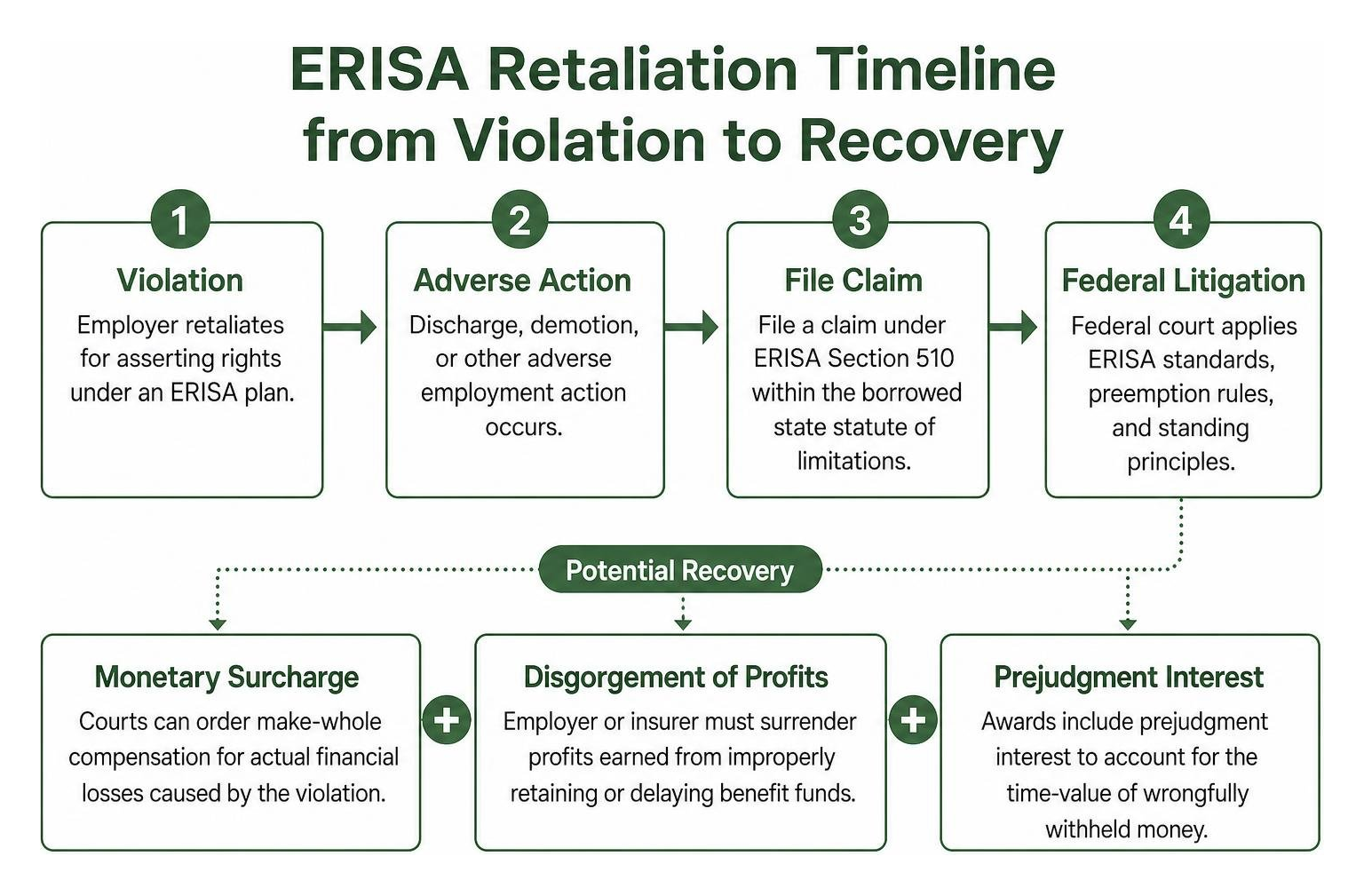
The legal landscape governing ERISA monetary remedies expanded significantly following the landmark Supreme Court decision in Cigna Corp. v. Amara. The Court established that the traditional trust-law remedy of monetary surcharge is available under Section 502(a)(3) upon a showing of “actual harm.”
As confirmed across multiple federal appellate circuits:
- Monetary surcharge enables courts to order breaching fiduciaries and employers to pay make-whole compensation for actual financial losses caused by their wrongful acts.
- Courts may order disgorgement of profits, requiring an employer or insurer to surrender profits earned from improperly retaining or delaying benefit funds.
- Awards frequently incorporate prejudgment interest under federal common law to account for the lost time-value of wrongfully withheld money.
Procedural Rules, Deadlines, and Preemption Doctrines
Navigating an ERISA claim requires compliance with strict procedural rules, jurisdictional boundaries, and statutory deadlines. Factual disputes over severance releases, plan documents, and underlying agreements are governed by federal pleading standards, as illustrated in cases like Wharton v. Duke Realty, LLP, where courts evaluate whether claims of post-termination retaliation survive initial motions to dismiss.
Borrowing State Statutes of Limitations
Because ERISA Section 510 does not contain an express, built-in statute of limitations, federal courts apply the state borrowing doctrine. Under this rule, federal courts adopt the limitations period from the most analogous state-law cause of action in the forum state where the claim arose.
In Jerome SANDBERG v. KPMG PEAT MARWICK, LLP, the Second Circuit held that ERISA Section 510 claims are most analogous to state-law wrongful discharge or retaliatory discharge claims, rather than general breach of contract actions.
Because state statutes of limitations for retaliatory discharge are often short—frequently two years from the date of the adverse employment action—claimants must act promptly. Missing this borrowed state deadline will result in total dismissal of the federal action.
Complete Preemption of State Wrongful Discharge Claims
Employees often ask whether they can bypass ERISA’s equitable relief limitations by filing a state common-law lawsuit for wrongful termination, intentional infliction of emotional distress, or breach of contract to pursue punitive damages.
The Supreme Court resolved this definitively in INGERSOLL-RAND COMPANY v. Perry McCLENDON. The Court held that ERISA Section 514(a) and Section 502(a) completely preempt state common-law wrongful termination claims whenever the alleged discharge is based on an employer’s desire to avoid benefit obligations. Under ERISA Section 502(e)(1), federal district courts maintain exclusive jurisdiction over Section 510 claims. Pleading state tort theories will not avoid preemption if establishing liability depends on the existence and terms of an ERISA-covered plan.
Standing After Plan Dissolution or Lump-Sum Distribution
A frequent tactic used by employers facing benefit disputes is terminating the underlying benefit plan or disbursing plan funds in a lump sum, arguing that the former worker is no longer a current “plan participant” and therefore lacks standing to sue under Section 502.
The Ninth Circuit rejected this loophole in McBride v. PLM International, Inc.. The court ruled that under ERISA’s whistleblower and anti-retaliation provisions, participant status must be measured at the time of the alleged violation, not at the time the lawsuit is filed. Holding otherwise would allow an employer’s wrongful conduct to immunize it from federal liability simply by liquidating the plan before a discharged whistleblower can file a complaint.
Frequently Asked Questions About ERISA Retaliation Claims
Can an employer fire you right before your pension vests?
No. Discharging an employee to prevent them from reaching pension vesting thresholds is a direct violation of ERISA Section 510. If an employee is terminated shortly before reaching a cliff-vesting milestone (such as months before completing five years of service), courts view this timing as strong circumstantial evidence of specific intent to interfere with benefit rights. The employer must prove a legitimate, non-discriminatory business reason for the timing of the discharge.
Are punitive damages available in an ERISA retaliation lawsuit?
Punitive damages and compensation for emotional distress are not available under ERISA. Civil remedies under Section 502(a)(3) are limited to appropriate equitable relief. However, this includes substantial monetary restitution such as back pay, front pay, lost benefit reinstatement, surcharge for actual financial harm, prejudgment interest, and discretionary awards of reasonable attorney’s fees and litigation costs.
How does an ERISA retaliation claim intersect with FMLA litigation?
ERISA Section 510 claims often arise concurrently with Family and Medical Leave Act disputes. When an employee takes approved medical leave to treat a serious health condition, an employer managing a self-insured healthcare plan may see rising medical claims and decide to terminate the worker under the guise of an unexcused absence or workforce reduction.
In these situations, the termination may violate both the FMLA (for unlawful interference and retaliation) and ERISA Section 510 (for terminating the employee to cut healthcare costs). Navigating these overlapping federal claims requires comprehensive experience across both statutory frameworks, including formal FMLA litigation.
Conclusion
Facing an unlawful termination after years of dedicated service is financially and personally devastating. When an employer hides behind restructuring, budget cuts, or sudden performance criticisms to avoid paying earned retirement benefits or costly medical claims, they violate federal law.
Successfully asserting an ERISA Section 510 claim requires rapid action to preserve critical evidence, satisfy state-borrowed statutes of limitations, and construct a compelling record of employer pretext.
At Alan L. Frank Law Associates, P.C., our legal team represents employees across Pennsylvania and New Jersey—including Philadelphia and Jenkintown—in complex federal employment and benefits disputes. If you suspect your termination was motivated by benefit interference or retaliation for exercising your statutory rights, we are prepared to evaluate your case, hold your employer accountable, and pursue the full make-whole restitution you deserve.