
Beginner’s Guide to Securities Litigation Basics


Beginner’s Guide to Securities Litigation Basics
Fundamental Legal Frameworks in Securities Litigation
Securities litigation operates under a comprehensive web of federal and state statutory frameworks designed to preserve market transparency and protect investors from deceptive practices. At the federal level, investor actions are primarily governed by two foundational pieces of legislation: the Securities Act of 1933 (the “Securities Act”) and the Securities Exchange Act of 1934 (the “Exchange Act”).
While the Securities Act regulates initial public offerings and the primary issuance of financial instruments, the Exchange Act oversees ongoing secondary market trading, periodic reporting requirements, and broad corporate disclosures. Central to this protection is Rule 10b-5, promulgated under Section 10(b) of the Exchange Act, which serves as the principal catch-all mechanism prohibiting fraudulent schemes, affirmative material misstatements, and actionable omissions of fact in connection with the purchase or sale of any security.
Elements of Section 10(b) and Rule 10b-5 Claims
To establish a successful private securities fraud claim under Section 10(b) and Rule 10b-5, an investor must plead and prove six essential substantive elements:
- A Material Misrepresentation or Omission: The defendant made a false statement of material fact or omitted a fact necessary to make prior statements not misleading under the circumstances.
- Scienter: The defendant acted with a wrongful state of mind, defined as an intent to deceive, manipulate, or defraud, or demonstrated severe recklessness representing an extreme departure from ordinary care.
- A Connection with the Purchase or Sale of a Security: The deceptive conduct directly touched upon a securities transaction.
- Reliance (Transaction Causation): The investor relied on the misrepresentation, often established through the fraud-on-the-market doctrine for publicly traded securities.
- Economic Loss: The plaintiff suffered an actual measurable financial decline in the value of their holdings.
- Loss Causation: A direct causal nexus between the revelation of the concealed truth and the subsequent drop in the security’s market price.
Proving these technical components requires meticulous financial reconstruction. Our firm regularly leverages extensive accounting forensics when evaluating these matters, as reflected in our past success securing a Multi-Million Dollar Securities Claim in Federal Court Settled for aggrieved investors.
Section 11 Strict Liability and Section 20(a) Control Person Claims
Unlike claims brought under the Exchange Act, Section 11 of the Securities Act provides investors with a virtually strict liability remedy for registration statements containing untrue statements of material fact or omitting material information required by law. Plaintiffs bringing Section 11 claims are not required to demonstrate corporate scienter, negligence, or direct investor reliance. Once an investor proves a registration statement was materially deficient when it became effective, liability attaches directly to the issuer, its signing directors, and underwriters, subject only to statutory affirmative defenses such as negative causation or underwriter due diligence.
When an underlying violation of the Exchange Act is established, Section 20(a) extends joint and several liability to “control persons.” To maintain an actionable Section 20(a) claim, a plaintiff must demonstrate:
- An underlying primary violation of the federal securities laws committed by the controlled entity.
- Direct or indirect control exercised by the individual defendant over the primary violator’s general operations.
- Specific power or influence possessed and exercised to control the specific corporate transaction or disclosure upon which the primary violation is predicated.
A corporate title or board seat alone is insufficient; plaintiffs must show practical operational control over the specific disclosure channels or corporate mechanisms that allowed the misrepresentation to occur.
Pleading Standards Under Federal Securities Litigation Laws
Navigating private securities litigation requires clearing some of the strictest procedural hurdles in federal civil practice. The Private Securities Litigation Reform Act of 1995 (PSLRA), codified under 15 U.S.C. § 78u-4, amended the Exchange Act to mandate heightened pleading standards designed to filter out non-meritorious lawsuits before costly discovery begins.
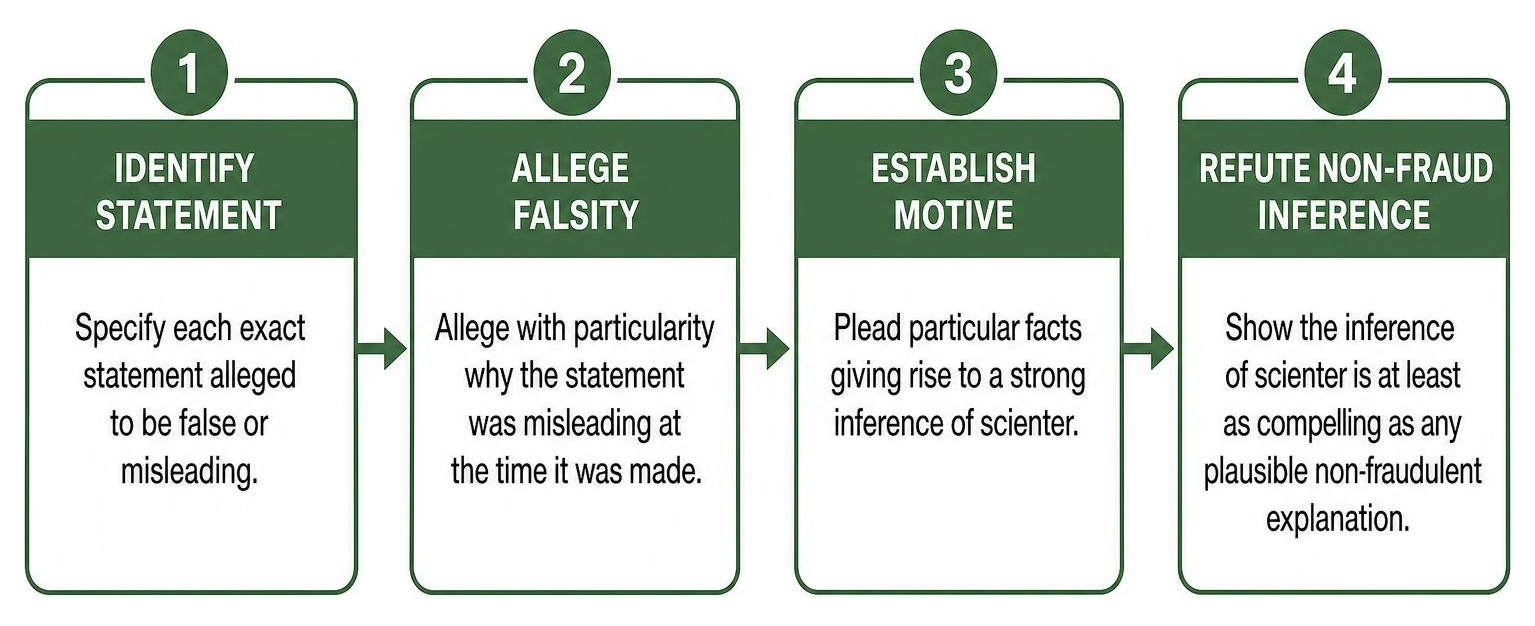
Under Federal Rule of Civil Procedure 9(b) and the PSLRA, plaintiffs cannot rely on broad or generalized allegations of wrongdoing. Every complaint alleging fraud must specify:
- Each exact statement alleged to have been false or misleading.
- The precise reasons why the statement was misleading at the time it was made.
- Specific factual support identifying the time, place, speaker, and content of each communication.
- Particularized facts giving rise to a “strong inference” of scienter that is at least as compelling as any plausible non-fraudulent alternative explanation.
Meeting these rigorous thresholds requires extensive pre-filing investigation. We apply this standard when pursuing shareholder relief, such as in our $6,000,000 Settlement Securities Fraud Claims GA Federal Court resolution.
Internal Control Failures and Corporate Disclosure Deficiencies
Federal securities regulations place substantial emphasis on corporate governance and transparency. Public issuers are required to establish, maintain, and regularly evaluate their Internal Control over Financial Reporting (ICFR). Under Sections 302 and 906 of the Sarbanes-Oxley Act of 2002 (SOX), principal executive and financial officers must personally certify the effectiveness of these disclosure controls in periodic SEC filings. When an issuer affirms that its internal controls are sound while knowingly or recklessly failing to maintain essential operational safeguards, those statements expose the company and its management to fraud liability.
Loss of WKSI Status and Unregistered Shelf Issuances
A prime example of operational breakdowns translating into fraud claims occurs when issuers mishandle shelf registration statements under SEC Rule 415. Highly capitalized, frequent issuers qualify as Well-Known Seasoned Issuers (WKSIs), enjoying the privilege of filing automatically effective shelf registrations without pre-paying fees or specifying fixed dollar limits on future securities issuances.
However, if an issuer becomes subject to a regulatory enforcement order or felony conviction, it becomes an “ineligible issuer” and loses its WKSI privileges. Ineligible issuers must specify exact offering caps, pay registration fees upfront, and implement real-time tracking systems to ensure offerings do not exceed registered limits.
When a major international financial institution lost its WKSI status and subsequently failed to implement any internal mechanism to track issuances, it sold approximately $17.7 billion in unregistered structured notes and exchange-traded notes over several years. As analyzed in the judicial Majority Opinion, repeatedly assuring the public of robust internal controls while lacking basic tracking tools established actionable recklessness under Section 10(b). The breakdown resulted in a $200 million SEC civil penalty, more than $161 million in disgorgement, and hundreds of millions in investor rescission offers.
Accounting Irregularities, Storm Warnings, and Foreign Investigations
Accounting manipulation remains a frequent driver of complex securities cases. Deceptive practices often involve manipulating long-term contract accounting, such as the percentage-of-completion method, where corporate actors deliberately underestimate expected costs to prematurely accelerate recognized revenues while tracking true liabilities on hidden secondary ledgers.
Litigating these claims requires navigating procedural timing defenses. Under Section 11, plaintiffs face a strict one-year statute of limitations triggered upon discovery or after receiving “inquiry notice” via public storm warnings. As established by the United States Court of Appeals For the Second Circuit, storm warnings only start the limitations clock if the public disclosures relate directly to the specific misrepresentations alleged. Furthermore, under Federal Rule of Civil Procedure 15(c), amended complaints can incorporate granular findings from foreign regulatory and criminal proceedings, relating back to earlier filings if the claims arise from the same core fraudulent conduct.
Proving Loss Causation, Damages, and Choosing Dispute Forums

Securities claims cannot succeed purely on the existence of corporate misstatements; the law requires proof that the fraud directly caused quantifiable economic harm.
Corrective Disclosures, Price Impact, and Damages Metrics
Loss causation requires showing that the market reacted negatively to the revelation of previously concealed facts. A corrective disclosure does not need to be a formal admission of fraud; it may occur through regulatory announcements, earnings restatements, investigative journalism, or operational admissions that reveal the underlying truth.
Econometricians measure this harm through formal event studies, isolating fraud-related drops from broader market or sector declines. Two primary metrics define aggregate shareholder losses:
- Disclosure Dollar Loss (DDL): Measures the absolute change in market capitalization from the trading day immediately preceding a corrective disclosure to the trading day immediately following it.
- Maximum Dollar Loss (MDL): Measures the total decline in market capitalization from the stock’s highest class-period peak to the day following the final corrective disclosure.
Statements made by corporate officers after an initial corrective disclosure are scrutinized carefully. While vague reassurances may be dismissed as non-actionable puffery, concrete denials of systemic risk can form the basis of subsequent fraud claims if proven false.
Federal Court Litigation Versus FINRA Arbitration Forums
Aggrieved investors have distinct legal pathways depending on the nature of the misconduct and the parties involved. While broad corporate accounting schemes and nationwide disclosure failures are typically litigated in federal class actions, disputes arising from broker-dealer misconduct, unauthorized trading, or unsuitable investment recommendations are resolved primarily through dispute resolution forums.
For retail and institutional investors dealing with broker negligence, utilizing FINRA as a Forum for Claims Involving Stockbroker Misconduct offers an efficient alternative to traditional courtroom trials. Working alongside dedicated FINRA Attorneys allows investors to arbitrate claims involving churning, failure to supervise, and professional malpractice. When seeking legal guidance from a Securities Lawyer Stock Market Broker Malpractice Negligence professional, investors gain direct access to arbitration panels equipped to assess individual account mismanagement.
Modern Trends in Securities Litigation Filings and Market Losses
According to the Securities Class Action Filings 2025 Midyear Assessment, securities class action filings have shown distinct shifts in thematic exposure and market impact:
- Semiannual core filings remained steady at 111 federal actions in the first half of 2025, matching historical averages.
- Despite flat filing volumes, Maximum Dollar Loss climbed 154% to $1.85 trillion, driven largely by “mega filings” (cases involving over $5 billion in DDL or $10 billion in MDL), which comprised 91% of total MDL.
- Emerging tech claims surged, with Artificial Intelligence (AI) misrepresentation lawsuits reaching 12 filings in the first half of 2025 alone, on pace to significantly surpass previous annual totals.
- The Consumer Non-Cyclical sector saw a 31% rise in filings, heavily propelled by disclosure challenges in biotechnology and pharmaceutical pipelines.
Frequently Asked Questions About Investor Claims
What must an investor prove to establish a Rule 10b-5 securities fraud claim?
An investor must establish six core components: an affirmative material misstatement or actionable omission, scienter (intentional misconduct or severe recklessness), a direct connection to a securities transaction, investor reliance (often presumed under the fraud-on-the-market theory), actual economic loss, and loss causation linking the disclosure of the truth to the financial decline.
How does the loss of WKSI status create exposure to securities fraud litigation?
When an issuer loses Well-Known Seasoned Issuer status, it becomes an ineligible issuer prohibited from selling unlimited unregistered securities off automatic shelf registrations. If the company fails to establish internal tracking mechanisms, continues offering unregistered securities above statutory limits, and falsely certifies in SEC filings that its internal controls are effective, it faces significant exposure to Section 10(b) fraud claims, SEC enforcement penalties, and mandatory rescission liabilities.
When does the storm warnings doctrine trigger the statute of limitations for securities claims?
Under the storm warnings doctrine, the one-year statute of limitations for Section 11 claims begins running on the date an investor receives inquiry notice—when public information would suggest to an investor of reasonable diligence that fraud likely occurred. However, judicial precedent requires that the storm warning relate directly and specifically to the precise misrepresentations alleged in the lawsuit, rather than general disclosures of market downturns or broad corporate financial distress.
Protecting Investor Rights Through Targeted Legal Action
Navigating complex financial disputes requires specialized trial experience, deep statutory knowledge, and rigorous financial analysis. Whether addressing nationwide corporate disclosure failures, complex unregistered offerings, or specific brokerage misconduct, shareholders and institutions must act within strict statutory deadlines to preserve their claims.
At Alan L. Frank Law Associates, P.C., we represent individual and institutional investors in federal court litigation and FINRA arbitration from our offices in Philadelphia, PA, Jenkintown, PA, and across Pennsylvania and New Jersey. If your portfolio has suffered substantial financial damages due to misstated disclosures, internal control failures, or broker negligence, explore your legal options for Securities Litigation Investment Losses and contact our team to evaluate your path to recovery.