
Securities Losses Demand the Right Investment Fraud Attorneys Near Me


Securities Losses Demand the Right Investment Fraud Attorneys Near Me
Recognizing Warning Signs and Broker Misconduct
If you have suffered substantial financial losses due to broker misconduct or deceptive advisory practices, investment fraud attorneys help investors investigate broker misconduct, navigate FINRA arbitration or civil litigation, and recover lost capital. When an investment goes sour, brokers often blame market volatility. While market fluctuations are normal, deliberate deception, negligence, and regulatory violations are not. Broker misconduct happens when registered representatives or financial institutions violate securities regulations, breach their fiduciary obligations, or outright lie to line their own pockets.
Some of the most widespread forms of broker misconduct include:
- Unauthorized Trading: Buying or selling securities in your non-discretionary account without obtaining your prior permission for each transaction.
- Churning: Excessive trading in your account primarily to generate hefty commissions for the broker, running up fees while diminishing your capital.
- Misrepresentation and Omission: Leaving out critical risk factors or providing outright false information about a security to convince you to invest.
- Unsuitability: Recommending complex, speculative, or illiquid products that do not match your age, financial situation, risk tolerance, or retirement goals.
- Theft and Conversion: Directly misappropriating your funds or routing them into unauthorized private accounts.
To help distinguish between regular investment risks and illegal behavior, consider how professional advisory practices differ from illicit schemes:
| Standard Financial Advisory Practice | Fraudulent Investment Scheme |
|---|---|
| Clear, transparent disclosure of all risks and fee structures | Guarantees of high returns with “zero risk” or “downside protection” |
| Thorough assessment of your personal risk profile and timeline | High-pressure sales pitches demanding immediate money transfers |
| Comprehensive, verifiable monthly statements from clearinghouses | Evasive, vague answers when asked for documentation or withdrawals |
| Adherence to suitability and fiduciary standards | Unregistered securities or unvetted private placement programs |
What Is Investment Fraud and What Type of Crime Is It Considered?
Investment fraud is categorized as a white-collar, nonviolent crime committed for illicit financial gain. It occurs when an individual or entity uses deception, manipulation, false statements, or hidden omissions to induce individuals to purchase, hold, or sell financial instruments.
Under both federal and state laws, investment fraud spans multiple civil and criminal violations:
- Criminal Deception: Fraudulent operators can face criminal prosecution from the Department of Justice (DOJ) or state attorneys general, leading to felony charges, substantial criminal fines, and prison sentences.
- Regulatory Offenses: Civil enforcement agencies—such as the Securities and Exchange Commission (SEC)—regularly issue sanctions, bars, and civil monetary penalties against rogue brokers.
- Breach of Fiduciary Duty: Registered investment advisers have an affirmative legal duty to act strictly in your best financial interest. Violating this duty gives rise to civil liability.
While government agencies punish criminal behavior, they rarely secure total financial restitution for victimized individuals. Recovering your direct financial losses requires private legal action against the responsible parties.
Red Flags That Demand Investment Fraud Attorneys Near Me
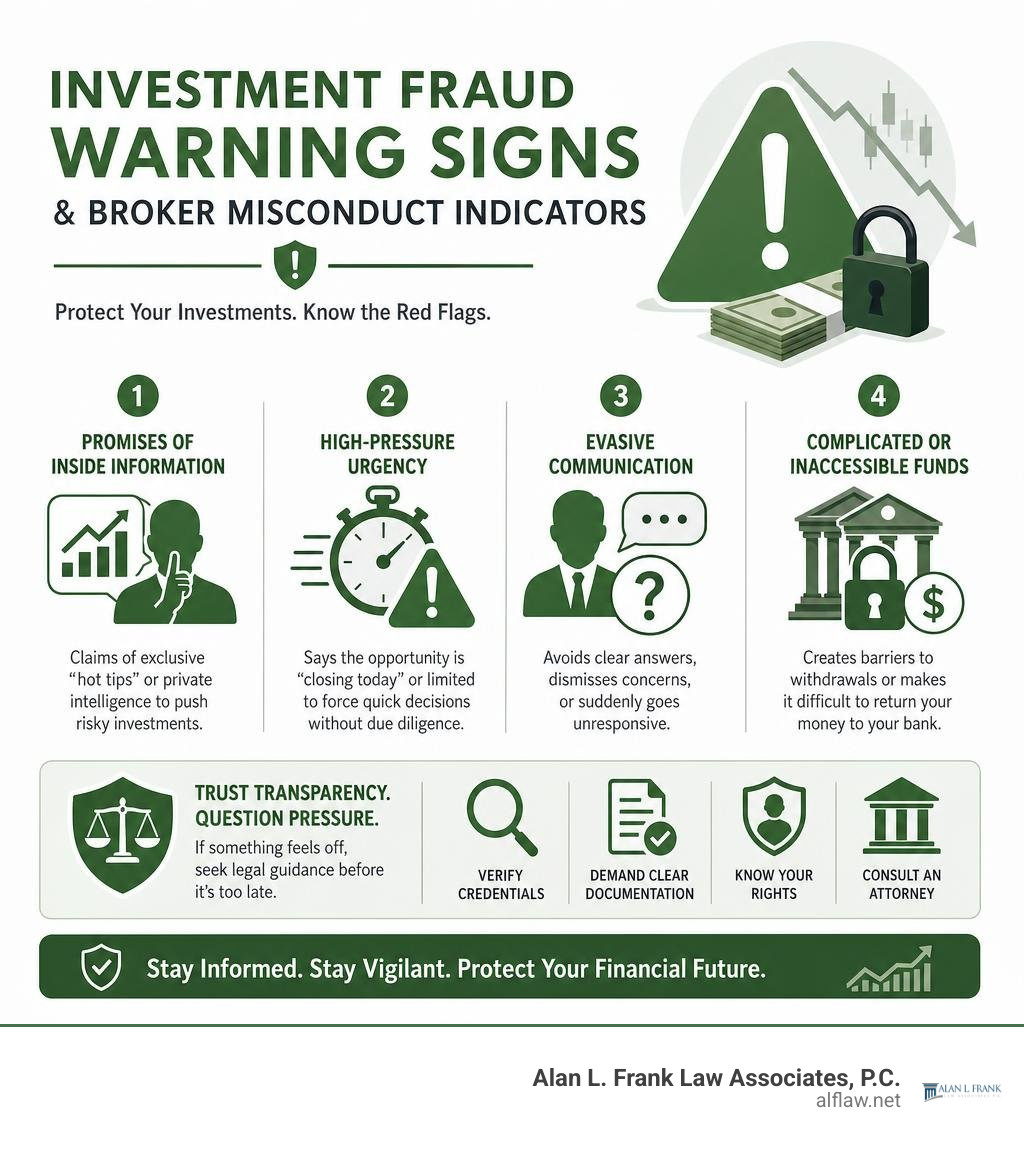
Fraudulent advisors and predatory brokers often rely on specific psychological and operational tactics to keep clients compliant and quiet. If you notice any of the following warning signs, it is time to consult a Securities Lawyer Stock Market Broker Malpractice professional:
- Promises of Inside Information: A broker who claims they are sharing an exclusive “hot tip” or private corporate intelligence out of personal goodwill is often trying to manipulate you into unvetted, risky positions.
- High-Pressure Urgency: Fraudsters often claim an opportunity is “closing today” or that allocations are strictly limited. This artificial urgency is designed to stop you from doing basic due diligence.
- Evasive Communication: When your questions regarding falling returns, portfolio allocations, or hidden management fees are met with excuses, dismissiveness, or sudden radio silence, your capital is likely in jeopardy.
- Complicated or Inaccessible Funds: If a broker creates continuous administrative hurdles whenever you request a partial distribution or attempt to wire your money back to your primary bank account, you may be caught in a financial trap.
Why You Need Investment Fraud Attorneys Near Me to Recover Losses
Taking on large Wall Street brokerages, regional investment firms, or deceptive registered representatives is an uphill climb for individual investors. Brokerage firms retain experienced legal defense teams specifically trained to shift the blame onto you, claiming you were a “sophisticated investor” who willingly accepted the downside risks.
Choosing among investment fraud attorneys near me is not just about geography; it is about finding securities counsel with the experience to investigate misconduct, calculate damages, and pursue recovery through the right forum.
Our team understands how to dismantle these standard corporate defenses. Investors who partner with seasoned counsel recover significantly more capital than those who attempt to navigate complex administrative processes on their own. We identify supervisory failures within broker-dealer networks, perform forensic damage calculations, and demand financial accountability. When you need to recover your investment, dedicated legal advocacy levels the playing field.
Can Legal Action Successfully Recover Your Investment Losses?
Yes. Defrauded investors have well-established legal avenues to pursue financial recovery, including arbitration and court litigation.
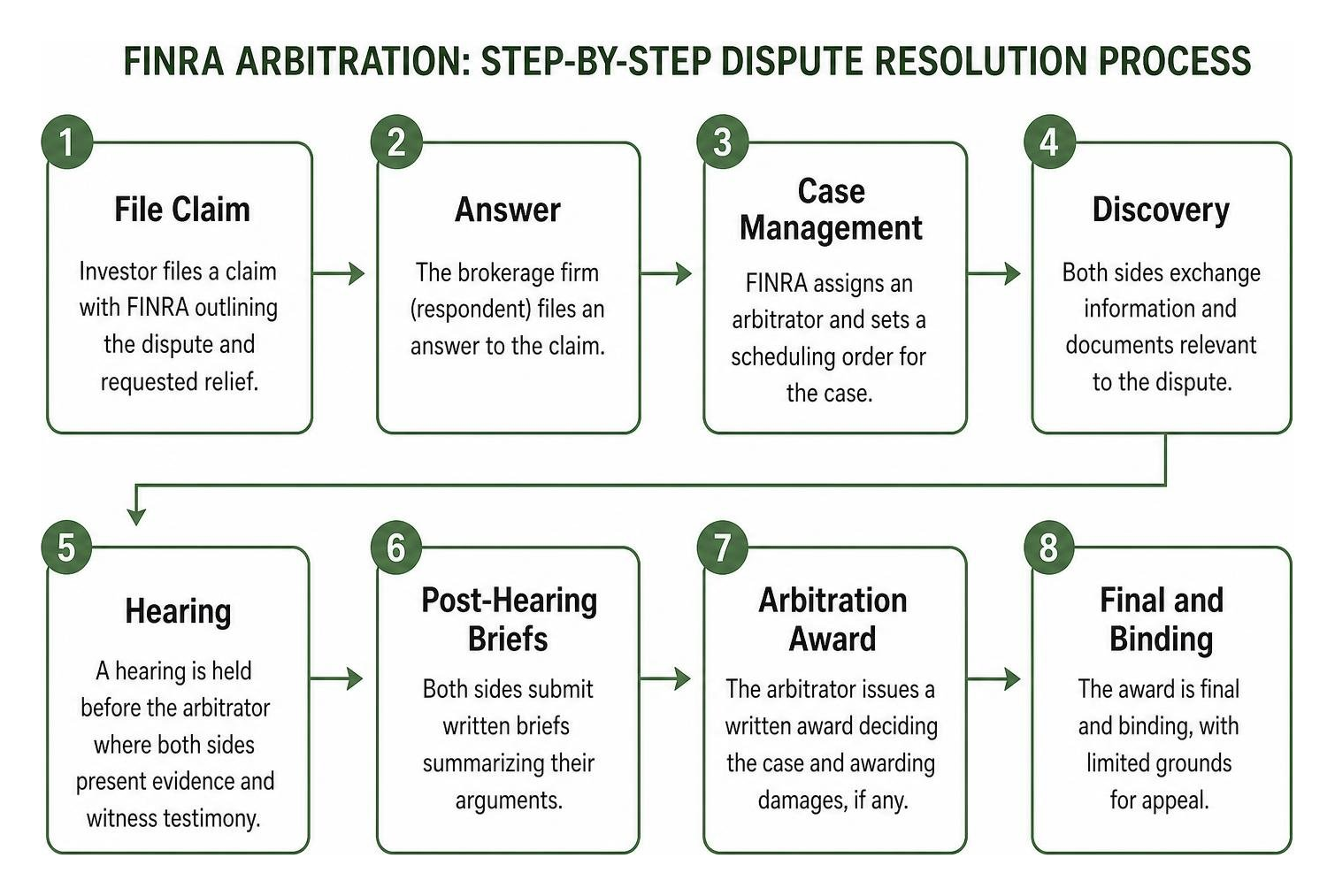
Most brokerage agreements contain mandatory arbitration clauses requiring disputes to be resolved through the Financial Industry Regulatory Authority (FINRA) rather than public jury trials. FINRA dispute resolution offers a binding forum where an arbitration panel evaluates the evidence and awards damages.
We routinely represent clients in this setting, having secured substantial outcomes such as a FINRA Award Against Merrill Lynch for $150,000. Understanding how to leverage FINRA as a Forum for Claims allows investors to bypass court backlogs and resolve misconduct disputes efficiently.
Depending on the underlying misconduct, a successful arbitration or civil action can recover:
- Compensatory Damages: Direct restoration of the principal capital you lost due to fraud, unsuitable advice, or unauthorized trades.
- Statutory Interest: Interest accrued on your lost capital from the date the misconduct occurred.
- Attorney’s Fees and Administrative Costs: Reimbursing your legal expenses when allowed by statute or contract terms.
- Punitive Damages: Additional financial penalties assessed against brokerage firms in cases involving egregious, willful misconduct.
How Finding the Right Investment Fraud Attorneys Near Me Helps Hold Brokers Accountable
Holding a financial advisor liable requires more than pointing out that an investment went down. Broker-dealers have an affirmative legal duty under securities regulations to supervise their registered representatives. When a brokerage fails to maintain adequate internal compliance systems, it shares direct liability for the resulting damages.
Our firm has deep experience uncovering failure-to-supervise patterns, as demonstrated by our FINRA Award Against Morgan Stanley for $310,000 in damages related to breach of fiduciary duty and professional negligence.
Whether we are addressing unsuitable investments, hidden kickbacks, or resolving a complex multi-million dollar securities claim in federal court, our attorneys conduct the detailed discovery needed to hold both individual brokers and their supervising firms legally accountable.
Critical Steps to Take When Suspecting Broker Fraud
The moments immediately following the realization that your broker has deceived you are crucial. How you respond can preserve your financial claim or accidentally damage your ability to recover funds later.

Brokers engaging in illicit activities like churning and unauthorized trading often count on investor confusion to delay legal action. For instance, in our FINRA Award Against Oppenheimer, establishing clear paper trails proved central to securing a $115,000 award for the investor.
Immediate Actions to Protect Your Legal Claim
If you suspect financial misconduct, follow these concrete steps right away:
- Secure Complete Account Records: Download and print every monthly account statement, trade confirmation, customer agreement, and portfolio summary. Do not rely on your broker’s digital portal remaining accessible.
- Preserve All Communications: Save every email, text message, voicemail, and handwritten note from your broker. If your advisor made verbal promises or explanations over the phone, write a detailed contemporaneous log including the date, time, and specifics of what was said.
- Avoid Confronting the Broker Without Counsel: Calling your broker in anger often gives them a heads-up to alter their notes or fabricate explanations. Keep your interactions limited and professional.
- Do Not Sign Broad Release Agreements: If a brokerage firm offers you a partial “goodwill” settlement or asks you to sign new account waivers, do not sign anything before an attorney reviews the paperwork. These agreements often contain broad liability releases that extinguish your right to pursue full recovery.
- Schedule an Immediate Case Review: Securities claims carry strict time limits. Seeking counsel early allows your legal team to examine your records, assess damages, and position your claim effectively, much like we did in a million dollar investor dispute claim that settled favorably prior to final hearings.
Frequently Asked Questions About Investment Loss Recovery
Do I need a lawyer for an investment fraud case?
While you are not legally required to have an attorney to submit a complaint or file for FINRA arbitration, proceeding without one puts you at a severe disadvantage. Securities arbitration involves complex discovery rules, financial damages modeling, and substantive securities laws.
Brokerage houses are represented by experienced defense litigators whose sole job is to minimize or eliminate what the firm pays you. Retaining experienced securities counsel ensures that your claim is properly structured, procedural deadlines are met, and your case is backed by compelling financial evidence.
How long does an investment fraud case typically take?
The duration of an investment fraud case depends on the dispute forum and case complexity. A standard FINRA arbitration proceeding generally takes between 12 to 18 months from the initial Statement of Claim to the final evidentiary hearing and award.
Cases involving straightforward issues or smaller damages may resolve faster, especially if the brokerage firm opts to engage in early settlement negotiations or formal mediation. Complex matters involving multiple parties, extensive institutional discovery, or federal court litigation can take longer.
What is the average recovery in an investment fraud claim?
While past performance does not guarantee future results in any individual legal action, industry data shows that investors who retain legal counsel recover an average of 60% to 70% of their actual losses through negotiated settlements or arbitration awards.
Your total recovery amount depends on several factors, including:
- The strength and availability of documentary evidence
- The degree of the broker’s supervisory failure
- The collectability and insurance coverage of the brokerage firm
- The specific nature of the misconduct (such as outright theft versus unsuitability)
Conclusion
Securities losses caused by fraud, deceit, or broker malpractice can disrupt your retirement plans, family security, and business stability. You do not have to accept unlawful financial conduct as mere bad luck in the market.
At Alan L. Frank Law Associates, P.C., we draw on extensive trial and arbitration experience to hold negligent brokers and financial institutions accountable. If you believe your investment losses were caused by improper financial practices, contact our team today to evaluate your case through our Securities Litigation & Investment Losses practice.