
The Survival Guide to 50 50 Shareholders Dispute and Director Deadlocks


The Survival Guide to 50 50 Shareholders Dispute and Director Deadlocks
Resolve 50 50 Director Disputes Before the Business Stalls
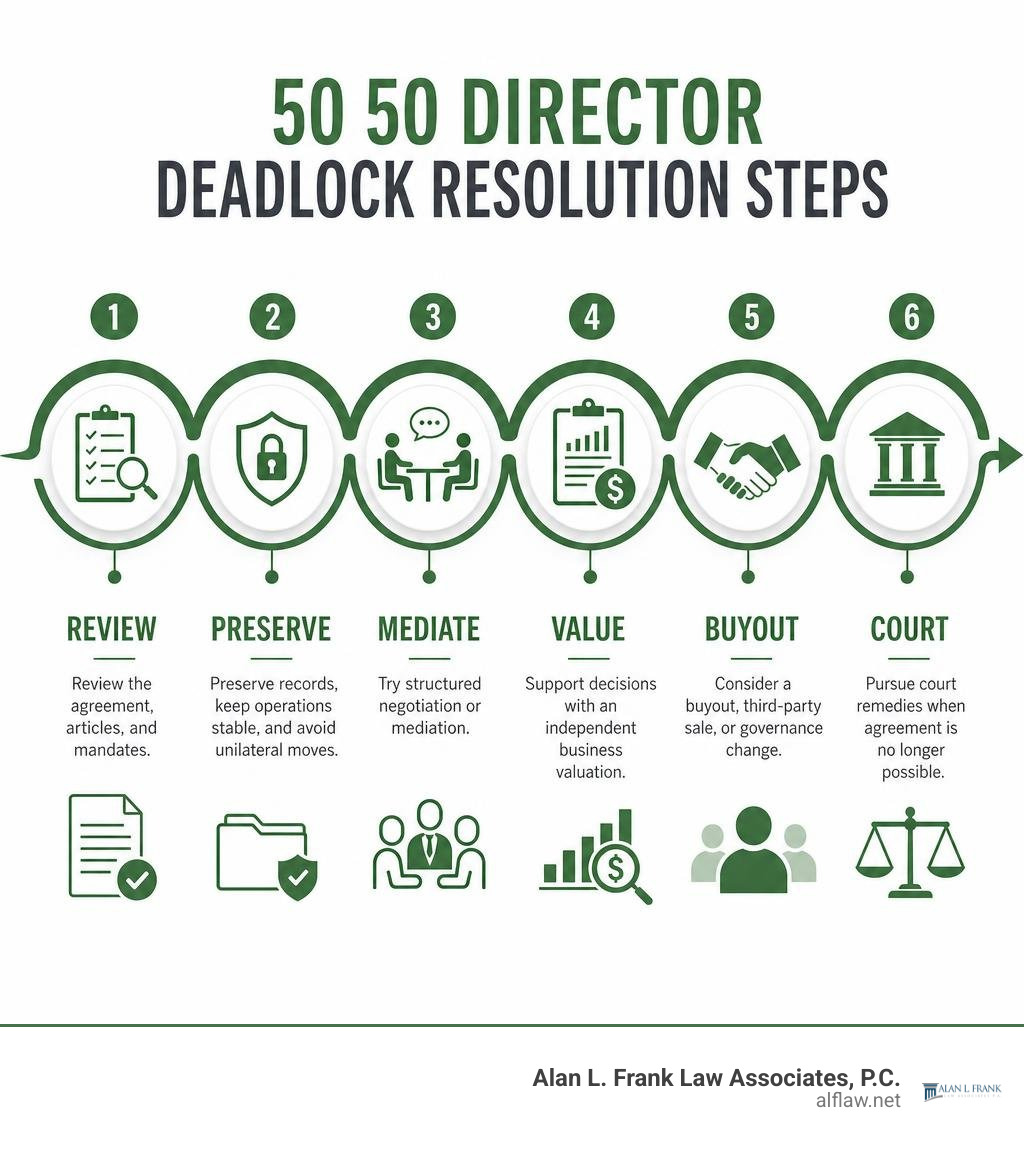
When equal directors cannot agree, act early to protect the company and its value. For 50 50 director disputes, the practical path is usually to:
- Review the shareholders’ agreement, articles, and bank mandates for any deadlock procedure.
- Keep records, maintain ordinary business operations, and avoid unilateral moves such as excluding the other director or moving company funds.
- Try a structured negotiation or commercial mediation, supported by an independent business valuation.
- Consider a buyout, third-party sale, governance change, or court remedy if agreement is no longer possible.
A 50/50 structure can feel fair at the start. But it gives neither owner a majority to make key decisions alone. Ordinary resolutions generally need more than 50% support, while major decisions may require a 75% vote. Without a casting vote, neutral director, or contractual exit process, a disagreement over funding, hiring, dividends, strategy, or a sale can freeze the business.
Deadlock is not just an uncomfortable boardroom dispute. It can interrupt payroll decisions, delay customer commitments, strain bank relationships, and erode the value both owners worked to build. If one director also withholds information, takes company opportunities, blocks access, or uses company assets for personal benefit, the dispute may involve more than deadlock. It may create grounds for urgent legal action.
I am Alan L. Frank, Managing Attorney at Alan L. Frank Law Associates, P.C., with more than 20 years of experience leading complex commercial litigation involving business disputes and financial harm. This guide explains the practical and legal options available in 50 50 director disputes, from early negotiation through litigation or arbitration when necessary.
Anatomy of 50 50 Director Disputes and Corporate Deadlock
A 50/50 corporate deadlock occurs when an equal equity split meets an evenly divided board of directors, leaving neither party with the statutory voting power to pass ordinary resolutions. In business practice across Pennsylvania and New Jersey, founders frequently design their businesses with an even balance of power, assuming mutual goodwill will always prevail. However, corporate statutes require a majority vote to conduct standard business governance. When two equal directors hold opposing viewpoints on fundamental matters, the business enters structural paralysis.
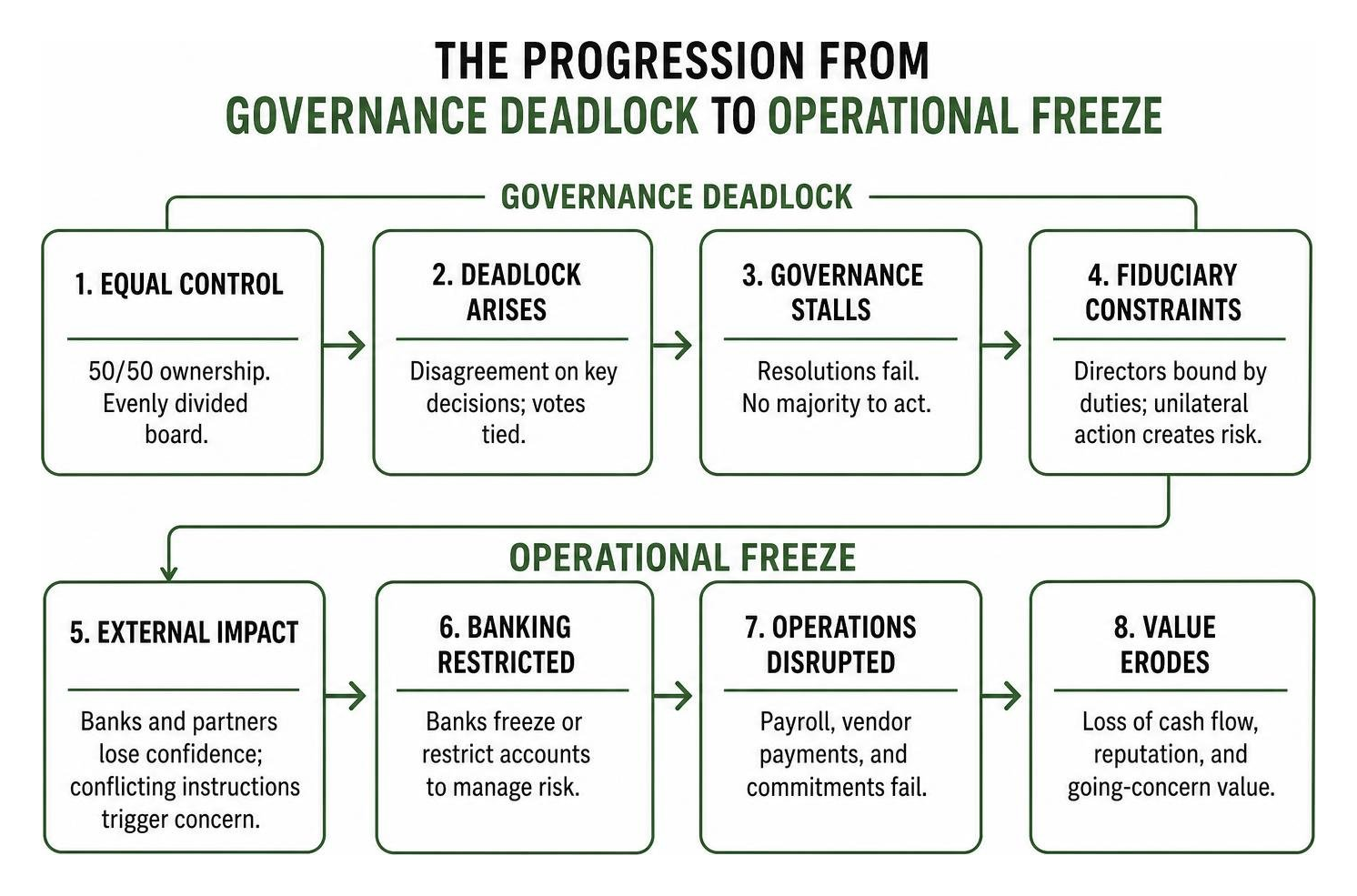
This deadlock is particularly damaging because closely held entities often operate as quasi-partnerships. In these companies, the owners are not passive investors; they are the sole executive managers who rely on daily collaboration. When personal trust disintegrates, corporate governance stalls completely. Board meetings fail for lack of quorum or end in persistent voting ties. Meanwhile, each director remains bound by strict fiduciary duties of care, loyalty, and good faith. Attempting to maneuver around a deadlock by making unilateral commercial commitments can expose a director to significant personal liability.
Furthermore, operational paralysis quickly spills into external commercial relationships. Commercial lenders and financial institutions are sensitive to internal management conflicts. If a bank detects that equal directors are issuing contradictory instructions, it may unilaterally freeze the company’s operating accounts to protect itself from liability. Once banking access is frozen, routine payroll, vendor payments, and operational contracts fail, accelerating the loss of going-concern value.
Structural Vulnerabilities in Equal Ownership Companies
The root cause of an equal ownership crisis is rarely a single bad decision. Rather, it is the structural architecture of the company. In standard corporate formation documents, statutory defaults dictate that ordinary resolutions require greater than 50% approval, while extraordinary corporate transactions—such as mergers, asset sales, or structural charter amendments—often require supermajority thresholds up to 75%.
When an entity operates with two directors and equal share ownership:
- Neither director can pass an ordinary resolution independently.
- Neither director can unilaterally appoint or remove executive officers.
- Neither shareholder can vote out the opposing director at an annual meeting.
- The board cannot approve new capital calls, debt financing, or distributions without unanimous consent.
Without an odd-numbered board or an express casting vote, this governance model functions like a vehicle with two steering wheels being turned in opposite directions. The resulting stalemate prevents timely responses to market conditions, key employee departures, and competitive threats.
Early Warning Signs That 50 50 Director Disputes Are Escalating
Deadlocks rarely appear overnight. They typically follow an identifiable pattern of behavioral and operational friction. Identifying these signals early allows directors to seek legal counsel before irreversible corporate damage occurs.
- Communication Breakdown: Routine executive communications transition from collaborative discussions to formal, guarded emails, and eventually to silence or communications conducted solely through private attorneys.
- Management Exclusion: One director unilaterally cuts off the other from cloud software, enterprise resource planning (ERP) platforms, customer databases, or general ledger accounting systems.
- Unauthorized Financial Transactions: Sudden, unilateral changes appear in corporate financial management, including altered banking signature mandates, undisclosed executive compensation draws, or unexplained disbursements to third parties.
- Competing Business Activities: A frustrated director diverts prospective business opportunities, registers a separate competing legal entity, or solicits company clients and employees behind the scenes.
- Unilateral Equity Dilution Attempts: One party attempts to issue new shares to friendly third parties or convert questionable personal loans into voting equity to break the 50/50 balance.
Contractual and Internal Mechanisms to Resolve Deadlock
The cleanest and most cost-effective way to break an operational stalemate is through the mechanisms established within the company’s organizational documents. When disputes arise, the first step is analyzing the existing bylaws, operating agreements, and shareholder contracts to identify any contractual pathways for breaking ties.
Our firm routinely counsels clients through complex Corporate and Transactional Matters to address governance gaps, execute structural buyouts, or reconstruct corporate operating agreements to resolve internal conflicts.
Tie-Breaker Clauses and Casting Vote Provisions
When founders recognize deadlock risks during entity formation or governance restructuring, they often adopt tie-breaker provisions to prevent total paralysis:
- Neutral Third-Party Arbiters: Governing agreements can designate a trusted neutral advisor, such as an industry specialist or corporate attorney, who holds a provisional voting seat solely for resolving deadlocked issues.
- Advisory and Independent Directors: Expanding an even board to an odd-numbered board (e.g., three directors) ensures that every major strategic dispute produces a decisive majority outcome.
- Rotating Casting Votes: Agreements may grant a casting vote that alternates annually between the two directors, incentivizing reasonable behavior since the power balance shifts every twelve months.
- Partitioned Operational Authority: Governance documents can divide decision-making authority by department. For instance, one director maintains sole final authority over technical and product decisions, while the other retains sole operational authority over sales, accounting, and compliance.
Structured Buy-Sell and Exit Mechanisms
When internal governance mechanisms can no longer preserve the working relationship, the business must separate ownership interests. Well-drafted agreements utilize defined contractual exit mechanics.
| Buyout Mechanism | Core Operational Structure | Primary Strategic Advantage | Primary Risk or Drawback |
|---|---|---|---|
| Shotgun Clause (Russian Roulette) | Partner A sets a binding price per share; Partner B must either purchase Partner A’s shares or sell their own shares at that price. | Forces Partner A to propose a strictly fair valuation, as they do not know whether they will be a buyer or seller. | Wealth disparities can allow a liquid partner to intentionally lowball a capital-constrained partner who cannot finance a purchase. |
| Texas Shootout (Internal Auction) | Both deadlocked directors submit confidential sealed bids to an escrow agent indicating the price at which they are willing to buy the other out. | The highest bidder acquires the entire company, maximizing enterprise valuation between motivated owners. | Can escalate into an irrational bidding war that depletes the acquiring director’s operational cash reserves. |
| Appraisal-Based Buyout | An independent certified business appraiser (or the average of two distinct appraisals) determines the fair market value of the equity. | Produces an objective, evidence-based valuation free from emotional or liquidity-based manipulation. | Appraisals can be time-consuming, expensive, and subject to contentious disputes regarding underlying valuation methods. |
Alternative Dispute Resolution for Equal Business Owners

When governing documents lack functional tie-breaker or buyout terms, equal directors do not need to head straight into open court. Public litigation can damage customer relationships, alarm lenders, and drain corporate capital. Alternative dispute resolution (ADR) provides a confidential setting to resolve conflicts and preserve going-concern value.
Engaging Independent Mediation in 50 50 Director Disputes
Commercial mediation is an effective, non-binding mechanism for deadlocked directors. Unlike a judge or arbitrator, a seasoned commercial mediator does not impose a ruling. Instead, the mediator facilitates structured, without-prejudice negotiations to uncover the commercial realities behind the legal posturing.
In closely held companies, personal disputes often mask distinct underlying business objectives. One director may wish to scale rapidly and reinvest profits, while the other seeks consistent dividend distributions or an orderly exit. A skilled mediator can help structure:
- A customized stock redemption plan financed through corporate cash flows over several years.
- An asset division or business demerger, allowing each director to walk away with a functional operating unit, distinct customer book, or proprietary asset.
- Equalization payments and transitional consulting agreements that address equity disparities while avoiding immediate tax penalties.
Binding Arbitration vs Out-of-Court Demergers
If mediation does not yield a consensual agreement, binding arbitration offers a private alternative to trial court litigation. When an operating agreement contains a mandatory arbitration clause, disputes regarding fiduciary duty breaches, valuation conflicts, or governance ties are submitted to a neutral arbitrator whose award is legally enforceable in state and federal courts.
Alternatively, deadlocked directors can negotiate a voluntary, out-of-court corporate demerger. In a demerger, the company’s operating assets, real property, accounts receivable, and staff are divided to form two separate, non-competing entities. When structured in compliance with state corporate and tax frameworks, a demerger allows both founders to continue operating in their areas of strength without the operational disruption of an involuntary wind-down.
Legal Remedies and Court Intervention for Deadlocked Directors

When contractual remedies are unavailable and alternative dispute resolution fails, judicial intervention becomes necessary. In Pennsylvania and New Jersey, state commercial courts possess broad statutory and equitable authority to intervene in deadlocked companies.
Our team at Alan L. Frank Law Associates, P.C. brings deep experience in commercial litigation and Securities Litigation Investment Losses, advocating for business owners facing severe operational paralysis, corporate asset diversion, and partner misconduct across multiple Cases.
Involuntary Judicial Dissolution and Winding-Up Petitions
The most definitive court remedy for corporate deadlock is a petition for involuntary judicial dissolution. Under Pennsylvania and New Jersey business corporation and LLC laws, a 50% shareholder or director may petition a court to dissolve the entity when:
- The directors are deadlocked in the management of corporate affairs.
- The shareholders are unable to break the deadlock.
- Irreparable injury to the corporation is threatened or being suffered, or the business can no longer be conducted to the advantage of the enterprise.
Judicial dissolution is an equitable remedy of last resort. Courts are generally reluctant to shut down a profitable, operating business simply because its owners disagree. However, upon a showing that trust has irrevocably broken down and management is paralyzed, the court can order the liquidation of the business, appoint a receiver to wind up operations, and distribute surplus net assets to the shareholders. Because forced liquidation under court supervision often yields significantly less than fair market going-concern value, filing for dissolution frequently serves as a strategic catalyst that drives the opposing party toward a negotiated buyout.
Shareholder Oppression Claims and Breach of Fiduciary Duty
Deadlocks rarely occur in a vacuum; they are often accompanied by bad-faith conduct. When an equal director engages in freeze-out tactics, diverts corporate opportunities, alters bank accounts, or pays themselves unauthorized management fees, the impacted co-owner can assert direct and derivative claims for shareholder oppression and breach of fiduciary duty.
Under applicable state laws, co-directors owe each other the utmost duties of good faith and loyalty. Where oppressive conduct or bad faith is proven, courts can grant flexible equitable relief, including:
- Preliminary Injunctions: Restraining orders preventing the rogue director from dissipating company capital, modifying bank mandates, or entering into unauthorized commercial contracts.
- Appointment of a Provisional Director or Custodian: Appointing an independent, court-supervised third party to take over executive voting control or oversee financial disbursements until the dispute is resolved.
- Compulsory Court-Ordered Stock Buyout: Compelling the bad-faith director to sell their equity interest—or purchase the innocent director’s interest—at an independently determined fair value without applying a minority discount.
Frequently Asked Questions About 50 50 Director Disputes
Can one director force a buyout in a 50/50 company without an agreement?
Under default corporate and LLC statutes, a 50% director cannot unilaterally force their equal partner to sell their shares without an express contractual buyout trigger, such as a shotgun or buy-sell agreement.
However, if one director engages in unlawful freeze-out tactics, self-dealing, or severe breaches of fiduciary duty, the aggrieved director can petition the court for equitable relief under state shareholder oppression statutes. In such circumstances, the court has the authority to order a compulsory buyout of one party’s equity interest at fair value to resolve the deadlock and remedy the misconduct.
What happens to company bank accounts during a severe director deadlock?
When commercial banks receive contradictory operational instructions, competing board resolutions, or notifications of serious internal litigation from equal signatories, their standard risk-management protocol is to temporarily freeze the corporate accounts.
A bank account freeze protects the financial institution from conflicting liability, but it immediately halts the company’s ability to process payroll, remit taxes, and pay vendors. To restore operational banking access, the deadlocked parties must either sign a joint operational stipulation or seek an emergency status quo injunction from a commercial court judge to authorize necessary business expenditures.
How long does it take to litigate a 50/50 deadlock dispute in court?
A fully contested shareholder and director deadlock lawsuit typically takes between 12 and 24 months to reach a final trial judgment. However, the litigation process contains several critical phases that often lead to an earlier resolution:
Because extended commercial litigation carries substantial legal expenses and risks destroying the underlying enterprise, most contested director disputes settle during the initial injunction phase or through court-ordered mediation once independent business valuations are established.
Conclusion
A 50/50 corporate deadlock represents one of the most serious organizational threats a closely held business can face. Without proactive planning, structural gridlock can quickly turn commercial success into operational paralysis, frozen bank accounts, and severe enterprise devaluation.
Resolving an equal director dispute requires early, disciplined legal strategy. Business owners must carefully review their governing agreements, maintain strict adherence to their individual fiduciary duties, avoid unilateral retaliatory actions, and leverage skilled negotiation and mediation. When fair settlement proves impossible, commercial litigation, custodian appointments, and statutory buyout petitions provide the necessary legal leverage to protect your commercial investment.
If you are facing an escalating boardroom deadlock or partner dispute, contact Alan L. Frank Law Associates, P.C. to consult with our experienced legal team. We can evaluate your governing documents, design an effective legal and valuation strategy, and work to protect your business assets and enterprise value.