
Why Your S Corp Might Be a Taxing Relationship


Why Your S Corp Might Be a Taxing Relationship
Why S Corporation Tax Issues Matter to Owners
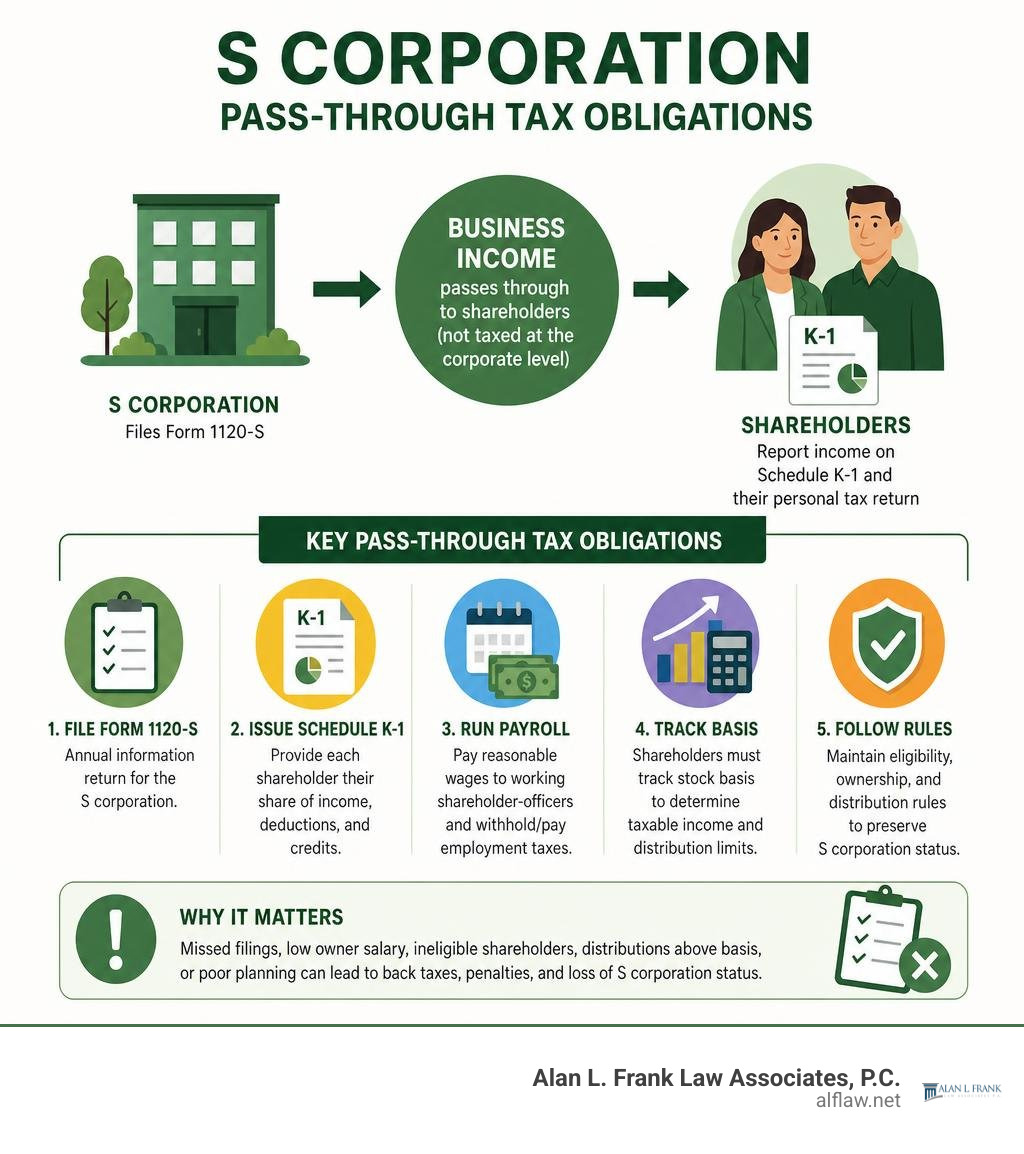
S corporation tax issues usually come down to one fact: business income can pass through to shareholders even when no cash is distributed. To stay compliant, an S corporation must file Form 1120-S, give each shareholder a Schedule K-1, run payroll for working shareholder-officers, track stock basis, and follow strict ownership and distribution rules.
The election can avoid federal C corporation double taxation and may reduce employment tax on profits properly paid as distributions rather than wages. But the benefits come with real limits. A low owner salary, an ineligible shareholder, distributions above basis, a missed filing, or a poorly planned C-to-S conversion can lead to back taxes, penalties, or even termination of S status.
I am Alan L. Frank, managing attorney at Alan L. Frank Law Associates, P.C., with more than 20 years of experience in complex business disputes, tax controversies, and financial-loss matters. As a CPA with a Master’s in Tax Law, I help business owners understand the legal and financial stakes behind S corporation tax issues before they become costly disputes.
Understanding Pass-Through Taxation and S Corporation Eligibility
Subchapter S of the Internal Revenue Code allows qualifying domestic corporations and limited liability companies (LLCs) electing corporate status to avoid federal entity-level income tax. Instead of paying corporate taxes, the company flows its net income, deductions, losses, and credits directly through to shareholders.
Maintaining Subchapter S eligibility requires strict adherence to statutory rules. The entity must:
- Be a domestic corporation or eligible domestic entity.
- Have no more than 100 allowable shareholders (family members can be treated as a single shareholder under specific rules).
- Limit shareholders strictly to individuals, certain qualifying trusts, and estates (partnerships, corporations, and non-resident aliens are prohibited).
- Maintain only a single class of stock (voting rights may differ, but distribution and liquidation rights must remain identical across all shares).
- Avoid ineligible entity classifications, such as certain financial institutions, insurance companies, or domestic international sales corporations (DISCs).
To elect S corporation status, the business must submit Form 2553 (Election by a Small Business Corporation) signed by 100% of its shareholders. The filing deadline is strict: the 15th day of the third month of the tax year in which the election is to take effect, or anytime during the preceding tax year.
At the entity level, the business reports its operations annually on Form 1120-S and issues a Schedule K-1 to each shareholder detailing their pro-rata share of corporate items. If an S corporation is required to file 10 or more returns of any type in aggregate within a calendar year, it is mandated to submit its Forms 1120-S electronically.
| Feature | S Corporation | C Corporation |
|---|---|---|
| Federal Entity Tax | Pass-through (Generally $0 federal income tax) | Flat 21% corporate income tax rate |
| Shareholder Taxation | Taxed on allocated share of profits via Schedule K-1 | Taxed on dividends actually received |
| Shareholder Restrictions | Maximum 100; no entities or non-resident aliens | Unlimited shareholders; entities and foreign owners permitted |
| Stock Classes | Single class of stock only (voting rights may vary) | Multiple classes (common, preferred) permitted |
| FICA / Payroll Taxes | Paid only on reasonable W-2 wages; distributions exempt | Paid on employee wages; dividends subject to income tax |
For ongoing legislative and administrative insights affecting entities, review Current developments in S corporations.
Pass-Through Mechanics and Shareholder Filing Requirements
Shareholders report their distributive share of corporate income, deductions, and credits on Schedule E of their personal Form 1040. Because pass-through profits are taxed in the year earned regardless of whether cash is distributed, shareholders must make quarterly estimated payments using Form 1040-ES to avoid underpayment penalties.
A critical compliance obligation is maintaining an accurate record of stock and debt basis using IRS Form 7203 (S Corporation Shareholder Stock and Debt Basis Limitations).
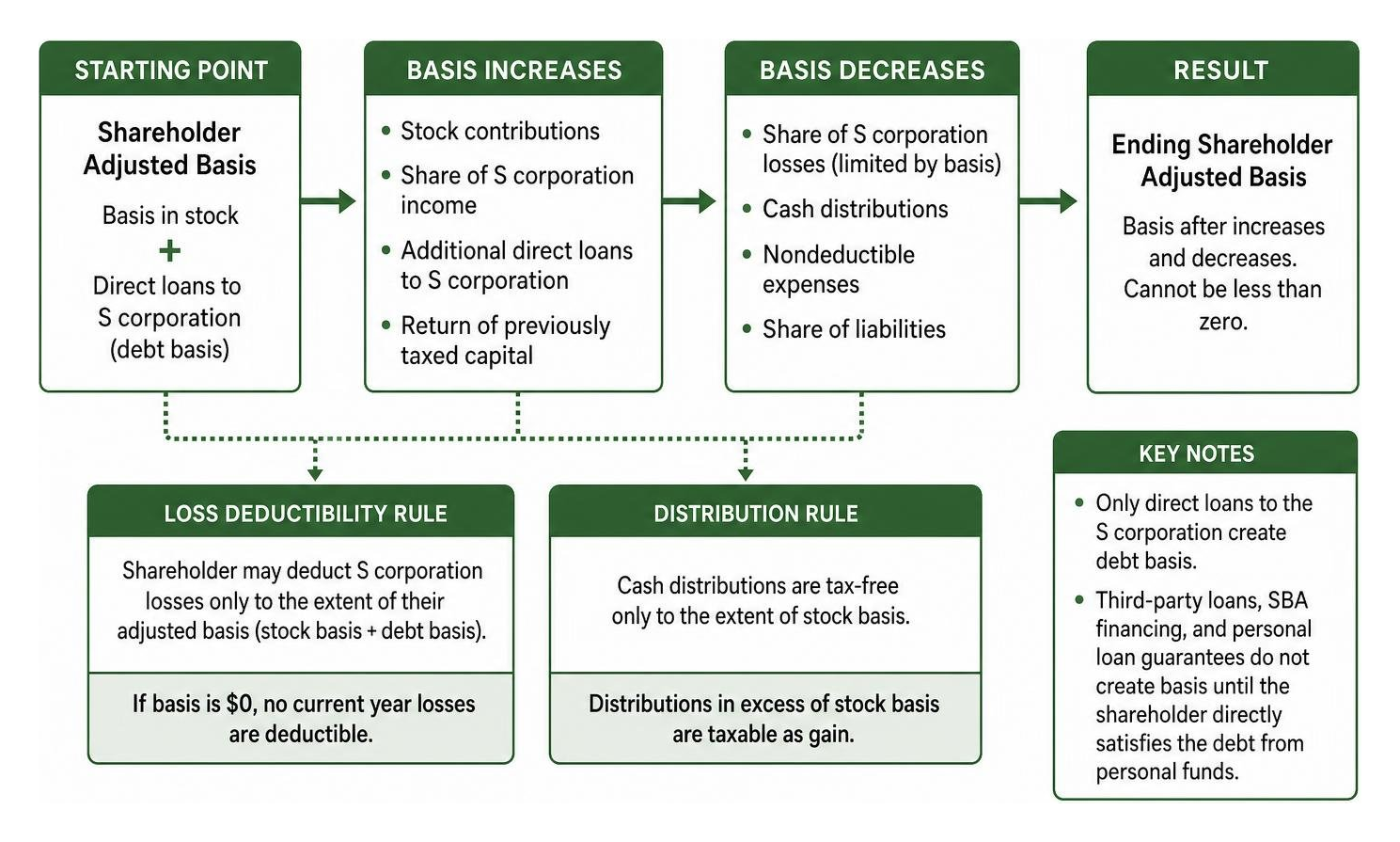
A shareholder can only deduct corporate pass-through losses to the extent of their adjusted basis in stock plus any direct loans made to the corporation (debt basis). While direct loans create debt basis that unlocks loss deductibility, debt basis does not protect cash distributions from being taxed. Third-party corporate loans, SBA financing, and personal loan guarantees do not create basis until the shareholder directly satisfies the debt from personal funds.
The Permanent Qualified Business Income Deduction Post-OBBBA
The One Big Beautiful Bill Act (OBBBA) permanently codified the Section 199A Qualified Business Income (QBI) deduction. This deduction allows eligible non-corporate taxpayers to deduct up to 20% of their Qualified Business Income from pass-through entities.
For S corporation shareholders, QBI is calculated solely on their allocable share of pass-through business profit, excluding W-2 wages paid to the shareholder. For higher-income owners, especially those operating a Specified Service Trade or Business (SSTB) such as law, health, consulting, or financial services, the deduction begins phasing out above statutory inflation-adjusted thresholds ($201,750 for single filers and $403,500 for married filing jointly).
Above these phaseout bands, the QBI deduction for non-SSTB businesses is capped based on the greater of:
- 50% of the S corporation’s W-2 wages paid to employees, or
- 25% of W-2 wages plus 2.5% of the unadjusted basis of qualified depreciable property.
Common S Corporation Tax Issues and Compliance Pitfalls
A frequent tax trap arises when business owners treat their S corporation bank account like a personal piggy bank. Unlike sole proprietorships, distributions in an S corporation are tax-free only to the extent of the shareholder’s adjusted stock basis. Distributions exceeding stock basis trigger immediate capital gains tax under Section 1368(b).
When an S corporation has a history as a C corporation, distribution accounting follows strict four-tier statutory ordering rules:
- Accumulated Adjustments Account (AAA): Distributions are tax-free up to the balance of post-election undistributed S corp earnings (reducing stock basis).
- Accumulated Earnings and Profits (E&P): Payouts exceeding AAA are treated and taxed as ordinary C corporation dividends (do not reduce stock basis).
- Remaining Stock Basis: Sourced tax-free against remaining shareholder basis.
- Capital Gains: Any excess distribution beyond basis is taxed as capital gain.
Schedule M-2 on Form 1120-S tracks the corporation’s AAA and Other Adjustments Account (OAA). Schedule M-2 must never be treated as an arbitrary balancing figure. If a corporation with C-era accumulated E&P earns passive investment income (rents, royalties, interest) exceeding 25% of its gross receipts for three consecutive taxable years, its S election terminates automatically under Section 1375.
Managing distributions and equity transactions requires experienced legal counsel in corporate and transactional matters to protect against accidental corporate non-compliance.

Navigating S Corporation Tax Issues with Reasonable Compensation
The IRS closely monitors officer compensation on Form 1120-S (Line 7). Shareholder-employees who perform more than minor services are legally classified as employees under Section 3121(d) and must receive fair-market W-2 wages subject to FICA and federal withholding before taking non-wage distributions.
Under the precedent set in Watson v. Commissioner (8th Cir. 2012), an owner taking an artificially low salary ($24,000) while withdrawing substantial distributions ($203,000) faces full reclassification of distributions into taxable wages, accompanied by back payroll taxes, statutory interest, and accuracy-related penalties.
The IRS S-Corp Audit Technique Guide flags any distribution-to-salary ratio exceeding 2:1 for examination. Automated IRS matching algorithms routinely screen returns reporting zero or nominal officer compensation relative to gross revenue. Setting reasonable compensation requires analyzing:
- The employee’s qualifications, responsibilities, and time devoted to the business.
- Comparable salaries for similar positions in the same geographic region (using Bureau of Labor Statistics wage data).
- The corporation’s gross revenue, net profit, and dividend distribution history.
State-Level S Corporation Tax Issues and Multistate Apportionment
State compliance introduces another layer of tax liability. For businesses operating or qualifying across state lines, compliance obligations differ significantly:
- In Pennsylvania, S corporations must file annual state returns to pass income through to shareholders, tracking state-specific basis adjustments and local reporting rules as outlined by the Department of Revenue.
- In New Jersey, pass-through entities must observe specific state election and withholding mandates to ensure income is allocated correctly.
- In California, S corporations face an entity-level tax equal to the greater of 1.5% of net income or an $800 annual minimum franchise tax on Form 100S (with first-year new entities exempt from the $800 minimum).
Furthermore, multi-state businesses frequently utilize state Pass-Through Entity Tax (PTET) elections to work around the federal $10,000 State and Local Tax (SALT) deduction limitation. However, PTET distributions must be structured symmetrically so they do not inadvertently create disproportionate economic rights, which would violate the single-class-of-stock restriction.
C Corporation Conversions, Built-In Gains, and Corporate Transactions
Converting an existing C corporation to an S corporation allows owners to stop double taxation, but it introduces transition rules under Section 1374.
The corporate Built-In Gains (BIG) tax imposes a 21% entity-level federal income tax on any net appreciation in corporate assets that existed at the date of conversion if those assets are sold or disposed of within a 5-year statutory recognition period. In addition, converting corporations utilizing the LIFO inventory accounting method must pay a LIFO recapture tax under Section 1363(d), payable in four equal annual installments starting with the final C corporation return.
When managing corporate structural reorganizations or entity transitions, working with an experienced business law team ensures that entity conversions are handled correctly.
Structuring S Corporation Mergers and Acquisitions
When buying or selling an S corporation, deal structure dictates post-closing tax liabilities:
- Asset Purchases: Buyers prefer asset acquisitions to achieve a fair market value step-up in depreciable tax basis, while insulating themselves from historical liabilities.
- Stock Purchases: Sellers prefer stock sales to obtain capital gains rates and avoid asset-level gain recognition.
- Section 338(h)(10) Elections: Corporate buyers and S corporation shareholders can jointly elect to treat a qualified stock purchase as a deemed asset acquisition, providing the buyer with a full basis step-up while keeping the legal stock structure intact.
- Section 336(e) Elections: Provides a similar deemed asset sale mechanism when the acquirer is a non-corporate entity, partnership, or individual.
- Type F Reorganizations: Sellers frequently execute a pre-closing Type F reorganization, rolling the target into a holding company structure to permit non-qualifying institutional buyers to acquire the operating company without terminating flow-through tax status.
IRS Enforcement Trends and Tax Controversy Risks in 2026
The IRS has deployed automated analytics to cross-reference Schedule K-1 distributions against Form 1125-E officer compensation schedules.
Common audit triggers include:
- Zero officer compensation reported on Form 1120-S Line 7 alongside substantial shareholder distributions.
- Distribution-to-salary ratios exceeding 2:1.
- Shareholder loss deductions claimed without an attached Form 7203 validating adequate stock or debt basis.
- Appreciated property distributions characterized as non-taxable return of capital.
- Ineligible entity shareholders holding legal title to shares.
When audits uncover unrecorded payroll obligations, the IRS can assess a 20% accuracy-related penalty alongside personal liability under the Trust Fund Recovery Penalty (IRC Section 6672) against responsible corporate officers.
If an S election is inadvertently invalidated due to an ineligible shareholder or missed filing deadline, corporations can seek administrative relief under Revenue Procedure 2013-30 within 3 years and 75 days of the original effective date by demonstrating reasonable cause.
Frequently Asked Questions About S Corporation Taxes
What is the 2:1 distribution-to-salary audit trigger for S corporations?
The IRS Audit Technique Guide for S corporations instructs examiners and automated compliance systems to flag returns where non-wage distributions exceed officer W-2 compensation by a 2:1 margin or greater. If an audit determines salary was set below market rates to avoid FICA taxes, the IRS will recharacterize distributions into wages under Watson v. Commissioner.
When does an S corporation trigger the corporate built-in gains tax?
Under IRC Section 1374, an S corporation triggers the built-in gains tax if it was previously a C corporation and sells appreciated assets within five years of the S election effective date. The tax is assessed at the maximum corporate rate (21%) on the net unrealized built-in gain that existed on the conversion date.
Can an S corporation distribute appreciated real estate tax-free to shareholders?
No. Under Section 311(b), distributing appreciated property (such as commercial real estate) from an S corporation to a shareholder is treated as a deemed sale at fair market value. The corporation recognizes a taxable gain that flows through to shareholders, creating tax liability without generating cash proceeds.
Conclusion
An S corporation offers valuable tax benefits, but failing to respect its operational boundaries can lead to costly tax controversies and penalties. Whether establishing officer compensation, resolving basis accounting errors, navigating multi-state filings, or planning an acquisition, proactive governance protects your bottom line.
At Alan L. Frank Law Associates, P.C., our attorneys bring deep experience in commercial disputes, tax controversy defense, and corporate transactions. If your business is facing an audit, shareholder dispute, or restructuring challenge, our team is prepared to protect your enterprise.
Explore our practice in tax matters, probate and estate planning to schedule a consultation.