
Commercial Tenant Eviction Process Explained Step by Step


Commercial Tenant Eviction Process Explained Step by Step
How to Evict a Commercial Tenant Who Has Not Paid Rent
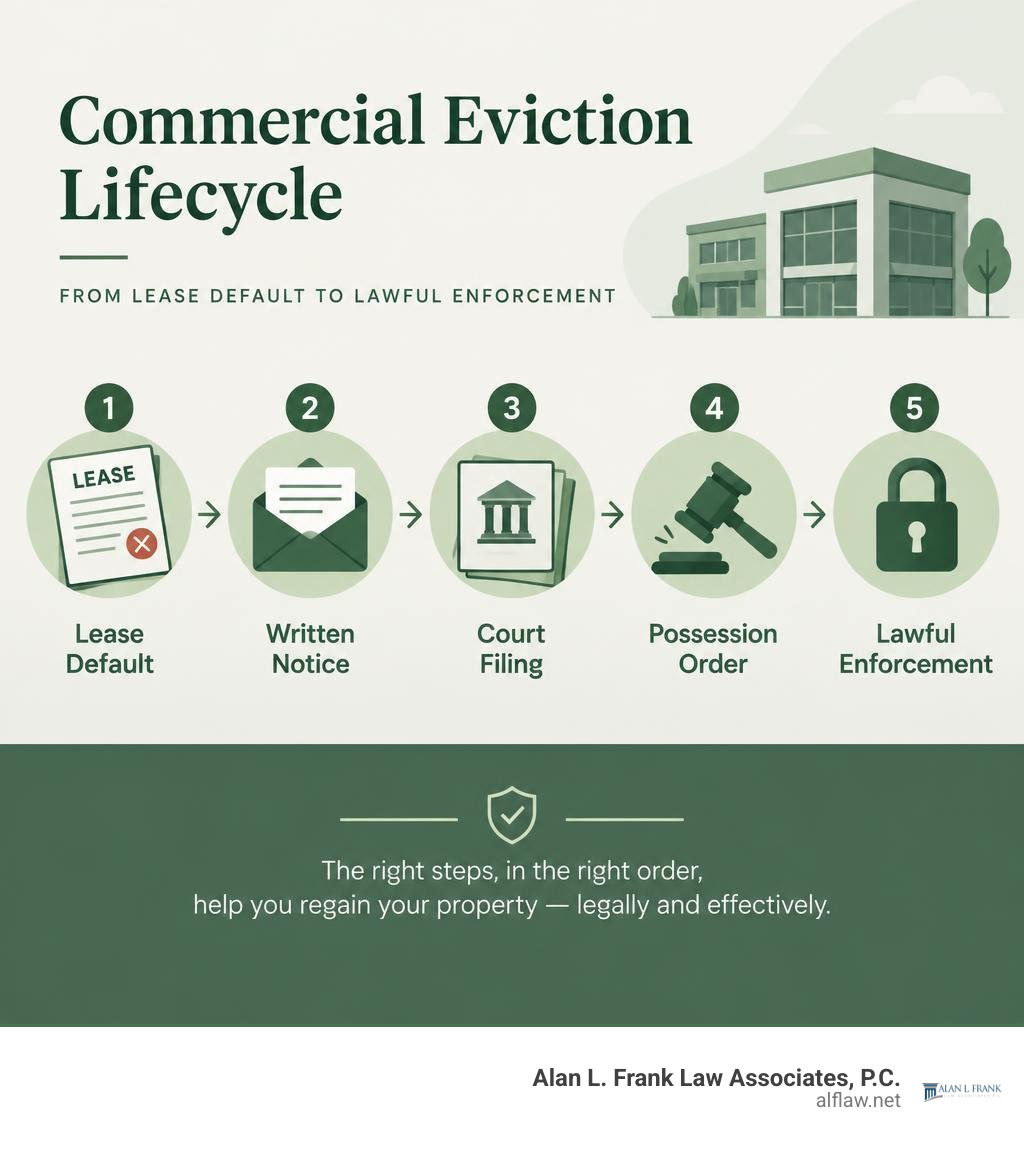
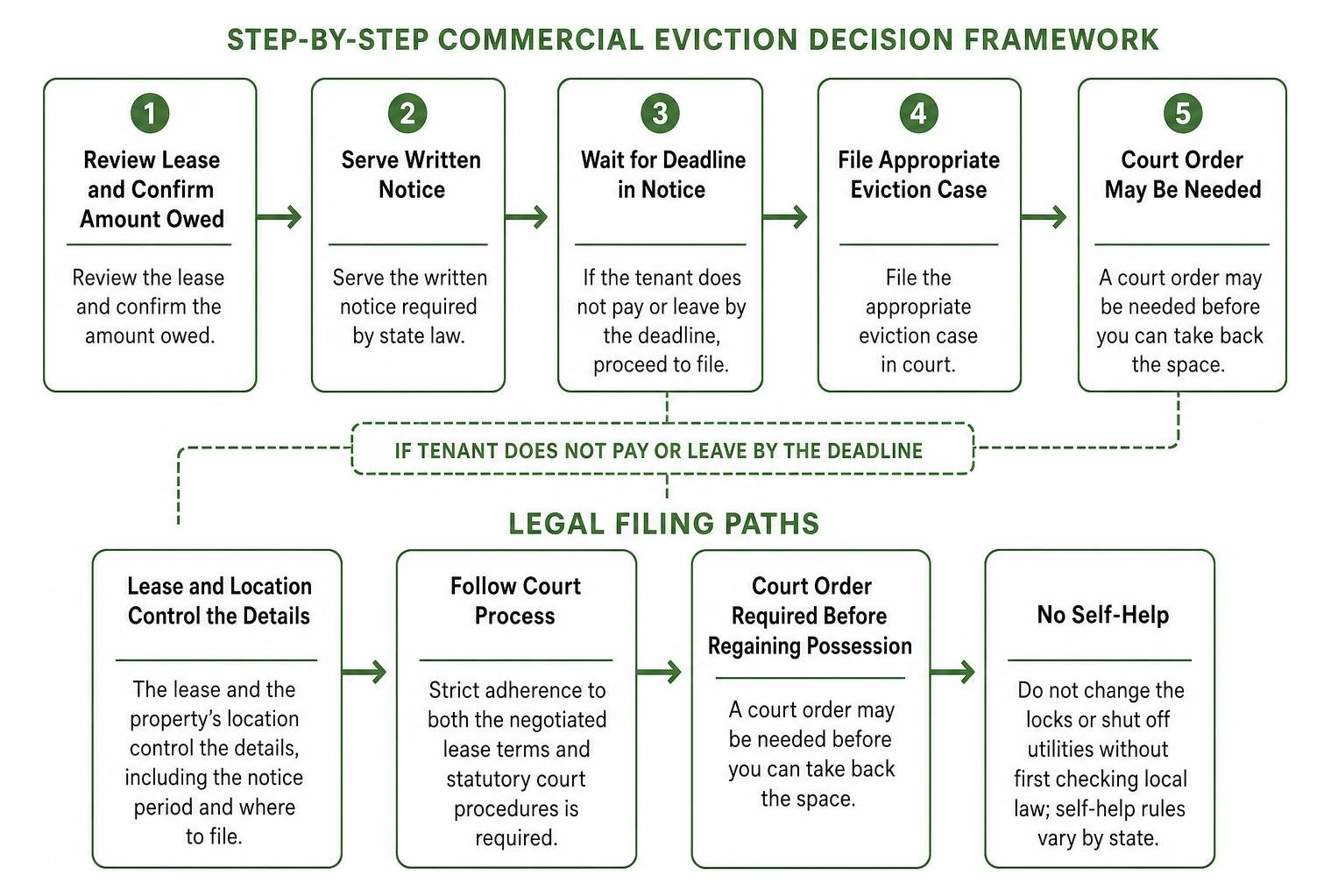
To evict a commercial tenant for unpaid rent, review the lease, confirm the amount owed, and serve the written notice required by state law. If the tenant does not pay or leave by the deadline, file the appropriate eviction case. A court order may be needed before you can take back the space. Do not change the locks or shut off utilities without first checking local law; self-help rules vary by state.
The lease and the property’s location control the details, including the notice period and where to file. Getting those steps right can prevent delays when rent is already overdue.
I am Alan L. Frank, and I have led a firm handling complex commercial litigation for over 20 years. That business-dispute experience shapes this guide to how to evict commercial tenant businesses while protecting your rights.
How to evict commercial tenant word roundup:
- Constructive Eviction Explained for Tenants and Landlords
- What Is Real Estate Litigation and Do You Need Legal Representation
Legal Grounds and Requirements: How to Evict a Commercial Tenant
Evicting a commercial tenant is vastly different from removing a residential tenant. Commercial leases are treated as arms-length business contracts between sophisticated parties. As landlords, we possess broad contractual freedom to define default events, establish cure timelines, and determine remedies. However, exercising those remedies requires strict adherence to both the negotiated lease terms and statutory court procedures.
A commercial eviction typically originates from one of two basic categories: monetary defaults or operational breaches. When a tenant defaults, a landlord cannot simply resort to immediate physical removal. Doing so risks liability if the tenant counterclaims with constructive eviction claims or sues for wrongful lockout damages.
Legal Grounds: Understanding How to Evict a Commercial Tenant for Lease Violations
While failure to pay base rent is the primary catalyst for commercial evictions, non-monetary operational breaches frequently force property owners into court. Common non-monetary defaults include:
- Unauthorized Subletting or Assignment: Transferring possession to a third party without the landlord’s written consent.
- Lapse of Required Insurance: Failing to maintain general liability, property, or casualty insurance coverage naming the landlord as an additional insured. Courts frequently view an insurance lapse as an incurable default.
- Unpermitted Structural Alterations: Making modifications to building infrastructure, HVAC systems, or load-bearing walls without prior approval or local municipal permits.
- Property Waste and Damage: Allowing substantial physical deterioration or creating hazardous environmental conditions on the premises.
- Failure to Provide Estoppel Certificates: Refusing to execute financial estoppels required during commercial refinancing or property sales.
- Mechanic’s Liens: Allowing contractor or vendor liens to attach to the landlord’s fee simple title following unauthorized tenant improvements.
When addressing non-monetary violations, landlords must serve a formal “Notice to Cure” detailing the specific covenant breached and providing the exact cure timeframe (commonly 15 to 30 days) stipulated in the lease.
Nonpayment of Rent vs. Holdover Proceedings
Choosing the proper judicial vehicle is critical when recovering commercial real estate. In jurisdictions like New York, New Jersey, and Nevada, actions fall into distinct categories:
In a standard summary nonpayment action, the tenancy remains legally intact. If the tenant deposits the back rent into court before the eviction warrant executes, the eviction action may be terminated.
Conversely, a holdover proceeding applies when the lease term has naturally expired, or where the landlord has formally terminated the tenancy pursuant to a contractual conditional limitation clause. Once a conditional limitation notice expires, the lease ceases to exist. At that point, the tenant cannot unilaterally revive their tenancy simply by tendering back rent. You can explore regional differences in statutory possession remedies via the Commercial Tenancies – Civil Law Self-Help Center.
The Commercial Eviction Process: Step-by-Step Notice and Filing Procedures

Navigating a commercial eviction requires a precise sequence of statutory notices, court filings, and judicial hearings. Skipping a single notice requirement can lead to the dismissal of your lawsuit, forcing you to restart the process while the tenant occupies your property rent-free.
State Notice Periods and How to Evict a Commercial Tenant Lawfully
Statutory notice requirements vary widely by state. If your commercial lease specifies a longer cure period than state law requires, the contractual lease terms control.
| Jurisdiction | Minimum Notice for Nonpayment | Minimum Notice for Other Lease Breaches | Key Statutory Features |
|---|---|---|---|
| Pennsylvania | 10 Days (or per lease terms) | 15–30 Days (per lease terms) | Lease terms often waive notice; Confession of Judgment permitted |
| New Jersey | Notice to Quit (or per lease) | 30 Days (Notice to Cease / Quit) | Handled in Superior Court Special Civil Part |
| New York | 14-Day Written Rent Demand | 10–30 Days (per lease cure clause) | RPAPL § 711(2); Strict personal service rules |
| Florida | 3-Day Notice (excluding weekends) | 15-Day Notice to Cure | Summary procedure with 5-day tenant answer window |
| Virginia | 5-Day Notice to Pay or Quit | 30 Days (or per lease terms) | Self-help permitted if no breach of peace (Va. Code § 55.1-1400) |
| Ohio | 3-Day Notice to Leave | Contractual Notice to Cure | Forcible Entry and Detainer (FED) action |
| Nevada | 5-Day Notice to Pay or Quit | Formal Eviction (per lease) | Summary eviction process applies strictly to nonpayment |
For practical insights on how Ohio courts structure notice-and-cure rules, review Eviction 101 for Commercial Tenants – Legal Aid Society of Cleveland.
Summary Eviction vs. Formal Ejectment Actions
When initiating a judicial commercial eviction, selecting the proper court determines the speed and scope of your recovery:
- Summary Commercial Eviction: An expedited statutory action designed to quickly restore real property possession to the owner. In Pennsylvania, these claims are heard in Magisterial District Courts or the Philadelphia Municipal Court. In New Jersey, they are filed in the Special Civil Part under the New Jersey Landlord-Tenant Court Information rules. Summary courts offer rapid hearing dates (often within 10 to 21 days), but they carry statutory monetary caps on back-rent judgments.
- Plenary Action in Ejectment: A comprehensive civil lawsuit filed in general jurisdiction courts, such as the Pennsylvania Court of Common Pleas or the New Jersey Superior Court Law Division. While slower, an ejectment action allows property owners to simultaneously pursue possession, full breach-of-contract damages, accelerated future rent, and tortious property damages without monetary caps.
Commercial Landlord Rights, Self-Help Restrictions, and Post-Eviction Property

When a business tenant falls thousands of dollars behind on rent, landlords often want to change the deadbolts, cut the power, or padlock the warehouse gates over the weekend. However, engaging in self-help measures carries immense financial and legal exposure.
In Pennsylvania and New Jersey, self-help evictions are unlawful. Landlords who change locks or shut off utilities without a court order can face lawsuits for illegal lockout, conversion, interference with contractual relations, and statutory treble damages. Evictions must be executed through the Sheriff or Constable following a valid Writ of Possession.
Handling Abandoned Personal Property and Tenant Fixtures
Commercial evictions frequently leave behind expensive machinery, restaurant equipment, office workstations, or inventory. Landlords cannot simply toss these items into a dumpster:
- Sheriff Oversight and Immediate Window: In many jurisdictions, the executing sheriff or constable will supervise the physical removal of goods to a public curb or designated warehouse. In Virginia (Va. Code § 55.1-1415), the tenant has a statutory 24-hour window to retrieve their property from the public way before the landlord may sell or dispose of it.
- Storage and Formal Notice Requirements: In states like Nevada and New Jersey, landlords must safely store abandoned property and serve a 14-day written notice via certified mail requiring the tenant to pay reasonable moving and storage costs to reclaim their goods.
- Warehouse Liens and Public Sale: If the property remains unclaimed after statutory notice periods lapse, the landlord may sell the property at a commercially reasonable public or private sale. Sale proceeds must first cover moving, inventory, and storage costs, followed by delinquent rent arrears. Any surplus funds must be remitted to the tenant.
Confession of Judgment and Expedited Repossession
Pennsylvania commercial landlords hold an effective legal remedy unavailable in most other states: Confession of Judgment.
Under Pennsylvania law, a commercial lease containing an explicit, conspicuous “Warrant of Attorney” empowers the landlord’s counsel to enter a direct legal judgment against the defaulting tenant with the county Prothonotary (Court Clerk) without a preliminary trial.
- Confession for Possession: Allows the landlord to obtain an immediate judgment for possession and secure an expedited Writ of Possession without enduring months of trial scheduling.
- Confession for Money: Allows direct entry of a monetary judgment for past-due rent, late fees, and reasonable legal costs.
To learn more about drafting enforceable warrants of attorney and navigating post-judgment tenant challenges, review the PA Commercial Landlord Remedies Guide.
Recovering Unpaid Rent, Accelerated Damages, and the Duty to Mitigate
Regaining physical possession of a commercial unit is often only half the battle. A defaulting business frequently leaves behind months of unpaid rent arrears, damaged real estate, and remaining years on an unfulfilled lease term.
Accelerated Rent Clauses and the Double Recovery Prohibition
Well-drafted commercial leases regularly feature Rent Acceleration Clauses. These provisions state that upon default, all future rent due for the remainder of the lease term becomes immediately due and payable.
However, courts enforce strict boundaries on rent acceleration:
- Present Value Discounting: Courts require landlords to discount accelerated future rent amounts to present value (commonly utilizing a standard 6% statutory interest rate) to prevent unjust windfalls.
- The Double Recovery Prohibition: A landlord cannot recover both accelerated future rent for the entire term and take possession of the real estate to re-let it to a new paying tenant. Under Pennsylvania and New Jersey precedent, collecting double rent for the same square footage constitutes an impermissible double recovery. Landlords must elect their remedies carefully.
The Landlord’s Duty to Mitigate Damages
When a commercial tenant vacates or is evicted before the lease expires, the landlord’s obligation to search for a replacement tenant varies across state lines:
- Pennsylvania: Commercial landlords generally have no common law duty to mitigate damages unless an express mitigation requirement was drafted into the commercial lease agreement. The landlord can theoretically leave the space empty and sue the tenant for rent as it accrues.
- New Jersey and New York: Commercial landlords are generally expected or statutorily incentivized to exercise reasonable commercial diligence to re-let the space to mitigate losses, particularly when seeking large future damages awards in court.
To ensure post-eviction rent claims withstand judicial scrutiny, retain experienced real estate litigation counsel to structure and document your financial claims.
Frequently Asked Questions about Commercial Tenant Eviction
Can a commercial landlord change the locks without going to court?
In Pennsylvania and New Jersey, no. Commercial landlords must proceed through lawful judicial eviction channels and utilize court officers (Sheriffs or Constables) to execute lockouts. In a limited number of states (like Virginia or Ohio, if explicitly stated in the lease), self-help lockouts are permitted only if they can be accomplished peaceably without breaching the peace.
Does a landlord have to mitigate damages after evicting a commercial tenant?
It depends on the state and lease terms. In Pennsylvania, there is no automatic common law duty to mitigate damages for commercial leases unless the lease contract expressly requires it. In New Jersey, landlords should make reasonable commercial efforts to re-let the premises to preserve their right to recover future rent losses.
What should a commercial tenant do upon receiving an eviction notice?
A commercial tenant should immediately review the lease default provisions, identify the stated cure deadline, and consult a commercial litigation attorney. In New York, a tenant facing lease termination for non-monetary defaults can file for a Yellowstone Injunction in Supreme Court to freeze the cure period while litigating the dispute. In Pennsylvania, a tenant facing a confession of judgment must file a formal Petition to Strike or Open Judgment within 30 days.
Conclusion
Evicting a commercial tenant requires careful navigation of contract law, state statutes, and local court procedures. Whether dealing with protracted monetary default, unauthorized property alterations, or complex rent acceleration claims, commercial landlords cannot afford procedural mistakes that prolong vacancies.
At Alan L. Frank Law Associates, P.C., we provide aggressive representation for commercial property owners and businesses throughout Pennsylvania and New Jersey. From drafting airtight default notices and executing Confessions of Judgment to navigating complex commercial litigation services, our team delivers multi-million dollar recovery experience to protect your commercial real estate investments. Contact our offices today to schedule a comprehensive case consultation.