
Rule 10b-5 Violation Lawyer: When Material Misstatements Cross the Legal Line


Rule 10b-5 Violation Lawyer: When Material Misstatements Cross the Legal Line
When to Speak With a Rule 10b-5 Violation Lawyer
If you lost money after buying or selling a security, a Rule 10b-5 violation lawyer can assess whether a material false statement or deceptive act caused your loss. Save your trade records, offering materials, public statements, and any messages you received. Speak with counsel promptly: filing deadlines apply.
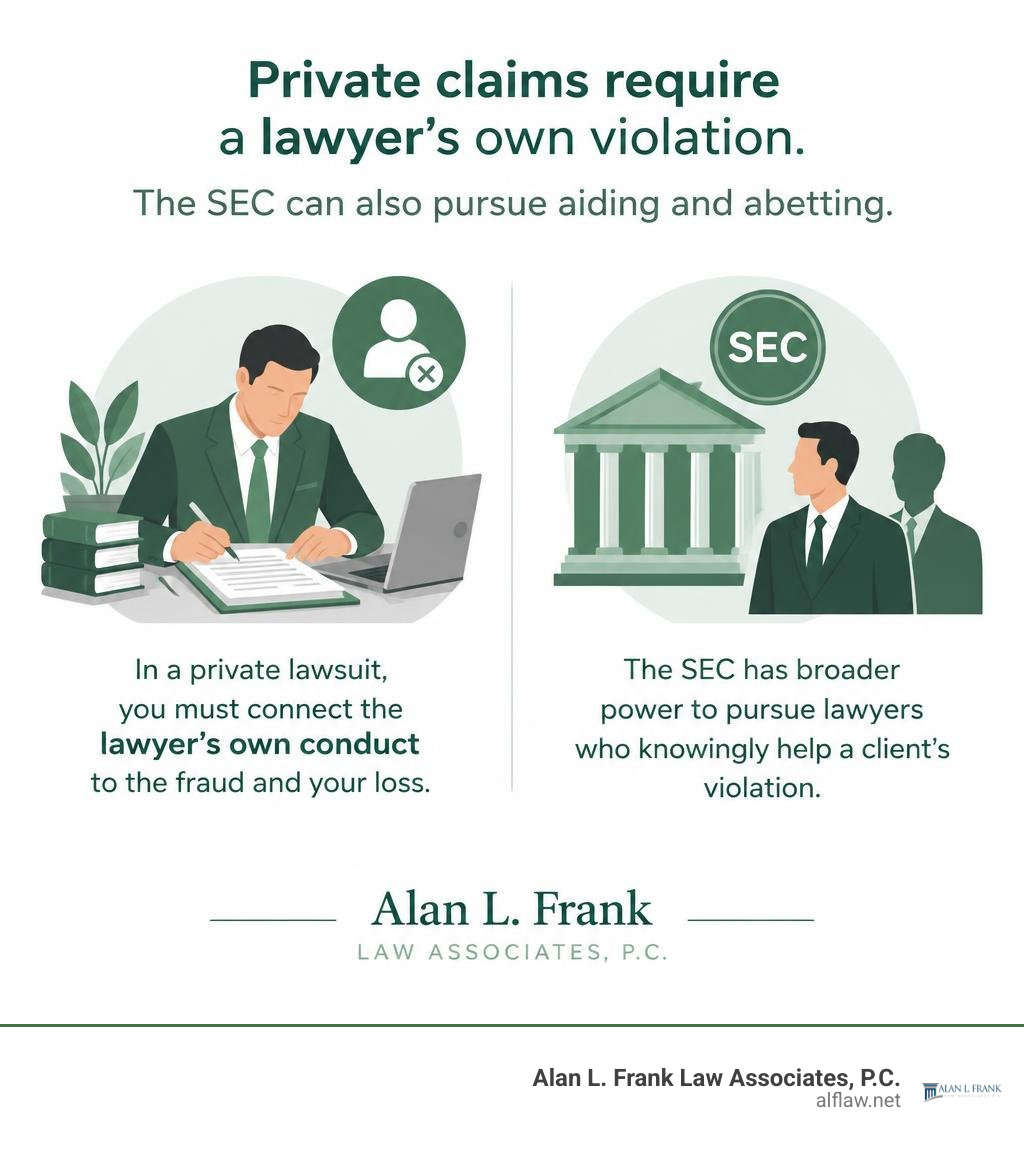
A claim against the company’s lawyer needs more than proof that the lawyer helped draft a false document. In a private lawsuit, you must connect the lawyer’s own conduct to the fraud and your loss. The SEC has broader power to pursue lawyers who knowingly help a client’s violation.
I’m Alan L. Frank, a CPA and litigation attorney with over 20 years leading my firm and experience with securities and investment-loss disputes. As a Rule 10b-5 violation lawyer, I start by asking who was responsible for the statement or act, what the investor relied on, and how the loss occurred.
Rule 10b-5 violation lawyer terms you need:
When a Rule 10b-5 violation lawyer assesses an attorney’s primary liability
When complex investment deals collapse, defrauded investors naturally examine every participant in the transaction—including the issuer’s legal counsel. Navigating Rule 10b-5’s antifraud provisions requires distinguishing between secondary actors who merely facilitate a deal and those who cross the line into primary securities fraud.
In the realm of private securities litigation, an attorney cannot be held liable simply because they represented a dishonest client. The United States Supreme Court has never established a broad doctrine of professional liability for outside counsel under Section 10(b) of the Securities Exchange Act of 1934. Instead, liability must always be grounded in specific, independent conduct that directly violates federal antifraud standards.
When a Rule 10b-5 violation lawyer can distinguish primary liability from aiding and abetting
The modern foundation of secondary actor litigation rests on the landmark Supreme Court decision in Central Bank of Denver v. First Interstate Bank of Denver (1994). The Court eliminated the judicially created private right of action for aiding and abetting under Section 10(b) and Rule 10b-5.
Under Central Bank, a secondary actor such as an attorney or accountant is not liable to private plaintiffs for providing substantial assistance to another party’s fraudulent scheme. To be sued successfully by an investor, the attorney must independently satisfy every single element of a primary violation. While the Securities and Exchange Commission (SEC) retains statutory authority to bring enforcement actions against individuals who aid and abet violations, private litigants cannot bridge factual gaps with general allegations of assistance.
How a Rule 10b-5 violation lawyer analyzes false opinion letters and drafted documents
For years, federal circuits split over when an attorney’s document preparation crossed into primary liability:
- The Bright-Line Test: Adopted by circuits like the Second Circuit, this standard holds that an attorney is liable for a misstatement only if the statement is explicitly attributed to the lawyer at the time of dissemination to the public.
- The Substantial Participation Test: Once favored by the Ninth Circuit, this standard permitted liability if a secondary actor played a significant or substantial role in creating the fraudulent statement, even without public attribution.
Supreme Court jurisprudence has largely solidified the bright-line rule. When an attorney issues a formal, signed legal opinion letter containing knowingly false statements—such as falsely certifying that shares are unrestricted or that a merger complies with governing law—that attorney has made an attributed public statement. Conversely, behind-the-scenes drafting of an issuer’s prospectus or registration statement generally shields the draftsperson from private 10b-5(b) misstatement claims.
When scheme liability may apply without a public misstatement
Investors are not entirely limited to misstatement claims under subsection (b) of Rule 10b-5. Rules 10b-5(a) and 10b-5(c) create liability for employing any “device, scheme, or artifice to defraud” or engaging in any “act, practice, or course of business” that operates as a fraud.
Following the Supreme Court’s decision in Lorenzo v. SEC (2019), an individual who disseminates false statements with scienter can be liable under subsections (a) and (c), even if they are not the “maker” of the statement under subsection (b). However, in private litigation governed by Stoneridge Investment Partners, LLC v. Scientific-Atlanta, Inc. (2008), scheme liability against secondary actors requires showing that the attorney engaged in an inherently deceptive act upon which the market or transaction relied, rather than ordinary, non-deceptive commercial or legal assistance.
How the maker, attribution, and reliance rules limit claims against lawyers
Securities laws protect open markets, but they do not convert outside legal advisers into general guarantors of their clients’ business honesty. Defrauded investors pursuing investment-loss litigation must confront stringent procedural and substantive hurdles established by the Supreme Court.

Who is the “maker” of a statement under Janus?
In Janus Capital Group, Inc. v. First Derivative Traders (2011), the Supreme Court established a definitive rule: the “maker” of a statement is the person or entity with ultimate authority over the statement, including its content and whether and how to communicate it.
The Court drew a clear analogy to a speechwriter and a speaker. Even if a speechwriter crafts every word of an address, the person who delivers the speech and controls its release is the maker. Because corporate issuers retain ultimate authority over their prospectuses, SEC filings, and press releases, outside securities lawyers acting in their traditional advisory and drafting roles cannot be sued under Rule 10b-5(b) for statements made by their corporate clients.
Why attribution matters to reliance
Reliance (transaction causation) establishes the causal connection between a defendant’s fraud and an investor’s decision. In private securities litigation against corporate counsel, attribution is indispensable:
- If a statement is released solely in the name of the issuer, investors rely on the issuer’s credibility, not the undisclosed outside attorney’s expertise.
- Under the fraud-on-the-market doctrine, prices reflect public statements, meaning uncredited draftspersons cannot easily be linked to price inflation.
- Explicit attribution—such as an investor relying directly on a signed formal opinion letter—is required to satisfy transaction causation against an individual attorney.
When a lawyer’s conduct may still support scheme liability
Scheme liability remains a narrow exception where an attorney steps outside traditional legal advisory functions. When counsel actively orchestrates sham transactions, fabricates corporate records, or directly disseminates known falsehoods to third parties to facilitate an illegal offering, they cross the threshold into actionable, deceptive conduct under Rule 10b-5(a) and (c).
What investors must prove—and the procedural hurdles in a Rule 10b-5 case
Pursuing investment loss claims under Section 10(b) requires clearing heightened pleading standards designed to eliminate speculative claims at the courthouse door.
The six elements of a private Rule 10b-5 claim
A private plaintiff must establish six elements to succeed on a Rule 10b-5 claim:
- Material Misstatement or Omission: A false statement or omission that significantly alters the “total mix” of information available to a reasonable investor.
- Scienter: An intent to deceive, manipulate, or defraud, or an extreme departure from ordinary care (severe recklessness).
- Connection to Purchase or Sale: A direct link between the deceptive conduct and a purchase or sale of securities.
- Reliance: Actual transaction reliance by the plaintiff or a valid legal presumption (such as fraud-on-the-market).
- Economic Loss: Measurable financial damage suffered by the investor.
- Loss Causation: A direct causal connection showing the fraud—and not general market declines—caused the financial loss.
How the PSLRA and standing rules affect a claim
The Private Securities Litigation Reform Act of 1995 (PSLRA) imposes strict pleading requirements. Under the Supreme Court’s ruling in Tellabs, Inc. v. Makor Issues & Rights, Ltd. (2007), a plaintiff must plead specific facts creating a “strong inference” of scienter that is cogent and at least as compelling as any opposing, non-fraudulent inference.
Additionally, under the longstanding Blue Chip Stamps v. Manor Drug Stores (1975) rule, standing is restricted exclusively to actual purchasers or sellers. Individuals who merely held onto securities or refrained from purchasing due to misleading disclosures lack standing to bring a Rule 10b-5 private action. The PSLRA also imposes an automatic stay of discovery while motions to dismiss are pending, preventing plaintiffs from conducting discovery to uncover evidence not already in their possession.
Deadlines, domestic transactions, and possible recovery
Federal securities claims face strict statutory timelines under 28 U.S.C. Section 1658(b):
- Statute of Limitations: Claims must be filed within two years of the actual or constructive discovery of the facts constituting the violation.
- Statute of Repose: All claims are completely barred five years after the violation occurred, regardless of when it was discovered.
Furthermore, following Morrison v. National Australia Bank Ltd. (2010), Section 10(b) applies exclusively to securities listed on domestic exchanges or domestic transactions where irrevocable liability is incurred within the United States. To establish damages, investors must identify a corrective disclosure that revealed the truth to the market, triggering a direct price drop.
How attorney misconduct can be addressed outside private Rule 10b-5 litigation
Because private civil litigation against attorneys faces high procedural bars, public regulatory and ethical frameworks serve as the primary mechanisms for holding dishonest securities lawyers accountable.
What SEC and professional-conduct rules can do
The SEC and state bar authorities enforce extensive rules governing lawyer conduct:
- SEC Rule 102(e): Authorizes the Commission to censure attorneys or suspend them from practicing or appearing before the SEC if they lack integrity, engage in improper professional conduct, or willfully violate securities regulations.
- Sarbanes-Oxley Part 205: Codifies “up-the-ladder” reporting requirements, compelling attorneys who represent public issuers to report credible evidence of material violations to the chief legal officer, audit committee, or board of directors.
- State Ethics Rules: State disciplinary boards enforce Model Rules 1.2(d), 1.6, and 1.13, subjecting lawyers who assist in client fraud to suspension or disbarment.
How SEC enforcement differs from a private investor lawsuit
Unlike private plaintiffs, the SEC is not bound by Central Bank‘s prohibition on aiding and abetting liability. Under Section 20(e) of the Exchange Act, the SEC can prosecute any person who knowingly or recklessly provides substantial assistance to a securities law violator. Regulators are not required to demonstrate investor reliance, loss causation, or purchase/sale standing, allowing them to seek civil monetary penalties, officer-and-director bars, and disgorgement of ill-gotten profits.
What enforcement examples show about lawyer exposure
Regulatory enforcement actions demonstrate the legal boundaries for attorneys:
- In microcap and shell-company schemes, the SEC routinely prosecutes attorneys who draft false legal opinion letters to improperly remove restrictive legends, as highlighted in the SEC allegations concerning James M. Schneider.
- In insider trading investigations, the SEC aggressively targets outside corporate counsel who trade on material nonpublic transaction data obtained during due diligence, as detailed in an SEC insider-trading action involving an attorney.
How to choose counsel and prepare for an investment-loss consultation
When complex securities losses occur, investors must carefully evaluate whether their claims belong in federal court or within alternative dispute resolution forums, such as FINRA arbitration and broker-misconduct claims.
Questions to ask a prospective securities-litigation lawyer
Before retaining legal representation, ask targeted questions regarding their experience:
- How many Section 10(b) and Rule 10b-5 cases have you litigated in federal district and appellate courts?
- How do you assess primary liability versus aiding-and-abetting defenses under current Supreme Court standards?
- What is your track record in managing PSLRA motion-to-dismiss proceedings and class certification hearings?
- Do you handle securities claims on a contingency fee, hourly basis, or structured hybrid arrangement?
- Do any existing institutional representations create conflicts of interest regarding the target defendants?
Records to gather before a consultation
To facilitate an effective evaluation of your potential claim, gather the following documentation prior to your legal consultation:
- Complete trade confirmations, monthly brokerage statements, and custodial account summaries showing the exact dates and prices of all relevant purchases and sales.
- Offering memoranda, private placement memoranda (PPMs), prospectuses, subscription agreements, and periodic SEC filings (Forms 10-K, 10-Q, 8-K).
- All written communications, emails, text messages, and promotional pitch decks received from the issuer, brokers, or advisory professionals.
- A chronological summary detailing when you made your investments, when you discovered the alleged fraud, and when the asset suffered a drop in value.
Frequently Asked Questions about Rule 10b-5 claims against lawyers
Can an investor sue a lawyer for helping a client commit securities fraud?
Generally, no. Under the Supreme Court’s Central Bank ruling, private civil plaintiffs cannot sue secondary actors for aiding and abetting securities fraud. An attorney can only be sued by private investors if their own conduct independently meets all six elements of a primary Rule 10b-5 violation, including making an attributed material misstatement or engaging in an inherently deceptive act.
Can a lawyer be liable for drafting a false document without signing or publishing it?
Under Janus Capital Group v. First Derivative Traders, an attorney who merely drafts a document that is issued and signed by a client is not the “maker” of the statement for purposes of Rule 10b-5(b). Because the client retains ultimate authority over the statement’s dissemination, private misstatement claims against the uncredited drafting attorney will typically be dismissed.
What is the difference between SEC enforcement and a private Rule 10b-5 lawsuit?
The SEC has broad statutory authority to bring enforcement actions against attorneys for aiding and abetting securities fraud, seeking civil fines, penny-stock bars, and practice bans under Rule 102(e). Private investors, by contrast, must prove primary liability, individual or market reliance, loss causation, and actual out-of-pocket economic losses.
Conclusion
Holding secondary participants accountable in securities fraud requires a clear, conduct-based legal analysis. While the Supreme Court’s decisions in Central Bank, Stoneridge, and Janus have limited private claims against traditional legal advisers, attorneys who cross the line into primary deception, draft fraudulent opinion letters, or participate in unlawful schemes remain subject to federal liability.
At Alan L. Frank Law Associates, P.C., we represent investors across Pennsylvania and New Jersey—with offices in Philadelphia and Jenkintown—in complex disputes. If you suffered substantial financial damages due to corporate misrepresentations, contact our team for comprehensive securities litigation and investment-loss representation.