
What Is Real Estate Litigation and Do You Need Legal Representation?


What Is Real Estate Litigation and Do You Need Legal Representation?
What Real Estate Litigation Means for Property Owners and Investors
Real Estate Litigation is the legal process used to resolve a dispute involving property, a real estate contract, financing, ownership, construction, or land-use rights. You may need legal representation when the dispute puts a major asset, transaction, business relationship, or deadline at risk – especially if you have received a default notice, lawsuit, lien, foreclosure filing, or demand for damages.
Common disputes include:
- Failed purchases or sales, deposit disputes, and broken contract terms
- Commercial lease defaults, rent claims, and eviction or holdover matters
- Title defects, boundary conflicts, easement disputes, and co-owner deadlocks
- Construction defects, payment claims, and project delays
- Mortgage defaults, guaranty claims, foreclosure, and lender-borrower disputes
The stakes can be especially high in 2026. More than $1.5 trillion in U.S. commercial real estate loans are maturing this year, while office and multifamily distress has increased pressure on borrowers, guarantors, lenders, and investors. A prompt legal review can help preserve evidence, identify leverage, meet court deadlines, and determine whether negotiation, mediation, arbitration, or a lawsuit is the soundest path.
I am Alan L. Frank, Managing Attorney at Alan L. Frank Law Associates, P.C., with more than 20 years of experience leading complex commercial litigation matters. My background in law, tax, and accounting helps me assess the financial and legal issues that often drive Real Estate Litigation and related business disputes.
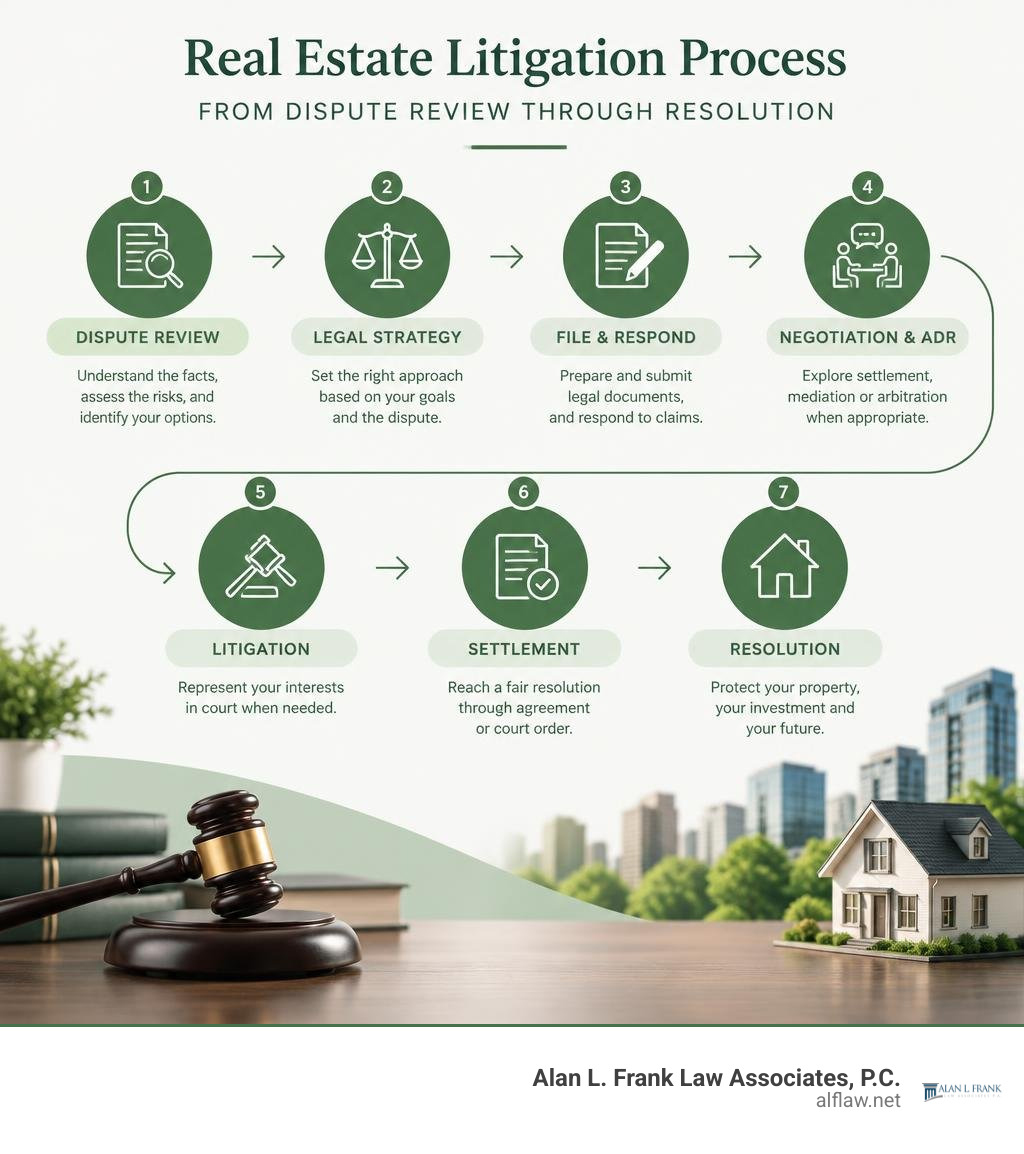
Key terms for Real Estate Litigation:
Understanding Real Estate Legal Disputes and Market Pressures
Real property conflicts rarely happen in a vacuum. A property dispute is typically born at the intersection of strict contract terms, equitable property doctrines, and broad economic shifts. When a buyer refuses to close, an escrow agent balks at releasing a six-figure earnest money deposit, or a seller fails to convey marketable title free of encumbrances, the injured party must decide between enforcing the contract or walking away.
In formal courtroom advocacy, real estate claims frequently center on remedies that do not exist in standard breach-of-contract cases:
- Specific Performance: Because real estate is legally unique, money damages are not always adequate. When a seller breaches an agreement of sale without a valid excuse, a buyer can ask the court to compel the transfer of the deed.
- Contract Reformation: When written instruments do not accurately reflect the actual meeting of the minds due to mutual mistake, scrivener error, or fraud, courts can reform deeds, mortgages, or lease terms.
- Rescission and Equitable Restitution: When material misrepresentations or latent defects taint an entire purchase, an aggrieved buyer may seek to unwind the deal completely.
- Fiduciary Duty Claims: In real estate partnerships, limited liability companies, and joint ventures, managing partners owe fiduciary obligations of loyalty and care to their investors.
Navigating these challenges requires understanding benchmarks set across both regional jurisdictions and national practice standards, such as those cataloged in the Real Estate Litigation 2026 | Global Practice Guides | Chambers and Partners.
Navigating High-Stakes Commercial Real Estate Litigation
The commercial market in 2026 is facing a massive structural reset. Nearly $1 trillion in U.S. commercial real estate loans came due in 2025 alone, representing approximately 20% of all outstanding commercial and multifamily mortgages. With over $1.5 trillion in commercial debt maturing across the country this year, refinancing gaps have forced lenders and borrowers into high-stakes legal battles.
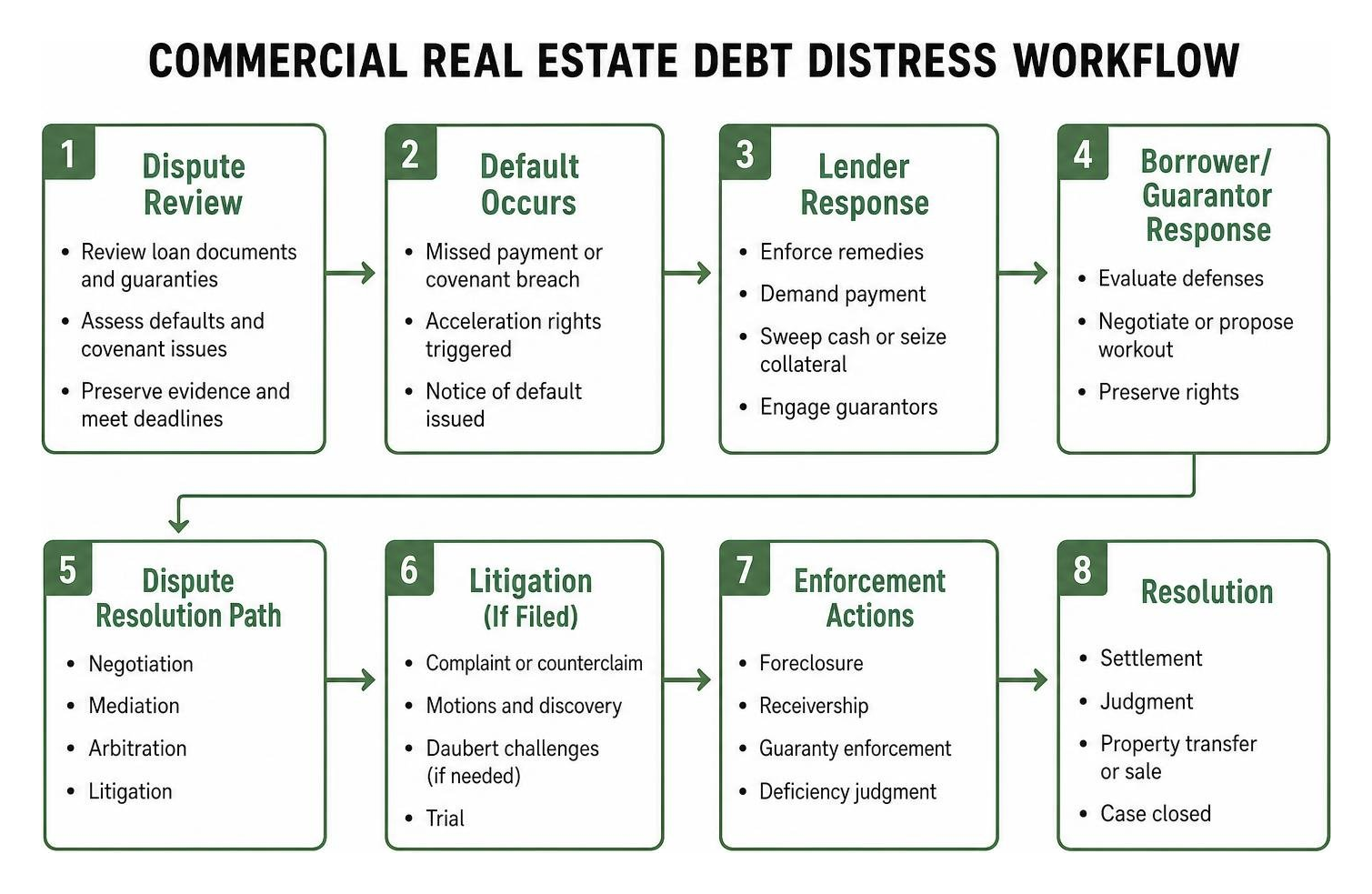
Office commercial mortgage-backed securities (CMBS) delinquency rates hit a record 11.8% in late 2025, surpassing the peaks seen during the 2008 Global Financial Crisis. Meanwhile, multifamily loan delinquencies surged by 88 basis points year-over-year to 1.47%. In the first half of 2025, commercial real estate foreclosures reached their highest midyear total since 2014, with roughly two-thirds of apartment foreclosures tied to floating-rate debt originated in 2021 and 2022.
These market pressures drive complex commercial conflicts:
- Private Credit and Non-Bank Lender Enforcement: Non-bank real estate lenders have raised over $137 billion across more than 430 closed-end debt funds since 2020. With the broader private credit asset class surpassing $2 trillion in assets under management, alternative lenders move quickly to enforce loan covenants, sweep cash accounts, or seize collateral.
- Mezzanine Debt and UCC Foreclosures: Rather than undergoing a multi-year judicial foreclosure on real property, mezzanine lenders often initiate expedited Uniform Commercial Code (UCC) sales to foreclose on the pledged equity interests of the borrowing entity itself.
- Guarantor Liability Litigation: When non-recourse carve-outs (“bad boy” guaranties) are triggered by bankruptcy filings, unpermitted transfers, or waste, lenders seek personal deficiency judgments directly against sponsor principals.
- Chapter 11 Workouts and Receiverships: Distressed borrowers often seek bankruptcy protection to invoke the automatic stay, halt foreclosure sales, and restructure debt through cram-down plans, while secured lenders fight for the immediate appointment of an equity receiver to manage property operations and capture rent rolls.
Property Boundaries and Co-Ownership Actions
Disputes between neighboring landowners and co-owners require careful analysis of legal titles, municipal recordings, and physical property inspections.
Boundary conflicts typically involve fence encroachments, disputed driveways, unrecorded access easements, or claims of adverse possession. To resolve these issues, parties must carefully evaluate historic records and surveys. We often guide clients through how homeowners can successfully challenge disputed boundary lines to safeguard their property rights.
Early evidentiary collection is critical. Knowing where to find existing property surveys without ordering a new one can establish chains of title and historical monument markers before litigation expenses escalate.
When multiple parties hold title to real estate as tenants in common or joint tenants and disagree on leasing, management, or sales, an owner has an absolute statutory right to file a partition lawsuit. Understanding the procedural mechanisms for partitioning real property allows co-owners to pursue either an equitable physical division of the land or a court-supervised sale with an accounting of all capital contributions and carrying costs.
Core Types of Real Estate Litigation in Commercial and Residential Markets

Real estate litigation covers a wide spectrum of issues across residential developments, retail plazas, industrial warehouses, and corporate office parks.
| Asset Class | Primary Dispute Triggers | Typical Governing Mechanisms | Key Remedies Sought |
|---|---|---|---|
| Commercial Office / Retail | Rent defaults, CAM audit discrepancies, tenant holdovers, co-tenancy clause failures | Master lease agreements, state commercial landlord-tenant statutes | Rent acceleration, possession writs, breach damages, lease forfeiture |
| Multifamily Housing | Loan defaults, partnership freezes, tenant habitability claims, fair housing challenges | Operating agreements, agency loan covenants, local housing codes | Receiver appointments, partition, judicial foreclosure, injunctions |
| Industrial / Logistics | Access easements, environmental spills, loading dock encroachments, power delivery | Recorded easements, state environmental quality acts, municipal zoning codes | Specific performance, quiet title, remediation damages, code compliance |
| Residential Development | Foundation failures, builder warranty breaches, boundary errors, tax reassessments | Purchase contracts, express warranties, county assessment appeals boards | Repair damages, rescission, tax assessment reductions, title correction |
Construction Access, Land Use, and Structural Defects
Construction projects frequently spark litigation when excavation, underpinning, or crane operations impact neighboring properties. In dense metropolitan areas across Pennsylvania and New Jersey, developers and adjacent landowners regularly litigate license agreements, safety protections, and access terms to prevent structural damage or project shutdowns.
When construction errors occur, owners face significant financial losses. We regularly help property owners address housing and construction defect claims arising from sub-standard contractor workmanship, architectural errors, and water intrusion. In severe cases, we pursue claims involving structural foundation failure claims to recover the cost of structural stabilization.
Property owners must also determine whether their builder will honor contractual obligations, making it critical to examine whether your warranty coverage provides an effective path to relief or simply limits developer liability.
Commercial Lease and Foreclosure Disputes
Commercial leasing disputes often involve rent acceleration, lease interpretation, tenant improvements, and common area maintenance (CAM) audits. When businesses struggle, landlords look to enforce lease covenants and recover unpaid balances:
- Good-Guy Guaranties: In commercial retail and office settings, landlords frequently require a limited personal guarantee. Recent case law emphasizes that guarantor liability depends strictly on timely surrender, written notice, and compliance with property condition terms.
- Holdover and Ejectment: When a commercial tenant refuses to vacate at lease expiration, landlords initiate formal ejectment or summary possession actions, seeking double or triple rent damages as defined by lease terms or state law.
- Judicial Foreclosure Actions: In mortgage default situations, lenders file foreclosure complaints in state or federal courts to establish lien priority, foreclose junior encumbrances, and secure a sheriff’s sale of the mortgaged asset.
Pre-Trial Strategies and Dispute Resolution Methods

Not every real estate dispute belongs in a multi-week trial. Strategic pre-trial maneuvering and alternative dispute resolution (ADR) can deliver effective outcomes without the delay and expense of courtroom litigation.
- Pre-Litigation Demand Notices: A detailed, evidence-backed demand letter puts adverse parties on formal notice, triggers contractual cure periods, and establishes bad faith if the dispute proceeds to court.
- Filing a Notice of Lis Pendens: In actions directly affecting title to real property, recording a notice of lis pendens in county land records alerts prospective buyers and lenders to pending claims, clouding title and preventing the property from being sold or encumbered during the lawsuit.
- Mediation: A neutral mediator with real estate expertise facilitates structured negotiations, allowing parties to craft creative commercial settlements, lease modifications, or buyout structures that a court cannot order.
- Binding Arbitration: Many standard purchase contracts and commercial development agreements include mandatory arbitration clauses. While arbitration limits formal discovery and appellate rights, it provides private proceedings and faster resolutions before panels experienced in real property law.
- Injunctive Relief: In urgent cases involving improper demolition, tree removal, easement blockage, or wrongful foreclosure sales, litigators must act quickly to secure temporary restraining orders (TROs) and preliminary injunctions.
Strategic Importance of Legal Representation in Property Disputes
Real estate disputes involve strict procedural deadlines, complex evidentiary burdens, and detailed statutory rules. Missing a response deadline for a mechanic’s lien, failing to file an answer to a commercial foreclosure complaint, or waiving a contractual title-objection window can permanently compromise your legal rights.
Our firm provides comprehensive counsel across our broad practice areas, combining courtroom trial experience with practical financial analysis. When millions of dollars in equity, commercial collateral, or developmental entitlements are on the line, having a legal team that understands both balance sheets and civil procedure is critical.
When to Retain Counsel for Real Estate Litigation
You should engage dedicated counsel as soon as you identify early indicators of a dispute, including:
- Closing Deadlocks: When an escrow agent receives conflicting release instructions, or a party fails to satisfy financing, environmental, or title contingencies by the contractual closing date.
- Notices of Default or Acceleration: When a lender issues a formal default notice, exercises an assignment of rents, or threatens immediate loan acceleration.
- Mechanic’s Liens and Contractor Non-Payment: When general contractors or subcontractors record liens against a property, placing construction loan disbursements and sales closings in immediate jeopardy.
- Environmental Contamination Claims: When phase I/II environmental site assessments reveal historic spills, hazardous substances, or petroleum leaks requiring Superfund or state environmental agency reporting.
- Partnership Deadlock: When operating members of an LLC disagree on capital calls, property refinancing, or asset dispositions.
- Predatory Lending Violations: When debt instruments include unlawful interest rate calculations, unconscionable fees, or deceptive lending practices.
Frequently Asked Questions About Property Disputes
What is the difference between real estate litigation and transactional real estate?
Transactional real estate focuses on structuring, negotiating, and closing deals. Transactional attorneys draft agreements of sale, review title commitments, structure financing documents, and draft commercial leases to prevent future problems.
Real estate litigation occurs when those agreements break down, terms are breached, or external disputes arise. Litigators evaluate claims, manage discovery, draft motions, advocate in court or arbitration, and enforce judgments.
How can property owners avoid formal real estate trials?
Property owners can minimize the likelihood of a trial by:
- Drafting clear, unambiguous contracts with well-defined default and cure mechanisms.
- Conducting thorough due diligence, including property boundary surveys, environmental reviews, and zoning verification before closing.
- Engaging in early pre-dispute mediation before litigation positions harden.
- Working with lenders during loan distress to negotiate consensual loan modifications, forbearance agreements, or discounted payoffs.
What macroeconomic factors are driving property disputes in 2026?
Real estate disputes in 2026 are heavily driven by the massive maturity wall of commercial mortgages originated during the near-zero interest rate environment of 2020–2022. Because current refinancing rates are substantially higher, many properties face significant equity shortfalls and lower valuations. These pressures have led to higher delinquency rates, increased commercial foreclosures, partnership capital disputes, and conflicts over personal loan guaranties.
Conclusion
Property disputes and commercial real estate challenges require decisive, informed action. Whether you are an owner protecting your boundaries, an investor handling a partnership deadlock, or a developer navigating a distressed debt market, early legal intervention protects your capital and positions your case for success.
At Alan L. Frank Law Associates, P.C., we draw on decades of nationwide trial experience, deep financial knowledge, and proven dispute-resolution strategies to protect our clients’ real estate assets across Pennsylvania and New Jersey. If you face a property conflict or commercial dispute, contact our commercial litigation team today to schedule an initial legal consultation.