
Know Your Jurisdiction Before Stepping into Court


Know Your Jurisdiction Before Stepping into Court
Where to File a Lawsuit: Start With Court Authority
To decide where to file a lawsuit, first identify a state whose courts have authority over the defendant. Next, check which court can hear your type of claim and whether it belongs in state or federal court. Then choose a county connected to the defendant or the dispute, and confirm the correct court division and courthouse under local rules.
That order matters when a business dispute, investment loss, or injury involves people or companies in different states. Filing in the wrong place can delay your case or force you to start over.
I’m Alan L. Frank, managing attorney at Alan L. Frank Law Associates, P.C. My more than 20 years handling complex commercial and significant personal injury cases inform how I assess where to file lawsuit claims.
Where to file lawsuit terms explained:
Understanding Court Authority: Personal vs. Subject-Matter Jurisdiction
Before any judge can sign an order, hear arguments, or enter an enforceable judgment, the chosen court must possess two distinct forms of legal power: personal jurisdiction and subject-matter jurisdiction. As outlined in helpful state resources like the California Courts Self Help Guide on jurisdiction and venue, filing without confirming both elements renders your initial pleading vulnerable to immediate dismissal.
Establishing Personal Jurisdiction Over Individuals and Businesses
Personal jurisdiction governs a court’s constitutional authority over the defendant being sued. Under foundational constitutional due process principles, a court cannot force a person or company to defend a lawsuit unless they maintain sufficient “minimum contacts” with the forum state.
We evaluate personal jurisdiction across two categories:
- General (All-Purpose) Jurisdiction: A court holds general personal jurisdiction when an individual is legally domiciled within that state, or when a corporate entity is incorporated or maintains its principal place of business there. In these forums, the party can be sued over any underlying claim, regardless of where the incident occurred.
- Specific (Case-Linked) Jurisdiction: If a defendant lives or operates out of state, the court can exercise specific personal jurisdiction under state long-arm statutes. The lawsuit must arise directly from the defendant’s purposeful activities inside the state—such as entering into a commercial agreement, driving on local roadways, selling defective products into the local stream of commerce, or owning local real property.
Classifying Subject-Matter Jurisdiction: General, Limited, and Exclusive
Subject-matter jurisdiction concerns the court’s authority to hear the specific type of claim you are asserting. Unlike personal jurisdiction, subject-matter jurisdiction cannot be waived by the parties or granted by mutual consent. If a court lacks the legal power to hear a dispute, any judgment it issues is void.
- General Jurisdiction: State trial courts of general jurisdiction—such as the Court of Common Pleas in Pennsylvania or the Superior Court Law Division in New Jersey—can hear almost any civil controversy, ranging from contract disputes to catastrophic injury claims.
- Limited Jurisdiction: Courts created to resolve specific disputes within narrow statutory boundaries or monetary damage caps. Examples include municipal courts, small claims divisions, probate courts handling estate administration, and family courts.
- Exclusive Jurisdiction: Matters reserved by statute for a single court system. For example, federal bankruptcy courts have exclusive jurisdiction over bankruptcy proceedings, and federal district courts have exclusive authority over patent and copyright infringement claims.
How to Determine Where to File Lawsuit Claims Accurately
Selecting the correct judicial forum requires balancing legal rules, party convenience, contractual choice-of-law provisions, and practical litigation goals. For intricate business disputes or complex commercial litigation, determining the right forum is a core strategic consideration.
| Court Type | Typical Monetary Limits | Core Subject Matter | Typical Procedural Features |
|---|---|---|---|
| Small Claims / Municipal | Varies by state ($5,000 in NJ; local caps in PA) | Unpaid debts, small property damage, minor contract breaches | Simplified rules of evidence, informal hearings, expedited schedule |
| State Trial Court | No upper cap (e.g., NJ Superior Court over $20,000) | General torts, large breach of contract, real estate, estate litigation | Full formal discovery, motion practice, jury or bench trials |
| Federal District Court | $75,000+ for diversity; no cap for federal statutes | Federal statutory violations, constitutional rights, cross-border claims | Strict Federal Rules of Civil Procedure (FRCP), mandatory electronic filing |
Choosing Between State and Federal Court: Where to File Lawsuit Actions
Federal courts are courts of limited jurisdiction. You cannot file a civil lawsuit in federal court simply because you prefer the forum; the case must qualify under one of two primary jurisdictional doctrines:
- Federal Question Jurisdiction: The claim arises directly under the United States Constitution, federal treaties, or federal statutory frameworks (such as federal securities statutes or civil rights laws).
- Diversity of Citizenship Jurisdiction: The dispute is between citizens of entirely different states (complete diversity), and the amount in controversy exceeds the statutory threshold of $75,000, exclusive of interest and costs.
When claims qualify for both systems, the courts have concurrent jurisdiction. However, if a plaintiff files a qualifying federal-diversity case in state court, the out-of-state defendant often holds the legal right to remove the case to the local federal district court under federal removal statutes.
Assessing Small Claims Thresholds: Where to File a Lawsuit for Minor Damages
For smaller monetary disagreements, small claims courts provide an accessible, cost-effective alternative to formal trial tracks. These divisions limit discovery, lower filing fees, and permit relaxed evidentiary standards.
Monetary caps vary by jurisdiction:
- In Pennsylvania, Magisterial District Courts handle civil claims up to statutory neighborhood thresholds (often $12,000), while the Philadelphia Municipal Court provides tailored small claims and civil procedures.
- According to the New Jersey Courts civil division guidance, claims are divided across structured monetary tiers: Small Claims handles matters of $5,000 or less, the Special Civil Part manages disputes between $5,000 and $20,000, and the Civil Division of the Superior Court hears claims exceeding $20,000.
- Across other regional models, caps differ: Massachusetts sets small claims at $7,000 or less, Illinois limits small claims to $10,000 or less, and California caps general individual small claims at $12,500.
Selecting the Proper County Venue and Courthouse Location
Once you determine the state and court system, you must select the correct venue—the specific county and courthouse assigned to hear the matter.
General venue principles include:
- Defendant’s Residence or Business Hub: Filing in the county where the defendant resides or maintains registered headquarters.
- Location of the Incident: Filing where the contract was executed, where performance occurred or was breached, or where a physical accident or personal injury occurred.
- Location of Real Property: When disputes involve title, boundaries, or partition, as in real estate litigation and property disputes, proper venue lies in the county where the parcel of land is physically situated.
Litigants can research specific geographic assignments and local rules using comprehensive FindLaw court directories or designated state court locator portals.
Preparing, Filing, and Serving Your Civil Action

Initiating a formal civil lawsuit requires drafting precise pleadings, satisfying clerk submission rules, paying filing fees, and completing service of process on all named defendants. Helpful step-by-step procedural resources, such as the Illinois Legal Aid guide to filing a complaint, illustrate how missing a technical formatting rule can halt an initial filing.
Identifying the Proper Legal Name of Defendants
Suing an incorrect entity name can delay your case or invalidate an eventual judgment. We take precise steps to identify the proper legal parties:
- Individuals: Identify full legal names, avoiding abbreviations or nicknames, along with their primary residence.
- Corporations and LLCs: Search state corporate registry databases (such as the Pennsylvania Department of State or the New Jersey Division of Revenue and Enterprise Services) to confirm exact registered corporate names and identify their appointed registered agent for service of process.
- Unincorporated or Sole Proprietorships: If a business operates under a trade name, name the individual owner alongside their “doing business as” (d/b/a) or fictitious name designation (e.g., John Doe d/b/a Quality Contracting).
Drafting Pleadings, Calculating Filing Fees, and Requesting Waivers
To initiate a civil action, you must assemble a formal packet of initiating documents:
- Civil Complaint (or Statement of Claim): The foundational pleading setting forth numbered paragraphs of jurisdictional facts, specific legal causes of action, factual allegations, and a clear prayer for relief requesting monetary damages or equitable remedies.
- Civil Summons: The official court notice notifying the defendant that they have been sued and specifying the mandatory deadline to file a responsive pleading (such as 35 days in New Jersey Superior Court civil matters).
- Civil Case Information Statement (Cover Sheet): Administrative intake forms required by state court systems to categorize case complexity, discovery tracks, and jury trial demands.
Managing Filing Fees and In Forma Pauperis Waivers
State and federal courts require initial statutory filing fees to open a civil docket. In New Jersey, initiating a general civil lawsuit in Superior Court costs $250 (defendants pay $175 to file an answer), while filing fees in Delaware range from $35 in Justice of the Peace Court up to $175 in Superior Court.
If an individual plaintiff cannot afford required court fees due to financial hardship, courts provide fee waiver petitions—frequently termed in forma pauperis applications or Affidavits of Indigency. Under standard state guidelines, litigants qualify if their household income falls at or below 150% of the federal poverty guidelines and liquid financial assets remain below statutory limits (such as $2,500).
Executing Service of Process and Filing Proof of Delivery
Filing your complaint with the court clerk is only the first half of starting a case. You must then execute service of process by delivering a copy of the summons, filed complaint, and track assignment notices to every named defendant in strict compliance with procedural rules.
Key service considerations include:
- Disinterested Third-Party Requirement: The plaintiff cannot personally hand legal papers to a defendant. Service must be executed by a sheriff, constable, or authorized third-party process server who is at least 18 years old and not a party to the lawsuit.
- Return of Service: Once service is accomplished, the process server must execute an affidavit of service (or return of service) documenting the date, time, location, and method of delivery, which must be promptly filed with the court clerk.
- Service Timelines: Rules mandate prompt delivery (often within 30 to 120 days depending on the forum) to prevent administrative dismissal of the case.
The Legal and Financial Consequences of Filing in the Wrong Forum
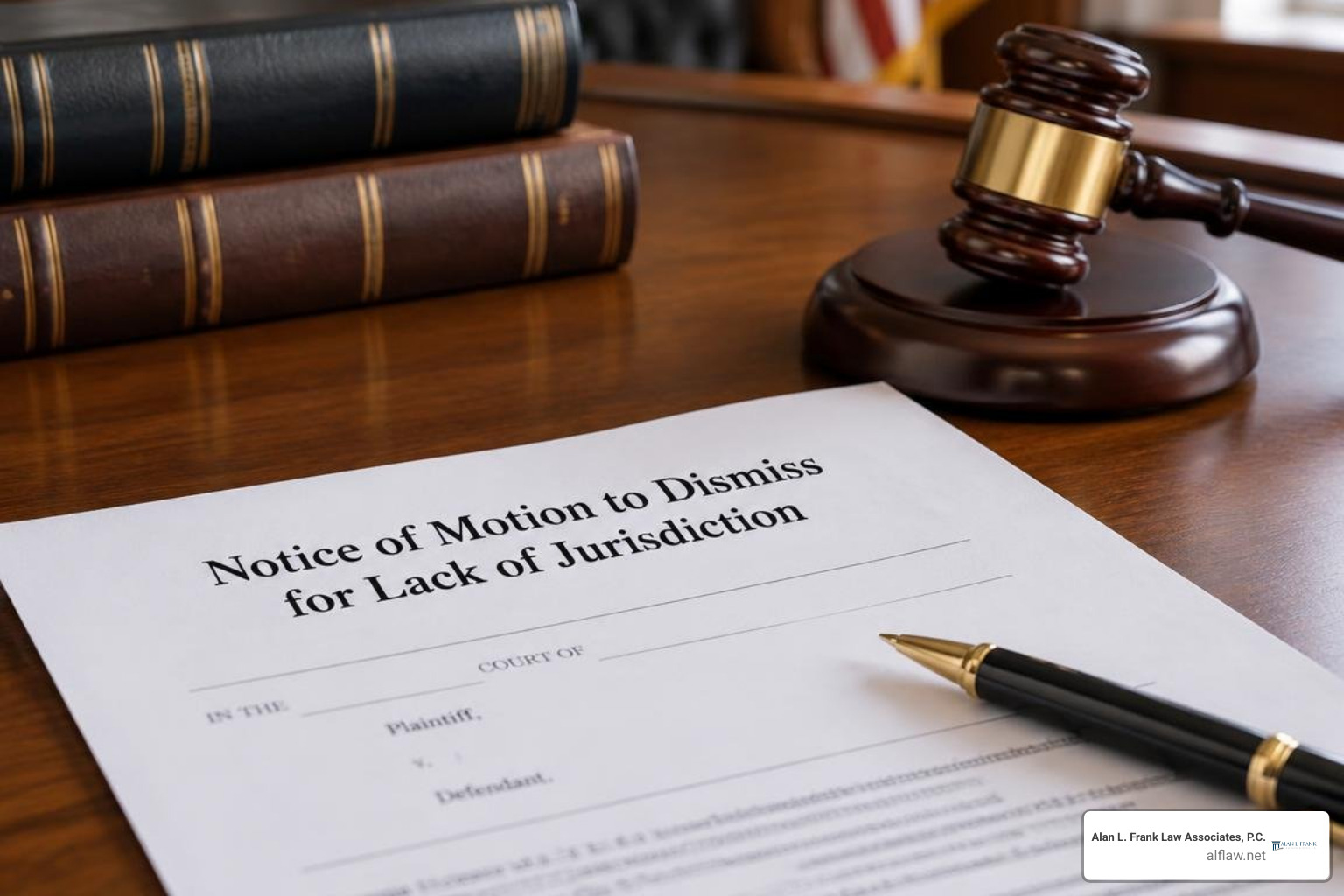
Filing a civil lawsuit in an improper court or incorrect geographic venue triggers immediate procedural obstacles and unnecessary expenses:
- Motions to Dismiss: The defendant’s legal counsel will likely file a preliminary motion to dismiss under civil procedure rules for lack of personal jurisdiction, improper subject-matter jurisdiction, or improper venue.
- Forfeited Filing Fees: Initial statutory filing fees (which can exceed several hundred dollars) are non-refundable. If your case is dismissed for lack of jurisdiction, those administrative costs are lost.
- Statute of Limitations Expiration: If you file your initial lawsuit near the end of the statutory limitation period and the case is dismissed for lack of subject-matter jurisdiction rather than transferred, the limitations clock may expire before you can refile in the proper forum, permanently barring your recovery.
- Wasted Time and Procedural Delays: Resolving venue challenges, contesting jurisdictional motions, and waiting for formal transfer orders can delay your case for months before discovery even begins. Notably, statistics demonstrate that only 2% of civil cases ever go to trial; the remaining 98% resolve through negotiated settlement, mediation, or arbitration. Spending unnecessary time fighting over the initial courthouse venue delays dispute resolution and increases litigation costs.
Frequently Asked Questions About Filing a Civil Lawsuit
What is the difference between jurisdiction and venue?
Jurisdiction refers to a court’s constitutional and statutory legal power to hear a category of dispute (subject-matter jurisdiction) and bind a specific party to its judgments (personal jurisdiction). Venue refers to the proper geographical county, district, or physical courthouse location within an authorized court system where the trial should take place. A court may hold broad jurisdiction across an entire state, but local procedural venue rules dictate the specific county where the complaint should be submitted.
What should I do if I cannot afford the court filing fee?
If you meet qualifying low-income thresholds, you can file a petition to proceed in forma pauperis (fee waiver application) concurrently with your initial complaint. You must complete a sworn financial disclosure detailing your monthly income, living expenses, debts, and liquid assets. If the court grants your application, initial docketing fees, summons issuance charges, and certain administrative costs are waived or deferred.
Can I deliver the summons and complaint to the defendant myself?
No. Civil procedure rules strictly prohibit parties to a lawsuit from serving their own summons and complaint. Service of process must be performed by a county sheriff, deputy, constable, or an independent, competent adult aged 18 or older who has no personal interest or stake in the legal outcome. Attempting personal delivery yourself will render service invalid, leaving you unable to obtain a default judgment if the defendant fails to answer.
Strategic Guidance for Your Civil Claims
Determining where to file a civil lawsuit requires careful analysis of personal jurisdiction, subject-matter authority, statutory damage thresholds, and local county venue rules. Taking the time to select the correct forum helps avoid procedural delays, protect the statute of limitations, and position your claim for a fair resolution.
If you have questions regarding complex commercial matters or construction defect litigation FAQs, our team at Alan L. Frank Law Associates, P.C. brings over two decades of trial and litigation experience across Pennsylvania and New Jersey to help guide your dispute effectively.