
How Shareholders Can Successfully Object to a Restructuring Plan


How Shareholders Can Successfully Object to a Restructuring Plan
How to Start a Restructuring Plan Shareholder Objection
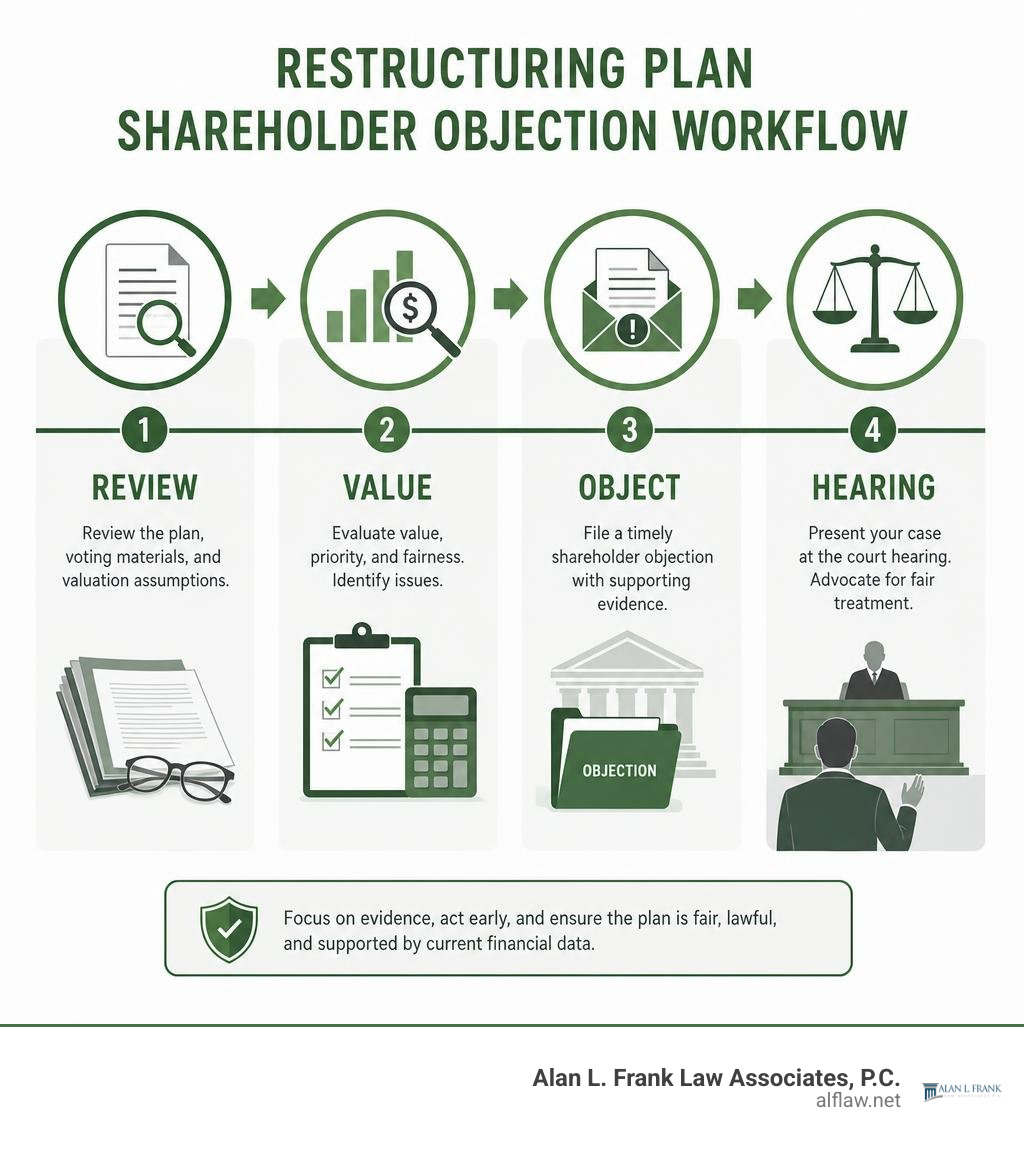
A restructuring plan shareholder objection is most effective when you act early and focus on evidence. Review the plan, voting materials, and valuation assumptions; identify whether the company has understated its value or favored insiders; and file a timely objection at the relevant court hearing. If your shares are being cancelled, diluted, or preserved for selected investors while creditors take losses, ask whether the proposed treatment is legally fair and supported by current financial data.
Key steps include:
- Challenge the valuation. Test whether the company’s forecasts, liquidation analysis, and enterprise value are too pessimistic.
- Check priority and fairness. In a US Chapter 11 case, existing equity generally cannot retain property while a dissenting senior creditor class is unpaid in full, subject to narrow exceptions.
- Review disclosures and releases. Missing valuation information, coercive opt-out releases, or insider-friendly deal protections may provide grounds to object.
- Preserve evidence and meet deadlines. Court restructuring timelines can move quickly, so obtain the plan documents and seek legal and financial advice promptly.
The central question is often whether shareholders are truly out of the money. A plan may label equity as worthless, but debt trading prices, comparable-company values, improved market conditions, and updated forecasts can show that enterprise value exceeds liabilities. That evidence can change both leverage in negotiations and the outcome at confirmation or sanction.
I am Alan L. Frank, Managing Attorney at Alan L. Frank Law Associates, P.C., with more than 20 years of experience in complex commercial litigation, investment-loss disputes, and securities matters. My background as an attorney, CPA, and holder of a Master’s in Tax Law informs a practical approach to a restructuring plan shareholder objection where valuation, disclosure, and financial harm are central issues.
Legal Grounds for a Restructuring Plan Shareholder Objection

When a distressed business proposes a court-supervised recapitalization, equity holders are frequently told that enterprise value has vanished and that canceling or diluting their shares is an unavoidable commercial reality. However, corporate boards and debtor companies do not have unchecked discretion to strip equity value. Both federal reorganization statutes and international corporate restructuring regimes provide formal procedural and substantive protections.
To mount an effective challenge, dissenting stakeholders must establish solid statutory grounds under governing corporate and bankruptcy law. In the United States, Chapter 11 of the Bankruptcy Code requires full disclosure, proper classification of claims, feasibility, and compliance with the fair and equitable requirements of 11 U.S.C. § 1129. In the United Kingdom, Part 26A of the Companies Act 2006 demands satisfaction of strict statutory conditions before a court will invoke cross-class cram down powers. Navigating these overlapping legal frameworks often intersects with broader Corporate and Transactional Matters, requiring a close review of corporate charters, indentures, and debt covenants.
Flawed Valuation Models and Depressed Counterfactuals
The primary foundation of almost every coercive restructuring plan is a depressed enterprise valuation. Plan proponents routinely rely on pessimistic financial forecasts, inflated discount rates, and ultra-conservative terminal multiples to present the business as deeply insolvent. By artificially depressing the company’s valuation, debtors attempt to show that equity is entirely “out of the money,” eliminating the need to provide distributions or voting rights to junior stakeholders.
Shareholders can defeat these strategies by scrutinizing the debtor’s underlying assumptions. In major corporate reorganizations, public market pricing data and industry rebound indicators often contradict gloomy expert reports. For example, during high-profile bankruptcy proceedings, an Ad Hoc Committee Shareholder Objection can demonstrate that when unsecured debt trades near par value and peer multiples rebound, the debtor’s liquidation analysis significantly undervalues the enterprise. If the company ignores post-petition revenue growth or applies unreasonable discounts to tangible assets—such as discounting millions in collectible book debts to near zero—the court can reject the plan’s valuation baseline entirely.
Failure to Satisfy the ‘No Worse Off’ Test
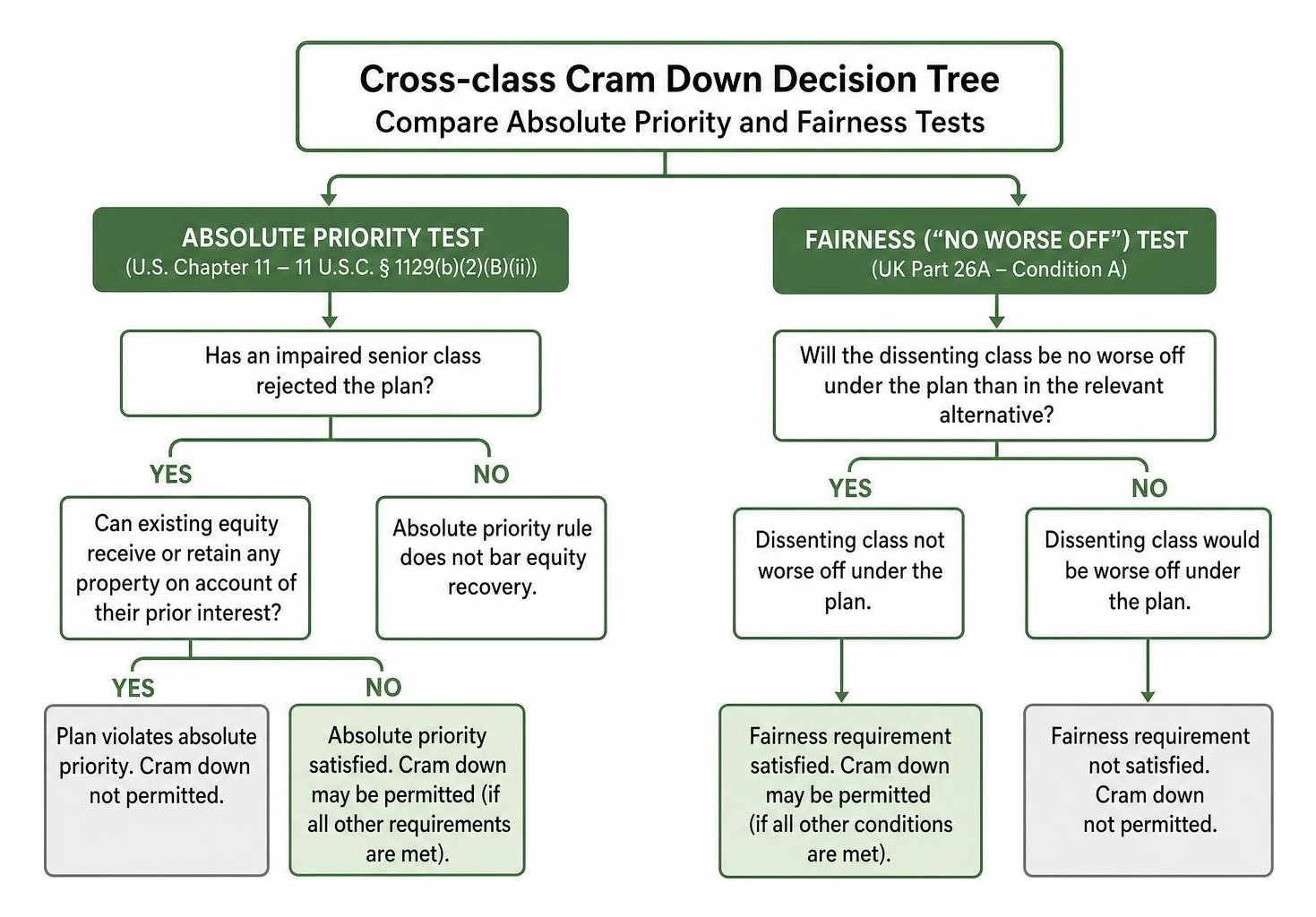
Under modern restructuring frameworks, such as UK Part 26A, a court cannot cram down a dissenting class unless the plan satisfies the “no worse off” test (commonly codified as Condition A). This standard requires the court to be satisfied that members of the dissenting class will not be placed in a worse financial position under the proposed restructuring plan than they would experience in the “relevant alternative.”
The relevant alternative is defined as whatever scenario the court determines is most likely to occur if the restructuring plan is rejected. While debtor companies frequently threaten immediate liquidation or insolvency administration to force compliance, courts will closely examine whether the business has sufficient operational runway to pursue consensual alternatives or continue trading. If an objecting stakeholder proves that the debtor’s counterfactual is overly pessimistic or that an orderly workout would yield superior value, the court lacks jurisdiction to impose a cross-class cram down.
Breach of Fiduciary Duty and Insider Self-Dealing
Restructuring plans are frequently structured to benefit controlling shareholders, private equity sponsors, or select senior lenders at the expense of public minority equity holders. When controlling insiders engineer take-private recapitalizations or debt-for-equity swaps, directors owe strict fiduciary duties of loyalty, care, and good faith.
Common fiduciary breaches in corporate restructurings include:
- Late or Compromised Special Committees: Establishing an independent committee days before plan execution, without independent financial advisors or a mandate to explore alternative bids.
- Asymmetric Rollover Terms: Offering unlisted, illiquid rollover equity units to public shareholders with punitive transfer restrictions while insiders retain liquid control stakes.
- Dual-Class Control Exploitation: Using super-voting stock to approve dilutive transactions by written consent without conditioning the deal on a majority-of-the-minority shareholder vote.
When fiduciaries depress corporate value to facilitate an insider-backed buyout, minority investors can pursue direct and class action remedies through Securities Litigation Investment Losses to recover monetary damages and prevent self-dealing.
Strategic Grounds to Challenge Valuation and Unfair Cram Downs
Beyond structural disclosure and fiduciary flaws, shareholders facing restructuring dilution can challenge the commercial fairness of how the plan allocates value between competing classes. Courts will not sanction plans that arbitrarily reorder statutory priorities or direct windfall profits to favored stakeholders.
Absolute Priority Violations in a Restructuring Plan Shareholder Objection
In US Chapter 11 reorganizations, the Absolute Priority Rule codified in 11 U.S.C. § 1129(b)(2)(B)(ii) serves as a critical defense for impaired classes. Under this rule, if an impaired class of unsecured creditors or senior interest holders rejects a plan, no junior class—including existing equity—may receive or retain any property under the plan on account of their prior interest unless the dissenting senior class is paid in full.
Debtors often attempt to circumvent this rule through the “new value exception,” arguing that existing shareholders can retain their equity by injecting new capital. However, as reinforced in a United States Bankruptcy Court SDNY Memorandum Opinion, any new value contribution must meet rigorous criteria:
- It must be new capital paid in actual money or money’s worth (not speculative future guarantees or conditional arbitration proceeds).
- It must be necessary to the successful operation of the business.
- It must be substantial and reasonably equivalent to the enterprise value retained.
- It must be subjected to competitive market testing rather than negotiated as an exclusive, insider-only deal.
Commercial Justification Deficits and Equity Preservation
In cross-border restructurings under UK or Commonwealth law, courts do not apply a rigid absolute priority rule, but they strictly review whether there is a “reasonable commercial justification” for allowing equity holders to retain value while creditors take write-downs.
In Re Sino-Ocean Group Holding Ltd, a dissenting creditor objected because existing shareholders retained a 53.8% majority stake post-restructuring. The court sanctioned the plan only after the company presented clear commercial evidence demonstrating that preserving state-owned shareholder stakes above 15% was essential to maintaining state-backed credit perceptions and securing favorable borrowing rates. Absent compelling, documented commercial necessity, courts routinely refuse to sanction plans that allocate the “restructuring surplus” exclusively to equity holders or favored lenders while cramming down dissenting classes.
Coercive Third-Party Releases and Opt-Out Clauses
A major area of restructuring abuse involves non-consensual third-party releases and overly broad exculpation provisions. Debtors often attempt to extinguish direct shareholder claims against corporate officers, directors, financial advisors, and private sponsors without providing adequate consideration.
Federal courts have grown increasingly hostile toward deemed-consent and “opt-out” mechanisms in Chapter 11 disclosure packages. Silence or the failure to check an opt-out box on a proxy ballot does not constitute affirmative consent to release direct legal claims. Dissenting shareholders can successfully object to plan confirmation if the releases:
- Exculpate non-estate fiduciaries for pre-petition misconduct.
- Provide de minimis consideration (such as minor cash pools representing less than 1% incremental recovery) in exchange for extinguishing substantial fraud or disclosure claims.
- Are not strictly necessary to the reorganized debtor’s ongoing operational survival.
How Shareholders Can Mount a Formal Restructuring Plan Challenge
Challenging a multi-million-dollar corporate restructuring requires structured legal action, disciplined evidentiary development, and rapid execution. Dissenting stakeholders must organize early to build leverage and Recover Your Investment before unappealable confirmation orders are entered.
Key Deadlines for a Restructuring Plan Shareholder Objection at Court Hearings
Restructuring litigation operates on accelerated timetables. Missing a procedural filing window can permanently waive valid substantive objections. Dissenting stakeholders must track two distinct litigation phases:
- The Convening / Disclosure Hearing: In UK Part 26A proceedings, the court reviews class composition and voting structures at the convening stage. In US Chapter 11, the court evaluates whether the disclosure statement contains “adequate information.” Objections regarding class gerrymandering, release language, and informational deficiencies must be raised here.
- The Sanction / Confirmation Hearing: This is the full evidentiary trial where the court determines whether statutory cram down standards, valuation baselines, and overall fairness requirements have been satisfied. Formal written objections, expert rebuttal declarations, and deposition notices must be served well in advance of this hearing.
Investigating Board Misconduct Through Section 220 Books and Records
Before filing formal objections or derivative lawsuits in state court, shareholders in Delaware corporations have a powerful statutory tool: a books and records inspection demand under 8 Del. C. § 220 (and comparable state statutes in Pennsylvania and New Jersey).
A properly drafted Section 220 demand allows shareholders to inspect:
- Minutes of board of directors and special committee meetings.
- Communications between corporate officers and restructuring financial advisors.
- Preliminary financial forecasts, liquidation models, and unredacted solvency opinions.
- Conflict-of-interest disclosures regarding insider rollover equity agreements.
Uncovering discrepancies between internal financial forecasts and the depressed numbers presented in public disclosure statements provides decisive ammunition to defeat plan confirmation.
Proving ‘In-the-Money’ Status Without Filing Competing Valuations
A common misconception is that dissenting shareholders must spend hundreds of thousands of dollars commissioning their own comprehensive enterprise valuation to defeat a restructuring plan. While independent expert testimony is valuable, courts have confirmed that objectors can successfully block plan sanction simply by undermining the credibility, methodology, and underlying assumptions of the debtor’s valuation witnesses.
Through targeted cross-examination and document discovery, shareholders can expose:
- Arbitrary increases in the weighted average cost of capital (WACC) used in discounted cash flow models.
- Selective exclusion of rebounding macroeconomic and commodity price trends.
- Inconsistent treatment of recoverable assets, such as book debts, unbilled tax credits, and valuable intellectual property.
- Par trading values of the company’s publicly traded bonds that directly contradict management’s claims of deep insolvency.
Comparative Legal Frameworks: US, UK, and Singapore Restructuring Standards

Modern corporate restructurings frequently cross international borders, requiring corporate debtors to balance jurisdictional standards across the United States, the United Kingdom, and Singapore.
| Statutory Framework | Primary Restructuring Tool | Cram Down Mechanism | Treatment of Existing Equity & Absolute Priority |
|---|---|---|---|
| United States | Chapter 11 Bankruptcy Code | 11 U.S.C. § 1129(b) Cramdown | Strict Absolute Priority Rule: Equity cannot retain value over dissenting senior classes unless paid in full or qualified under the market-tested New Value Exception. |
| United Kingdom | Part 26A Companies Act 2006 | Section 901G Cross-Class Cram Down | Discretionary Fairness Standard: No strict statutory absolute priority rule. Equity retention permitted if justified by commercial necessity and dissenting classes satisfy the “no worse off” test. |
| Singapore | IRDA 2018 (Section 70) | Judicial Cram Down of Schemes | Fair and Equitable Standard: Requires plan not to be unfairly discriminatory. Ongoing reforms emphasize new value rules and enhanced shareholder protection balances. |
UK Part 26A Cross-Class Cram Downs vs. US Chapter 11 Rules
The fundamental divergence between English and American restructuring practice lies in how each regime treats statutory priority. Under US Chapter 11, the absolute priority rule is a rigid statutory mandate: if an impaired creditor class votes “no,” equity cannot retain an ownership stake without paying that creditor in full, regardless of how commercially sensible equity retention might seem.
In contrast, under UK Part 26A, the English High Court exercises broad judicial discretion. If Condition A (the “no worse off” test) and Condition B (approval by at least one class with a genuine economic interest) are satisfied, the court performs a “horizontal comparison” to determine whether the restructuring surplus is distributed fairly. English courts will sanction plans that allow shareholders to retain equity while creditors take hair cuts, provided the retention serves a legitimate commercial purpose that protects the going-concern enterprise.
Singapore IRDA Section 70 and Emerging Shareholder Protections
Singapore’s Insolvency, Restructuring and Dissolution Act 2018 (IRDA) combines elements of both US Chapter 11 and UK scheme jurisprudence. Under Section 70 of the IRDA, the Singapore High Court can approve a cram down if the scheme does not unfairly discriminate between classes and satisfies the fair and equitable baseline.
Recent legislative committee recommendations have proposed formalizing a “new value exception” within Singapore law, clarifying the precise capital contributions existing equity holders must inject to retain ownership stakes over creditor objections.
Frequently Asked Questions About Restructuring Plan Objections
Can shareholders retain equity if creditors are crammed down and not paid in full?
Under US Chapter 11, shareholders generally cannot retain equity over the objection of an impaired senior creditor class unless they satisfy the strict criteria of the new value exception through substantial, market-tested cash injections. Under UK Part 26A, shareholders can retain equity without injecting new capital if the company proves a compelling commercial justification—such as preserving key operational licenses, state-owned financing advantages, or crucial business relationships—and the dissenting classes are no worse off than in liquidation.
What is the legal standard for the ‘no worse off’ test in restructuring plans?
The “no worse off” test (Condition A under UK Part 26A) requires the court to determine that dissenting stakeholders will recover at least as much under the proposed restructuring plan as they would in the “relevant alternative.” The relevant alternative is what would most likely happen if the plan fails, which is typically an immediate liquidation or an administration fire-sale, though courts will evaluate whether continued trading or alternative transactions are realistically achievable.
Can dissenting shareholders successfully object without submitting their own valuation?
Yes. Courts hold an independent duty to scrutinize the debtor’s valuation evidence. Dissenting shareholders can successfully defeat a restructuring plan by cross-examining the debtor’s experts and proving that the company’s financial models rely on artificially depressed revenue projections, flawed discount rates, or distorted liquidation assumptions, without having to bear the expense of submitting a standalone appraisal report.
Conclusion
Distressed corporate restructurings and recapitalizations present significant financial risks to equity holders, but a proposed plan is not an uncontestable mandate. Whether challenging artificially depressed valuation metrics, defeating coercive third-party releases, or enforcing statutory priority protections, shareholders have powerful legal avenues to protect their investments.
Successfully stopping an unfair restructuring requires moving quickly, uncovering board conflicts, and rigorously challenging the financial assumptions presented to the court. At Alan L. Frank Law Associates, P.C., our legal team combines decades of aggressive courtroom trial experience with deep corporate and tax knowledge to represent investors and stakeholders in complex Commercial Litigation across Pennsylvania, New Jersey, and nationwide. If your equity holdings are threatened by an unfair restructuring plan or cramdown attempt, we are prepared to evaluate your case and enforce your rights.