
Target Date Fund Losses: A Guide to Recovery


Target Date Fund Losses: A Guide to Recovery
When an ETF Recommendation May Be Unsuitable
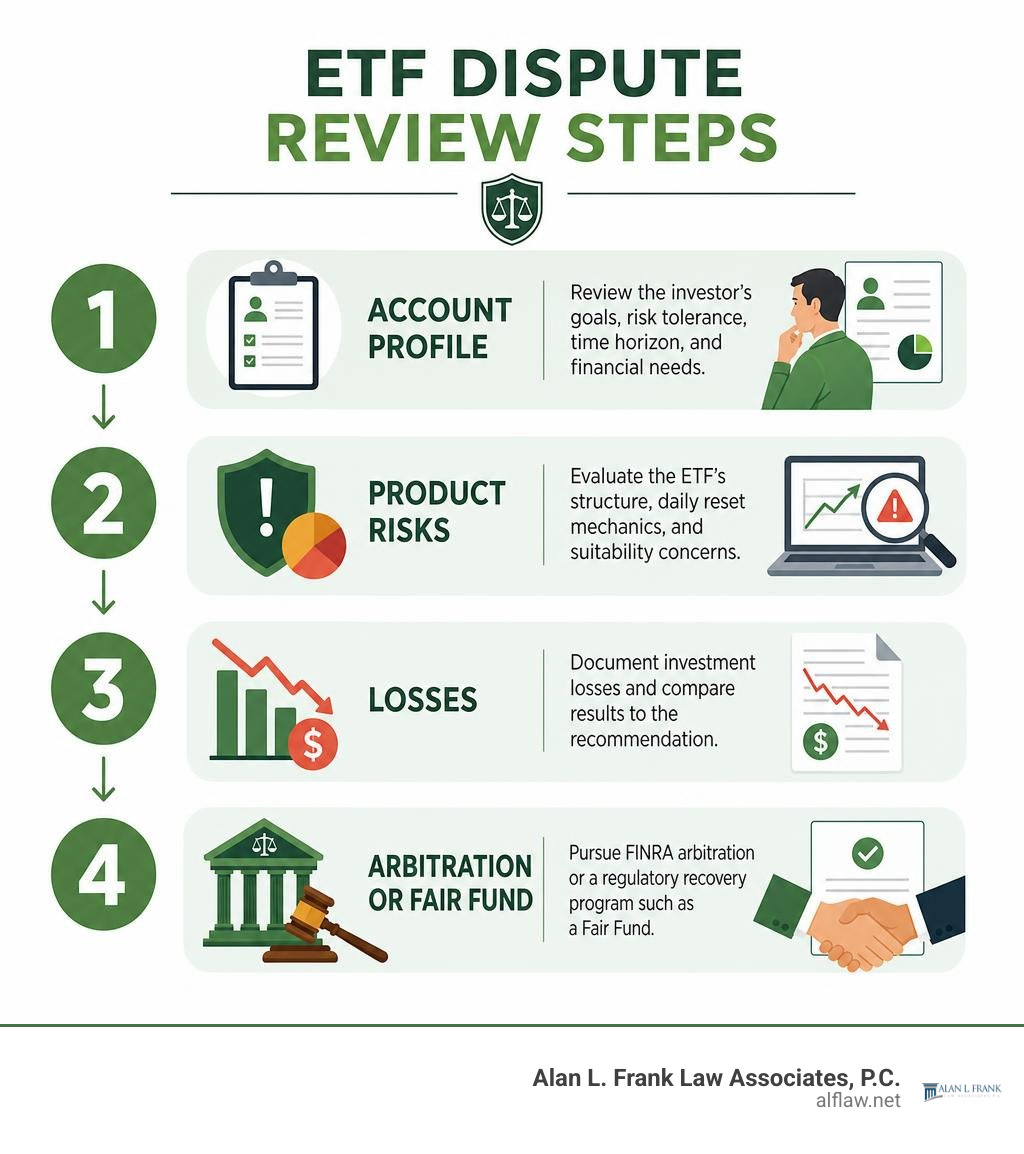
An ETF unsuitable recommendation dispute may arise when a broker recommends a complex fund that does not fit the investor’s goals, risk tolerance, financial needs, or intended holding period. Investors should save account statements and communications, compare the recommendation with their client profile, and promptly assess whether a FINRA arbitration claim or regulatory recovery program may apply.
Leveraged, inverse, and volatility-linked exchange-traded products are often built for short-term trading. Many reset their exposure each day, so gains and losses compound differently over time than the index they track. A fund can therefore lose substantial value even when the underlying market moves in the direction an investor expected.
Red flags include a broker placing a large share of a retiree’s income-focused account in a daily-reset product, calling a volatility product a long-term “hedge,” or leaving the investment untouched for weeks or months. In regulatory cases, firms have faced sanctions where their representatives and supervisors did not adequately understand or monitor these risks.
I am Alan L. Frank, Managing Attorney at Alan L. Frank Law Associates, P.C., with more than 20 years of experience handling complex commercial disputes and investment-loss matters nationwide. As a CPA and attorney with a Master’s in Tax Law, I evaluate the financial records and legal issues that can shape an ETF unsuitable recommendation dispute.
Understanding Non-Traditional Fund Mechanics and Daily Reset Flaws
Traditional exchange-traded funds (ETFs) generally track a basket of securities to replicate the performance of an underlying index, such as the S&P 500 or the Russell 2000. These traditional funds are typically designed for buy-and-hold strategies. However, non-traditional exchange-traded products—such as leveraged, inverse, inverse-leveraged, and volatility-linked exchange-traded notes (ETNs)—function under completely different mechanics.
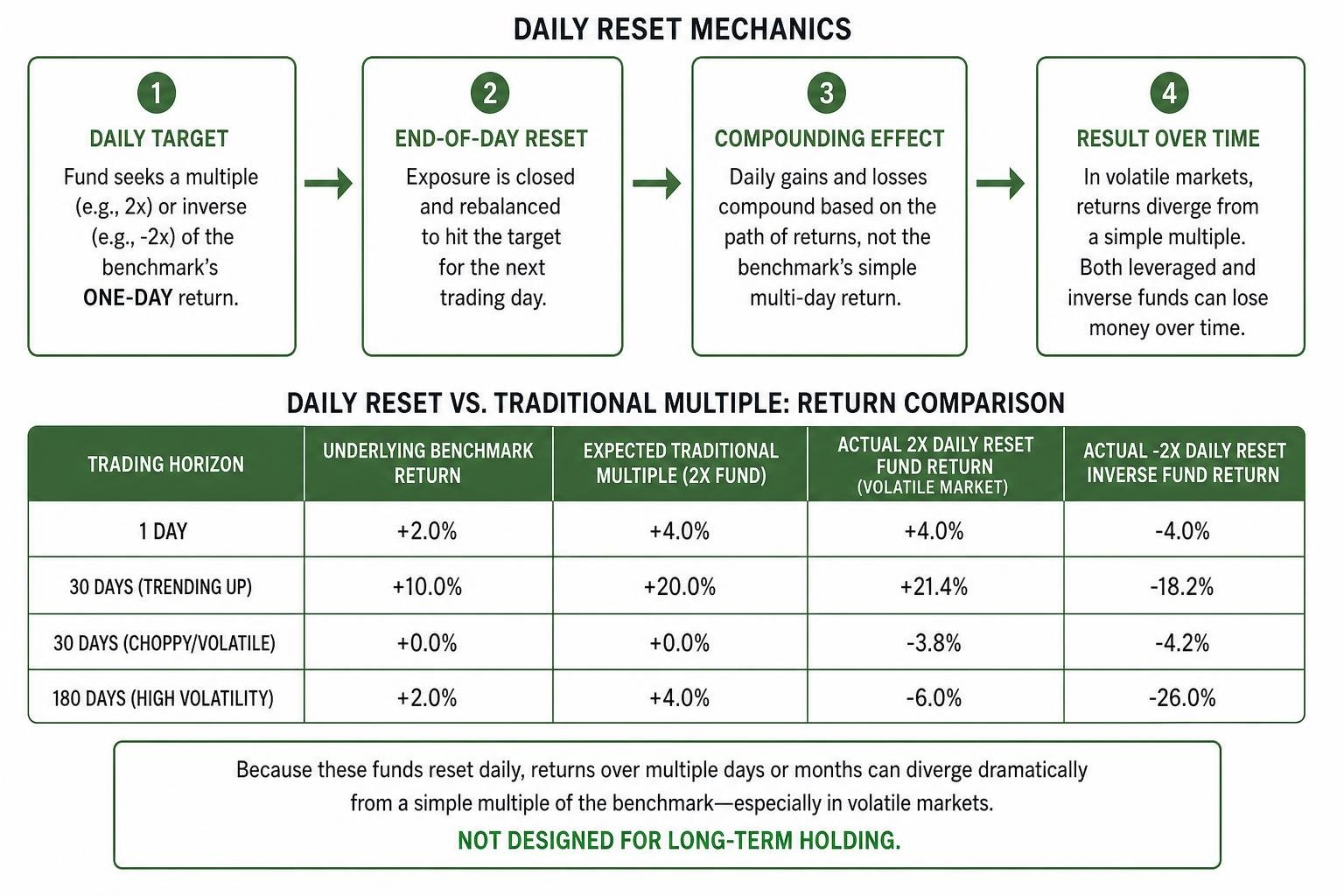
Non-traditional funds use complex derivative instruments, including total return swaps, equity index swaps, and futures contracts, to achieve their stated objectives. Most importantly, these products are engineered to achieve their performance objectives on a daily basis. Because these funds reset their exposure every trading session, their multi-day, multi-week, or multi-month returns diverge dramatically from a simple multiple of the underlying index’s performance over that same timeframe.
| Trading Horizon | Underlying Benchmark Return | Expected Traditional Multiple (2x Fund) | Actual 2x Daily Reset Fund Return (Volatile Market) | Actual -2x Daily Reset Inverse Fund Return |
|---|---|---|---|---|
| 1 Day | +2.0% | +4.0% | +4.0% | -4.0% |
| 30 Days (Trending Up) | +10.0% | +20.0% | +21.4% | -18.2% |
| 30 Days (Choppy/Volatile) | +0.0% | +0.0% | -3.8% | -4.2% |
| 180 Days (High Volatility) | +2.0% | +4.0% | -6.0% | -26.0% |
As the table illustrates, during periods of market volatility, both a leveraged fund and an inverse leveraged fund tracking the exact same underlying benchmark can lose money simultaneously over extended holding periods. For example, between December 2008 and April 2009, an underlying oil and gas index gained roughly 2%. Over that exact same period, a 2x leveraged fund tied to that index dropped by 6%, while the corresponding -2x inverse fund plummeted by 26%. This mathematical breakdown—often called “volatility drag” or “volatility decay”—makes non-traditional funds structurally defective for long-term retail portfolios.
Leveraged and Inverse Fund Structure
Geared and inverse funds seek to deliver a multiple (such as 2x or 3x) or the opposite (-1x, -2x, or -3x) of the single-day percentage change of a specific benchmark. To achieve this, the fund manager enters into swap agreements and futures contracts that must be rebalanced at the end of every trading day.
In June 2009, FINRA issued Regulatory Notice 09-31 to warn broker-dealers about the substantial risks associated with leveraged and inverse exchange-traded products. FINRA explicitly stated that these funds are generally unsuitable for retail investors who plan to hold them for longer than one trading session. Despite this clear regulatory guidance, many registered representatives have continued to recommend these instruments as medium- or long-term portfolio strategies, failing to understand how daily rebalancing magnifies losses over time.
Volatility Compounding and Contango Decay
The structural risks are even more pronounced in volatility-linked exchange-traded products, such as those tracking the Cboe Volatility Index (VIX) through short-term futures contracts (e.g., the iPath S&P 500 VIX Short-Term Futures ETN, formerly ticker VXX).
Because the spot VIX index itself is not directly investable, volatility ETPs purchase rolling short-term VIX futures contracts. Under normal market conditions, VIX futures trade in a condition known as contango—where longer-dated futures contracts trade at higher prices than near-term contracts. To maintain continuous exposure, the fund must constantly sell cheaper expiring contracts to purchase more expensive forward contracts.
This ongoing monthly process generates a severe, continuous negative roll yield. As a direct mathematical result, buy-and-hold investors in short-term volatility futures products face an expected long-term value near zero. Brokers who pitch these products as permanent “market hedges” or “insurance policies” demonstrate a fundamental misunderstanding of futures-based derivatives.
Regulatory Standards and the ETF Unsuitable Recommendation Dispute Framework
Broker-dealers and registered representatives are bound by professional conduct rules designed to protect investors from reckless, inappropriate investment advice. When a broker recommends complex derivatives without understanding their mechanics, or sells them to an investor whose profile does not support high-risk speculation, the investor may pursue compensation through a formal dispute.

Historically governed by NASD Rule 2310 (and subsequently codified under FINRA Rule 2111 and SEC Regulation Best Interest), the suitability doctrine requires brokers to have an objective, reasonable basis for every recommendation they make to customers. When financial professionals disregard these standards, aggrieved investors can turn to FINRA as a forum for claims involving stockbroker misconduct to recover their financial losses.
Two-Step Suitability under NASD Rule 2310 and FINRA Rule 2111
A lawful recommendation requires satisfying two distinct legal standards:
- Reasonable-Basis Suitability: The broker and the brokerage firm must conduct reasonable due diligence to understand the security’s risks, terms, and mechanics. The broker must determine that the product is suitable for at least some investors. Recommending a daily reset product as a multi-month hold violates reasonable-basis suitability because the product is mathematically engineered for short-term trading.
- Customer-Specific Suitability: Even if a product is viable for sophisticated day-traders, the broker must verify that the investment is suitable for the specific customer based on their investment profile. This profile includes the investor’s age, other investments, financial situation and needs, tax status, investment objectives, investment experience, investment time horizon, liquidity needs, and risk tolerance, as emphasized in regulatory guidance such as Notice to Members 05-26.
Common Red Flags in an ETF Unsuitable Recommendation Dispute
When analyzing brokerage accounts for potential misconduct, we look for distinct patterns that point to supervisory failure and broker negligence:
- Mismatched Investment Objectives: Recommending volatile, daily reset, or leveraged products to investors with conservative, moderate, or income-focused investment profiles.
- Elderly and Retiree Exploitation: Placing senior citizens or retirees who depend on capital preservation into complex derivative vehicles.
- Excessive Holding Durations: Allowing products engineered for single-day rebalancing to sit in customer accounts unmonitored for months or years.
- Overconcentration: Allocating large percentages of an investor’s liquid net worth into one or two non-traditional ETPs.
- Misrepresenting Risk as “Hedging”: Falsely telling a customer that an inverse or volatility product will protect their retirement savings during market downturns while ignoring contango decay.
If your financial advisor exposed your portfolio to catastrophic drawdowns through inappropriate trading strategies, you may have grounds to pursue a claim for securities lawyer stock market broker malpractice negligence.
Regulatory Enforcement Case Studies: Supervisory Failures in Volatility and Complex ETPs
Federal regulators and FINRA have repeatedly sanctioned national broker-dealers for failing to establish, maintain, and enforce written supervisory procedures (WSPs) regarding non-traditional and complex ETPs. Under Section 15(b)(4)(E) of the Securities Exchange Act of 1934, brokerage firms have an affirmative legal duty to reasonably supervise their representatives to prevent violations of the federal securities laws.
SEC Sanctions Against American Portfolios for VXX Mismanagement
A prime example of systemic supervisory failure occurred in the SEC administrative proceeding against American Portfolios Financial Services, Inc. and American Portfolios Advisors, Inc.. The SEC found that between January 2016 and February 2020, approximately 60 registered representatives recommended that retail brokerage customers purchase and hold VXX as a long-term portfolio hedge against market declines.
The SEC’s findings revealed widespread negligence:
- Representatives recommended VXX based on general internet searches and cable television political commentary, without reading the prospectus or understanding negative roll yield and contango.
- In total, 422 APFS retail brokerage accounts lost money holding VXX, with an average holding period of 4 months—and some accounts holding the product for up to 22 months.
- On average, these brokerage customers lost more than 42% of the money invested.
- Additionally, 62 APA retail advisory accounts suffered severe losses holding VXX for up to 17 months.
- The firm’s supervisory systems only searched for high commissions or variable annuity churn, entirely failing to monitor extended holding periods in exchange-traded volatility products.
As a result, the SEC censured the firms, ordered them to cease and desist from future violations, and required them to pay $653,072 in civil penalties, disgorgement, and prejudgment interest into a Fair Fund for affected investors.
Institutional Oversight Deficits in an ETF Unsuitable Recommendation Dispute
Similar supervisory breakdowns occurred during the expansion of non-traditional ETFs across the broader financial industry. Between June 2006 and April 2009, the number of non-traditional ETFs trading on national exchanges exploded from just a few funds to more than 100 products managing approximately $22 billion in assets.
Major broker-dealers routinely failed to update their compliance systems to handle these derivative products:
- At Morgan Stanley Fined $1.75M for Weak Supervision of ETF Sales – , customers bought and sold more than $4.78 billion in non-traditional ETFs between January 2008 and June 2009 without adequate supervisory controls.
- In one egregious case, a 74-year-old customer with an income objective and a net worth under $300,000 had over 25% of their account concentrated in a single non-traditional ETF. The broker held the position for 128 trading days, generating losses exceeding $13,000.
- In another instance, an 89-year-old client with an income objective and a net worth under $200,000 was allocated over 59% of their account into a single non-traditional ETF held for 39 trading days, resulting in losses exceeding $10,000.
- Regulators ultimately sanctioned four major wirehouses—Citigroup Global Markets Inc., UBS Financial Services Inc., Wells Fargo Advisors LLC, and Morgan Stanley—ordering them to pay a combined $7.3 million in fines and $1.8 million in customer restitution.
These institutional enforcement actions show that supervisory failures are rarely isolated incidents; they frequently reflect firm-wide neglect. When brokerage firms breach their legal duties, arbitration panels hold them accountable, as seen in cases securing a FINRA award in the amount of $310,000 against Morgan Stanley for breach of fiduciary duty and professional negligence.
Legal Strategies to Recover Investment Losses from Mismanaged Funds
Investors who have suffered financial losses due to unsuitable ETF recommendations do not have to accept those losses as normal market risks. Depending on the circumstances of the case, several legal pathways exist to recover your invested principal.
When assessing your options, working with experienced FINRA attorneys allows you to conduct an exhaustive forensic audit of your account statements, track holding durations, evaluate performance deviations against relevant market benchmarks, and quantify actual damages.
Pursuing FINRA Arbitration for Broker Negligence
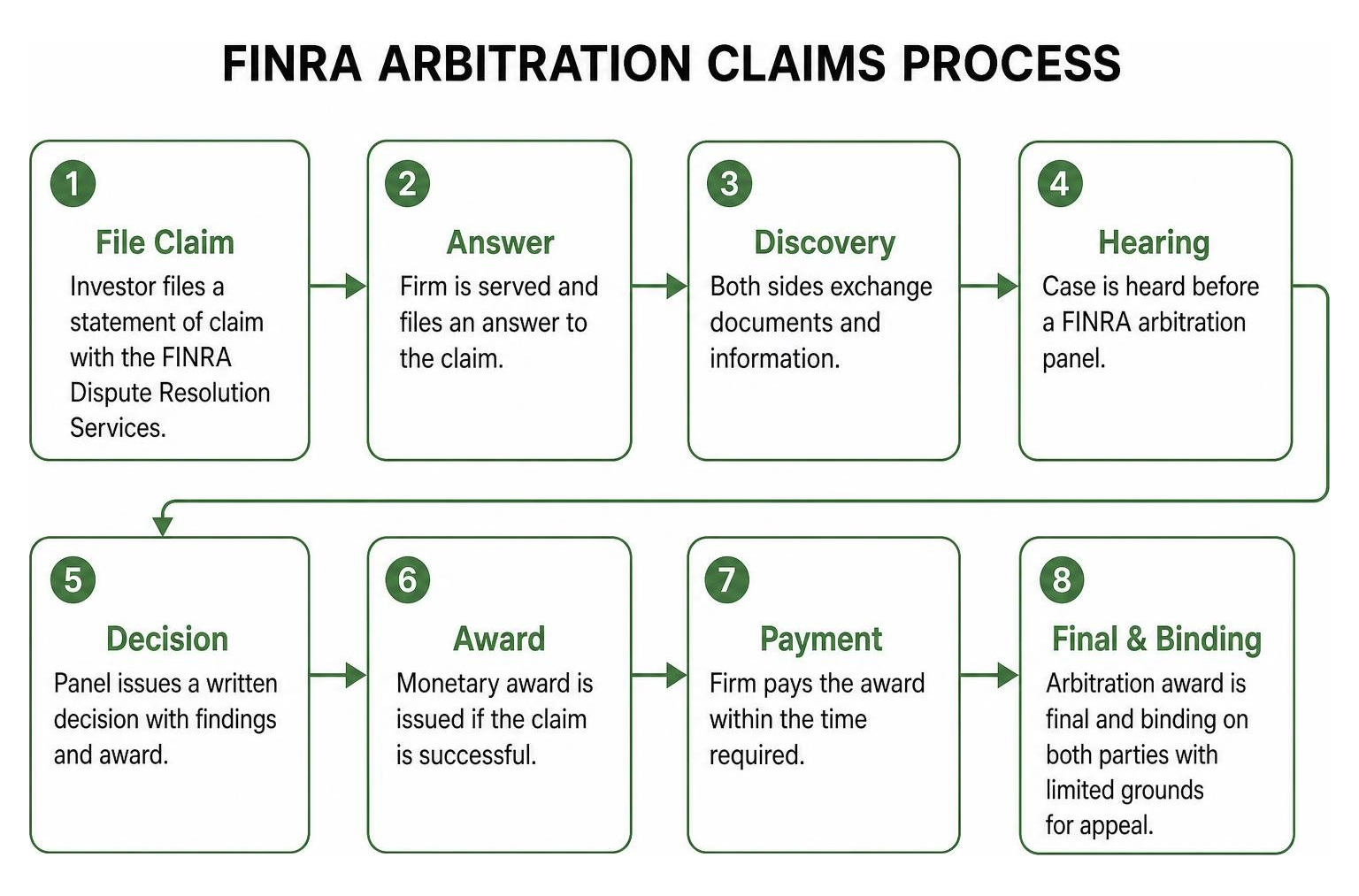
Most retail brokerage customer agreements contain mandatory pre-dispute arbitration clauses, requiring disputes to be resolved through FINRA Dispute Resolution Services rather than state or federal courts.
The FINRA arbitration process involves several structured stages:
- Statement of Claim: We draft and file a comprehensive Statement of Claim detailing the broker’s unsuitable recommendations, the firm’s failure to supervise under FINRA Rule 3110 (and former NASD Rule 3010), misrepresentations or omissions regarding product reset risks, and specific financial damages.
- Arbitrator Selection: Both parties rank and strike potential arbitrators from FINRA’s neutral roster to select a three-member panel (or a single arbitrator for smaller claims).
- Discovery: We request internal firm communications, broker notes, automated surveillance exception reports, compliance audit notes, and supervisory correspondence.
- Evidentiary Hearing: Our attorneys present documentary evidence, cross-examine the broker and compliance supervisors, introduce expert financial testimony on daily reset compounding or contango roll costs, and argue your damages.
Under FINRA Rule 12206, claims are eligible for arbitration if filed within six years from the date of the event or occurrence giving rise to the dispute. However, waiting to file can complicate evidentiary discovery, so prospective claimants should act promptly.
Regulatory Fair Funds and Restitution Distributions
In certain enforcement proceedings, federal regulators establish distribution funds to compensate harmed investors directly:
- Sarbanes-Oxley Section 308(a) Fair Funds: When the SEC obtains civil penalties and disgorgement from a sanctioned firm, it may combine those sums into a Fair Fund to distribute money directly to eligible injured customers.
- FINRA Restitution Orders: As part of regulatory settlements (such as Letters of Acceptance, Waiver, and Consent), FINRA frequently mandates that firms deposit restitution into designated accounts for affected account holders.
Participating in a Fair Fund distribution generally does not prevent an investor from pursuing separate FINRA arbitration claims for excess uncompensated losses, provided there is no double recovery for the same dollar of damage.
Frequently Asked Questions About Complex Fund Disputes
Why are daily reset funds unsuitable for long-term buy-and-hold strategies?
Daily reset funds rebalance their underlying derivative contracts (such as swaps and futures) at the close of every trading session to deliver a specific daily multiple or inverse return. Because each day’s return compounds off the prior day’s ending value, prolonged volatility causes the fund’s price to steadily decay. Over weeks, months, or years, the fund’s total return will diverge drastically from the long-term return of the underlying benchmark, often producing severe losses even when the underlying market index moves in the direction the investor anticipated.
What evidence establishes broker liability in fund mismanagement claims?
Broker liability is established through clear documentary records demonstrating that the broker failed in their reasonable-basis or customer-specific suitability obligations. Key evidence includes:
- Account opening documents showing conservative risk tolerances or income objectives that conflict with speculative derivative products.
- Monthly brokerage statements demonstrating extended holding periods (weeks or months) for funds engineered exclusively for intraday or single-day use.
- The absence of written risk disclosures regarding daily rebalancing, contango, or negative roll yields.
- Internal brokerage firm records showing a lack of automated trade surveillance, missing compliance alerts, or inadequate representative training on complex exchange-traded products.
What is the timeline for filing an arbitration claim to recover investment losses?
Under FINRA Rule 12206, an arbitration claim must be filed within six years of the event giving rise to the dispute (typically the date the unsuitable investment was recommended or purchased). However, state statutes of limitations for common law fraud, professional negligence, or breach of fiduciary duty may be considerably shorter, often ranging between two and four years. To preserve all available legal remedies and prevent critical evidence or compliance logs from being lost, investors should have their accounts reviewed by legal counsel as soon as an improper investment strategy is identified.
Conclusion
Complex financial products like leveraged, inverse, and volatility-linked exchange-traded funds were never engineered for ordinary, long-term buy-and-hold retail investing. When brokerage firms and registered representatives fail to understand these products, market them as safe long-term hedges, or neglect their mandatory supervisory duties, they can be held legally accountable for the resulting portfolio devastation.
At Alan L. Frank Law Associates, P.C., we represent investors in Pennsylvania, New Jersey, and nationwide in complex securities disputes, FINRA arbitrations, and regulatory recovery actions. If you suffered significant losses due to unsuitable fund recommendations or broker negligence, contact our team to evaluate your legal options through our dedicated securities litigation and investment losses practice. We provide rigorous, strategic representation to help you recover your hard-earned capital.