
Why Retirement Accounts Are Prime Targets for Unscrupulous Financial Advisers


Why Retirement Accounts Are Prime Targets for Unscrupulous Financial Advisers
Why an IRA Rollover Fraud Attorney Can Help Protect Your Recovery and Tax Status
If a broker, adviser, or scammer caused you to move retirement money into a bad investment or fraudulent account, act fast. An IRA rollover fraud attorney can help preserve evidence, seek recovery from responsible parties, and address the tax problem created when an IRA distribution is not returned within 60 days.
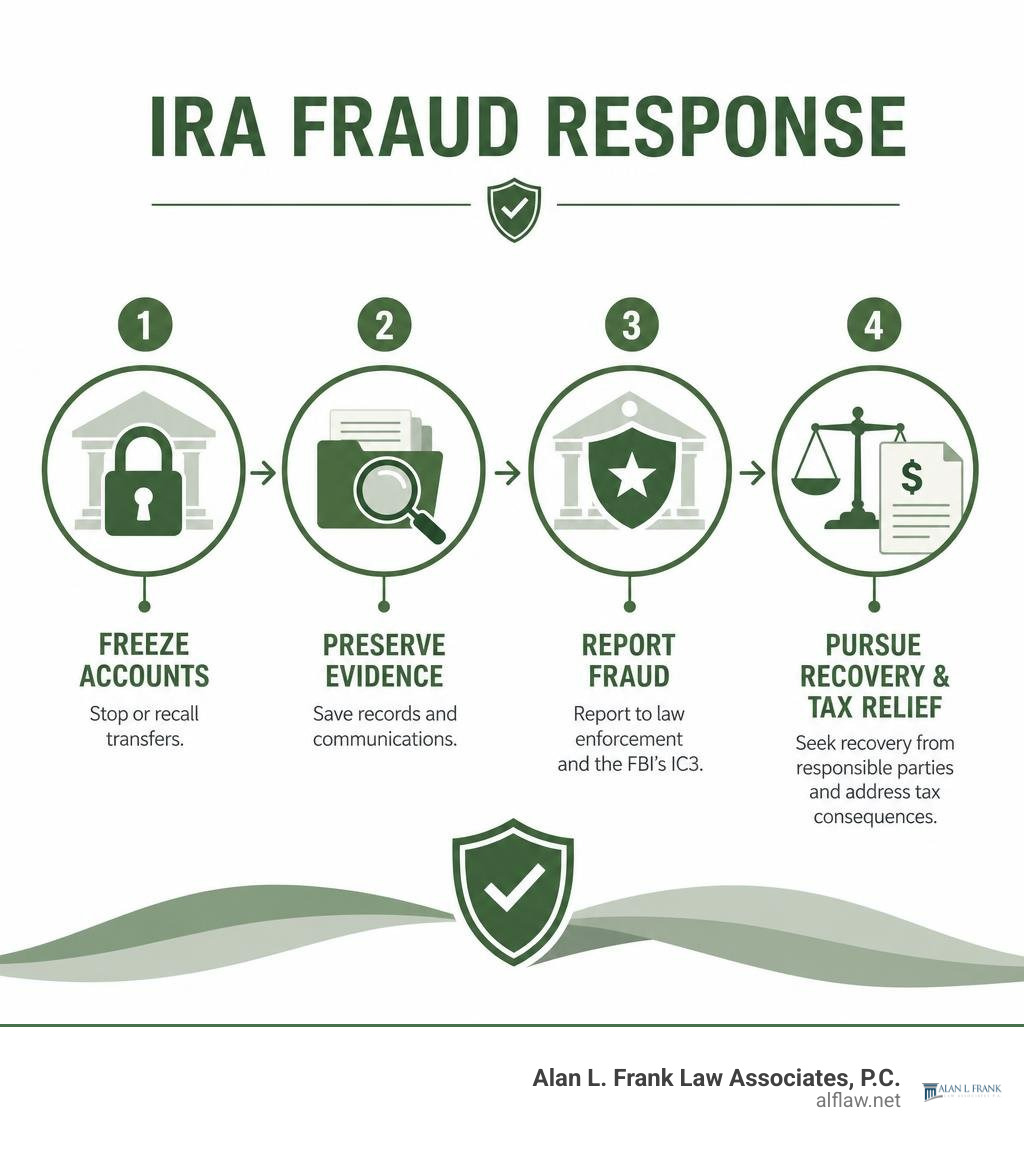
Start with these steps:
- Contact the IRA custodian and receiving institution to stop or recall transfers.
- Save texts, emails, call logs, account statements, wire records, and adviser communications.
- Report the fraud to law enforcement and the FBI’s IC3.
- Get legal and tax advice before treating the distribution as final or depositing replacement funds.
The danger is a costly double loss. Even when someone is tricked into withdrawing IRA funds, the IRS generally treats the withdrawal as taxable income unless it qualifies for rollover treatment or relief. In some fraud cases, the IRS has waived the 60-day rollover deadline through private letter rulings, particularly where the fraud was outside the victim’s control and funds were recovered or can be replaced.
I am Alan L. Frank, Managing Attorney at Alan L. Frank Law Associates, P.C., a CPA and attorney with a Master’s in Tax Law and more than 20 years of experience handling complex investment-loss, securities, commercial, and tax-related disputes. As an IRA rollover fraud attorney, I help clients assess potential recovery claims while working to limit the tax damage that can follow retirement-account fraud.
1. Key Vulnerabilities Exploited in Retirement Rollover Schemes

Retirement savers represent decades of disciplined accumulation. For bad actors, an individual retirement account (IRA) or a 401(k) rollover represents a massive, concentrated pool of capital ripe for exploitation. Unlike routine checking accounts with everyday fraud alerts, retirement balances are frequently moved in significant lump sums. Whether an investor is transitioning between jobs or entering retirement, moving six- or seven-figure balances creates brief windows where large transfers do not immediately look out of place to automated compliance algorithms.
Predatory advisers and organized criminal rings exploit distinct structural vulnerabilities:
- Lump-Sum Distributions: Moving large balances makes unauthorized or deceptive transfers blend into routine rollover requests.
- Complex Statutory Frameworks: Account holders often fail to understand the strict mechanics separating direct custodian transfers from indirect 60-day payouts.
- Custodial Compliance Gaps: Financial institutions frequently process rapid outward wire requests without performing identity checks, signature authentication, or secondary verification.
- Cognitive Vulnerabilities and Trust: Scammers deliberately prey on senior savers or investors navigating major life transitions, weaponizing urgency, fear, or false authority.
Impersonation Schemes and Unauthorized Asset Transfers
The Federal Bureau of Investigation’s Internet Crime Complaint Center (IC3) has repeatedly warned of sophisticated operations designed specifically to drain retirement accounts. Fraudsters no longer rely on obvious email pitches. Instead, they engineer multi-stage impersonation schemes involving compromised devices, spoofed bank phone numbers, and fabricated regulatory correspondence.
In administrative proceedings before the IRS, the scale of these operations is clear:
- Law Enforcement and Government Agency Impersonation: In IRS Private Letter Ruling (PLR) 202430010, scammers impersonated multiple federal agencies. They convinced a victim that her Social Security number was discovered in an abandoned vehicle tied to international drug trafficking. The fraudsters used forged government documents, staged three-way calls with fake police chiefs, and coerced the victim into liquidating her IRA across ten structured wire transfers to “protective government safety lockers.”
- Technical Support and Fraud Department Spoofing: In PLR 202535015, taxpayers received fake computer security alerts warning that their accounts were compromised. Posing as anti-fraud agents, the scammers instructed the savers to liquidate their retirement holdings and transfer the assets into designated cryptocurrency accounts for safekeeping.
- Device Takeovers: In PLR 202623022, fraudsters masquerading as financial institution security specialists convinced an account holder to grant remote desktop access under the guise of halting an identity theft attack. The perpetrators took control of the victim’s session, initiated an unauthorized IRA distribution, and converted the cash into untraceable offshore assets.
When assets are stolen or moved into non-qualified destinations, the transaction triggers severe federal tax liabilities unless immediate corrective legal measures are taken.
Churning, Unsuitable Products, and Custodial Negligence
Not all rollover fraud stems from shadowy criminal syndicates. A significant portion originates from registered representatives and investment advisers motivated by commissions and asset gathering. When an employee leaves a company, predatory financial advisers often pressure them to roll stable, low-cost employer-sponsored 401(k) plans into high-fee, proprietary individual retirement accounts.
Once funds land in an IRA, unscrupulous advisers may engage in churning—excessive trading designed primarily to generate broker commissions—or allocate retirement capital into complex, illiquid products such as:
- Non-Traded Real Estate Investment Trusts (REITs): Opaque products carrying upfront commissions as high as 10% to 15%, severe resale restrictions, and high risk of capital loss.
- High-Fee Variable and Indexed Annuities: Long surrender charge schedules lasting 7 to 10 years, complex cap rates, and heavy annual administrative costs that erode returns.
- Unregistered Private Placements: Speculative securities marketed with misleading promises of safety that omit key risks.
Brokerage firms and clearing custodians owe fiduciary, statutory, and regulatory duties to protect customer funds. When an adviser facilitates an unsuitable rollover or a custodian ignores red flags during a fraudulent wire transfer, savers have grounds to pursue claims for broker malpractice and negligence.
2. The Devastating Double Hit: Tax Penalties After IRA Theft

Many scam victims believe that losing money to fraud absolves them of tax liabilities. Unfortunately, tax laws do not automatically adjust for theft. As noted in financial analyses like Scammed Out of Your IRA? You Could Still Owe Taxes | Morningstar, fraud victims often face a secondary tax crisis after their savings are drained.
Under Internal Revenue Code (IRC) Section 408(d)(1), any distribution from a traditional IRA must be included in the taxpayer’s gross income for the taxable year in which the distribution is received. When an IRA owner signs withdrawal paperwork—even under fraudulent pretenses or severe manipulation—the IRS views that transaction as an intentional distribution. If those assets are transferred to a third party rather than deposited into an eligible retirement vehicle within the statutory timeframe, the full distribution amount becomes taxable ordinary income.
For taxpayers under age 59½, the distribution incurs an additional 10% early withdrawal penalty under IRC Section 72(t). A victim who loses a $500,000 IRA to a scammer could face an unexpected federal and state tax bill topping $200,000 the following April on money they no longer possess.
The 60-Day Rollover Trap and Mandatory Withholding Rules
To preserve the tax-deferred status of a retirement distribution, IRC Section 408(d)(3)(A) allows account owners an indirect rollover window of exactly 60 calendar days from the date they receive distributed funds to redeposit them into an eligible retirement plan.
The differences between an indirect rollover and a direct trustee-to-trustee transfer dictate whether an account owner is exposed to fraud and taxation:
| Feature | 60-Day Indirect Rollover | Direct Trustee-to-Trustee Transfer |
|---|---|---|
| Payment Method | Distribution paid directly to account owner via check or personal bank wire | Funds transferred directly between financial institutions |
| Rollover Deadline | Strict 60-calendar-day deadline under IRC § 408(d)(3)(A) | No 60-day time limit; transfer occurs directly |
| Mandatory Withholding | 20% federal withholding on employer-sponsored plans (e.g., 401k) | 0% withholding; full balance transfers tax-free |
| Annual Transaction Limits | Limited to 1 rollover per rolling 12-month period across all IRAs | Unlimited number of transfers allowed annually |
| Fraud Vulnerability | High: Scammers intercept funds while in the victim’s possession | Low: Assets remain insulated within institutional custodial rails |
| Tax Penalty Risk | Full ordinary income tax plus 10% early penalty if deadline is missed | None; funds retain unbroken tax-exempt status |
When taking an indirect rollover from an employer-sponsored retirement plan, federal law mandates an automatic 20% withholding deduction. If an employee requests an indirect rollover of a $100,000 401(k) balance, the plan custodian sends $80,000 to the employee and remits $20,000 to the IRS. To complete a tax-free rollover, the employee must deposit the full $100,000 into an IRA within 60 days, requiring them to come up with $20,000 out-of-pocket. If they only deposit the $80,000 received, the remaining $20,000 is treated as a permanent, taxable cash distribution.
The Once-Per-Year Limit Under Bobrow v. Commissioner
The mechanics of indirect rollovers carry another trap: the one-rollover-per-year limitation codified in IRC Section 408(d)(3)(B).
For decades, many taxpayers believed this restriction applied separately to each IRA account they owned. However, in the landmark Tax Court decision Bobrow v. Commissioner (T.C. Memo. 2014-21), a tax partner withdrew $65,000 across multiple accounts within a single year under overlapping 60-day intervals. The Tax Court ruled that the statutory limitation applies to the taxpayer, not individual accounts. An individual can execute only one indirect 60-day rollover across all of their traditional, Roth, SEP, and SIMPLE IRAs in any rolling 12-month period.
Violating this rule carries severe consequences:
- The subsequent rollover distribution is immediately taxable as ordinary income.
- The redeposited funds are treated as an invalid rollover, creating an “excess contribution” subject to an ongoing 6% annual excise tax under IRC Section 4973 until corrected.
As detailed in The IRA 60-Day Rollover Trap: How One Tax Attorney’s $65,000 Mistake Rewrote the Rules for Every American Retirement Saver | Beancount.io , this rule makes indirect rollovers dangerous for unsuspecting investors.
3. IRS Relief Mechanisms and Rollover Deadline Waivers
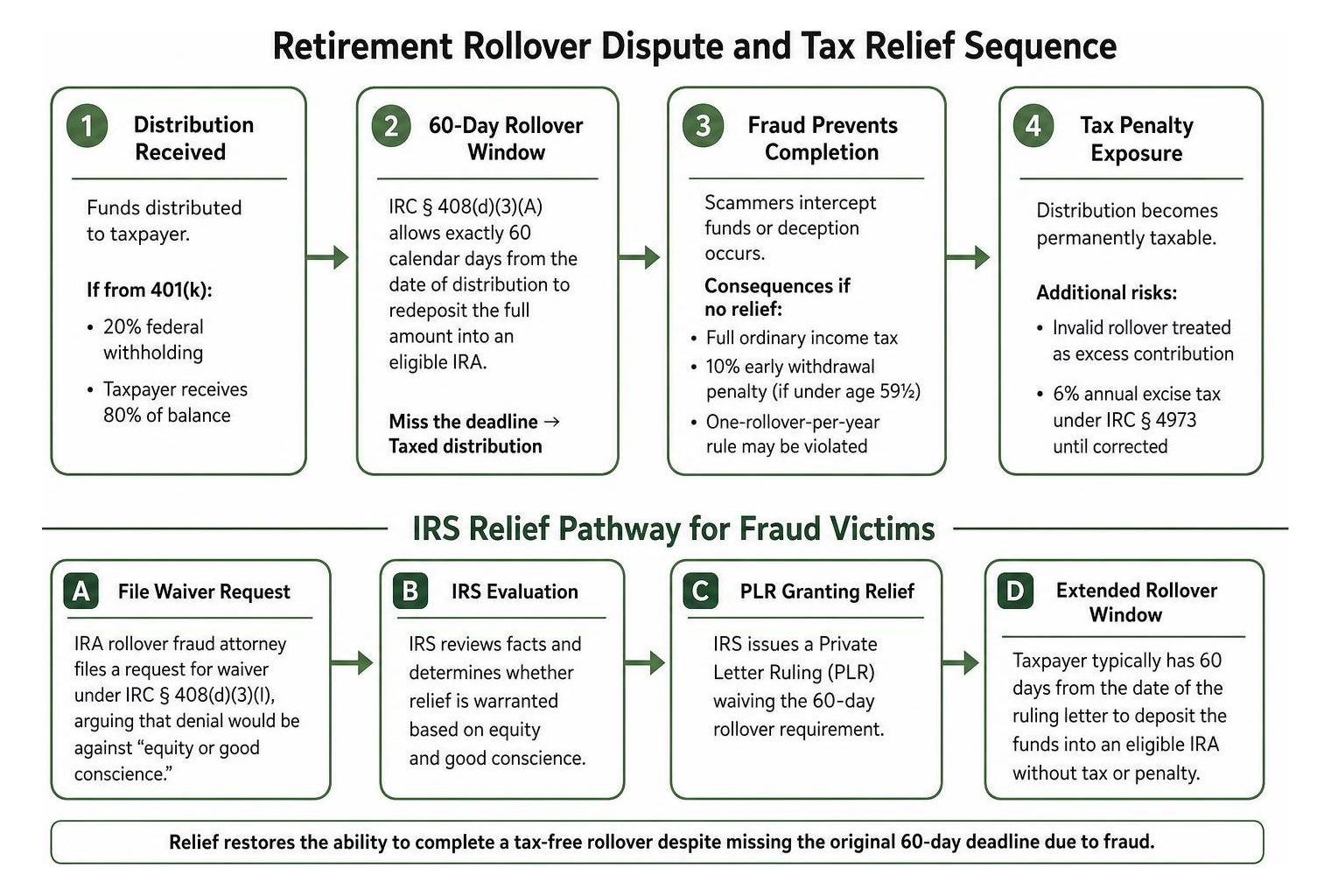
When fraud prevents a taxpayer from completing a rollover within 60 days, administrative relief may be available. Under IRC Section 408(d)(3)(I), the IRS holds statutory authority to waive the 60-day rollover requirement when failing to grant a waiver would be against “equity or good conscience.”
An IRA rollover fraud attorney can help victims secure this relief by filing an IRA distribution rollover requirement waiver for fraud victims through a formal Private Letter Ruling (PLR). When granted, the IRS issues an administrative order extending the rollover period—typically giving the taxpayer 60 days from the date of the ruling letter to deposit the funds into an eligible IRA without tax or penalty.
IRS rulings show a clear pattern of relief for victims of financial deception:
- PLR 202623022: The IRS waived the 60-day deadline after an unauthorized device intrusion orchestrated by imposter fraud specialists triggered an improper distribution.
- PLR 202244029: Relief was granted to an elderly saver deceived by imposter federal agents into liquidating retirement assets for bogus fraud investigations.
- PLR 202535015: As analyzed in Private Letter Ruling Grants a 60-Day Rollover Waiver in a Fraud Scenario — Current Federal Tax Developments, the IRS granted a waiver to taxpayers who wired IRA assets to fraudulent cryptocurrency accounts after law enforcement assisted in tracing and recovering the funds.
Revenue Procedure 2003-16 and Equity Standards
To evaluate waiver requests under IRC Section 408(d)(3)(I), the IRS applies the objective criteria set forth in Revenue Procedure 2003-16. Under this framework, the IRS analyzes:
- Third-Party Fraud and Criminal Acts: Whether the failure to deposit the funds resulted from fraud, identity theft, or deceptive manipulation outside the taxpayer’s control.
- Financial Institution and Custodial Errors: Whether delays were caused by incorrect routing instructions, unauthorized account holds, or processing backlogs.
- Incapacitation or Severe Hardship: Whether medical emergencies, cognitive impairment, hospitalization, or death incapacitated the taxpayer during the 60-day window.
- Use of the Distributed Funds: Whether the taxpayer retained, spent, or invested the funds for personal benefit (the funds must have remained unreachable or dedicated entirely to the fraud).
- Time Elapsed: The speed with which the taxpayer took corrective action upon discovering the deception.
A rollover waiver provides relief only if there are funds to redeposit. If stolen money is completely lost and cannot be recovered, an IRS waiver cannot restore the balance. In those circumstances, the taxpayer must either supply independent replacement funds to execute the rollover or work with legal counsel to mitigate the resulting income tax liability.
Why You Need an IRA Rollover Fraud Attorney for IRS Private Letter Rulings
Navigating the IRS National Office requires precise legal execution. Submitting a PLR request is not a simple form filing; it is an adversarial administrative proceeding governed by strict procedural rules.
An experienced tax attorney manages this process by:
- Preparing a Form 2848 Power of Attorney to represent you directly before IRS National Office attorneys and the Office of Chief Counsel.
- Assembling evidentiary records, including forensic transaction histories, subpoenaed bank communications, police incident reports, and IC3 complaints.
- Drafting legal memorandums demonstrating that your case meets the equity criteria of Revenue Procedure 2003-16 and controlling tax precedents.
- Ensuring the request does not run afoul of statutory exclusions, such as the once-per-year rollover rule or non-waivable Required Minimum Distribution (RMD) rules.
4. How an IRA Rollover Fraud Attorney Evaluates Your Case and Legal Recourse
At Alan L. Frank Law Associates, P.C., we examine retirement fraud from two angles: administrative tax defense and civil recovery litigation. Our goal is to recover your principal investment while insulating you from tax liabilities.
We assess multiple avenues of institutional liability:
- Broker-Dealer Supervision Failures: Did the brokerage firm fail to supervise its registered representative under FINRA Rule 3110 when they recommended unsuitable, high-commission rollover products?
- Custodial Breach of Duty: Did the self-directed IRA custodian or depository institution ignore obvious red flags, signature anomalies, or irregular wire transfer requests?
- Elder Financial Exploitation: Did financial institutions violate state statutes in Pennsylvania or New Jersey designed to freeze suspicious disbursements targeting vulnerable adults?
When to Hire an IRA Rollover Fraud Attorney for FINRA Arbitration
When an unscrupulous financial adviser or brokerage firm causes improper rollover distributions, standard court litigation is often blocked by mandatory arbitration clauses in customer agreements. Instead, claims are heard before the Financial Industry Regulatory Authority (FINRA).
Working with experienced FINRA attorneys allows defrauded savers to present claims before specialized arbitration panels. Using FINRA as a forum for claims involving stockbroker misconduct, our firm pursues full restitution for:
- Unsuitability: Recommending rollover strategies that conflicted with your risk tolerance, age, and liquidity needs.
- Misrepresentations and Omissions: Concealing surrender penalties, product liquidity limits, and internal broker fees.
- Unauthorized Trading and Churning: Executing trades or transferring balances without explicit customer authorization.
Immediate Action Steps After Uncovering Fraud
If you suspect your IRA rollover was diverted, stolen, or placed into an unauthorized investment, immediate action is essential to preserve your options to recover your investment:
- Demand an Immediate Account Freeze: Contact your IRA custodian and the receiving financial institution. Demand an immediate freeze on all pending outgoing wires, automated clearing house (ACH) transfers, and check issuances.
- Preserve All Contemporaneous Evidence: Preserve text messages, emails, marketing materials, new account applications, monthly statements, and notes from phone conversations with advisers or third parties.
- File Formal Law Enforcement Reports: File detailed reports with local police departments and submit an official complaint to the FBI’s Internet Crime Complaint Center (IC3). A formal police report is required by the IRS when requesting administrative rollover relief.
- Consult Legal and Tax Counsel Before Redepositing Assets: Do not move replacement funds or submit generic self-certification letters under Revenue Procedure 2020-46 without legal review. Improper self-certification can trigger unexpected tax penalties and IRS audits.
Frequently Asked Questions About IRA Rollover Fraud
What happens if stolen IRA rollover funds cannot be recovered?
If stolen IRA assets cannot be recovered through law enforcement clawbacks or securities litigation, an IRS 60-day rollover waiver cannot restore the lost funds on its own. A waiver gives you permission to deposit funds back into an eligible retirement plan without paying taxes or penalties.
To take advantage of a waiver, you must have access to independent replacement funds (such as personal savings or proceeds from other non-retirement assets) to make the rollover deposit. If you do not have replacement capital, the distribution is generally treated as taxable income. In that situation, an attorney can help review alternative tax dispute strategies or pursue civil claims against the institutions that permitted the unauthorized transfer.
What is the legal difference between a 60-day rollover and a direct trustee-to-trustee transfer?
In an indirect 60-day rollover, the retirement plan distributes funds directly to the account owner via check or personal bank transfer. The owner takes temporary possession of the funds and has 60 calendar days to deposit the entire gross balance into another eligible retirement account. Indirect rollovers are limited to one per rolling 12-month period across all IRAs and carry mandatory tax withholding if drawn from employer plans.
In a direct trustee-to-trustee transfer, the funds move directly from the existing custodian to the new custodian without you ever taking personal possession of the money. Direct transfers carry no 60-day deadlines, trigger no tax withholding, have no annual frequency limitations, and are insulated from the common interception points exploited by scammers.
Can Required Minimum Distributions (RMDs) be waived after rollover fraud?
No. Under IRC Section 408(a)(3) and Section 401(a)(9), amounts designated as Required Minimum Distributions (RMDs) are strictly ineligible for rollover treatment. Even if an RMD was stolen as part of a broader fraud scheme, the IRS does not hold statutory authority under Section 408(d)(3)(I) to waive the rollover deadline on that portion. The RMD amount must be treated as taxable income for that calendar year, though an attorney can assist in mitigating potential secondary excise penalties for missed distributions.
Conclusion: Protecting Your Retirement Savings and Recovering Losses
Retirement rollover fraud can jeopardize decades of disciplined financial planning, exposing you to substantial capital losses and unexpected federal tax liabilities. Recovering stolen assets and defending your tax status requires decisive legal action.
Alan L. Frank Law Associates, P.C. brings decades of combined legal, financial, and tax controversy experience to these complex cases. Operating from our offices in Philadelphia, PA, Jenkintown, PA, and New Jersey, our firm has secured multi-million dollar recoveries for investors harmed by predatory brokers, fraudulent investment schemes, and institutional negligence.
If you or a loved one lost retirement funds to an improper rollover, unauthorized transfer, or predatory adviser, contact us today to evaluate your options for securities litigation and investment losses. We will investigate your claims, pursue recovery against all responsible institutions, and work to protect your retirement assets from unnecessary tax penalties.