
Truth or Consequences in Real Estate Property Disclosures


Truth or Consequences in Real Estate Property Disclosures
What Is a Material Fact in Real Estate, and Why Does It Matter?
A material fact in real estate is information a reasonable person would consider important when deciding whether to buy, sell, or lease a property, or what price and terms to accept. A hidden foundation problem, a zoning restriction, or a title issue may qualify. Disclosure duties vary by state and by whether the person is a seller or a broker.
A disclosure form helps share what is known, but it may not cover every duty. When an important fact is left out, a deal can turn into a dispute over repairs, losses, or whether the contract should stand.
I’m Alan L. Frank, managing attorney at Alan L. Frank Law Associates, P.C. My experience with complex litigation and construction defect disputes informs this guide to a question that can shape a property deal: what is a material fact in real estate?
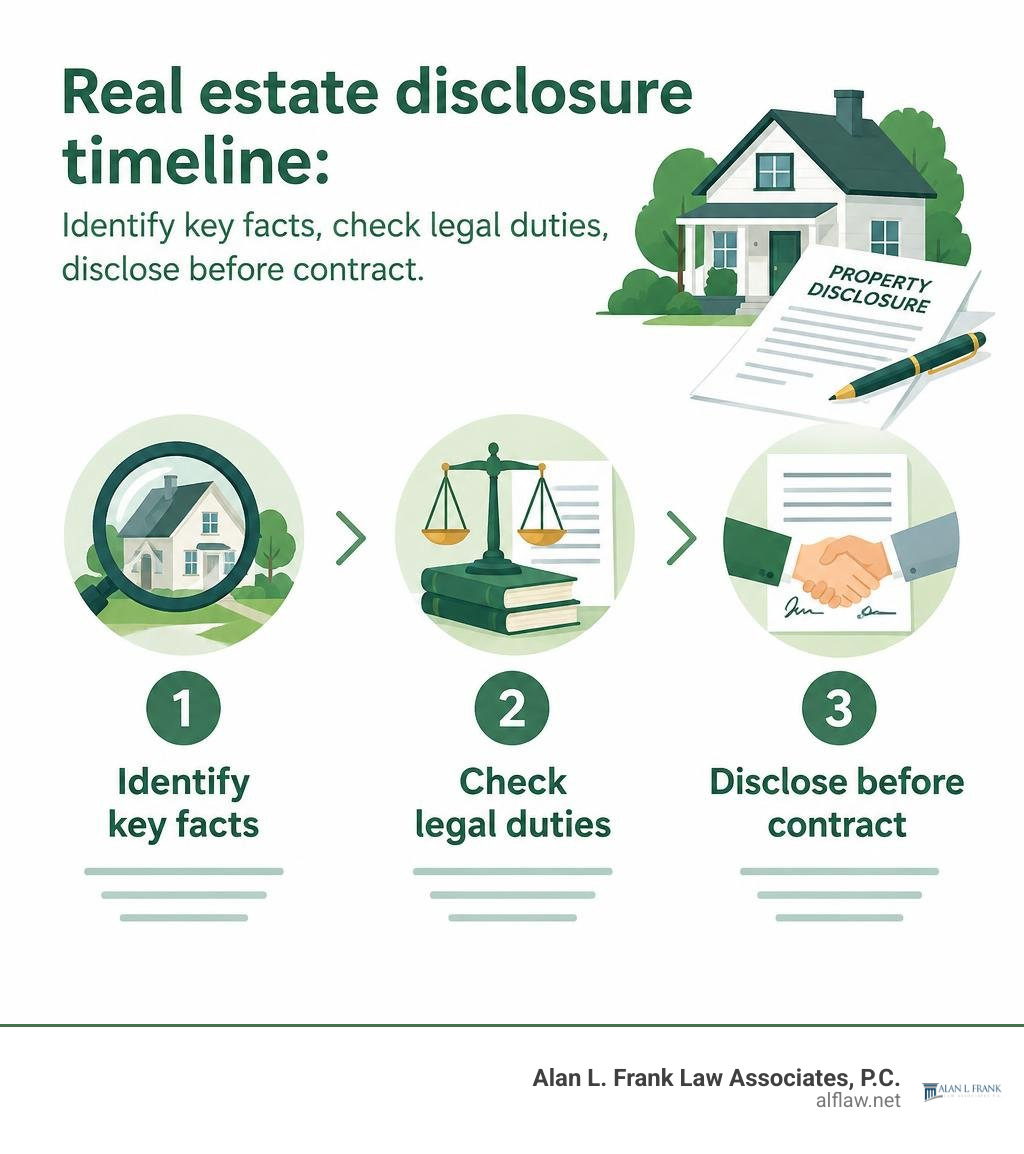
What is a material fact in real estate glossary:
Legal Definition: What Is a Material Fact in Real Estate?
In the simplest legal terms, a material fact is any piece of data, condition, or circumstance that could alter the decision of a reasonable party in a real estate transaction. If knowing the truth would prompt a buyer to walk away, lower their offer, or demand specific repairs, that information meets the threshold of materiality.
Materiality governs every phase of contract negotiations, from initial listing presentations to final settlement. When buyers analyze a property, they rely on disclosures to assess overall value and habitability. Omitting crucial details skews that calculation, creating an uneven playing field. When analyzing a potential purchase or reviewing a disclosure packet, spotting deal-breaking material defects early can save buyers months of frustration and thousands of dollars in unexpected repairs.
Understanding the Reasonable Person Standard and Statutory Mandates
The cornerstone of materiality is the objective “reasonable person” standard. The law does not ask whether an unusually fastidious buyer might care about a minor cosmetic scratch, nor does it excuse a seller simply because an unobservant buyer failed to ask the right questions. Instead, it asks: Would an average, prudent individual consider this detail important when making a financial commitment?
Statutory mandates codify this standard to protect consumers. For licensed real estate professionals, regulatory statutes—such as General Statute 93A-6(a)(1) in common regulatory frameworks and similar licensing rules enforced by state real estate commissions—establish clear affirmative duties. Brokers cannot hide behind passive silence. If a fact affects the property’s condition, the transaction’s viability, or the principal’s decision-making ability, it must be brought to light.
Determining What Is a Material Fact in Real Estate for Buyers and Sellers
While the objective standard sets the baseline, materiality also encompasses facts of subjective importance if a party has explicitly communicated their specific intentions. For instance, if a buyer tells their broker that they operate an at-home accounting firm requiring client visits, local zoning restrictions prohibiting commercial traffic become directly material to that specific buyer.
For sellers, determining materiality involves evaluating safety hazards, structural stability, environmental conditions, and legal encumbrances. Timing is vital: disclosures must occur before contract execution. Disclosing a failed septic system or an unpermitted addition after the purchase agreement is executed deprives the buyer of meaningful negotiation leverage and exposes the transaction to immediate cancellation.
The Four Core Categories of Real Estate Material Facts

To help brokers, sellers, and buyers evaluate their transactions, real estate jurisprudence generally divides material facts into four core operational categories:
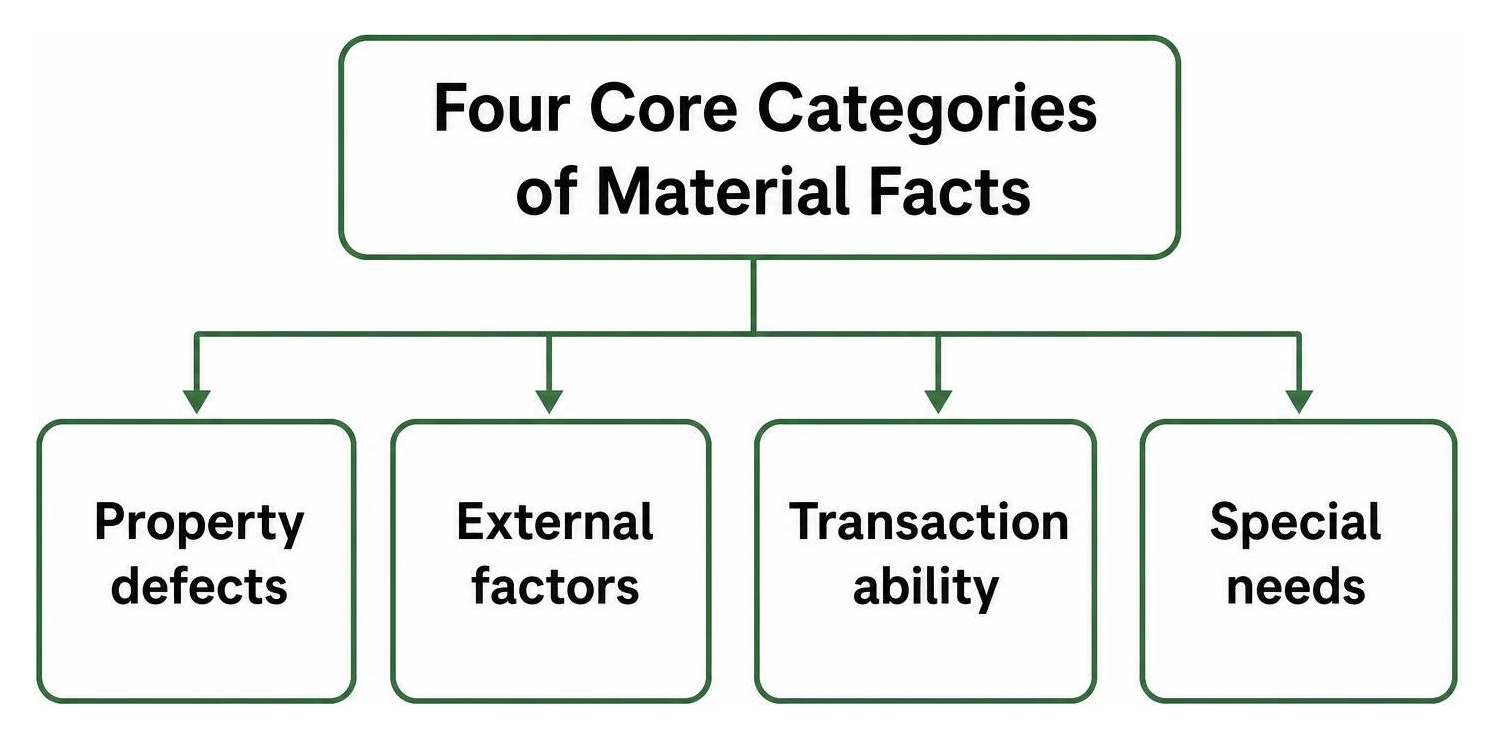
Physical Property Conditions and Hidden Structural Defects
The most common material facts involve the physical structure and its mechanical systems. Deteriorating roof shingles, cracked joists, unpermitted electrical work, and persistent plumbing failures fall squarely into this category.
Water intrusion remains one of the most litigated physical defects. When dealing with moisture issues, preventing costly water damage requires immediate remediation, and sellers must disclose prior basement flooding even if the area is dry on the day of the showing. Similarly, active foundation movement or compromised footers cannot simply be concealed behind fresh drywall. Early detection and transparency regarding foundation and structural failure protect sellers from claims of fraudulent concealment.
External Factors, Environmental Hazards, and Land Use Issues
A property does not exist in a vacuum. External factors that directly impact its use, enjoyment, or market value are also material facts. Common examples include:
- Environmental hazards such as radon levels exceeding the EPA action threshold (4.0 pCi/L), friable asbestos, lead-based paint, and buried underground oil storage tanks.
- Flood zone designations and recent revisions to local FEMA flood maps.
- Surrounding land use changes, such as pending commercial re-zonings, highway expansions, or planned municipal landfills adjacent to the parcel.
- Property access restrictions, including prescriptive easements and land use disputes that give third parties legal rights across the land.
- Boundary line disputes, where resolving disputed property boundary lines becomes critical due to fence encroachments or overlapping deeds.
Transaction Integrity, Title Encumbrances, and Special Party Concerns
The remaining two categories address the legal and personal elements of the deal:
- Facts affecting a party’s ability to complete the transaction: A seller in pre-foreclosure who cannot deliver clean title, an unrecorded judgment lien, or a buyer who has lost their primary source of mortgage funding. Discovering a recorded lis pendens notice signaling active litigation over ownership is an undeniable material fact that immediately halts a standard closing.
- Facts of special importance to a specific party: Unique requirements explicitly stated by a buyer or seller. If a purchaser specifically requires a property capable of supporting a six-horse barn, restrictive HOA covenants prohibiting livestock represent a material fact that must be disclosed.
Latent Defects vs. Patent Defects and the Duty to Inspect

The distinction between observable flaws and hidden hazards is essential to property disclosure disputes. The doctrine of caveat emptor (“let the buyer beware”) historically governed real estate sales, but modern statutory law significantly limits its application, especially concerning hidden defects.
Latent vs. Patent Defects: What Is a Material Fact in Real Estate Transactions?
Understanding the boundary between latent and patent defects dictates who bears the financial burden when a defect is uncovered:
| Defect Characteristic | Patent Defects | Latent Defects |
|---|---|---|
| Visibility | Open, obvious, and readily discoverable upon ordinary inspection | Concealed, hidden, or buried behind finished surfaces |
| Examples | Large visible drywall holes, broken window panes, missing steps | Cracked foundation footers, faulty in-wall wiring, hidden toxic mold |
| Duty to Disclose | Sellers generally need not disclose obvious conditions unless asked | Sellers must affirmatively disclose known latent defects |
| Buyer Burden | Buyer expected to observe during standard walkthrough | Buyer cannot reasonably discover without destructive testing |
When evaluating older properties or recent renovations, identifying hidden latent defects in homes is critical because these concealed conditions create substantial legal liability for sellers who fail to disclose them. Conversely, evaluating obvious patent property problems remains the initial responsibility of the buyer during routine pre-offer walkthroughs.
Visual Inspections, Red Flags, and the Affirmative Duty to Inquire
Real estate brokers hold an affirmative duty to discover and disclose material facts. This means a broker cannot adopt a policy of deliberate ignorance. Listing agents are expected to perform a diligent visual inspection of the accessible interior and exterior areas of a property.
During an inspection, brokers must watch for “red flags”—visible warning signs that indicate deeper latent problems. Examples of red flags include:
- Freshly painted patches restricted solely to basement walls or upper ceilings.
- Water stains beneath second-floor plumbing runs.
- Distinct sulfur or sewage odors near drain fields.
- Sloping floors or doors that stick inside square frames.
When a red flag appears, the broker has an affirmative obligation to inquire further, request documentation from the seller, and recommend structural engineers or qualified inspectors before marketing the property as pristine.
Disclosure Documents, Non-Material Stigmas, and Statutory Exemptions
To standardize the disclosure process, states provide structured statutory disclosure forms that sellers must execute prior to closing.
The Seller’s Property Disclosure (SPD) Form and “As-Is” Limits
In Pennsylvania, sellers must comply with statutory mandates such as 49 Pa. Code § 35.335a, which specifies disclosures regarding roof condition, basement water intrusion, plumbing systems, and hazardous materials.
A common misconception among sellers is that inserting an “as-is” clause into a sales contract absolves them from completing these forms or disclosing known issues. An “as-is” provision merely alerts the buyer that the seller will not perform cosmetic or negotiated repairs; it does not grant a license to commit fraud or conceal known latent defects. Buyers must carefully examine the contract, evaluating property warranty enforceability to ensure they preserve their legal rights if a seller conceals major defects.
Stigmatized Properties, In-Home Deaths, and Registry Exemptions
Not every sensitive fact is legally classified as a material fact. Psychological stigmas—events that occurred on the property that do not cause physical damage—are frequently governed by specific statutory exemptions:
- Deaths and Suicides: In many jurisdictions, including Pennsylvania, sellers and brokers are not legally required to volunteer that a natural death, suicide, or accidental death occurred inside the home, as these events do not alter the physical integrity or safety of the structure.
- Illnesses and Fair Housing: Federal and state fair housing laws strictly prohibit disclosing that a current or previous occupant was infected with HIV/AIDS or suffered from a protected disability.
- Sex Offender Registries: In most jurisdictions, sellers and agents are not legally obligated to research or disclose the proximity of individuals listed on Megan’s Law registries. Instead, standard contract notices advise buyers to consult public registry databases directly.
If a buyer asks a direct, specific question regarding a psychological stigma that is not barred by Fair Housing laws, the seller and agent must answer truthfully or explicitly refuse to answer rather than making a fraudulent misrepresentation.
Legal Consequences and Causes of Action for Non-Disclosure
When a seller or broker fails to disclose a known material fact, the aggrieved buyer has several avenues for legal recourse. In our practice at Alan L. Frank Law Associates, P.C., we regularly represent clients in real estate litigation representation arising from property transactions, defective construction, and undisclosed defects.
Causes of Action: Fraud, Deceptive Trade Practices, and License Discipline
Non-disclosure disputes typically involve several established legal claims:
- Fraudulent Concealment / Intentional Misrepresentation: Proven when a seller knowingly conceals a material defect with the intent to deceive the buyer, who reasonably relies on that silence and incurs damages.
- Negligent Misrepresentation: Occurs when a seller or broker fails to exercise reasonable care in gathering or communicating accurate material information.
- Breach of Contract and Statutory Violations: Failure to deliver a truthful, accurate Seller’s Property Disclosure statement violates state statutory mandates.
- Administrative Discipline: Real estate licensing commissions can suspend or permanently revoke a broker’s professional license, levy substantial administrative fines, and issue formal reprimands for failing to discover and disclose material facts.
Remedies, Rescission, and Damages in Property Defect Disputes
Courts provide specific remedies depending on the severity of the concealment:
- Actual / Compensatory Damages: The standard remedy, calculated as the direct cost to repair the undisclosed defect or the difference in the property’s fair market value caused by the defect.
- Contract Rescission: In severe cases where the property cannot be made safe or habitable, the court may void the purchase agreement, requiring the seller to return all purchase funds and take back title.
- Punitive Damages: When a seller engages in egregious, willful, or malicious concealment—such as physically masking severe foundation cracks immediately before an inspection—courts may award punitive damages for intentional property damage to punish the wrongdoer.
- Legal Fees: Prevailing parties may recover reasonable attorney fees and expert witness costs when authorized by statute or the underlying purchase contract.
When dealing with substantial structural failures in recently purchased or newly constructed properties, retaining a construction defect lawyer is essential to properly document the evidence, retain expert engineers, and build an airtight damages case.
Frequently Asked Questions About Real Estate Material Facts
Does an “as-is” clause exempt a seller from disclosing known defects?
No. An “as-is” clause is a contractual term allocating repair responsibilities between the parties; it is not a shield against tort liability or fraud. Under statutory disclosure laws and common law principles, a seller retains an independent legal duty to disclose known latent defects that cannot be discovered through an ordinary visual inspection. Concealing a known defect while selling “as-is” still exposes the seller to claims for fraudulent misrepresentation and rescission.
What is the difference between a broker’s duty and a seller’s duty to disclose?
The key distinction lies in the standard of discovery. A seller’s legal duty is generally based on actual knowledge—they must disclose the defects they know about, with no general duty to hire independent inspectors to discover unknown flaws.
Conversely, licensed real estate brokers have an affirmative statutory duty to discover and disclose. Brokers are held to the standard of a licensed real estate professional, requiring them to conduct a reasonable visual walkthrough of the property, investigate visible red flags, verify permitting and zoning details where appropriate, and disclose material facts they know or reasonably should have known.
When in doubt, what is the best practice for handling a potential material fact?
The cardinal rule of real estate risk management is straightforward: when in doubt, disclose. Providing a comprehensive, written disclosure before contract execution eliminates the buyer’s ability to later claim that they were fraudulently induced into the transaction. If a seller or broker is uncertain whether a past repair, drainage condition, or boundary anomaly reaches the threshold of materiality, they should consult with legal counsel. Knowing when to hire a real estate defect attorney can prevent a routine transaction from escalating into multi-year litigation.
Conclusion
Understanding real estate disclosure rules is vital for preserving the integrity of property transactions and avoiding costly legal disputes. A material fact is the foundation upon which a buyer evaluates risk, negotiates price, and decides whether to close. For sellers and real estate professionals across Pennsylvania and New Jersey, transparency is not merely good customer service—it is a clear legal obligation.
At Alan L. Frank Law Associates, P.C., we bring extensive trial experience and a track record of multi-million dollar recoveries to bear on complex real estate disputes, structural failure claims, and disclosure litigation. If you are navigating a disputed property transaction, have uncovered undisclosed latent defects after closing, or need trusted guidance on disclosure compliance, explore our housing and construction defect guidance or reach out to our offices in Philadelphia and Jenkintown to schedule a consultation.