
The Complete Guide to Hiring a Construction Defect Lawyer


The Complete Guide to Hiring a Construction Defect Lawyer
How to Choose a Construction Defect Lawyer
Choose a construction defect lawyer who can investigate both the building failure and the contracts behind it. Ask about experience with your type of structure, access to engineering experts, and the ability to pursue warranty, contract, or injury claims. Before your first meeting, save photos, inspection reports, plans, contracts, warranties, and repair records. Avoid removing damaged materials until they have been documented, unless safety requires immediate action.
I’m Alan L. Frank, managing attorney at Alan L. Frank Law Associates, P.C., with more than 20 years leading complex commercial litigation and significant personal injury cases. That background shapes the questions I recommend asking a construction defect lawyer, beginning with how they will protect and evaluate your claim.
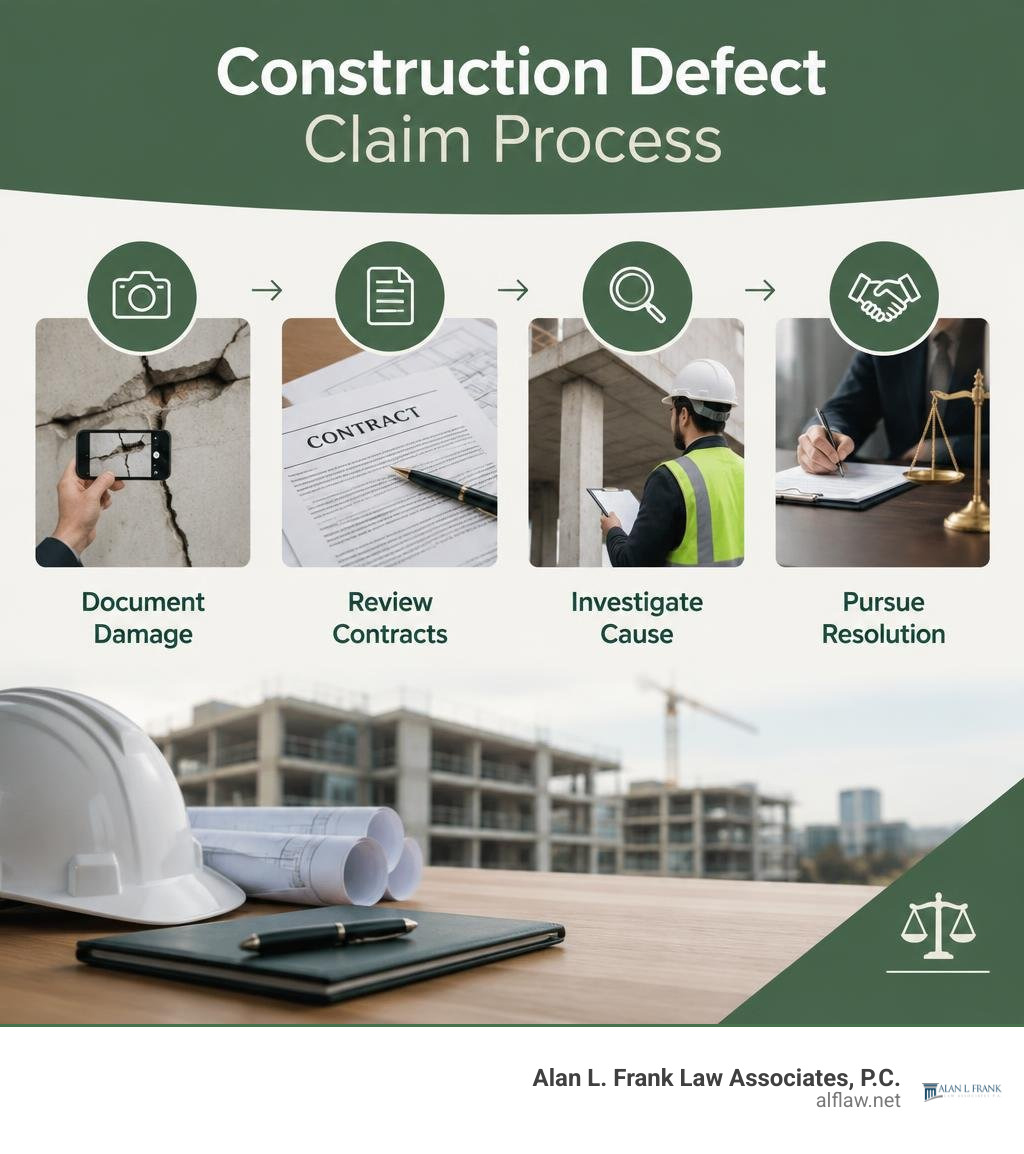
Simple construction defect lawyer glossary:
- punitive damages and property damage
- warranty claim construction defects
- don’t let water damage drown your wallet
For broader context on how construction defect claims fit within national litigation trends, the American Bar Association’s construction law resources provide useful background on industry standards and dispute resolution practices.
Common Structural Deficiencies and Property Failures
Construction defect claims have surged over 20% across the past decade. While single-family residences account for a substantial volume of these disputes, commercial, industrial, and multi-family structures face catastrophic financial stakes when structural integrity fails. A defect is rarely just an aesthetic blemish; it represents a fundamental breakdown in design, manufacturing, material quality, or site installation.
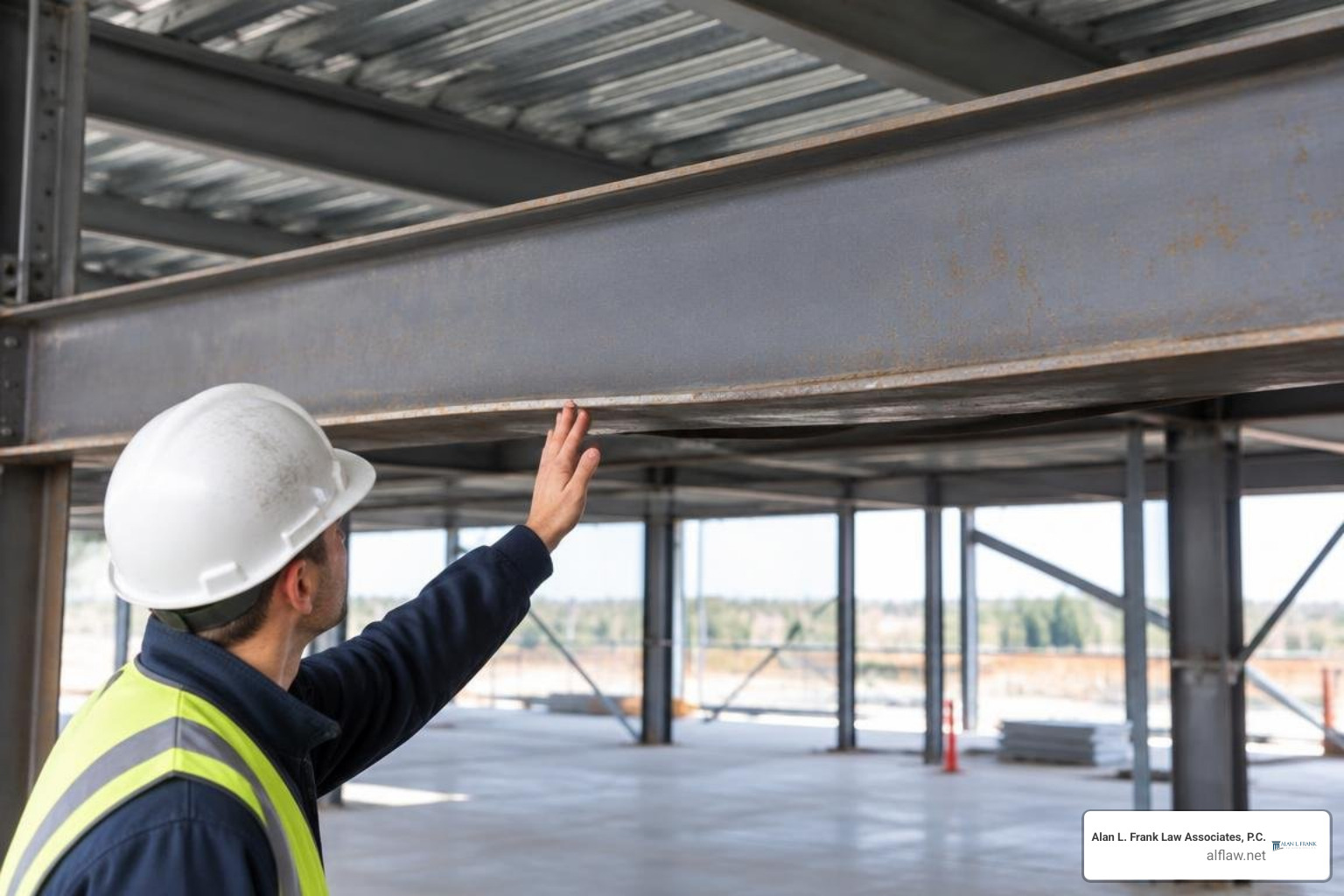
When a structural component fails, the consequences ripple throughout the entire building envelope. Identifying whether a failure stems from flawed architectural planning, substandard raw materials, or negligent assembly is critical. Proper evaluation begins with identifying critical material defects before physical damage escalates into a complete structural compromise.
When to Consult a Construction Defect Lawyer for Joist and Metal Building Defects
Pre-engineered metal buildings (PEMBs), open-web steel joists, and metal decking systems have become staples of modern commercial construction across Pennsylvania and New Jersey. These systems rely on precise engineering tolerances. When load calculations are mishandled or components are improperly fabricated, the entire load path becomes unstable.
Common failure points in pre-engineered framing and joist assemblies include:
- Improper Load Path Distribution: Errors in calculating dead loads, live loads, or localized snow drift accumulations that cause joist deflection or roll.
- Weld and Fastener Failures: Substandard field welding or missing high-strength structural bolts at critical truss and bridging connections.
- Defective Insulated Wall and Roof Panels: Delamination, thermal bridging, and joint sealant failures that allow moisture intrusion and ruin thermal performance.
- Erection Deviations: Contractors forcing misaligned steel framing into place, inducing pre-load stresses that lead to premature material fatigue.
Litigating these technical failures requires direct collaboration with structural engineers, metallurgists, and industry specialists who can analyze shop drawings, fabrication logs, and mill test reports.
Roof Failures, Foundation Cracks, and Water Intrusion
Nearly 40% of all construction defect lawsuits involve water intrusion or moisture-related issues, making it the single most common defect category nationwide. Water has an uncanny ability to exploit the smallest oversight in construction design, leading to hidden rot, toxic mold, and weakened framing.
Roofing systems on commercial warehouses and residential complexes frequently fail due to inadequate slope, improperly installed flashing, or defective drainage scuppers. Taking proactive legal and investigative steps for preventing structural roof failures can protect building occupants and preserve operational continuity.
Simultaneously, substructure problems present devastating structural risks. Soil conditions in the mid-Atlantic require rigorous geotechnical testing before pouring footings. When builders cut corners on compaction, drainage, or concrete curing, severe settlement occurs. Property owners must address foundation damage and settling issues immediately, as differential settlement causes diagonal wall cracking, unaligned door frames, and broken subterranean utility lines. Left unchecked, water entering through foundation fissures will compound structural decay, making mitigating catastrophic water damage an urgent priority.
Why You Need a Construction Defect Lawyer for Complex Liability Claims
Construction litigation is not a straightforward breach of contract matter. A single structural failure involves an intricate web of design professionals, general contractors, sub-tier trades, component manufacturers, and commercial insurance carriers. Navigating these overlapping layers demands sophisticated commercial litigation strategies tailored to complex liability frameworks.

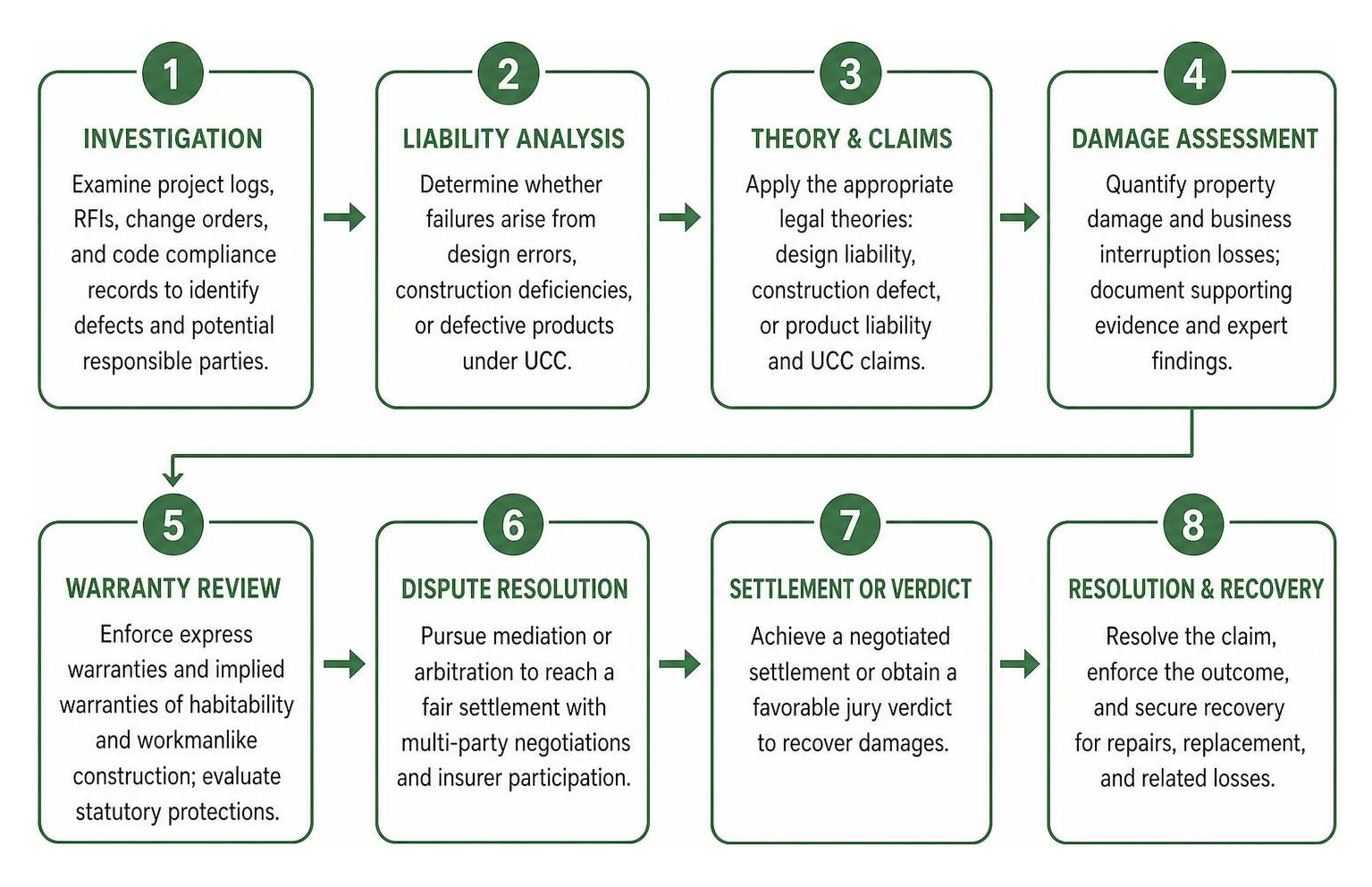
In any major claim, liability is rarely confined to one entity. An architect may blame the structural engineer; the engineer blames the fabricator; the fabricator points to the general contractor’s erection sequence; and the contractor claims the developer provided flawed geotechnical reports. We dismantle these finger-pointing defenses by systematically examining project logs, requests for information (RFIs), change orders, and building code compliance records to establish the standard of care breached by each participant.
Intersecting Design Engineering, Strict Product Liability, and UCC Claims
A foundational challenge in structural litigation is determining whether a failure constitutes a professional design error, a construction deficiency, or a defective product under the Uniform Commercial Code (UCC).
Pre-engineered components, such as manufactured steel trusses, metal decking, and steam boiler assemblies, often sit squarely at the intersection of contract law and product liability. When these systems harbor hidden latent defects, property owners can pursue claims under multiple legal theories:
| Defect Theory | Responsible Parties | Key Legal Elements | Applicable Standards / Laws |
|---|---|---|---|
| Design Liability | Architects, Structural Engineers, MEP Consultants | Breach of the professional standard of care; flawed calculations or specifications | Professional negligence, state licensing boards, local building codes |
| Construction Defect | General Contractors, Subcontractors, Installers | Failure to execute plans in a workmanlike manner; deviation from approved blueprints | Breach of contract, negligence, statutory builder warranties |
| Product Liability & UCC | Material Manufacturers, Component Fabricators, Distributors | Manufacturing defects, design defects in mass-produced goods, failure to warn | Strict product liability, UCC Article 2 (implied warranties of merchantability and fitness) |
When materials are sold as “goods” under UCC Article 2, buyers gain statutory protections that bypass the need to prove negligence. If a pre-fabricated steel beam fails under rated loads, the manufacturer may be held strictly liable for the resulting property damage and business interruption losses.
Enforcing Express and Implied Warranties in Construction Disputes
Warranties form the bedrock of construction defect recovery. Contracts typically contain express warranties guaranteeing that materials will be new, of good quality, and free from faults for a defined period (such as one or two years). However, many developers and contractors insert aggressive liability disclaimers, leading property owners to wonder about the true enforceability of construction warranties.
Beyond express contract terms, statutory and common-law implied warranties—such as the Implied Warranty of Habitability and the Implied Warranty of Workmanlike Construction—protect buyers against structural flaws that make a property unfit for its intended use. In many jurisdictions, builders cannot disclaim these core protections. Furthermore, analyzing statutory frameworks—including established construction standards modeled after comprehensive guidelines like statutory standards under SB800—provides objective benchmarks to demonstrate that a builder’s performance fell below acceptable tolerances.
Resolving Construction Disputes: Mediation, Arbitration, and Trial Strategy
The financial stakes in construction defect litigation make strategic dispute resolution essential. Nationwide, the average cost of a construction defect claim hovers around $65,000, with legal and expert fees often climbing past $100,000. In 2023, median defect settlements reached $250,000, while jury verdicts averaged $1.2 million. Because trials are lengthy and expensive, over 70% of construction defect claims are resolved through alternative dispute resolution (ADR), including mediation and binding arbitration.
Negotiating Multi-Party Settlements in Alternative Dispute Resolution
Mediation allows parties to negotiate a confidential, structured financial settlement without the unpredictability of a public jury trial. However, successful mediation requires exhaustive preparation. Mediators cannot force a settlement; they rely on objective proof of liability and damages to compel insurance carriers to contribute meaningful funds.
To position a case for a favorable mediation outcome, we compile a comprehensive mediation brief backed by key project documentation:
- Original contracts, subcontracts, change orders, and architectural specifications.
- Comprehensive photographic logs capturing the timeline of structural failure and water damage.
- Independent forensic engineering reports detailing root-cause analyses.
- Line-item repair estimates from licensed remedial contractors, alongside structural testing data.
- Complete records of all written notices of defect provided to builders and their responses.
- Meteorological records, when weather events are cited as contributing factors.
Defeating Common Contractor and Subcontractor Defenses
When faced with multi-million dollar repair demands, contractors and their commercial general liability (CGL) insurers rely on well-worn legal defenses. Overcoming these hurdles requires precise factual and legal counter-strategies:
- Statutes of Limitations and Repose: Defendants frequently claim the lawsuit was filed too late. We counter this by establishing the exact discovery date of latent defects and enforcing tolling agreements or repair-doctrine exceptions.
- Comparative Fault and Owner Neglect: Builders regularly argue that roof leaks or foundation settling resulted from a property owner’s failure to perform routine maintenance. We dismantle this defense using historical maintenance logs and forensic engineering testimony showing the failure occurred within structural assemblies inaccessible to routine maintenance.
- Acts of God / Weather Anomalies: Contractors often blame structural collapse on unprecedented snow, wind, or rain events. We employ forensic meteorological experts to correlate historical weather data with building code load design criteria, demonstrating that local conditions fell well within the parameters the structure was legally required to withstand.
- The “Spearin Doctrine” Defense: Subcontractors frequently claim they simply built according to the owner’s plans and cannot be held liable for resulting failures. We expose instances where the subcontractor deviated from specifications, failed to flag obvious architectural errors, or executed unworkmanlike installations.
Selecting Qualified Legal Representation for Structural Failure Claims
Structural defect litigation requires deep trial capability, financial resources to retain elite engineering experts, and a nuanced understanding of insurance coverage law. When evaluating legal counsel, property owners and commercial enterprises should focus on firms with proven results in complex, high-stakes property damage claims.
For guidance on finding seasoned counsel in your jurisdiction, review our guide on finding the right housing and construction defects attorney.
Key Qualifications to Demand from a Construction Defect Lawyer
A general practice attorney is not equipped to navigate the multi-tiered discovery, forensic testing, and insurance coverage battles inherent in commercial construction cases. When hiring an attorney, prioritize the following qualifications:
- Technical and Code Fluency: Your legal team must understand structural engineering concepts, including joist deflection, shear stresses, insulated wall panel physics, and local building code standards (such as the International Building Code and ASTM specifications).
- Network of Forensic Experts: Look for established working relationships with leading structural engineers, building envelope consultants, and meteorological analysts.
- Trial-Tested Credentials: Strong reputations earn respect from commercial insurers. We leverage extensive commercial litigation and significant personal injury trial experience to negotiate from a position of power.
- Insurance Coverage Expertise: Structural defect recoveries depend on identifying CGL policies, owner-controlled insurance programs (OCIPs), and professional liability policies. Your lawyer must know how to trigger coverage and defeat standard policy exclusions.
Case Study: Multi-Million Dollar Industrial Roof and Joist Collapse
To understand how legal strategy, forensic engineering, and contract law intersect, consider a representative case study from a commercial logistics facility in Pennsylvania.
Frequently Asked Questions About Construction Defect Litigation
What is the average timeline for resolving a construction defect lawsuit?
Most complex construction defect cases resolve within 12 to 24 months, though multi-party commercial disputes can take longer if full forensic destructive testing is required. The initial 3 to 6 months focus on gathering project records, retaining structural experts, and drafting complaints.
The formal discovery phase—including depositions of engineers, contractors, and project managers—typically spans 6 to 12 months. Most cases enter mediation or ADR toward the conclusion of discovery, where the vast majority settle. If a defendant insurer refuses a fair settlement, the case proceeds to a structured trial.
How do building codes and statutory warranties impact defect claims?
Building codes (such as the International Building Code, International Residential Code, and regional amendments across Pennsylvania and New Jersey) establish the minimum legal safety and performance standards for construction. A clear code violation serves as powerful evidence of negligence per se or breach of contract.
Statutory warranties reinforce these codes by establishing non-waivable performance standards for critical structural components, such as load-bearing framing, foundations, and roof assemblies. Demonstrating that a contractor failed to adhere to these statutory standards significantly reduces the evidentiary burden needed to prove liability.
What damages can be recovered in commercial or residential defect cases?
Plaintiffs in construction defect litigation can pursue a comprehensive array of economic and consequential damages:
- Cost of Remediation: The direct cost to engineer, permit, and construct full repairs to restore the building to its intended condition.
- Diminution in Value: Compensation for any permanent reduction in the property’s fair market value even after repairs are completed.
- Relocation and Loss of Use: Costs associated with temporary tenant relocation, loss of rental income, or warehouse downtime.
- Consequential Property Losses: Damage to internal inventory, machinery, fixtures, or personal property caused by water intrusion or structural collapse.
- Expert and Legal Costs: Under specific contract terms or statutory protections, recovery of engineering inspection fees, architectural consulting costs, and legal fees.
- Personal Injury Damages: When structural collapses or toxic mold conditions cause physical harm, claims may be paired with significant personal injury and wrongful death actions to hold negligent builders fully accountable.
Conclusion
Structural failures, joist deflections, and pervasive water leaks threaten the financial viability and safety of any property. Resolving these disputes requires a strategic legal approach that combines contract analysis, strict product liability claims, and aggressive advocacy against commercial insurance carriers.
At Alan L. Frank Law Associates, P.C., we draw upon decades of commercial litigation experience to protect property owners, developers, and commercial enterprises. If your building exhibits signs of structural distress, roof failure, or material defects, acting quickly preserves critical evidence and protects your rights within statutory deadlines. Schedule a construction defect legal consultation with our team today to evaluate your case and pursue the financial recovery your property requires.