
Why Arbitration for Construction Defects Might Be Your Best or Worst Move


Why Arbitration for Construction Defects Might Be Your Best or Worst Move
Is Arbitration for Construction Defects the Right Move?
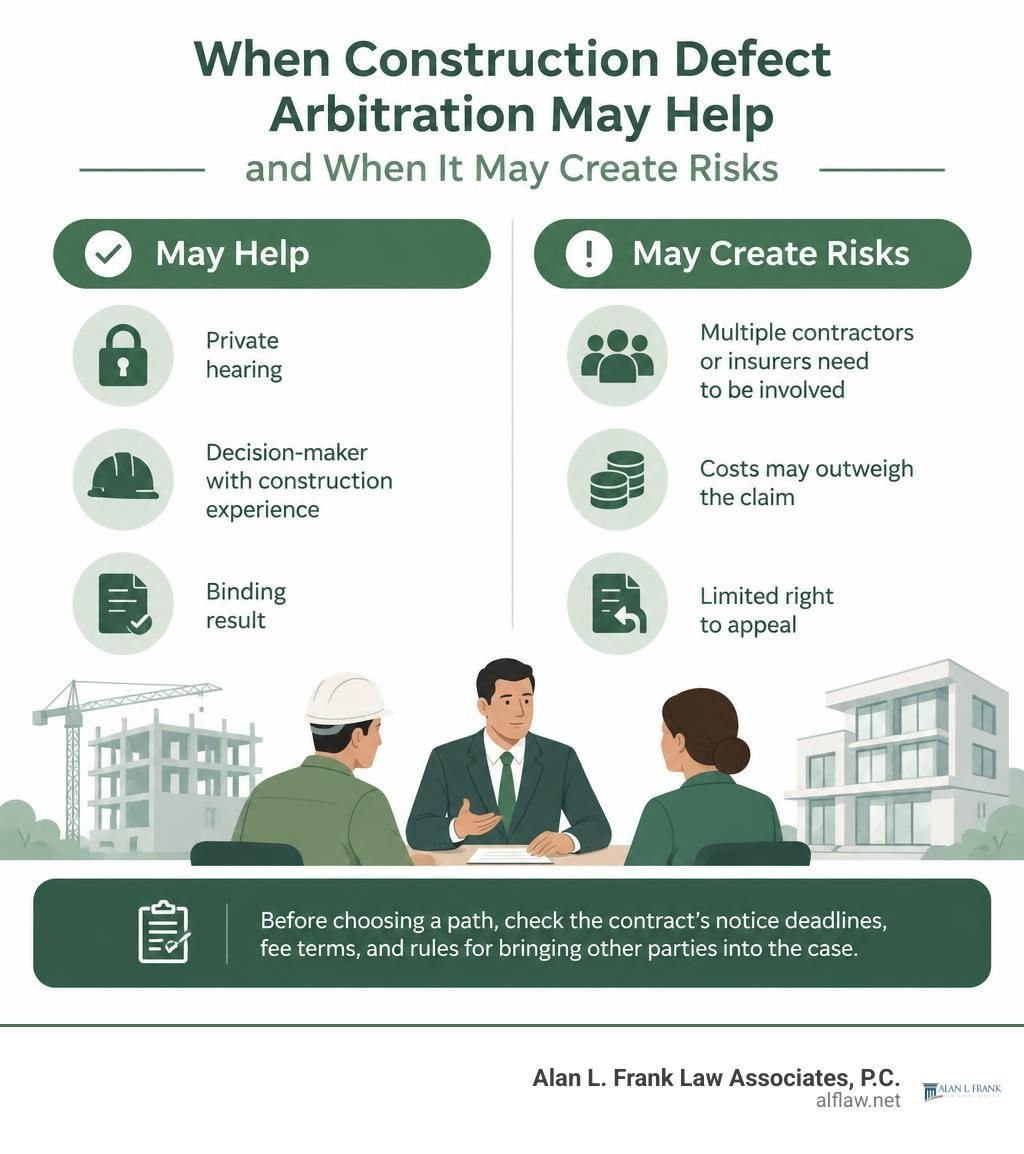
Arbitration for construction defects can be a good choice when you want a private hearing, a decision-maker with construction experience, and a binding result. It can be a poor choice when several contractors or insurers need to take part, costs may outweigh the claim, or you want a broad right to appeal. Before choosing a path, check the contract’s notice deadlines, fee terms, and rules for bringing other parties into the case.
I’m Alan L. Frank, managing attorney of Alan L. Frank Law Associates, P.C., and I’ve led the firm through more than 20 years of complex litigation. I bring that experience to evaluating the risks and potential benefits of arbitration for construction defects.
Discover more about arbitration for construction defects:
Arbitration for Construction Defects vs. Litigation and Mediation
When structural cracks, faulty roofs, or water intrusion compromise a property, resolving the issue quickly is critical. Property owners, developers, and contractors often find themselves weighing three primary paths: mediation, binding arbitration, and courtroom litigation. Understanding the functional differences between these avenues helps parties protect their financial and property rights before costs spiral out of control.
Mediation serves as a structured negotiation facilitated by a neutral third party. The mediator does not possess the authority to impose a binding order; rather, they help the disputing parties reach an amicable settlement. Because it remains voluntary and non-binding, mediation frequently functions as a low-risk preliminary step.
In contrast, both arbitration and courtroom litigation produce final, legally enforceable resolutions. Under the Federal Arbitration Act (FAA) and corresponding state arbitration acts across Pennsylvania and New Jersey, an arbitrator or a panel of arbitrators sits as private judges. The proceedings take place behind closed doors rather than in an open courtroom. While litigation adheres strictly to formal state or federal rules of civil procedure and evidence, arbitration relies on customized procedural rules set by ADR administrators like the American Arbitration Association (AAA) or JAMS.
Working with an experienced construction defect lawyer is essential when evaluating these procedural paths, as the forum chosen dictates everything from document disclosure to appeal rights.
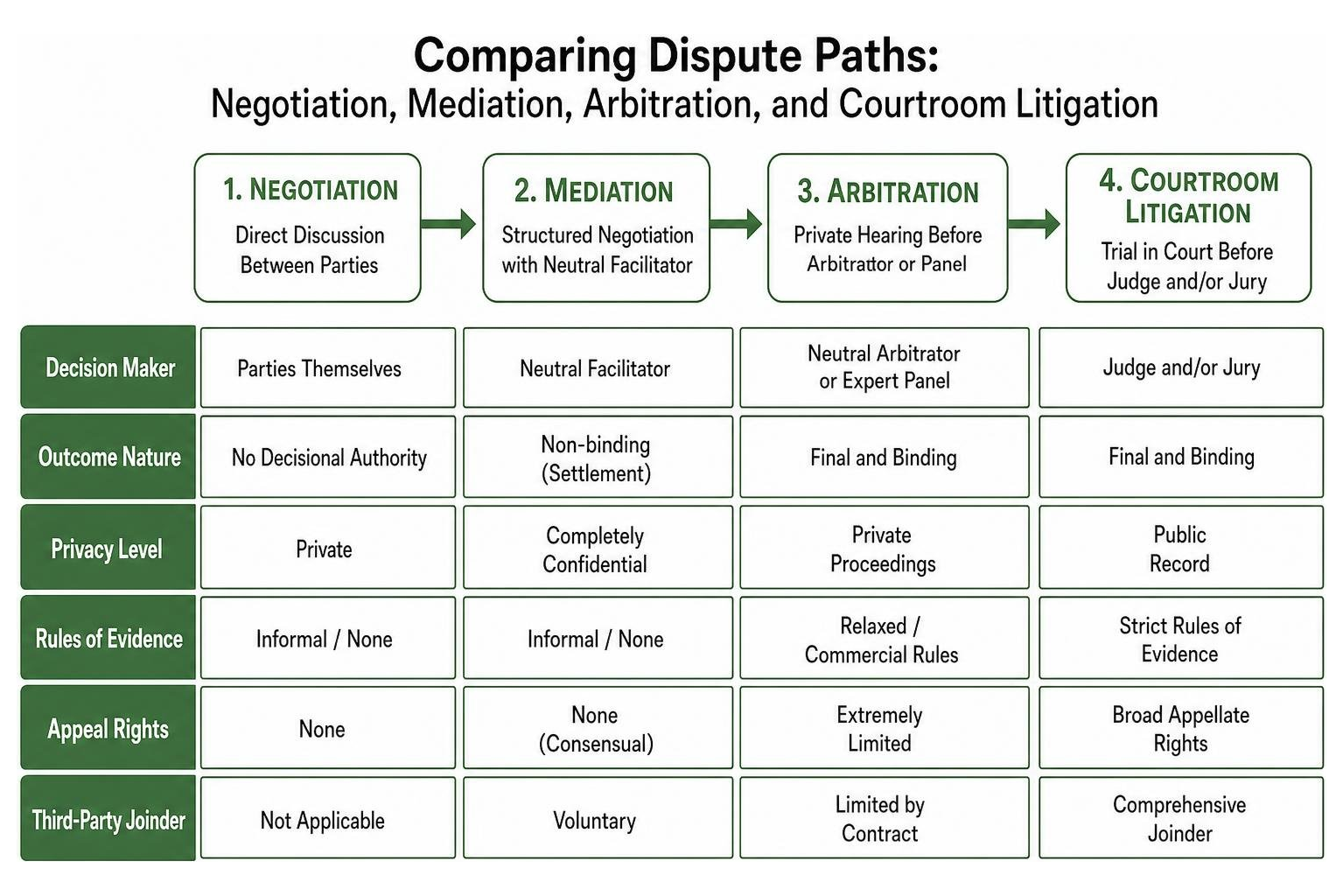
| Feature | Mediation | Arbitration | Courtroom Litigation |
|---|---|---|---|
| Decision Maker | Neutral Facilitator | Neutral Arbitrator or Expert Panel | Judge and/or Jury |
| Outcome Nature | Non-binding (Settlement) | Final and Binding | Final and Binding |
| Privacy Level | Completely Confidential | Private Proceedings | Public Record |
| Rules of Evidence | Informal / None | Relaxed / Commercial Rules | Strict Rules of Evidence |
| Appeal Rights | None (Consensual) | Extremely Limited | Broad Appellate Rights |
| Third-Party Joinder | Voluntary | Limited by Contract | Comprehensive Joinder |
Timeline and Cost Differences Across Dispute Forums
A primary argument favoring arbitration is speed. A dispute litigated in court commonly takes 36 months or more before it proceeds to trial, while arbitration may proceed to a final hearing within 18 to 24 months. Data indicates that arbitration can be up to 3x faster than court trials when comparing the median time to award for claims between $100,000 and $999,000 against the median time to trial in federal court.
However, speed comes with substantial upfront administrative and professional expenses:
- Arbitrator Compensation: In courtroom litigation, the judge and court staff are funded by public tax dollars. In arbitration, the parties pay the decision-maker directly. Arbitrator compensation typically ranges from $400 to $800 or more per hour, split between the parties. For complex hearings lasting weeks, neutral fees can easily exceed tens of thousands of dollars.
- Filing and Case Management Fees: Organizations such as the AAA charge initial filing, proceed, and final fees based on claim value. AAA filing fees generally range from $2,000 to $10,000 or more. For claims between $150,000 and $300,000, administrative fees alone can exceed $6,000 before neutral compensation begins.
- Total Exposure: Moderate construction defect arbitrations—encompassing attorney fees, expert engineering assessments, and ADR administrative charges—routinely total $75,000 to $250,000.
Failing to properly budget for these proceedings can leave owners stranded mid-dispute. It is crucial that you don’t let your case crumble like your foundation by underestimating the cash flow required to see an arbitration through to its final award.
Remedial Powers and Award Finality Under State and Federal Law
Arbitrators enjoy broad equitable powers to fashion remedies tailored to construction realities. Unlike judges, who are often constrained to monetary damages or specific statutory relief, arbitrators can order site inspections, repairs, punch-list completions, or even property transfers if the contract’s arbitration clause provides sufficient scope.
A notable illustration of this broad authority appears in David Co. v. Jim W. Miller Construction, Inc., 428 N.W.2d 590 (Minn. Ct. App. 1988), where the arbitrators ordered the contractor not only to pay $884,476 in damages but also to take title conveyance of the defective townhome development. Appellate courts affirmed that because the parties agreed to a broad arbitration submission without restricting equitable remedies, the panel possessed the discretion to craft a just resolution.
The trade-off for this flexibility is near-total finality. Under the FAA and state arbitration statutes, courts apply an extraordinarily deferential standard when reviewing awards. A court will not vacate an award simply because the arbitrator made an error of law or miscalculated factual evidence. Vacatur is strictly confined to narrow statutory grounds:
- The award was procured through corruption, fraud, or undue means.
- Evident partiality or corruption existed within the arbitration panel.
- The arbitrators engaged in misconduct by refusing to postpone a hearing upon sufficient cause or refusing to hear material evidence.
- The arbitrators exceeded their powers or imperfectly executed them such that a mutual, final, and definite award was not made.
Key Legal Doctrines and Enforceability in Defect Disputes
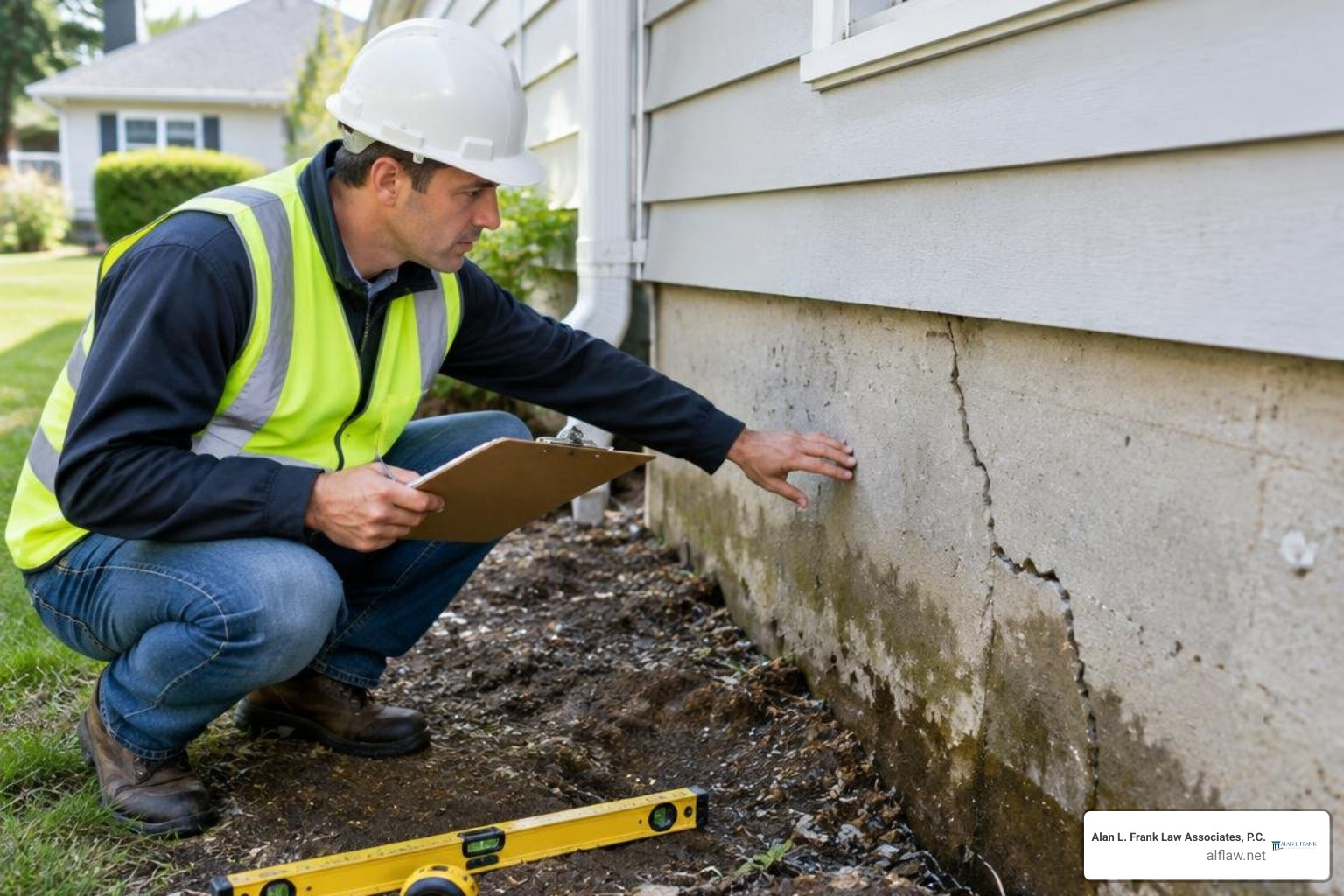
Construction defect disputes rarely involve just two original signers of a contract. Between subsequent purchasers, homeowners associations, general contractors, and trade subcontractors, disputes frequently pull in non-signatory entities. Courts apply specific contractual and equitable doctrines to determine whether these parties are compelled into private dispute forums.
Understanding the secret life of latent defects in your new home is critical, as water leaks, foundation shifts, and framing errors often take years to manifest, long after initial purchase agreements have been executed.
Binding Subsequent Purchasers Through Direct-Benefits Estoppel
A central issue in modern construction defect law is whether a homeowner who bought a property from an original owner—and thus never signed the builder’s original sales agreement—can be forced to arbitrate claims against the builder. Builders frequently argue that arbitration covenants in original deeds or warranty booklets run with the land or bind subsequent buyers under equitable principles.
State appellate decisions, such as guidance from the Supreme Court of Texas, highlight the doctrine of direct-benefits estoppel. Under direct-benefits estoppel, a non-signatory plaintiff who sues to enforce rights or warranties arising directly from a contract containing an arbitration clause is bound by that clause.
When a subsequent buyer discovers pervasive latent mold or structural defects and files suit alleging breach of express warranties or implied warranties of habitability and good workmanship that derive from the original sale, courts frequently rule that the buyer cannot cherry-pick the contract’s protections while dodging its arbitration mandate. Homeowners must carefully evaluate is your warranty worth the paper it’s printed on? before initiating formal defect proceedings against large commercial builders.
Homeowner Association Claims and Representative Capacity
In condominium and planned unit communities, construction defect disputes frequently involve large-scale failures across common elements, such as exterior stucco cladding, roofs, or parking structures. When a Homeowners Association (HOA) files a defect lawsuit on behalf of its members, developers often move to compel arbitration based on the arbitration clauses embedded within individual unit purchase contracts.
This representative capacity dynamic was underscored by the Third District Court of Appeal, which addressed instances where an association sues in its representative capacity for common-area construction defects. When an HOA exercises statutory standing to assert claims on behalf of unit owners who individually executed arbitration agreements, the association is routinely bound by those member agreements. Unless clear statutory public-policy carve-outs apply, developers can compel the entire representative action into private arbitration.
Procedural Frameworks and the AAA Construction Rules

When parties agree to arbitrate, they typically incorporate standard institutional rules. The American Arbitration Association (AAA) remains the leading administrator of construction industry disputes. The AAA maintains specialized Construction Industry Arbitration Rules designed to manage everything from modest residential disputes to massive infrastructure claims. In fact, the AAA’s largest construction claim reached $514,000,000 in 2025, supported by a roster of over 1,170 specialized Construction Panelists comprising industry-experienced attorneys, engineers, and construction professionals.
Securing the best local construction lawyers to help you build a solid case ensures that your legal team knows how to navigate these specialized procedural codes and leverage administrative conferences effectively.
How AAA Rules Shape Arbitration for Construction Defects
The AAA rules establish tailored procedural tracks determined by the monetary scope of the claim:
- Fast Track Procedures: These apply to two-party disputes where neither party’s claim or counterclaim exceeds $150,000. Fast Track rules strictly curtail discovery, utilize streamlined document exchanges, and mandate an expedited hearing schedule to resolve disputes quickly without burdensome administrative expense.
- Regular Track Procedures: Applicable to standard commercial disputes, regular track rules balance structured information exchange with preliminary administrative conferences to set firm scheduling deadlines.
- Large, Complex Construction Disputes: Under the 2024 AAA rule revisions, the monetary threshold for requiring a three-arbitrator panel rose to $3,000,000. These mega-claims follow expanded discovery protocols, specialized management by senior construction arbitrators, and comprehensive pre-hearing briefs.
Understanding these rule tiers is critical when filing claims. Identifying and categorizing structural failures early with a guide to spotting deal-breaking material defects allows counsel to strategically claim damages and select the most cost-effective dispute track.
Evidentiary Standards and Document Preservation on the Job
Unlike courtroom trials governed by strict statutory rules of evidence, arbitration panels operate under flexible evidentiary standards. Arbitrators generally admit any evidence they deem relevant and material to the dispute, reserving judgment on the weight and credibility of the documents presented.
Because construction defect arbitrations hinge on technical evaluations and chronological timelines, outcomes are won or lost in the project’s contemporaneous records. It is vital to protect your project before the roof caves in by maintaining meticulous, tamper-proof documentation throughout construction and post-completion remediation.
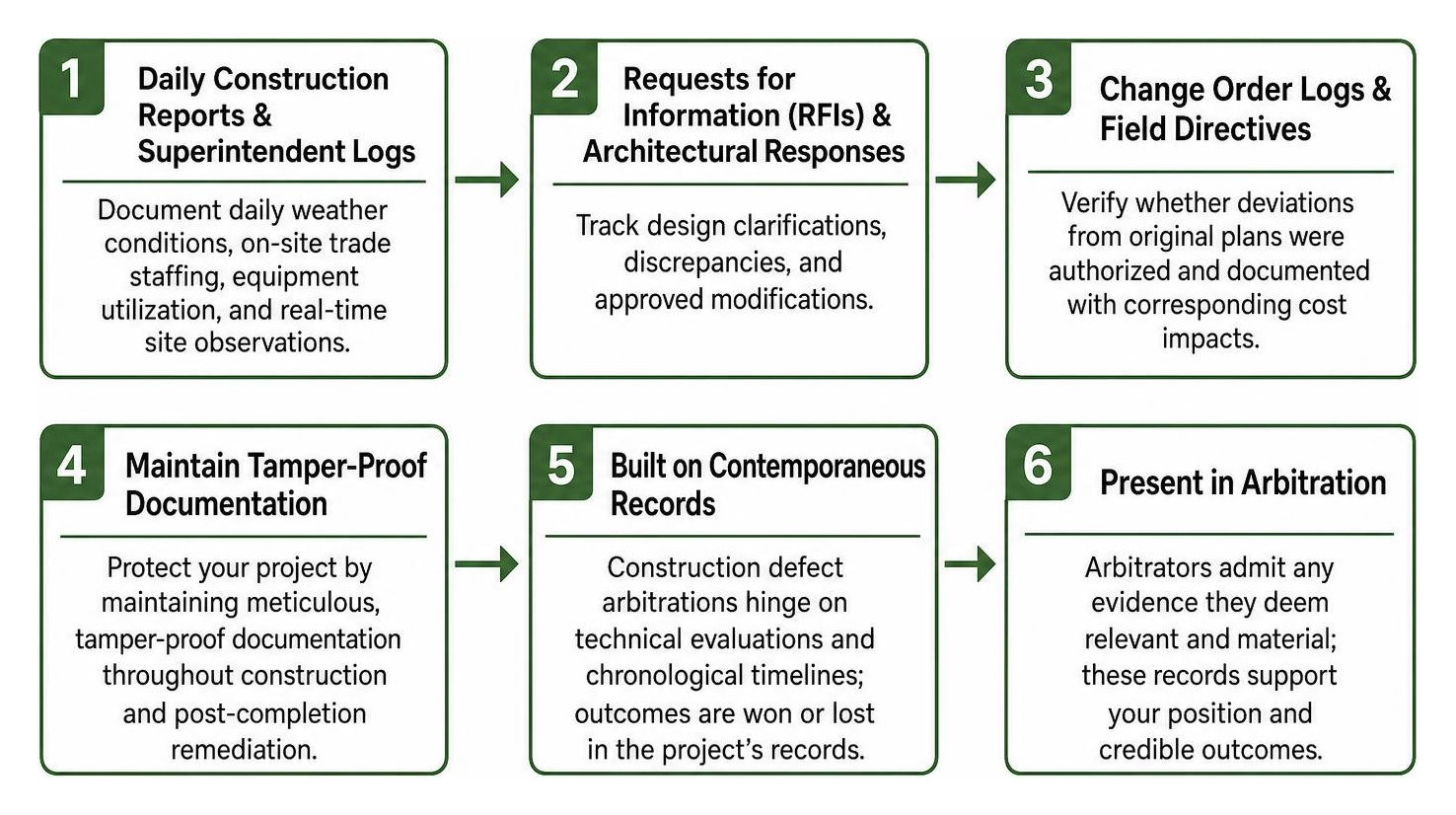
To build an unassailable position in arbitration, maintain the following records:
- Daily Construction Reports & Superintendent Logs: Documenting daily weather conditions, on-site trade staffing, equipment utilization, and real-time site observations.
- Requests for Information (RFIs) & Architectural Responses: Tracking design clarifications, discrepancies, and approved modifications.
- Change Order Logs & Field Directives: Verifying whether deviations from original plans were authorized and documented with corresponding cost impacts.
- Inspection Notices & Municipal Sign-Offs: Retaining third-party testing agency reports, structural engineering inspections, and local code enforcement certificates.
- Baseline and Recovery Project Schedules: Utilizing critical path method (CPM) schedule updates to isolate delays attributable to defective work from normal project schedule adjustments.
- Expert Forensic Engineering Evaluations: Retaining non-destructive and destructive testing evaluations, water-intrusion testing, and photographic or thermographic defect logs.
Strategic Contract Drafting and Risk Mitigation Safeguards
Contractual dispute terms are often dismissed as standard boilerplate during initial project negotiations. In practice, these terms shape every legal outcome should defects emerge. When negotiating construction agreements, developers, contractors, and owners should treat dispute resolution clauses as strategic risk-allocation tools.
Before executing agreements, evaluating what is real estate litigation and do you need legal representation? can clarify whether arbitration or courtroom litigation aligns best with your project risk profile.
Critical Contract Clauses That Control Arbitration for Construction Defects
Several key contractual provisions directly control the viability and outcome of construction defect arbitrations:
- Notice Provisions as Conditions Precedent: Contracts frequently require written notice of a defect within a strict window (e.g., 10 to 30 days of discovery) as an absolute condition precedent to asserting a claim. Arbitrators routinely enforce these provisions strictly; failing to provide timely formal notice can result in the complete denial of an otherwise valid defect claim, even if the developer informally knew about the issue.
- Mandatory Pre-Arbitration Mediation: Drafting a staged ADR clause requiring good-faith mediation prior to filing an arbitration demand forces early settlement discussions, often saving parties hundreds of thousands of dollars in administrative fees. Reviewing statutory frameworks such as everything you need to know about the SB800 manual provides valuable insight into how statutory repair procedures interact with pre-dispute notice periods.
- No-Damages-For-Delay & Liquidated Damages Clauses: When defect remediation causes schedule overruns, no-damages-for-delay clauses can limit contractor liability, while liquidated damages provisions establish enforceable daily financial assessments.
- Pay-If-Paid & Pay-When-Paid Terms: These contingent payment clauses dictate whether a general contractor must pay trade subcontractors before resolving prime defect claims with the project owner.
- Fee-Shifting Provisions: Under the standard “American Rule,” each party bears its own legal expenses. Including an enforceable fee-shifting clause enables the prevailing party to recover attorney fees, expert costs, and ADR administrative expenses, substantially increasing settlement leverage.
- Consolidation and Joinder Provisions: Construction defect claims routinely involve multi-tier accountability. If an owner arbitrates against a general contractor, but the general contractor cannot join the responsible framing, roofing, or plumbing subcontractors due to missing consolidation clauses, the contractor faces the risk of inconsistent awards across multiple separate proceedings.
Practical Safeguards for Owners, Developers, and Contractors
To mitigate the procedural risks of private dispute resolution, parties can insert practical safeguards directly into their contracts:
- Monetary Carve-Out Thresholds: Establish hybrid dispute systems. For example, mandate binding arbitration for claims under $500,000 to resolve smaller disputes quickly, while preserving the right to litigate high-exposure claims exceeding $1,000,000 in court where full discovery and broad appeal rights apply.
- Arbitrator Qualification Standards: Specify that any appointed arbitrator must possess at least 15 to 20 years of dedicated construction defect litigation experience or hold professional credentials in civil engineering or architecture.
- Subcontractor Flow-Down Clauses: General contractors must ensure all subcontracts incorporate mandatory flow-down clauses that bind trade contractors to the same dispute rules, consolidation terms, and arbitration forums found in the prime contract.
- Contractual Review Standards: While federal law restricts statutory appeals, parties in jurisdictions permitting expanded review can negotiate explicit contractual provisions allowing appellate arbitration panels to review awards for reversible errors of law.
Understanding these protections is vital when balancing compensatory claims against non-standard damages, such as punitive damages and property damage: what every homeowner should know.
Frequently Asked Questions About Construction Defect Arbitration
Can a homeowner bypass mandatory arbitration if severe latent defects are discovered?
Generally, no. If a valid, enforceable arbitration clause is present in the purchase contract, warranty booklet, or attached conveyance documents, courts will enforce the Federal Arbitration Act or state arbitration statutes and grant a motion to compel arbitration. The severity or latent nature of the defect does not invalidate an otherwise lawful agreement to arbitrate. A homeowner can only bypass arbitration if they establish traditional contract defenses, such as unconscionability, fraud in the inducement of the arbitration clause itself, or a mutual waiver of arbitration rights by both parties.
What makes arbitration more expensive than court litigation in defect cases?
While arbitration reduces trial wait times, it requires parties to privately fund the dispute forum. In public litigation, judicial salaries and courtroom facilities are provided at public expense. In arbitration, the parties must pay administrative filing and case management fees (often ranging from $2,000 to over $10,000) and compensate professional arbitrators at hourly rates between $400 and $800+ per hour. When complex construction defect arbitrations require extensive expert testimony, site visits, and multi-week evidentiary hearings, neutral compensation and administrative charges can quickly reach $75,000 to $250,000 or more.
How do courts decide whether to confirm or vacate a construction defect award?
Under the Federal Arbitration Act and corresponding state laws in Pennsylvania and New Jersey, judicial review of an arbitration award is extremely narrow and deferential. Courts will confirm awards unless a party proves statutory grounds for vacatur, such as evident partiality, corruption, arbitrator misconduct (e.g., refusing to hear material evidence), or instances where the arbitrator clearly exceeded their contractual authority. Courts will not vacate an award simply because the arbitrator made an error of law or misconstrued the facts.
Conclusion
Arbitration for construction defects offers substantial advantages, including industry-specific adjudicators, confidential hearings, and rapid dispute resolution compared to congested trial dockets. However, these benefits are balanced by substantial upfront neutral costs, limited discovery mechanisms, and virtually non-existent appeal rights.
Whether arbitration serves as your best move or your worst move depends entirely on how your construction contracts are drafted, how your site documentation is maintained, and how strategically your claims are framed. At Alan L. Frank Law Associates, P.C., we draw upon decades of complex commercial and construction litigation experience across Pennsylvania and New Jersey to help property owners, developers, and contractors navigate arbitration and protect their financial investments.
If you are facing an emerging construction defect dispute or need to evaluate an arbitration agreement, visit our Practice: FAQs Housing and Construction Defects page to schedule a comprehensive case evaluation with our legal team.