
When Corporate Greed Crosses the Line: Your Rights Under the SEC Whistleblower Program


When Corporate Greed Crosses the Line: Your Rights Under the SEC Whistleblower Program
Your First Steps With an Insider Trading Whistleblower Attorney
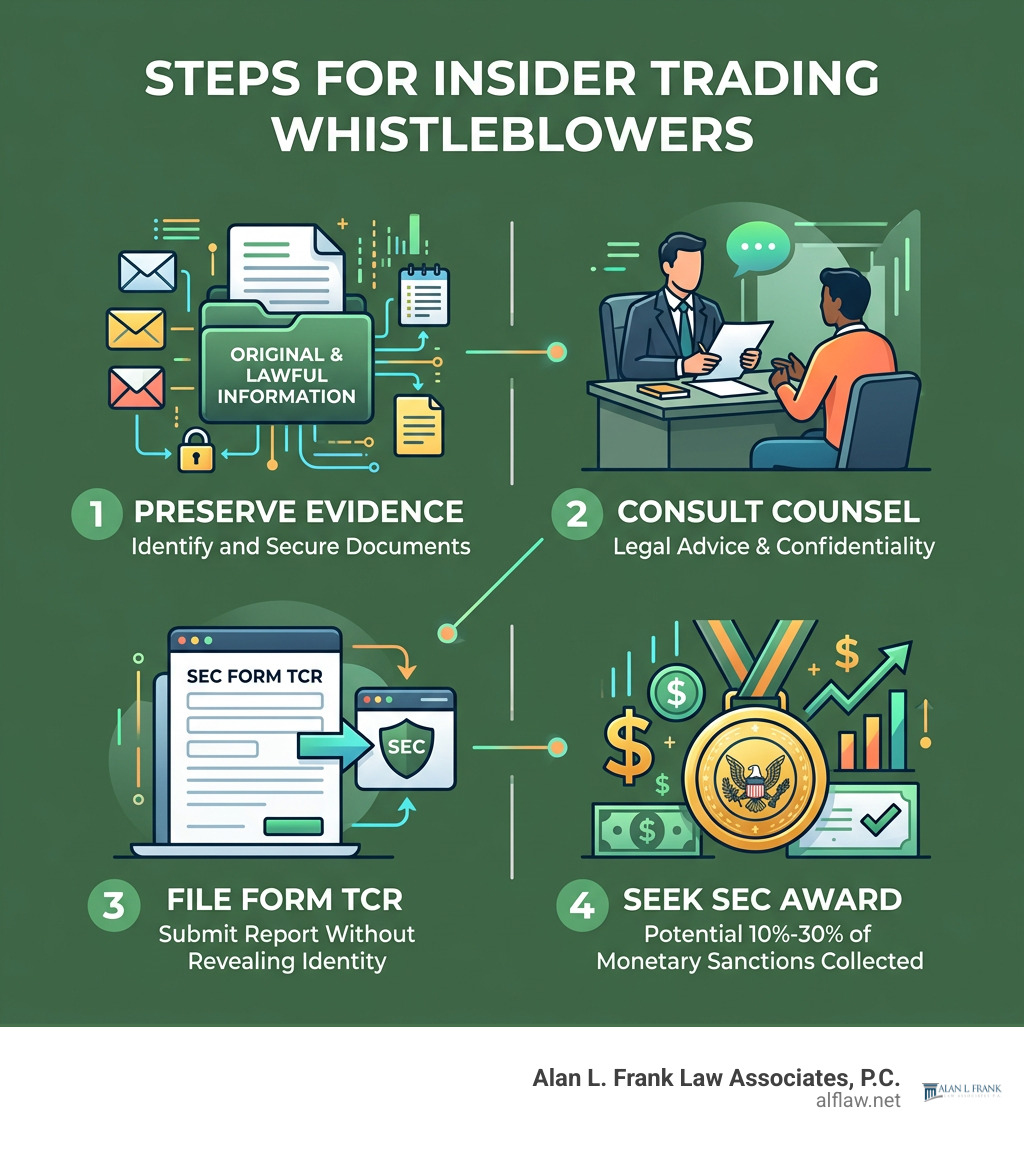
If you have credible evidence that someone traded on confidential company information, act carefully and early. An insider trading whistleblower attorney can help you preserve evidence, assess whether your information may qualify as original and voluntary, and submit an SEC Form TCR without unnecessarily exposing your identity.
Before reporting, take these steps:
- Preserve relevant emails, messages, trading records, meeting notes, and documents you lawfully possess.
- Do not alter, delete, or take information you are not allowed to access.
- Avoid discussing the report with coworkers or on social media.
- Speak with counsel before filing if you want to report anonymously or are concerned about retaliation.
Under the SEC Whistleblower Program, eligible individuals may receive 10% to 30% of monetary sanctions collected when a case results in more than $1 million in sanctions. A lawyer can also help you understand confidentiality, filing deadlines, and protections that may apply if an employer punishes you for raising concerns.
I am Alan L. Frank, Managing Attorney of Alan L. Frank Law Associates, P.C., with more than 20 years of experience handling complex commercial disputes, securities matters, investment-loss claims, and tax controversies. As an insider trading whistleblower attorney resource, I bring a legal and financial background that includes a J.D., an LL.M. in Tax Law, and CPA credentials to cases involving high-stakes financial misconduct.
Important insider trading whistleblower attorney terms:
How Insider Trading Schemes Harm Markets and Investors
Insider trading undermines the fundamental integrity of public markets. When corporate executives, board members, or industry professionals exploit material nonpublic information (MNPI), they gain an illicit advantage over everyday retail investors and institutional funds. This unfair advantage erodes public trust, distorts stock valuations, and deprives honest market participants of a level playing field.
In modern financial markets, illicit trading schemes generally arise under two primary legal theories enforced by the Securities and Exchange Commission (SEC) and the Department of Justice (DOJ): the Classical Theory and the Misappropriation Theory.
| Feature | Classical Theory | Misappropriation Theory |
|---|---|---|
| Duty Origin | Fiduciary duty owed directly to the corporation and its shareholders. | Fiduciary duty or duty of trust owed to the source of the confidential information. |
| Typical Actors | Corporate executives, directors, officers, and key employees. | Corporate outsiders: lawyers, accountants, consultants, printing staff, or family members. |
| Core Violation | Trading company shares or tipping outsiders for personal benefit while possessing MNPI. | Deceptively misusing confidential data from a principal or client for personal trading gain. |
| Common Scenarios | A CEO buying stock before an unannounced merger or clinical trial success. | A financial advisor or lawyer trading on deal data learned during confidential due diligence. |
Beyond direct trades, complex tipping schemes often involve networks of hedge fund managers, equity research analysts, and broker-dealers who pass tips along chains of recipients. When these unlawful operations occur, retail accounts suffer severe distortions. In these circumstances, victimized individuals often turn to securities litigation investment losses advocacy to evaluate whether bad actors manipulated price discovery to their detriment.
Step-by-Step Guide: How to Report Securities Fraud to the SEC
Reporting illicit conduct to federal regulators requires precision, compliance with statutory requirements, and complete discretion. Under the Dodd-Frank Wall Street Reform and Consumer Protection Act, the SEC Office of the Whistleblower accepts tips, complaints, and referrals from individuals who possess original information about federal securities violations.

To maximize your eligibility for financial recovery and safeguard your career, follow this structured reporting workflow:

1. Identify and Secure Original Information
To qualify under federal rules, your disclosure must consist of “original information.” This means the data must be:
- Derived from your independent knowledge (facts known to you that are not public) or independent analysis (critical evaluation of publicly available information revealing fraud).
- Not already known to the SEC from another public or regulatory source.
- Not exclusively sourced from government reports, hearings, audits, or major news media publications (unless you were the original source of that reporting).
2. Preserve Critical Evidence Lawfully
Gather documentation systematically while respecting lawful boundaries of workplace document possession. Never hack networks, copy trade secrets unrelated to the fraud, or violate attorney-client communications. Essential records to preserve include:
- Time-stamped emails, direct messages, and chat transcripts referencing nonpublic corporate developments.
- Personal calendar entries and detailed meeting notes corresponding to major announcements or unreleased earnings reports.
- Account statements, trading confirmations, or transaction logs showing suspicious pre-announcement trading activity.
- Internal presentations, financial models, draft press releases, and merger term sheets.
3. File SEC Form TCR
All formal submissions must be tendered via SEC Form TCR (Tip, Complaint, or Referral). The submission must lay out the full factual narrative clearly, explaining the timeline, the parties involved, the specific securities traded, and the exact profits generated or losses avoided. Navigating this process alongside seasoned litigators who understand broader securities litigation ensures that the submission is comprehensive, legally sound, and readily actionable for enforcement staff.
Why You Need an Insider Trading Whistleblower Attorney
Blowing the whistle on sophisticated securities fraud is rarely straightforward. Corporate wrongdoers frequently deploy aggressive legal teams, forensic investigators, and corporate security to uncover the source of internal leaks. Retaining dedicated counsel ensures that you do not face these pressures alone.
An attorney serves as an indispensable intermediary. If you wish to remain anonymous throughout the SEC investigation, federal law requires you to be represented by counsel who files the Form TCR on your behalf. Your legal representative verifies your identity, maintains your confidential documentation under attorney-client privilege, and communicates directly with SEC Division of Enforcement attorneys throughout the multi-year inquiry.
Furthermore, insider trading cases often cross multiple regulatory arenas. The illicit behavior might involve registered representatives, in which case evaluating FINRA as a forum for claims involving stockbroker misconduct or engaging experienced FINRA attorneys becomes essential. In other situations, fraudulent transactions may intersect with federal contracting or healthcare fraud, requiring coordination under the False Claims Act.

Strategic Benefits of Hiring an Insider Trading Whistleblower Attorney
Navigating the federal award system demands detailed knowledge of regulatory standards:
- Anonymous Submissions: Counsel can submit your tip anonymously, keeping your name hidden from public dockets, company leadership, and regulatory staff until the award distribution phase (and often permanently from the public).
- Substantive Advocacy: Legal counsel structures your raw data into a compelling legal brief that highlights statutory violations, helping SEC investigators quickly recognize the merit of your tip.
- Award Maximization: Statutory awards range from 10% to 30% of total monetary penalties collected in actions where recoveries exceed $1 million. Your lawyer advocates for the maximum percentage by documenting your timely assistance, the significance of your disclosures, and the personal risks you undertook.
Protecting Your Career with an Insider Trading Whistleblower Attorney
Workplace retaliation is a major concern for professionals discovering insider schemes. Federal statutes offer robust legal mechanisms to protect employees:
- Dodd-Frank Act (Section 922): Prohibits employers from discharging, demoting, suspending, threatening, harassing, or discriminating against employees who provide lawful tips to the SEC.
- Sarbanes-Oxley Act (SOX Section 806): Protects employees of publicly traded companies who report securities fraud, shareholder fraud, or violations of SEC regulations internally or externally.
- Statutory Remedies: Whistleblowers subjected to unlawful employer retaliation can pursue legal remedies including reinstatement to their former position, double back pay with interest, compensation for special damages, and reimbursement for litigation costs and legal fees.
Frequently Asked Questions About SEC Whistleblower Claims
What is the process for filing an insider trading whistleblower claim?
The process begins with an in-depth, confidential evaluation by legal counsel. Your attorney compiles the evidence, drafts the legal narrative, and submits SEC Form TCR anonymously. If SEC enforcement staff open an investigation based on your submission, counsel coordinates follow-up interviews, supplemental evidence submissions, and ongoing communications. Once a successful enforcement action yields a final judgment or settlement exceeding $1 million, your attorney files SEC Form WB-APP to claim your statutory reward.
How are SEC whistleblower awards calculated in insider trading cases?
Under federal rules, eligible awards range from 10% to 30% of the total monetary sanctions collected by the SEC and related regulatory or criminal authorities. The SEC Claims Review Staff determines the final percentage by assessing:
- The significance and quality of the information provided.
- The degree of ongoing assistance provided by the whistleblower and legal counsel.
- The law enforcement interest in deterring the specific violations reported.
- Whether the whistleblower participated in internal compliance programs before reporting externally.
What legal protections shield whistleblowers from employer retaliation?
Federal laws, including the Dodd-Frank Act and the Sarbanes-Oxley Act, prohibit employers from taking adverse employment actions against whistleblowers. If an employer retaliates, whistleblowers can file federal lawsuits seeking complete job reinstatement, double back pay with interest, and compensatory damages. Furthermore, reporting through legal counsel allows whistleblowers to preserve their anonymity throughout the investigative process, reducing the risk of workplace fallout.
Conclusion: Taking Action Against Market Manipulation
Uncovering corporate greed and market manipulation requires courage, diligence, and sophisticated legal guidance. At Alan L. Frank Law Associates, P.C., we represent whistleblowers, defrauded market participants, and institutional investors throughout Pennsylvania and New Jersey from our offices in Philadelphia and Jenkintown. Our team combines deep trial experience, tax law credentials, and accounting expertise to take on high-stakes securities matters.
If you possess credible, nonpublic evidence of insider trading, market manipulation, or securities fraud, protect your career and your legal rights by consulting an experienced advocate. Contact Alan L. Frank Law Associates, P.C. today for a confidential case evaluation, or explore how our team assists clients in pursuing securities litigation investment loss claims nationwide.