
Navigating Investment Loss Litigation Without Getting Burned Twice


Navigating Investment Loss Litigation Without Getting Burned Twice
When Is an Investment Loss Worth Pursuing?
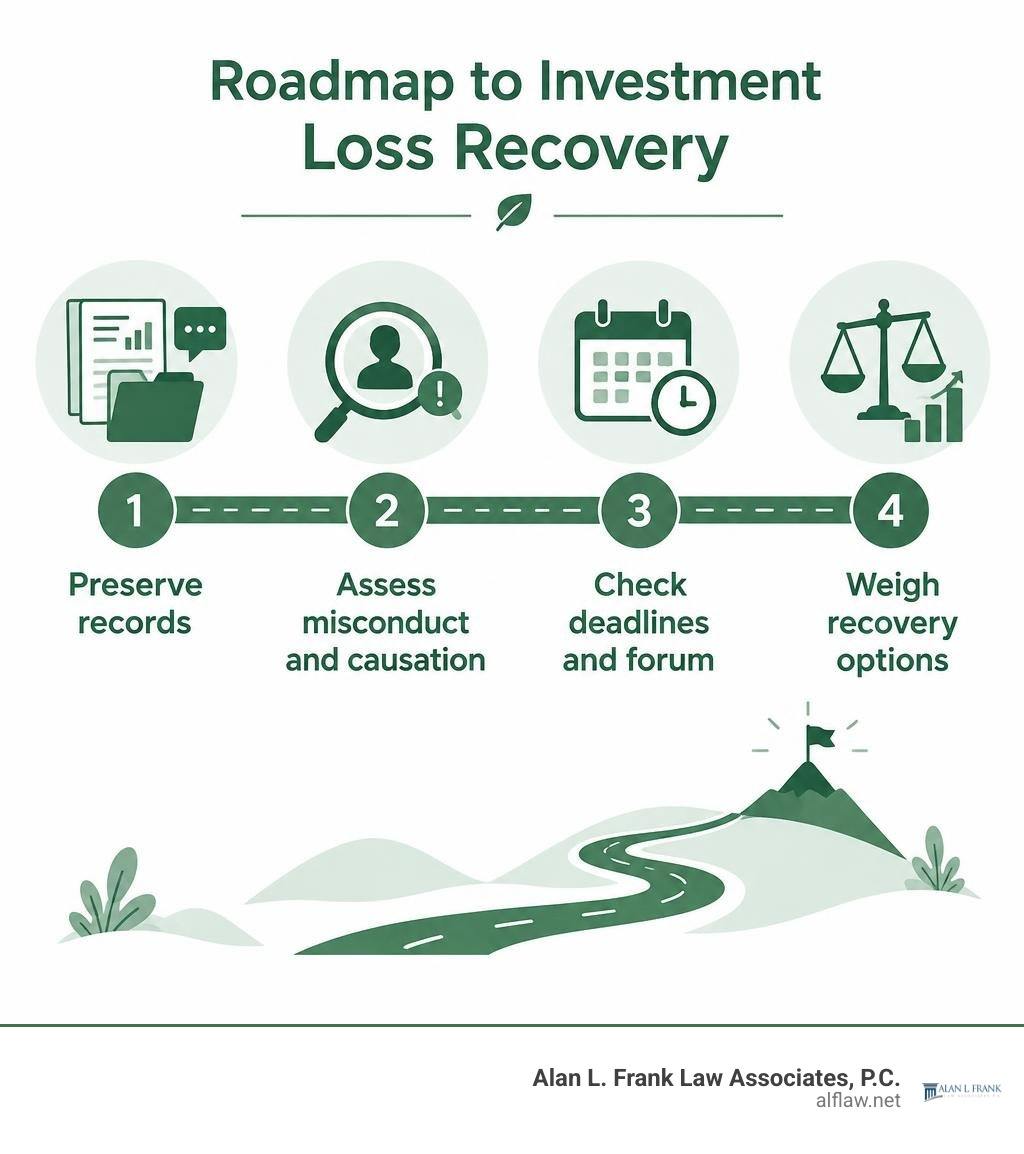
A falling portfolio alone is not grounds for a claim. If a broker or financial institution misled you, made trades without permission, or broke a duty it owed you, investment loss litigation may offer a path to recovery. Save your account records and messages, write down when you learned of the problem, and check your account agreement for arbitration terms. Then have a lawyer assess what caused the loss, whether a deadline applies, and whether the other party can pay.
I’m Alan L. Frank, managing attorney at Alan L. Frank Law Associates, P.C., with more than 20 years of experience handling complex disputes, including investment losses and securities matters. My background in law, tax law, and accounting helps me assess the evidence, recovery options, and tax issues that can shape investment loss litigation.
Important investment loss litigation terms:
Core Legal Grounds in Investment Loss Litigation

When an investment collapses, determining whether the event represents ordinary market volatility or actionable wrongdoing requires dissecting the legal duties binding your financial professionals. In private actions, experienced stock fraud attorneys analyze claims under state common law and foundational federal acts—specifically the Securities Act of 1933 and the Securities Exchange Act of 1934.
The cornerstone of modern federal securities enforcement is Section 10(b) of the 1934 Act and SEC Rule 10b-5. Under these provisions, investors can bring civil actions when a broker, issuer, or asset manager makes material misstatements or engages in manipulative practices in connection with the purchase or sale of a security. At the state level, financial advisers and registered representatives are often bound by common-law fiduciary duties. A fiduciary breach occurs when an adviser places their personal financial incentives—such as concealed commissions or undisclosed revenue-sharing—above the client’s explicit financial interests.
Actionable Misconduct vs. Market Downturns
The financial markets carry inherent risk. A drop in equity valuations during an economic contraction does not constitute fraud. However, legal liability arises when financial losses stem directly from breaches of care or intentional deceptions. Common actionable claims include:
- Unsuitability Claims: Recommending complex, high-risk, or illiquid products that do not match the investor’s verified investment profile, age, tax status, or risk tolerance.
- Material Omissions: Failing to disclose severe downside risks, liquidity locks, or internal conflicts of interest. This occurs frequently in private placement fraud, where issuers solicit capital using private placement memorandums that omit critical operational risks.
- Unauthorized Trading and Churning: Executing transactions without client authorization, or excessively trading an account primarily to generate broker commissions.
- Negligent Mismanagement: Failing to maintain documented asset allocation strategies or execute basic stop-loss parameters agreed upon in investment policy statements.
Proving Loss Causation and Broker Misrepresentation
Winning a securities claim requires more than proving an adviser lied or committed an error. You must demonstrate both transaction causation (that the deception induced you to make the investment) and loss causation (that the misconduct, rather than external market movements, caused your economic loss).
Defendants frequently argue that broader economic declines caused the portfolio drop. Overcoming this defense requires isolating the financial impact of the specific wrongful act using market-adjusted benchmarks. If an adviser recklessly concentrates an account in a speculative asset that drops 80% while the broader index rises 10%, comparative economic modeling establishes loss causation.
Pleading deficiencies can be fatal to an action. In the Knowles v. TD Ameritrade Holding Corp. litigation, an investor claimed over $16,000 in damages because an automated tax-loss harvesting algorithm left roughly 35% of his account in uninvested cash for 18 days, causing him to miss a market rally. The court affirmed dismissal because the plaintiff failed to identify a specific contractual promise breached by the brokerage and did not adequately plead the requisite wrongful intent or loss causation under federal standards. The Eighth Circuit’s ruling in Knowles v. TD Ameritrade Holding Corp. illustrates how courts apply these pleading requirements in algorithmic trading disputes.
Procedural Obstacles: SLUSA Preemption, Arbitration Clauses, and Deadlines
Even meritorious claims can be extinguished if an investor stumbles over procedural hurdles. Securities disputes are governed by federal preemption statutes, stringent administrative deadlines, and mandatory alternative dispute resolution clauses.
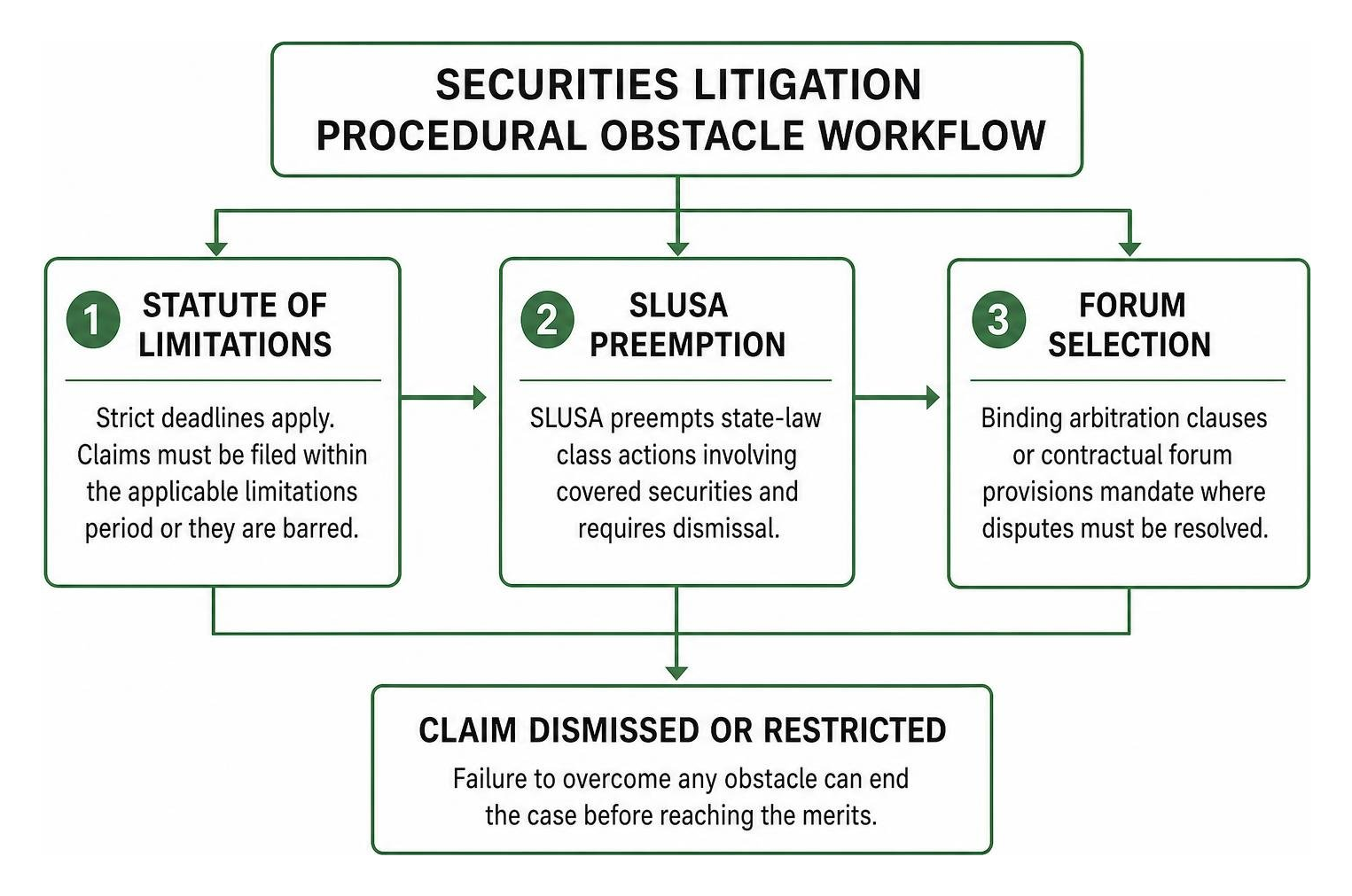
The Securities Litigation Uniform Standards Act of 1998 (SLUSA) prevents plaintiffs from evading federal pleading standards by bringing state-law class actions involving nationally traded “covered securities.” If a complaint alleges misrepresentations or deceptive omissions in connection with covered securities on a class-wide basis, SLUSA mandates preemption and dismissal in state court.
Additionally, the economic loss rule often prevents investors from bringing tort-based negligence claims if the underlying relationship is governed entirely by a written contract, unless an independent common-law fiduciary duty applies.
Federal Preemption and Contractual Limits
Brokerages frequently rely on SLUSA and Rule 12(b)(6) motions to dismiss investor lawsuits at the initial pleading stage. For example, in algorithmic trading disputes involving automated tax-loss harvesting, institutions draft broad limitation-of-liability clauses and account disclosures.
When market movements cause cash drag or trigger the Internal Revenue Code’s 30-day Wash Sale Rule (26 U.S.C. § 1091), brokerages argue that their contracts expressly permitted temporary cash allocations. Overcoming a Rule 12(b)(6) motion requires establishing specific contractual breaches or showing that the institution omitted material operational limitations before the investor enrolled.
FINRA Arbitration Versus Judicial Forums
Most retail investor disputes never see a courtroom jury because standard brokerage customer agreements contain mandatory predispute arbitration clauses. These agreements channel claims directly into dispute resolution administered by the Financial Industry Regulatory Authority (FINRA).
| Factor | FINRA Arbitration | Federal Civil Court |
|---|---|---|
| Decision Maker | Panel of 1 to 3 arbitrators (public/industry) | Federal judge and civil jury |
| Discovery Scope | Streamlined document production; depositions rare | Broad discovery, interrogatories, and extensive depositions |
| Duration | Typically 12 to 18 months to award | 2 to 4+ years through trial and appeals |
| Appellate Review | Highly restricted under Federal Arbitration Act | Full appellate review on legal and factual errors |
| Public Record | Hearing is private; award is publicly published | Filings, motions, and trial records are public |
Understanding how FINRA as a forum for claims involving stockbroker misconduct functions is essential. While FINRA offers faster resolutions, its awards are virtually final. Vacating an adverse arbitration award under the Federal Arbitration Act requires proving rare grounds such as arbitrator corruption, fraud, or evident partiality. Working with experienced FINRA attorneys ensures your statement of claim is properly structured from day one.
Damage Calculation, Restitution, and Institutional Insolvency
Calculating damages in securities disputes goes beyond subtracting your current portfolio balance from your starting deposit. Courts and arbitration panels apply distinct legal measures depending on the underlying cause of action.
- Rescissory Damages: Unwinds the transaction completely, returning the investor’s original capital minus any distributions received.
- Out-of-Pocket Losses: Measures the difference between the purchase price paid and the actual economic value of the security at the time of purchase.
- Well-Managed Portfolio Damages: Uses benchmark indices (such as a blend of the Russell 1000 and NASDAQ) to model what the portfolio would have yielded had the fiduciary managed it prudently.
- Dilution and Disgorgement: Strips the wrongdoer of ill-gotten profits and compensates investors for share dilution caused by improper trading practices.
Evaluating Evidentiary Burdens in Investment Loss Litigation
Proving financial damages requires expert econometric modeling. In complex mutual fund class actions, such as Fischer v. IG Investment Management Ltd., courts evaluated sophisticated damage methodologies to address market-timing abuses and time-zone arbitrage that diluted long-term investor returns. The court favored the “Next Day NAV” method over pure trader profit calculations because it measured the direct economic dilution suffered by the fund’s unit holders.
In individual disputes involving hedge fund disputes, financial experts reconstruct trading logs to prove deviation from stated investment mandates, presenting detailed models to justify compensatory damages, disgorgement, and statutory prejudgment interest.
Navigating Financial Institution Bankruptcy and Liquidation
When an insolvent brokerage or investment firm enters bankruptcy, civil litigation and arbitration are halted by the Bankruptcy Code’s automatic stay.
In such cases, recovery shifts to specialized insolvency proceedings. If a brokerage liquidates, the Securities Investor Protection Corporation (SIPC) protects customer accounts up to $500,000 (including a $250,000 limit for uninvested cash claims) against missing custodial assets, though SIPC does not cover losses caused by bad investment advice or market declines. Any loss exceeding statutory protections requires filing a formal Proof of Claim in bankruptcy court, where the investor is classified as a general unsecured creditor subject to statutory payout priorities.
Tax Implications of Fraud: IRC § 165 Theft Loss Deductions

Recovering investment losses is not limited to civil litigation; the tax code provides potential financial relief through theft loss deductions under Internal Revenue Code (IRC) § 165. While normal capital losses are limited to offsetting capital gains plus a maximum deduction of $3,000 against ordinary income per year, a properly substantiated theft loss can offset ordinary income without the standard $3,000 capital loss cap.
Securing these deductions requires careful navigation with knowledgeable investment fraud attorneys. The IRS applies strict scrutiny to taxpayers claiming theft losses from failed investments.
Proving Theft Losses and Deductibility Standards
To qualify under IRC § 165(a), the investor must prove that the loss resulted from a criminal taking under the law of the jurisdiction where the transaction occurred, executed with specific criminal intent (scienter). Mere contractual nonperformance, bad business judgment, or unsuitability does not qualify.
The difficulties of this standard are illustrated in Adkins v. United States. In Adkins, plaintiffs suffered more than $2.1 million in losses from a fraudulent pump-and-dump scheme and sought $317,458 in tax refunds across multiple tax years. Although several rogue brokers were criminally convicted and ordered to pay over $4 million in restitution (of which only $7,093.27 had been collected by 2014), the court scrutinized whether the investors had established direct privity with the thieves for every purchased stock.
Similarly, in Shaut v. Commissioner, a taxpayer attempted to deduct $1,380,000 in fraud losses ($720,000 in lost principal and $600,000 in legal expenses). The Tax Court disallowed the deduction because the taxpayer failed to prove the specific year of discovery, could not verify the absence of recovery prospects, and improperly attempted to classify litigation fees as ordinary business expenses under IRC § 162.
Timing and Net Operating Loss Carryforwards
Under Treasury Regulation § 1.165-1(d)(2), a theft loss is deductible only in the year of discovery, and only to the extent there is no “reasonable prospect of recovery.” If you are actively litigating against a solvent financial institution or pursuing a viable FINRA arbitration claim, the IRS considers that a reasonable prospect of recovery exists, requiring you to postpone the deduction until the claim is formally resolved, settled, or abandoned.
Improperly accelerating an IRC § 165 deduction can trigger substantial understatement penalties under IRC § 6662(a) (a 20% penalty on the underpaid tax). If an allowable theft loss exceeds your annual taxable income, the excess can generate a Net Operating Loss (NOL), which may be carried forward to offset future taxable income under prevailing federal tax rules.
Strategic Decision-Making: Costs, Evidence, and Feasibility
Pursuing securities litigation without a clear assessment of solvency and collectability can compound your financial losses. Before filing a complaint or arbitration demand, we evaluate the financial viability of the target, the strength of the documentary evidence, and parallel regulatory proceedings.
Strategic Pre-Filing Assessments in Investment Loss Litigation
A successful recovery strategy requires examining the following factors:
- Defendant Solvency and Insurance: Does the target brokerage carry adequate Errors and Omissions (E&O) insurance? Unregistered fraudsters often dissipate capital before an award is entered.
- Cost-Benefit Analysis: Litigating complex claims involves retaining forensic accountants, economic damage experts, and paying administrative arbitration fees. Total projected recovery must justify these costs.
- Parallel Regulatory Actions: Has the Securities and Exchange Commission (SEC), FINRA, or a state securities regulator initiated enforcement proceedings? Findings and restitution orders in parallel proceedings can provide critical leverage in private actions.
Preserving Communications and Institutional Records
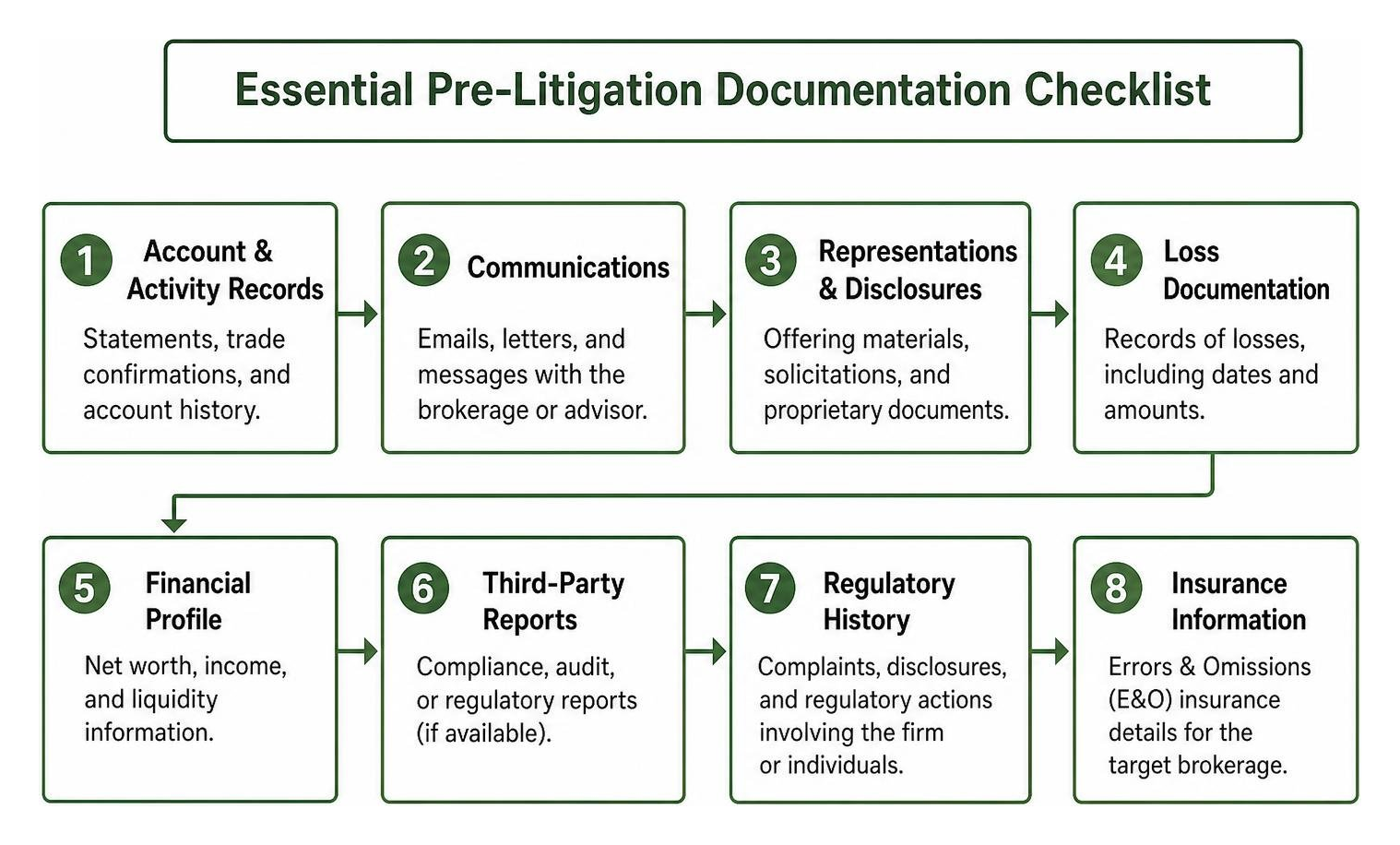
Strong documentary evidence is the single most important factor in overcoming institutional defenses. If you suspect misconduct, assemble and secure the following items immediately:
- Customer Account Agreements: Including all signed margin agreements, arbitration riders, and discretionary trading authorizations.
- Investment Policy Statements (IPS): Records defining your stated investment objectives, risk parameters, and liquidity constraints.
- Trade Confirmations and Monthly Account Statements: Complete chronological statements demonstrating account positions, cash balances, margin charges, and realized losses.
- Written Correspondence: Emails, text messages, handwritten meeting notes, and promotional marketing materials or private placement prospectuses provided by the adviser.
Frequently Asked Questions About Investment Loss Litigation
What distinguishes an ordinary market loss from actionable misconduct?
An ordinary market loss occurs when an investment declines due to general market forces, macroeconomic downturns, or legitimate business challenges. Actionable misconduct requires showing that the financial professional breached a legal or fiduciary duty, executed unauthorized trades, made material misstatements, or recommended investments that violated your established suitability parameters.
How does FINRA arbitration impact my ability to appeal an award?
Under the Federal Arbitration Act (FAA), judicial review of a FINRA arbitration award is extremely narrow. Courts cannot overturn an award simply because they disagree with the arbitrators’ factual findings or legal interpretations. To vacate an award, you must establish specific statutory grounds, such as arbitrator fraud, evident partiality, corruption, or severe misconduct during the hearings.
Can I claim an IRC § 165 theft deduction while actively pursuing litigation?
Generally, no. Treasury regulations state that you cannot claim an IRC § 165 theft loss deduction while there remains a “reasonable prospect of recovery” through pending civil litigation, arbitration, or insurance claims. The deduction must be claimed in the tax year the fraud is discovered and the prospect of recovery is resolved or clearly determined to have zero value.
Conclusion
Recovering from catastrophic investment losses requires avoiding emotional reactions and executing a disciplined legal strategy. Knowing the difference between ordinary market risk and actionable broker misconduct—while adhering to strict filing deadlines and managing tax implications—ensures you protect your financial rights without compounding your losses.
At Alan L. Frank Law Associates, P.C., we draw upon decades of nationwide experience in commercial litigation, accounting, and tax law to advocate for institutional and individual investors across Pennsylvania and New Jersey. If you believe your investment losses were caused by professional misconduct, breach of fiduciary duty, or securities fraud, contact our team to evaluate your securities litigation investment losses and explore your recovery options.