
The Generation Skipping Tax Dispute Survival Guide


The Generation Skipping Tax Dispute Survival Guide
Grounds and Causes of Action in a Private Placement Memo Dispute
A private placement memo dispute arises when an issuer or fund manager conceals critical risks, misrepresents financial data, or misallocates investor capital in an offering circular. Even under SEC Regulation D exemptions, investors can pursue actionable legal claims including SEC Rule 10b-5 securities fraud, material misstatements and omissions, breach of fiduciary duty, breach of contract, fraudulent inducement, and statutory rescission under state Blue Sky laws. When a deal unravels or underperforms, investors frequently turn to Securities Litigation & Investment Losses counsel to evaluate whether the offering memorandum concealed vital truths, breached fund agreements, or crossed the line into actionable misconduct despite boiler-plate risk disclosures.
Material Misstatements, Omissions, and Securities Anti-Fraud Rules
The cornerstone of investor protection in private offerings rests on anti-fraud provisions, notably Section 10(b) of the Securities Exchange Act of 1934 and SEC Rule 10b-5, alongside parallel state statutes. Under these provisions, it is unlawful to make any untrue statement of a material fact or to omit a material fact necessary to make the statements made not misleading.
A fact is legally “material” if there is a substantial likelihood that a reasonable investor would consider it important when making an investment decision. In private placements, material misrepresentations and omissions typically involve:
- Falsifying historical financial performance or existing operating revenues.
- Concealing encumbrances, prior liens, or existing debt obligations.
- Misrepresenting key personnel backgrounds, credentials, or past regulatory sanctions.
- Failing to provide accurate disclosure schedules that reflect the true operational challenges of the target enterprise.
Judicial standards require rigorous factual consistency. For example, documentary evidence standards under New York contract law demonstrate that courts will examine unambiguous transactional records to determine the true scope of party commitments. When offering documents omit the unvarnished realities of a venture, sponsors cannot avoid liability simply because the vehicle operated under a private placement exemption.
Conflicting Marketing Materials and Pitch Deck Discrepancies
A frequent trigger of private offering litigation is a stark narrative disconnect between slick marketing materials and the formal PPM. Promoters often distribute flashy pitch decks, executive summaries, or host webinars promising double-digit annual yields, guaranteed downside protection, or imminent liquidity events. When prospective limited partners finally receive the formal PPM, it contains fine print contradicting those representations.
Sponsors routinely attempt to defeat investor claims by citing “integration clauses” or “entire agreement clauses” within the subscription documents, arguing that the investor agreed not to rely on any statements outside the four corners of the PPM. However, integration clauses do not provide blanket immunity against fraud. When promotional materials induce an allocation through deceptive omissions, investors have viable avenues to Recover Your Investment through claims of fraudulent inducement and negligent misrepresentation.
Related-Party Transactions and Undisclosed Fee Structures
Self-dealing remains one of the most contentious issues in private equity and real estate syndications. While related-party transactions are not inherently illegal, failing to disclose them thoroughly and accurately is a direct path to litigation.
Consider the high-profile enforcement actions and civil disputes surrounding the GPB Automotive Portfolio. The offering circulars disclosed an objective to acquire income-producing auto dealerships while reserving broad operational discretion. However, friction erupted when substantial capital was diverted to affiliated operations support providers, special limited partners, and broker-dealer personnel via multi-tiered compensation arrangements and unapproved insider deals.
Common fee-related conflicts that trigger Commercial Litigation include:
- Undisclosed managerial assistance fees paid directly to principals.
- Servicing and administrative markups charged by affiliated entities without independent advisory committee approval.
- Unearned performance allocations calculated on inflated internal asset valuations rather than realized cash returns.
Safe Harbors, Risk Factors, and Legal Liability Shields

Issuers rely heavily on the “bespeaks caution” doctrine and statutory safe harbors to defend against investor lawsuits. When structured properly, cautionary language can neutralize claims that forward-looking statements were misleading. However, general partners often misunderstand the limits of these protections.
Contracts and restrictive covenants in private placements face strict judicial scrutiny. As seen in the judicial enforcement of non-circumvention terms, courts enforce the unambiguous language of private agreements, holding sophisticated parties to the letter of their written bargains while refusing to protect bad-faith maneuvers.
Boilerplate Disclaimers vs Meaningful Cautionary Language
To insulate an issuer from liability regarding forward-looking projections, risk factor disclosures must be meaningful, precise, and tailored to the specific commercial risks of the enterprise. Vague, boilerplate warnings—such as stating that “the company may experience competitive pressures or general economic downturns”—do not protect sponsors if they were aware of immediate, concrete operational failures at the time of the offering.
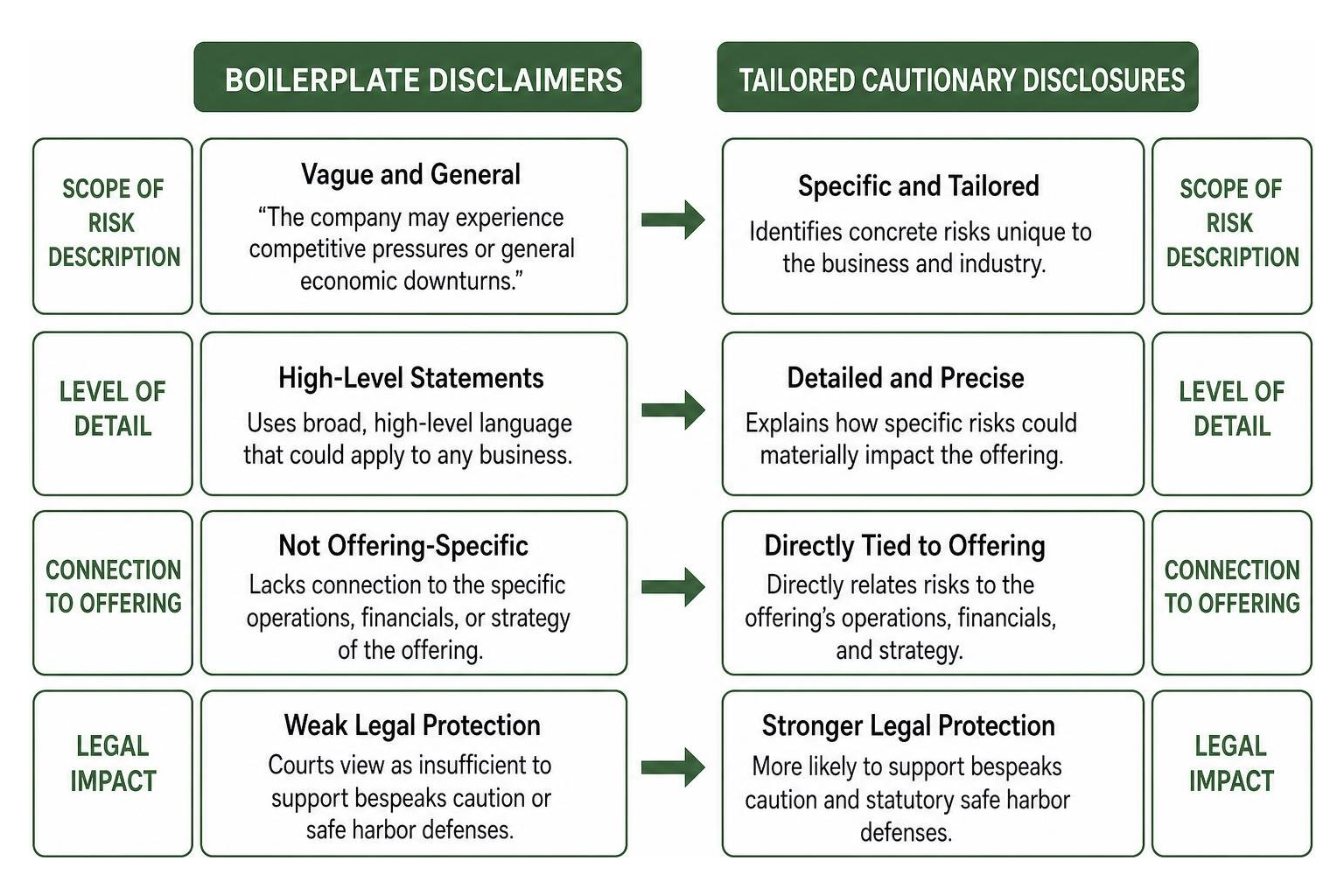
Courts evaluate whether projections had a reasonable basis in fact when made. If a sponsor projects rapid revenue expansion while internally aware of key customer cancellations or severe supply chain collapses, the “bespeaks caution” defense will fail.
Contested Clauses: Exculpation, Indemnification, and Side Agreements
During a dispute, general partners routinely invoke exculpation and indemnification clauses within the PPM and Limited Partnership Agreement (LPA) to shift legal costs onto the fund or bar claims based on ordinary negligence.
Plaintiffs routinely challenge these provisions on several grounds:
- Gross Negligence and Willful Misconduct: Public policy and standard contractual language prohibit exculpating managers for gross negligence, intentional fraud, or willful breaches of fiduciary duty.
- Conflicting Side Agreements: Sponsors sometimes enter into private side letters or voting pacts with select anchor investors without disclosing those preferential terms to the broader investor base.
- Improper Governance Actions: In Delaware Court of Chancery governance precedents, courts strictly enforce statutory and operating agreement requirements regarding manager removal and board actions, confirming that side voting pacts do not grant managers unchecked authority to act outside formal corporate governance frameworks.
Operational Breaches and Deviations from Offering Documents
A private placement memorandum is not merely a promotional brochure; it acts as the operational blueprint for the life of the fund. Back-office administration, accounting protocols, and capital deployment must strictly mirror the terms set forth in the offering circular. When operations deviate from the PPM, managers face significant liability.
| PPM Disclosed Term | Operational Breach / Deviation | Legal Exposure |
|---|---|---|
| Use of Proceeds | Diverting capital to pay parent debts or unapproved affiliate fees | Breach of Contract, Fraud, Misappropriation |
| Distribution Waterfall | Distributing carried interest before returning investor hurdle rates | Breach of LPA, Fiduciary Duty Claims |
| Valuation Methodology | Using subjective, unverified markups to compute asset management fees | Rule 10b-5 Claims, Unjust Enrichment |
| Leverage Limits | Exceeding stated debt-to-equity or leverage caps without consent | Breach of Operating Agreement, Injunction |
| Subscription Verification | Accepting non-accredited capital without required Rule 506 disclosures | Loss of Reg D Exemption, Statutory Rescission |
Misallocation and Use of Proceeds Divergence in a Private Placement Memo Dispute
When an offering memorandum states that 85% of net proceeds will be deployed directly into acquiring revenue-generating real estate or target portfolio companies, using that capital to cover unrelated corporate overhead, settle pre-existing liabilities, or fund personal loans is actionable misallocation.
Such diversions often trigger severe insolvency and restructuring disputes. In complex corporate workouts, as demonstrated in forbearance and fraudulent transfer analyses, aggressive debt renegotiations, cross-collateral pledges, and emergency liquidity transfers executed without fair consideration can be unwound as preferential or fraudulent transfers in subsequent bankruptcy and civil proceedings.
Improper Subscription Procedures and Investor Qualification Lapses
Regulation D offerings—specifically under Rule 506(b) and Rule 506(c)—impose strict guidelines on investor qualification. Under Rule 506(c), issuers engaging in general solicitation must take reasonable steps to verify that all purchasers are accredited investors.
When syndicators take shortcuts—such as failing to collect verified financial statements, ignoring investor qualification red flags, or missing mandatory regulatory filing deadlines—they risk blowing their registration exemption entirely. If an exemption is lost, the offering becomes an illegal unregistered public distribution of securities, granting purchasers an automatic statutory right to rescind their investments. This is a crucial area of review when analyzing Why Retirement Accounts Are Prime Targets for Unscrupulous Financial Advisers, as self-directed IRA funds are frequently solicited for illiquid private placements without proper suitability or qualification checks.
Legal Remedies and Forum Selection in a Private Placement Memo Dispute
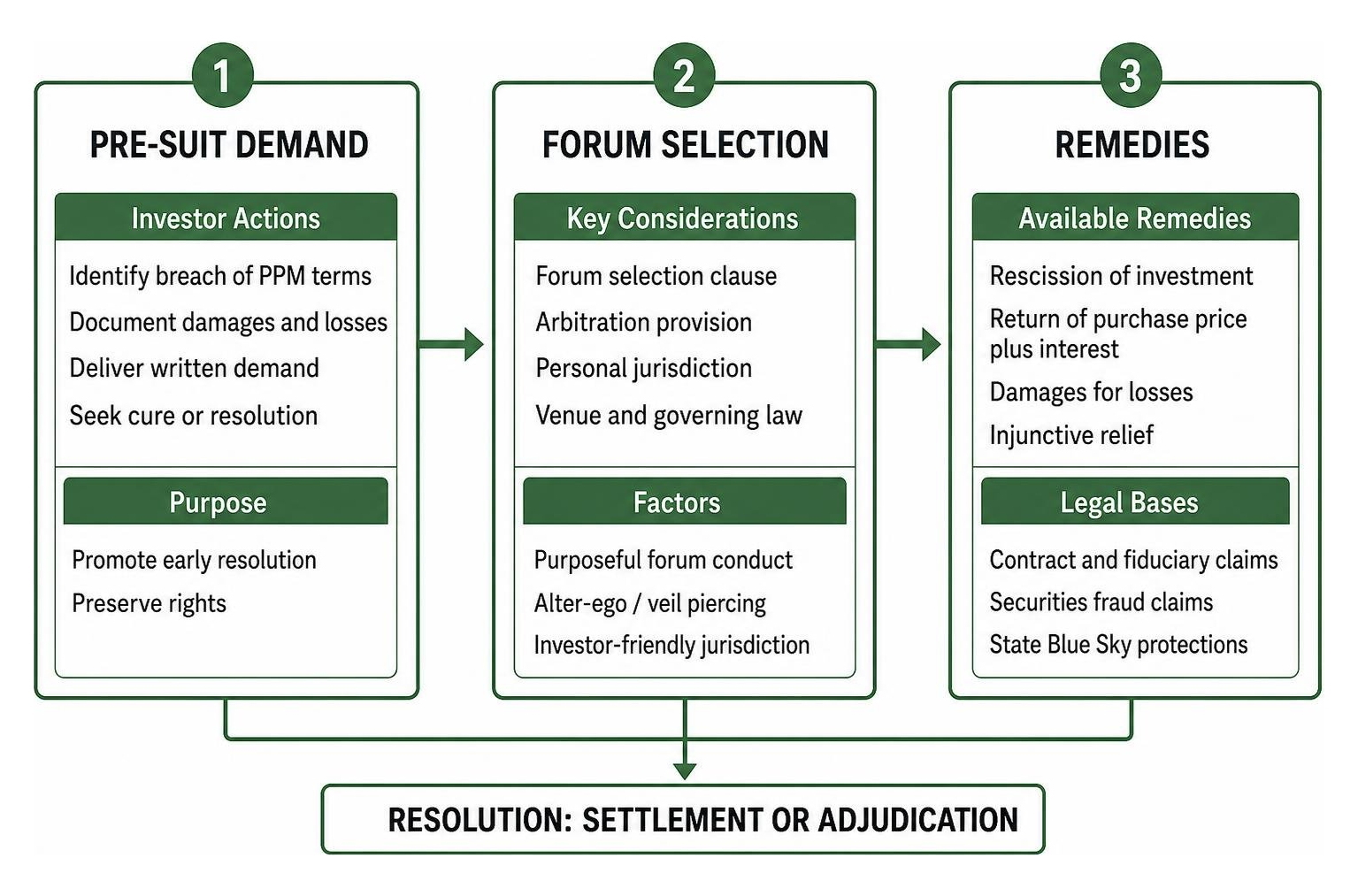
When a private placement dispute matures into formal legal action, investors can pursue several statutory and common-law remedies. Determining the proper procedural strategy requires analyzing forum selection clauses, arbitration provisions, and personal jurisdiction.
In multi-tiered syndications, sponsors frequently attempt to hide behind complex webs of out-of-state holding companies. However, courts maintain broad authority to establish personal jurisdiction over syndication entities where managers engage in purposeful forum conduct, and they will apply alter-ego doctrines to pierce corporate veils when affiliated entities are used to perpetrate a fraud.
Rescission Rights and State Blue Sky Protections
Rescission unwinds the transaction entirely: the investor surrenders the securities, and the issuer must return the full purchase price plus statutory interest from the date of payment, less any distributions received.
State Blue Sky laws often provide stronger, more investor-friendly remedies than federal statutes:
- Strict Liability for Unregistered Sales: Many state securities acts impose strict liability on issuers and control persons who sell unregistered, non-exempt securities.
- Statutory Cooling-Off Periods: Specific state statutes grant explicit statutory voidability windows. For instance, under Florida Securities and Investor Protection Act § 517.061(11), when sales are made to five or more Florida purchasers, each investor has an absolute right to void the transaction within three days of tendering consideration.
- Fee-Shifting Provisions: Unlike the standard “American Rule” where each side pays their own legal fees, many state Blue Sky laws require the losing issuer to pay the investor’s reasonable attorneys’ fees and litigation costs.
Court Litigation vs Arbitration and Enforcement
Most private placement memorandums and subscription agreements contain mandatory dispute resolution clauses. These dictate whether claims must proceed in state or federal court, or before an alternative dispute resolution body like the American Arbitration Association (AAA) or JAMS.
However, when investments are sold through intermediary broker-dealers or registered representatives, investors can utilize the arbitration forum provided by the Financial Industry Regulatory Authority (FINRA). Our FINRA Attorneys regularly represent claimants seeking recoveries against selling firms that failed to conduct reasonable due diligence on private placements before pitching them to clients.
Pursuing claims against brokerage firms under FINRA as a Forum for Claims Involving Stockbroker Misconduct provides an effective avenue for recovery, particularly when the underlying fund issuer is insolvent or uncollectible.
Frequently Asked Questions About Private Offering Disputes
How do courts evaluate forward-looking projections in a PPM?
Courts assess forward-looking projections under the “bespeaks caution” doctrine and statutory safe harbors. Projections are protected only if accompanied by meaningful, specific cautionary language highlighting the substantive factors that could cause actual results to differ. If an investor proves that the issuer knew the underlying assumptions were false or lacked a reasonable factual basis when made, the disclaimers will not protect the sponsor from fraud liability.
What should investors do when capital is deployed differently than disclosed?
Investors who suspect a use-of-proceeds deviation should immediately consult legal counsel to issue a formal demand for an inspection of fund books and records under state corporate or partnership law. Securing bank statements, general ledgers, and transaction logs allows forensic accountants to trace capital flows, identify improper commingling or self-dealing, and preserve evidence before assets are dissipated.
How do advisory and placement fee disputes affect fund recovery?
When promoters utilize unregistered finders or enter into unapproved fee-sharing pacts with broker-dealer personnel, those agreements can violate Section 15(a) of the Securities Exchange Act. Discovery of unlawful fee structures strengthens investor claims for contract voidability and can expose placement agents and sponsors to regulatory clawback actions, increasing the pool of capital available for investor restitution.
Conclusion
Private placement memorandums are legally binding disclosure documents designed to ensure transparency between fund sponsors and investors. When managers obscure material facts, divert capital from stated objectives, or inflate fee structures behind vague disclaimers, investors have established legal paths to hold wrongdoers accountable.
At Alan L. Frank Law Associates, P.C., we combine deep financial analysis with aggressive courtroom advocacy to represent investors across Pennsylvania, New Jersey, and nationwide. If you sustained substantial financial losses resulting from an offering circular discrepancy or fund manager misconduct, contact our team to discuss pursuing investment recovery and securities litigation. We can evaluate your documents, assess potential claims, and design a strategic legal plan to pursue the recovery you deserve.