
Navigating Wall Street’s Private Court to Reclaim Your Invested Capital


Navigating Wall Street’s Private Court to Reclaim Your Invested Capital
How a FINRA Dispute Resolution Attorney Can Help You Recover Investment Losses
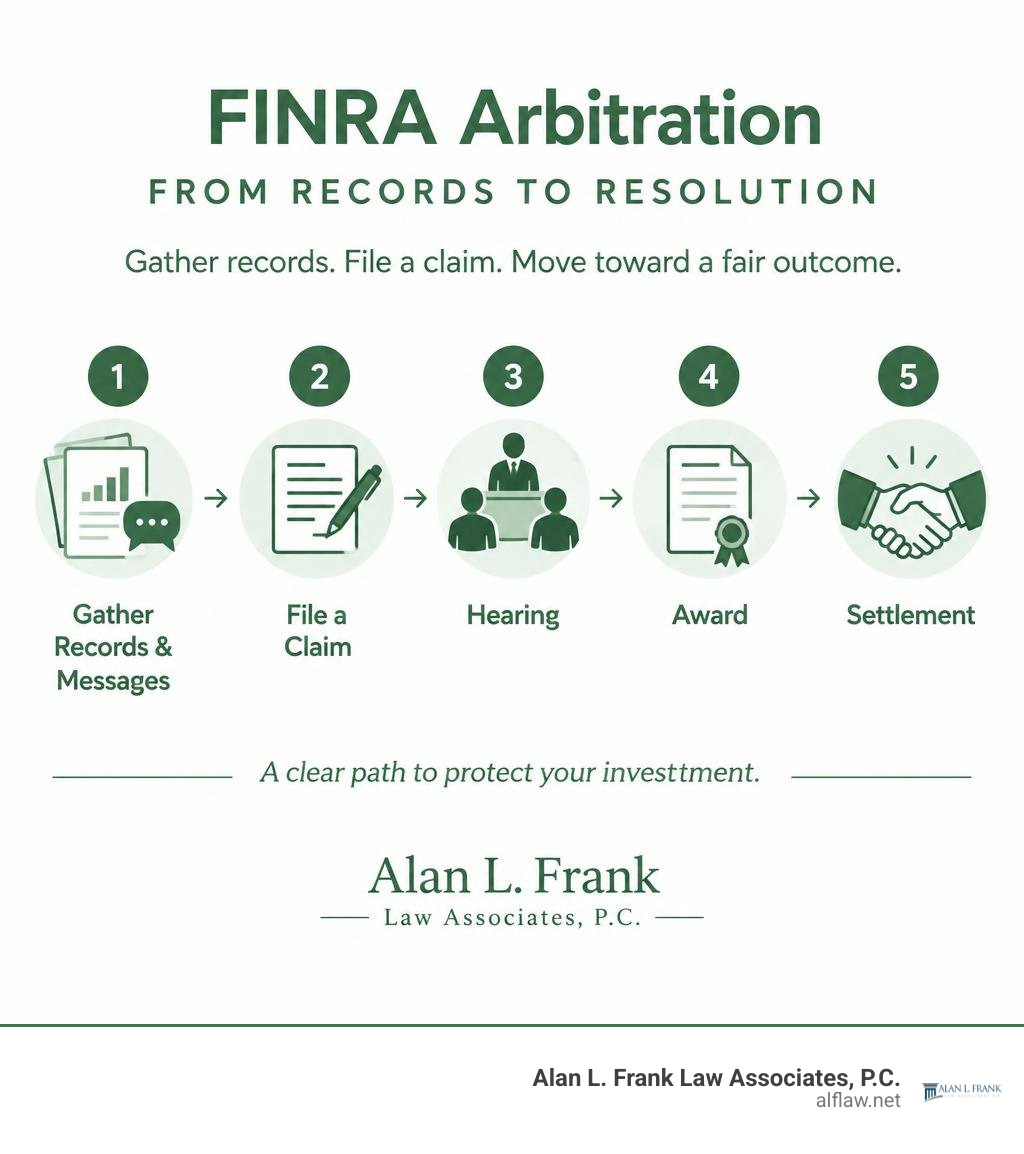
If a broker’s actions caused investment losses, save your account records and messages before you file a claim. A FINRA dispute resolution attorney can review what happened, identify the parties responsible, estimate your losses, and prepare a claim for arbitration. If both sides prefer to negotiate, mediation may also be an option.
FINRA arbitration ends in a binding decision if the parties do not settle. Mediation lets them work toward a voluntary agreement. In 2024, 84% of customer arbitration cases closed through settlement or paid damages, and the average case closed in 12.5 months. Those figures do not predict the outcome of your claim.
I’m Alan L. Frank, managing attorney at Alan L. Frank Law Associates, P.C. My work as a FINRA dispute resolution attorney draws on more than 20 years leading litigation involving investment losses and securities disputes, along with my accounting background.
FINRA dispute resolution attorney vocabulary:
Understanding FINRA Arbitration vs. Mediation
When disputes arise between public investors and brokerage firms or registered representatives, cases rarely end up in traditional civil courtrooms. Virtually every brokerage agreement includes a mandatory arbitration clause directing conflicts into Financial Industry Regulatory Authority (FINRA) Dispute Resolution Services. This specialized forum manages between 4,000 and 8,500 arbitrations every year alongside thousands of mediation proceedings.
To manage this volume, FINRA maintains an active roster of more than 8,000 qualified arbitrators and over 200 trained mediators across 69 regional hearing locations. All case management, document submissions, and official communications flow through the secure online FINRA Dispute Resolution Portal (DR Portal).
Understanding the procedural mechanics of FINRA as a forum for claims involving stockbroker misconduct is essential to recovering your capital. While both arbitration and mediation operate under the regulatory umbrella of Arbitration & Mediation programs, they serve distinct strategic functions.
Binding Arbitration vs. Voluntary Mediation
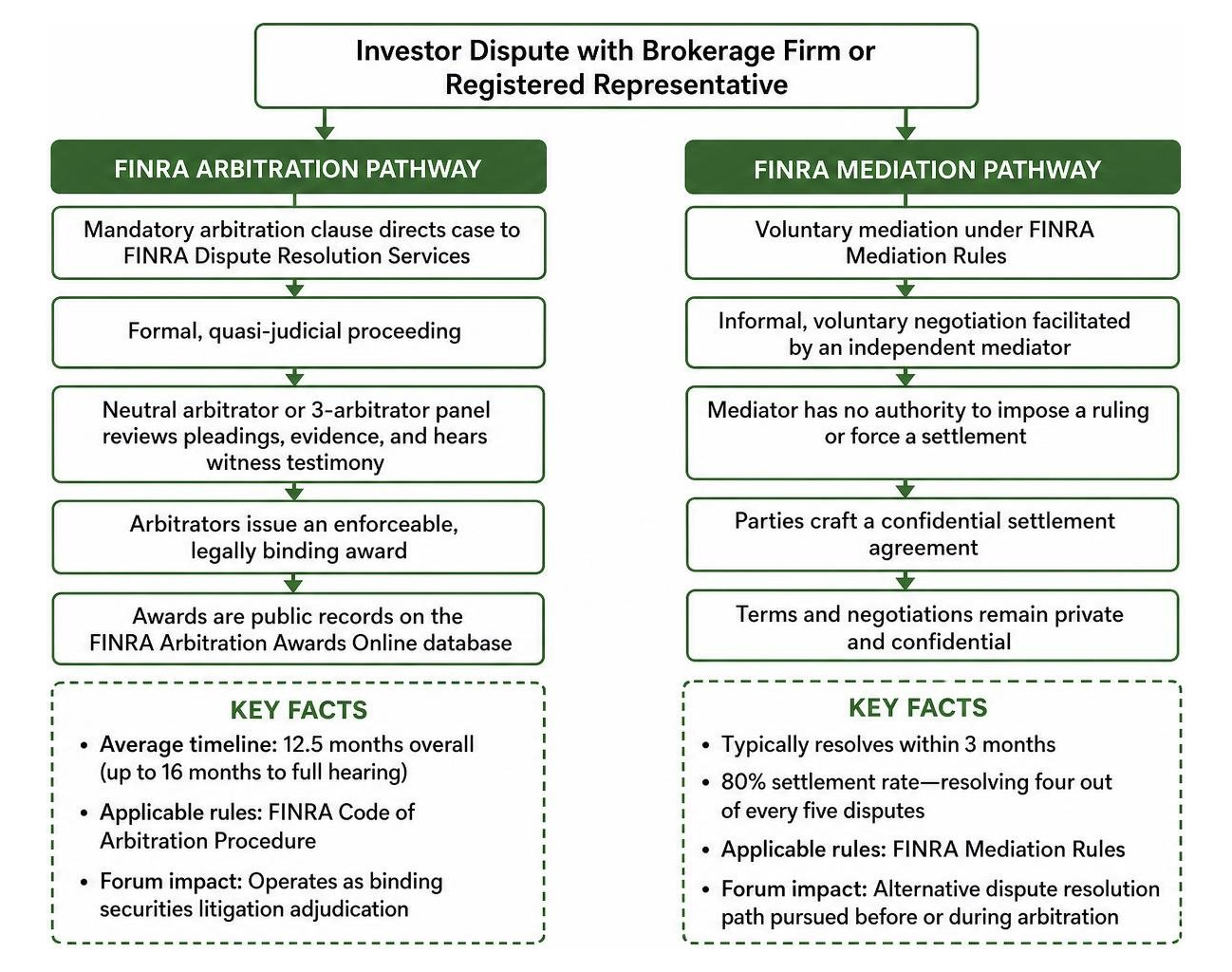
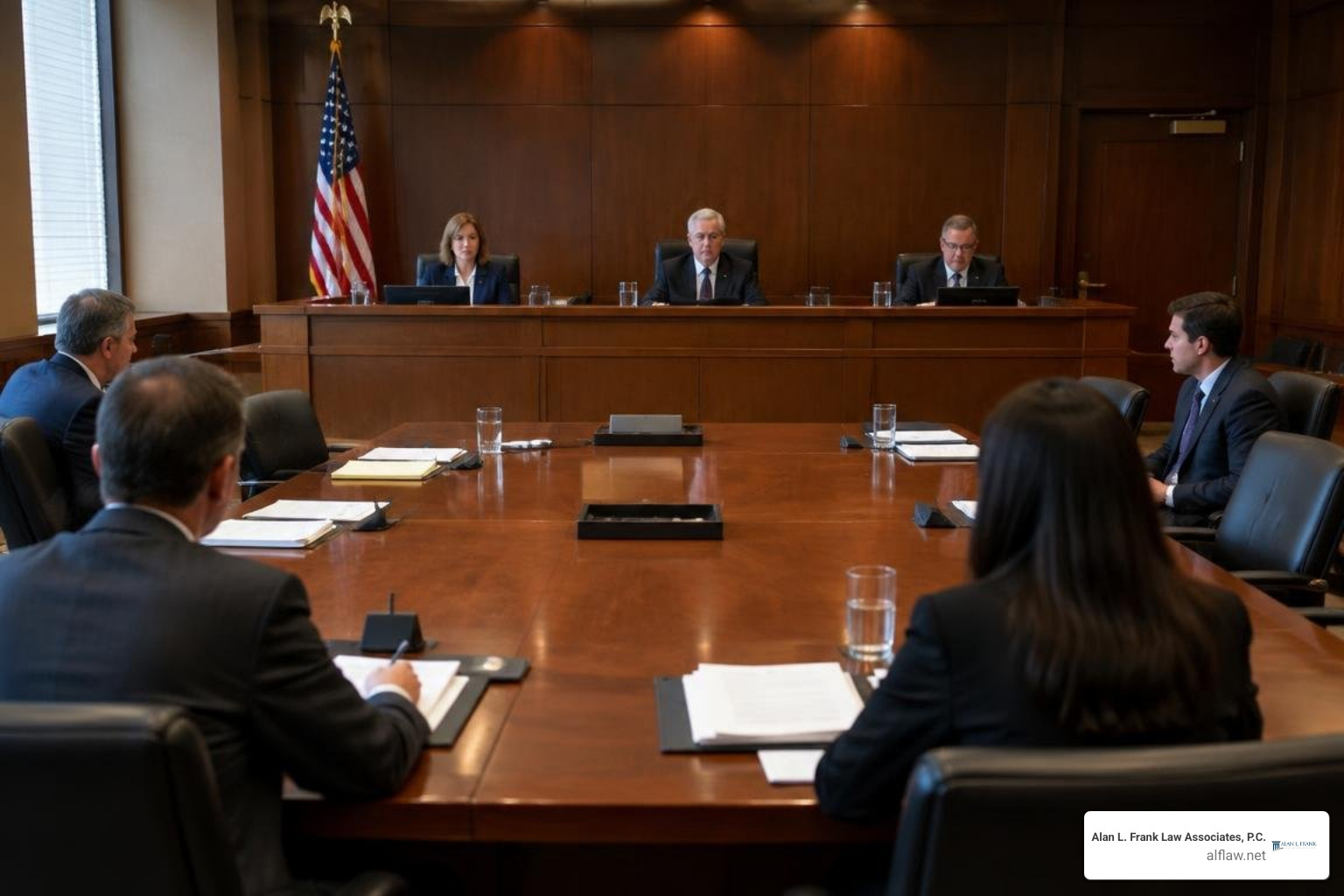
Arbitration is a formal, quasi-judicial proceeding where neutral arbitrators review pleadings, evaluate exhibits, hear witness testimony, and issue an enforceable, legally binding award. Customer arbitration awards are public records. A full formal hearing historically averages 16 months from the initial filing to the final award, though many disputes resolve earlier. In 2024, the overall average closure time across all customer cases was 12.5 months.
Mediation, by contrast, is an informal, entirely voluntary negotiation facilitated by an independent mediator. Mediators possess no authority to impose a ruling or force a settlement; their role is to bridge communication gaps, evaluate claim strengths and weaknesses, and assist parties in crafting a confidential settlement agreement. Mediation carries an impressive 80% settlement rate—resolving four out of every five disputes—and typically concludes within three months.
| Feature | FINRA Arbitration | FINRA Mediation |
|---|---|---|
| Outcome Nature | Legally binding, enforceable award | Voluntary, negotiated confidential agreement |
| Decision Maker | Neutral Arbitrator or 3-Arbitrator Panel | Parties craft terms; Mediator facilitates |
| Average Timeline | 12.5 months overall (up to 16 mos. to full hearing) | Typically resolves within 3 months |
| Public Disclosure | Awards are published on the FINRA Arbitration Awards Online database | Terms and negotiations remain private and confidential |
| Applicable Rules | FINRA Code of Arbitration Procedure | FINRA Mediation Rules |
| Forum Impact | Operates as binding securities litigation adjudication | Alternative dispute resolution path pursued before or during arbitration |
Inactive Brokerage Firms and Rule 12202 Rights
Before filing an arbitration claim, you must verify the operational standing of the respondent brokerage firm and broker on FINRA BrokerCheck. Under FINRA Rule 12202, claims against firms or individual brokers that have been expelled, suspended, or terminated from FINRA membership—or whose registrations are canceled or revoked—are ineligible for arbitration unless the customer explicitly agrees in writing.
Awards issued against defunct or insolvent firms carry significant unpaid award risks. If the opposing broker or firm is inactive, Rule 12202 grants investors the statutory right to bypass FINRA entirely and pursue the claim directly in state or federal civil court. Working with an attorney who understands why smart investors trust stock fraud attorneys to reclaim stolen capital ensures you choose the proper forum to maximize practical recovery opportunities.
Why You Need a FINRA Dispute Resolution Attorney
Wall Street firms and broker-dealers retain seasoned legal defense teams who know the FINRA Code of Arbitration Procedure intimately. Attempting to navigate this forum without legal representation places an investor at a distinct procedural and strategic disadvantage.

Proving liability requires translating intricate financial transaction histories, profit-and-loss statements, and compliance transcripts into compelling legal arguments. We analyze your losses across multiple methodologies, assessing net out-of-pocket losses, market-adjusted losses, and statutory interest calculations to build comprehensive damages models.
Understanding how to preserve your claims prevents you from getting burned twice by defense delay tactics and aggressive discovery motions.
Step-by-Step Guide to Navigating the FINRA Arbitration Process
Filing and litigating an investment loss claim follows a structured procedural timeline under FINRA Dispute Resolution Services:
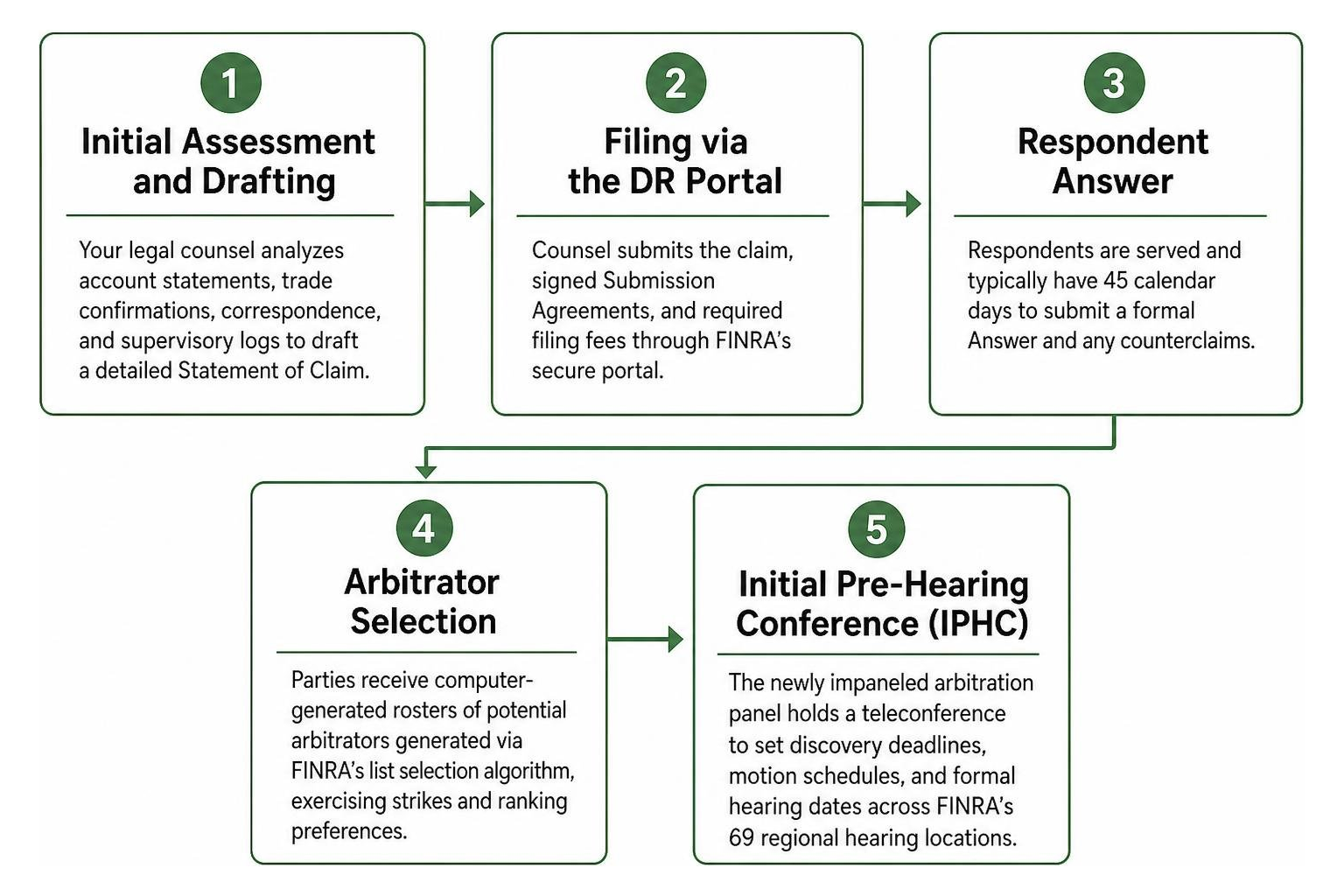
- Initial Assessment and Drafting: Your legal counsel analyzes account statements, trade confirmations, correspondence, and supervisory logs to draft a detailed Statement of Claim.
- Filing via the DR Portal: Counsel submits the claim, signed Submission Agreements, and required filing fees through FINRA’s secure portal.
- Respondent Answer: Respondents are served and typically have 45 calendar days to submit a formal Answer and any counterclaims.
- Arbitrator Selection: Parties receive computer-generated rosters of potential arbitrators generated via FINRA’s list selection algorithm, exercising strikes and ranking preferences.
- Initial Pre-Hearing Conference (IPHC): The newly impaneled arbitration panel holds a teleconference to set discovery deadlines, motion schedules, and formal hearing dates across FINRA’s 69 regional hearing locations.
- Discovery and Motion Practice: Parties exchange required core documents listed in the FINRA Discovery Guide and resolve evidentiary disputes.
- Mediation / Settlement Discussions: Parties often enter voluntary mediation to explore early resolution while hearing preparations proceed.
- Formal Evidentiary Hearing: Counsel presents opening remarks, witness examination, expert testimony on damages, and closing arguments before the panel.
- Final Binding Award: Arbitrators deliberate and issue an enforceable written award within 30 business days after closing the record.
Retaining dedicated FINRA attorneys ensures every step—from initial pleadings to cross-examination—is handled with precision.
Drafting the Statement of Claim and Avoiding Deficiencies
A poorly drafted Statement of Claim can derail your case before it begins. FINRA Dispute Resolution Services audits every initial filing for procedural deficiencies. Common errors include:
- Signatory Authority Mismatches: Failing to match claimant names exactly as registered on brokerage account records (e.g., trust entities, custodial UGMA/UTMA accounts, estates, or IRA designations).
- Unidentified Respondents: Naming “John Doe” parties, which FINRA rejects because it will not serve unidentified respondents.
- Unredacted Personal Confidential Information (PCI): Violating FINRA rules by failing to redact Social Security numbers, tax identification numbers, bank account numbers, or private medical details from public filings and attached exhibits.
- Missing Exhibit Indexing: Attaching unnumbered, disorganized document dumps rather than chronologically indexed, referenced exhibits.
If FINRA flags a filing as deficient, the claimant receives a formal deficiency notice and has exactly 30 calendar days to cure the defect. If the filing remains uncorrected, FINRA will close the case and retain a portion of the filing fee.
Fast-Track Hearings, Hardship Waivers, and State-Specific Rules
FINRA provides targeted procedural accommodations under specific circumstances:
- Expedited Proceedings for Senior or Seriously Ill Claimants: Through resources like the FINRA Securities Helpline for Seniors, investors suffering from advanced age or critical medical conditions can request accelerated scheduling. Arbitrators expedite discovery conferences, motion hearings, and evidentiary proceedings.
- Financial Hardship Fee Waivers: Claimants facing severe financial distress can submit verifiable financial documentation (such as tax returns and asset statements) to request a complete or partial waiver of FINRA arbitration filing fees and hearing session deposits.
- Regional Regulatory Considerations: Different hearing venues operate alongside distinct state procedural nuances. Hearing panels adhere strictly to arbitrator disclosure obligations, statutory interest requirements, and state-specific representative guidelines.
How a FINRA Dispute Resolution Attorney Counters Broker Expungement Requests
Brokers frequently attempt to expunge customer disputes from their public Central Registration Depository (CRD) and BrokerCheck profiles to protect their professional standing. Under updated FINRA expungement rules, these requests face stringent standards. Expungement is considered an extraordinary remedy that should only be granted when the claim is factually impossible, clearly erroneous, or when the broker was entirely uninvolved in the misconduct.
Having legal counsel present at expungement hearings protects the public record. When brokers seek expungement, a seasoned attorney steps forward to cross-examine the broker, present evidentiary account records, and ensure customer dispute histories remain accessible to the public. If you need representation, consult experienced securities losses demand the right investment fraud attorneys near me resources to evaluate your options.
Selecting the Right Legal Counsel for Your Investment Loss
Securities arbitration is an intricate legal field involving complex federal securities acts, state blue sky laws, and strict self-regulatory organization (SRO) guidelines. Identifying the right advocate requires careful vetting of an attorney’s direct experience in FINRA dispute resolution forums.
Investors can identify licensed legal professionals through state bar referral panels, specialized securities bar associations, and federal directories accessible via Find an Attorney | FINRA.org. Most investor recovery law firms operate on a contingency fee arrangement—advancing litigation expenses and collecting legal fees only if capital is successfully recovered via settlement or award.
Whether an investor is recovering from complex private placements or deceptive high yield investment scams unmasking modern ponzi schemes and fake funds, retaining qualified counsel directly impacts the bottom-line financial outcome.
Key Questions to Ask a FINRA Dispute Resolution Attorney Before Hiring
Before signing a retainer agreement, interview prospective attorneys using targeted questions:
- How many cases have you litigated before FINRA Dispute Resolution Services panels?
- What is your assessment of the liability issues, damages models, and collectible recovery paths for my specific claim?
- How do you structure contingency fees, administrative filing fees, and out-of-pocket expert witness costs?
- Are you licensed and experienced in handling securities disputes across our designated regional hearing location?
- What is your strategy for assessing whether my losses stem from broker mismanagement, such as a target date fund losses a guide to recovery analysis?
Frequently Asked Questions About FINRA Dispute Resolution
How long does a typical FINRA arbitration claim take from filing to award?
In 2024, the average customer arbitration case closed in 12.5 months. Cases that proceed to a full, formal evidentiary hearing historically average roughly 16 months from filing to final award. However, disputes involving claims of $50,000 or less qualify for simplified arbitration decided on written submissions by a single arbitrator, substantially reducing the timeline. Additionally, voluntary mediation can resolve claims in as little as three months.
What happens if a broker or brokerage firm goes out of business during the dispute?
If a respondent brokerage firm or representative becomes inactive, expelled, or bankrupt during proceedings, FINRA notifies the claimant. Under Rule 12202, you have 60 days to decide whether to proceed in FINRA arbitration, amend your claim to add solvent supervisory parties, or withdraw the arbitration to pursue the claim in civil court. Because awards against defunct firms carry significant non-payment risks, legal counsel will evaluate whether solvent clearing firms, parent corporations, or supervisory principals can be held liable.
Can an out-of-state attorney represent me in my local FINRA arbitration hearing?
In most jurisdictions, yes. Under ABA Model Rule 5.5 (Multi-Jurisdictional Practice), licensed attorneys in good standing may represent clients in out-of-state arbitration proceedings if the legal services arise out of or reasonably relate to the attorney’s practice in their home jurisdiction. However, local state bar requirements and hearing venue guidelines must always be verified before formal appearance.
Conclusion
Navigating FINRA’s arbitration and mediation systems requires deep procedural familiarity, financial acumen, and relentless advocacy. At Alan L. Frank Law Associates, P.C., our legal team brings multi-million dollar recovery experience across nationwide securities disputes, tax controversies, estate planning, and business litigation. We protect investors against predatory practices, deceptive brokerage conduct, and unsuitability schemes.
If you have suffered substantial investment losses due to stockbroker misconduct or supervisory negligence, contact our legal team today through our Securities Litigation Investment Losses practice to evaluate your claim and begin the capital recovery process.