
Lis Pendens Explained for Buyers Sellers and Litigants


Lis Pendens Explained for Buyers Sellers and Litigants
What Is a Lis Pendens Notice, and Why Does It Matter?
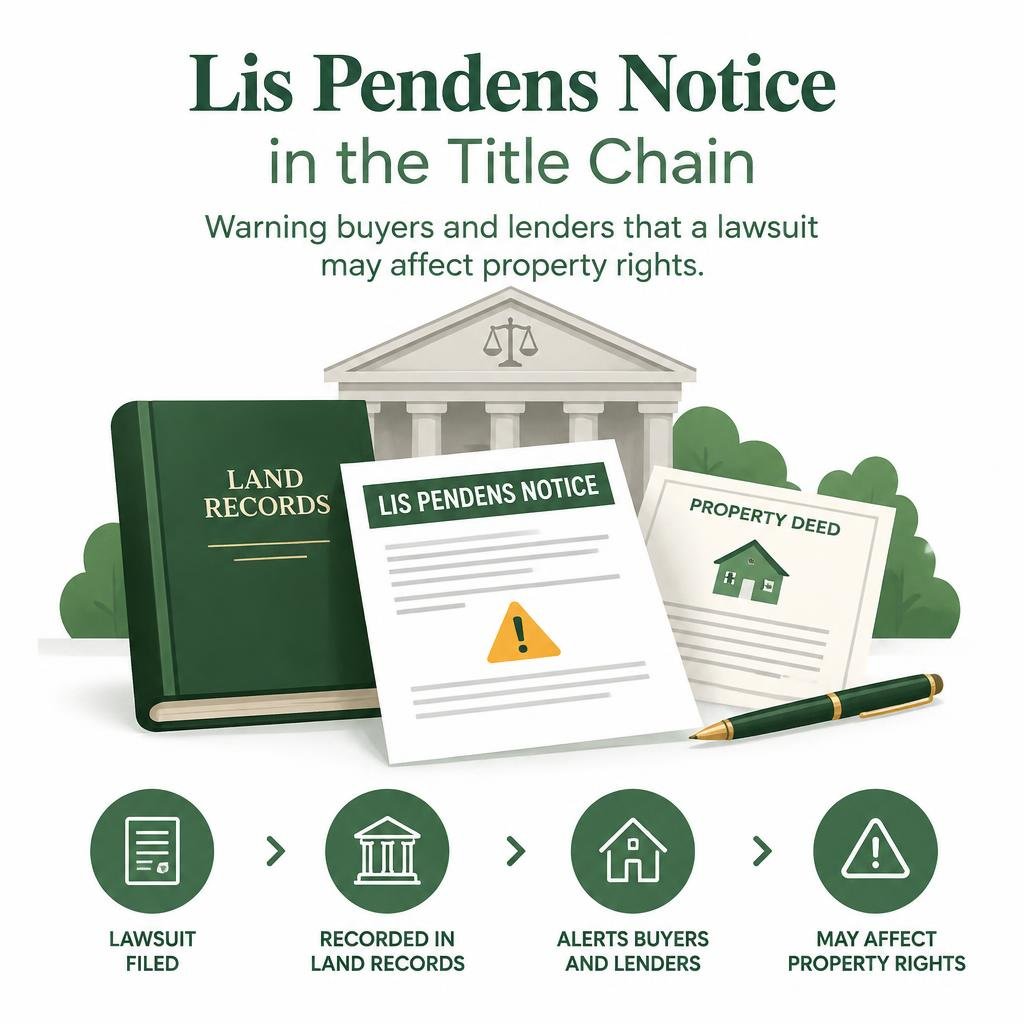
A lis pendens notice is a public filing that warns buyers and lenders about a pending lawsuit that may affect rights in real estate. The Latin term means “suit pending.” Once recorded in the property’s land records, the notice alerts anyone considering a purchase or loan that the court’s decision could affect the interest they acquire.
A lis pendens does not automatically stop an owner from selling or refinancing. But it can cloud the title, making buyers, lenders, and title insurers reluctant to move forward. The rules for filing and removing a notice depend on state law.
I’m Alan L. Frank, managing attorney at Alan L. Frank Law Associates, P.C., with more than 20 years of experience leading complex commercial litigation. My work with business and construction disputes informs this guide to what a lis pendens notice is and why the answer matters to buyers, sellers, and litigants.
What is lis pendens notice helpful reading:
What Is a Lis Pendens Notice and How Does It Affect Real Estate?

When real property becomes the focal point of civil litigation, the legal system needs an orderly mechanism to prevent defendants from simply transferring the real estate to an unsuspecting buyer mid-lawsuit. That mechanism is the lis pendens notice.
Recorded directly in the county recorder of deeds or land records office, this formal document acts as a statutory loudspeaker. It integrates with the property’s chain of title, providing constructive notice to the entire world that title, ownership, or use rights regarding the parcel are in dispute. In jurisdictional practice, it is often formally known as a notice of pendency.
Under the traditional legal doctrine, courts evaluate competing filings through a three-pronged identity test to determine whether a later-filed lawsuit involves the same cause of action, substantially identical parties, and identical relief. If a prior action encompasses those elements and carries a recorded notice, it establishes definitive priority over all subsequently acquired interests.
What a Lis Pendens Notice Is in Legal Definition and Etymology
The term lis pendens is Latin for “suit pending.” Emerging from historical English common law, the doctrine established that whoever purchased real estate during active litigation took that property subject to whatever judgment the court ultimately rendered.
Modern statutory law formalizes this doctrine of lis pendens by requiring a recorded written instrument in the county land records. Rather than relying on unwritten common-law presumptions, modern title examiners can quickly verify public records to see if a formal notice has clouded the parcel.
The Core Purpose of Filing and Recording Notice in County Land Records
The primary purpose of recording a notice of pendency is preservation. It accomplishes two vital legal functions:
- Third-Party Warning: It strips potential purchasers or lenders of “bona fide purchaser” (BFP) status. A BFP is someone who buys property for value without notice of competing claims. Once a lis pendens is recorded, every prospective buyer is legally charged with constructive notice of the dispute.
- Interest Protection and Marketability Freeze: It secures the plaintiff’s claimed interest against intervening encumbrances. If an owner attempts to convey the deed or take out a secondary mortgage while the dispute proceeds, the buyer or lender takes their position subordinate to the eventual court ruling.
Qualifying Actions: Lawsuits That Justify Recording a Lis Pendens

A lis pendens is a powerful instrument, but it cannot be leveraged indiscriminately. A plaintiff cannot record a notice on a defendant’s home merely because the defendant owes money for an unrelated contractual dispute, an unpaid credit card, or a general commercial debt. The underlying action must directly involve title to, possession of, or use rights in the specific real property.
When a dispute arises, engaging experienced real estate litigation representation ensures that any recorded instrument strictly adheres to statutory boundaries.
| Claim Type | Qualifies for Lis Pendens? | Legal Basis |
|---|---|---|
| Specific Performance (Real Estate Sale) | Yes | Seeks court-ordered transfer of real property title. |
| Mortgage Foreclosure | Yes | Direct enforcement of a recorded security instrument against property. |
| Quiet Title / Adverse Possession | Yes | Action to determine ownership and establish rightful legal title. |
| Property Partition Lawsuits | Yes | Co-owners seeking judicial division or sale of shared land. |
| Prescriptive Easements & Boundary Disputes | Yes | Litigating legal rights, access, and physical boundaries of land. |
| Fraudulent Conveyance (Real Estate) | Yes | Action to reverse an unlawful real estate transfer. |
| Unsecured Debt / Breach of Contract | No | Purely monetary damages; no direct claim to title or real property interest. |
| General Business or Personal Injury Claims | No | Tort or debt claims that must secure a money judgment before lien attachment. |
Title Disputes, Boundary Line Conflicts, and Partition Actions
Several distinct types of property lawsuits justify a lis pendens:
- Adverse Possession and Quiet Title: When a party claims ownership through continuous, hostile, open, and notorious use, recording notice protects their emerging title claim.
- Partition Lawsuits: In actions involving partitioning real property among co-owners, a lis pendens prevents any single co-tenant from transferring their fractional interest to outside third parties.
- Boundary and Access Conflicts: Litigants resolving disputed boundary lines or asserting prescriptive easement claims record notice to bind future parcel owners to the access determinations.
- Marital Dissolution: In divorce actions where real estate is held in one spouse’s name, the non-titled spouse may record notice to prevent an unauthorized asset sale prior to equitable distribution.
Recorded Instruments vs. Unrecorded Claims and the Fair Nexus Rule
When a lawsuit is founded on a duly recorded instrument—such as a recorded mortgage or deed restriction—the right to record a lis pendens is generally automatic.
However, when a lawsuit rests on an unrecorded claim—such as an action seeking an equitable lien, constructive trust, or specific performance of an unrecorded purchase contract—courts apply the fair nexus rule. The plaintiff must establish a direct connection (prima facie nexus) between the legal or equitable ownership of the real property and the dispute embodied in the lawsuit. If the underlying claim is merely a disguised effort to secure a future money judgment, the court will discharge the notice.
Statutory Requirements and Document Preparation Guidelines
Drafting and recording a lis pendens requires strict compliance with real property statutes. A single procedural error can invalidate the notice and expose the filer to significant financial liability.
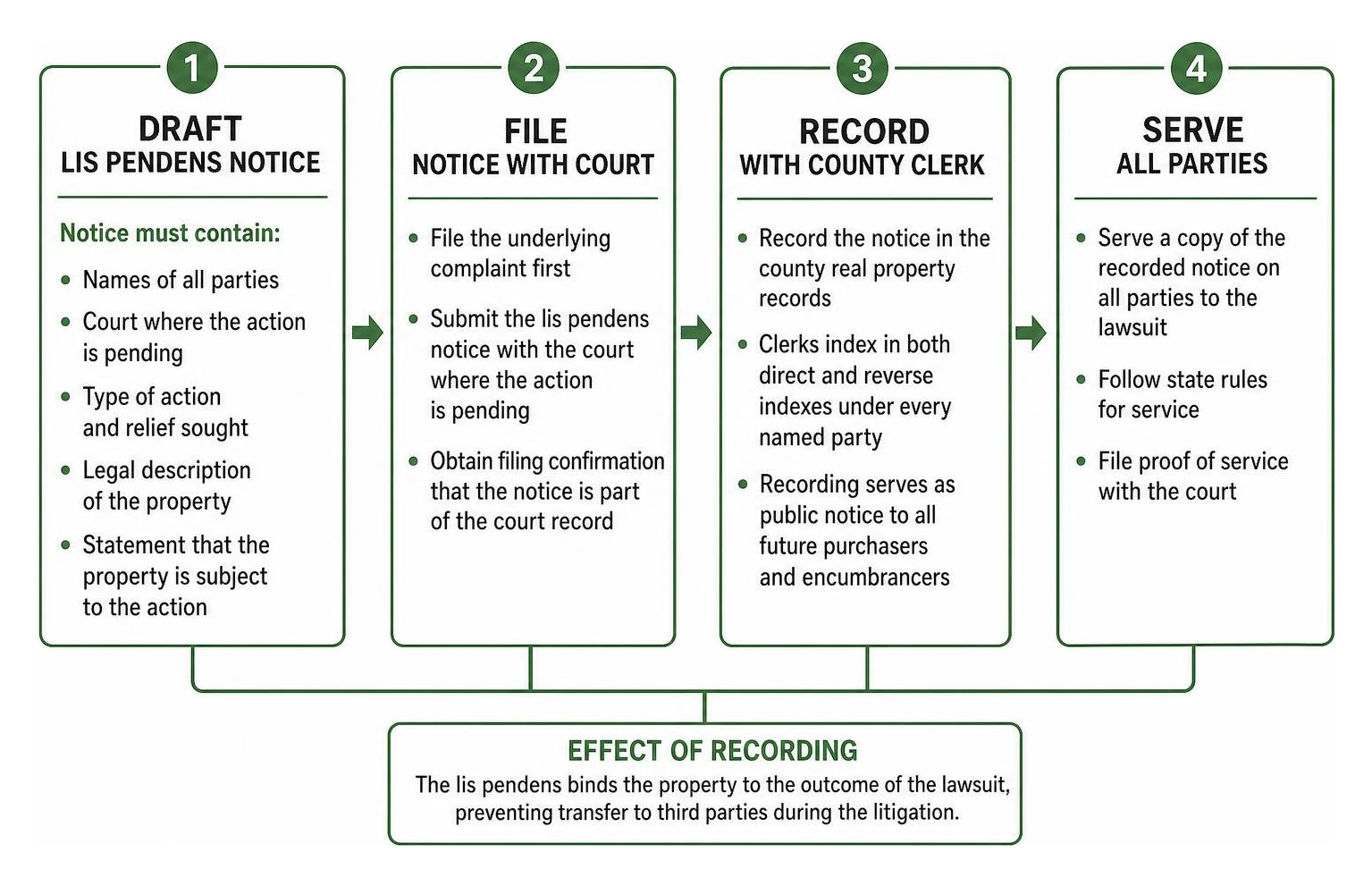
State statutes govern everything from exact document contents to indexing methods. Under Texas lis pendens filing statutes, for instance, county clerks record notices in designated registries and cross-index them in both direct and reverse indexes under every named party’s name. Similarly, statutory requirements under Connecticut law require rigorous alignment between the filed complaint and the land records.
What a Lis Pendens Notice Must Contain Under Statutory Filing Rules
To satisfy county recorder standards, a lis pendens must typically contain:
- The full style of the case, court jurisdiction, and civil docket number.
- Complete legal names of all plaintiffs and defendants.
- A clear statement detailing the nature of the action and the real-property relief sought.
- An exact legal property description (metes and bounds, lot and block, or parcel ID), rather than just an informal street address.
- The formal signature of the filing party, their agent, or their licensed attorney.
Procedural Deadlines, County Land Record Filings, and Service of Process
Filing the lawsuit in civil court is step one; properly recording and serving the notice is step two. Many states enforce strict service-of-process deadlines. Texas mandates serving copies of the recorded notice to all affected property owners within 3 days of filing. Connecticut requires serving a true and attested copy within 30 days of recording and subsequently filing proof of service with the court. Failing to strictly execute these service windows provides the property owner with immediate grounds to quash the notice.
Impact on Property Transactions: How Lis Pendens Affects Buyers, Sellers, and Lenders
A lis pendens functions as a powerful practical freeze on real estate transactions. While it does not physically lock the front door of the property, it completely disrupts the financial and legal machinery required to close a sale or refinance.
Consequences for Sellers Seeking to Close, Refinance, or Transfer Property
For a property owner, an active lis pendens operates as an oppressive cloud on the title. Institutional lenders will immediately freeze refinance applications or refuse to fund new mortgages because their security interest would become subordinate to the pending lawsuit.
Furthermore, standard purchase agreements require sellers to convey marketable, insurable title free of liens and encumbrances. Because a lis pendens renders title unmarketable, the seller cannot fulfill their closing covenants, often causing buyers to terminate contracts and demand earnest money refunds.
Critical Risks and Due Diligence for Prospective Buyers and Investors
For buyers and investors, purchasing real estate encumbered by a lis pendens carries immense risk:
- Subject-to-Litigation Liability: If you purchase the property and the plaintiff wins the lawsuit, you can be legally forced to surrender the deed or clear the plaintiff’s judgment out of your own pocket.
- Title Insurance Denial: Title insurers will specifically exempt the pending lawsuit from their title policy or refuse to issue a commitment altogether until the notice is formally expunged.
- Forfeited Capital: Closing without title insurance leaves your acquisition capital entirely unprotected if the court orders a foreclosure or judicial deed transfer.
Challenging, Expunging, and Discharging an Improper Lis Pendens
When a plaintiff records an improper, frivolous, or non-qualifying notice, the property owner is not without remedy. Courts provide expedited procedures to challenge, bond around, or expunge the filing.
Procedural Grounds for a Motion to Expunge or Discharge
A property owner can file a formal motion to expunge or discharge on several legal grounds:
- Lack of Subject-Matter Nexus: Demonstrating that the underlying lawsuit seeks purely monetary damages rather than direct title or possession rights.
- Procedural Defects: Proving that the plaintiff failed to serve the notice within statutory timeframes, omitted the legal description, or failed to file an underlying complaint.
- Absence of Probable Cause: Proving that the plaintiff cannot establish a credible, good-faith legal basis for their property claim.
Lis Pendens Bond Requirements and Calculation of Damages
When a lawsuit is not based on a recorded instrument, courts frequently exercise their discretion to condition the lis pendens on the plaintiff posting an indemnity bond.
This bond protects the property owner against damages suffered while the notice clouds the title if the lawsuit is ultimately dismissed or determined to be baseless. Courts calculate bond amounts by evaluating:
- Diminution of real estate market value during the litigation window.
- Ongoing carrying costs, including mortgage interest, property taxes, and insurance.
- Foregone profits from lost, verifiable commercial transactions.
- Reasonable attorney fees incurred by the property owner to expunge the notice.
Effective Duration, Expiration Timelines, and Extension Rules
A notice of pendency does not remain effective indefinitely. Statutory duration varies by state:
- In jurisdictions with specific duration limits, such as the statutory rules for notice expiration in Colorado, a recorded notice remains in effect for up to six years unless extended, or expires 49 days after final judgment or an appealable order unless an appeal is filed.
- In other jurisdictions, the notice remains active until the underlying litigation reaches final resolution, dismissal, or formal settlement, at which point a release of lis pendens must be recorded in the county land records.
Frequently Asked Questions About Lis Pendens Notices
How long does a lis pendens remain effective on a property title?
A lis pendens remains effective throughout the active pendency of the underlying litigation, including appellate review periods, unless discharged earlier by court order. Some states enforce statutory sunset caps (such as six years) unless an extension is recorded before expiration. Once the lawsuit is resolved, a formal release or certificate of dismissal must be recorded in the county land records to clear the title.
Can a homeowner sell or refinance a house with an active lis pendens?
While it is legally possible to transfer a deed, it is practically almost impossible to sell or refinance through standard commercial channels. Institutional mortgage lenders will not approve financing, and title insurance companies refuse to issue clean policies over an active notice. To close a transaction, the seller must generally settle the underlying lawsuit, post an approved cash bond into court escrow, or successfully obtain a judicial expungement order.
What legal penalties apply for filing a frivolous or improper lis pendens?
Filing a notice of pendency without a qualifying real property claim carries severe financial and legal penalties. The affected property owner can sue the filer for slander of title, tortious interference with contractual relations, and abuse of process. Courts routinely sanction improper filers by awarding compensatory damages for lost property sales, statutory penalties, and full reimbursement of the property owner’s attorney fees and court costs.
Conclusion
Understanding the function and boundaries of a lis pendens notice is critical whether you are litigating a real estate dispute, defending your property against an improper cloud on title, or navigating a complex commercial acquisition. When leveraged properly, it preserves valuable real estate rights; when misused, it exposes the filer to significant financial and legal liability.
At Alan L. Frank Law Associates, P.C., we provide strategic, results-driven counsel across Pennsylvania and New Jersey for property owners, investors, and business litigants navigating contested real estate matters. If you need to protect your property rights, clear an unlawful cloud on title, or manage active real estate disputes, explore our commercial litigation and dispute resolution counsel to protect your real estate investments.