
Understanding Prescriptive Easements and Property Use Rules


Understanding Prescriptive Easements and Property Use Rules
What Is a Prescriptive Easement, and Why Does It Matter?
A prescriptive easement is a limited right to use someone else’s land, such as a path or driveway, gained through long-term use rather than a written agreement. The use generally must be open, continuous, and without the owner’s permission for the period required by local law. It gives the user a right of use, not ownership of the land.
That distinction matters if you use a neighbor’s route to reach your property, or someone else regularly crosses yours. The required years and rules vary by jurisdiction, so the history of the use matters as much as the route itself.
I’m Alan L. Frank, managing attorney at Alan L. Frank Law Associates, P.C., with more than 20 years of experience leading complex litigation. That experience shapes how I approach the question “what is a prescriptive easement”: start with the facts, then check the local law.
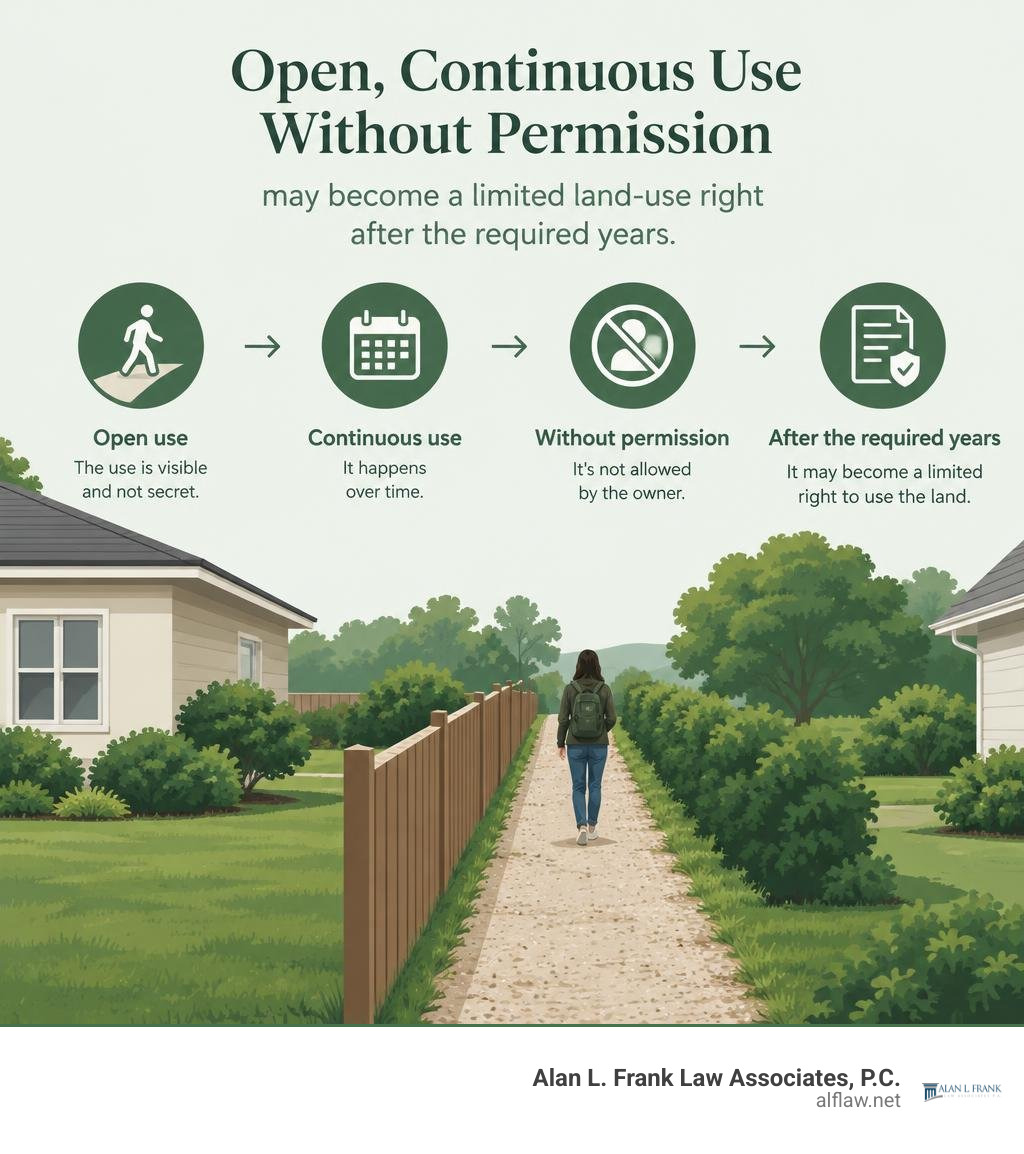
What is a prescriptive easement vocab explained:
Legal Framework: What Is a Prescriptive Easement?
At its core, a prescriptive easement is an unwritten, non-possessory interest in land created by operation of law. Unlike an ordinary property title where you own the physical soil in fee simple, an easement grants only an incorporeal hereditament—a specific right to use real estate owned by another party.
In every easement arrangement, real property is divided conceptually into two distinct interests:
- Dominant Tenement: The parcel of real estate that benefits from the easement right (for example, the property whose owner crosses over adjacent land to reach an otherwise inaccessible road).
- Servient Tenement: The parcel of real estate burdened by the easement (the land that must endure the crossing, drainage, or specific physical intrusion).
When a claimant establishes an easement by prescription, they do not gain the right to build structures, occupy the land exclusively, or exclude the titled owner. Instead, they gain an irrevocable, permanent right-of-way or access route tailored strictly to their historical pattern of unpermitted use.
Core Differences Between Easement Types
Not all property access rights arise from contentious trespass. Real estate law recognizes several distinct types of easements, each defined by how they originate:
- Express Easements: Created through an explicit, formal written instrument such as a deed, contract, or subdivision plat. These documents are recorded in local land records and clearly specify the easement’s boundaries, maintenance obligations, and scope.
- Implied Easements (by Prior Use): Arise when a single parcel is split into two, and an existing, apparent, and continuous use of one section to benefit the other was clearly intended to continue permanently after the division.
- Easements by Necessity: Created when a parcel becomes landlocked due to a severance of common title. The court grants a right-of-way across neighboring parcels because access to a public roadway is essential to any reasonable enjoyment of real property.
- Prescriptive Easements: Established entirely through unpermitted, long-term adverse conduct without any written instrument or original common ownership necessity.
- Negative Easements: Prohibitions that restrict a servient owner from doing something on their own land (such as building a structure that blocks light or air). Negative easements cannot be acquired by prescription because they do not involve an actionable physical trespass.
| Easement Category | Creation Method | Written Deed Required? | Primary Legal Basis | Can Be Prescriptive? |
|---|---|---|---|---|
| Express | Written deed or contract | Yes | Express agreement of parties | No |
| Implied | Prior existing use before land division | No | Presumed intent at severance | No |
| Necessity | Landlocked parcel created by subdivision | No | Strict access necessity | No |
| Prescriptive | Adverse, open, continuous use over time | No | Statutory duration & conduct | Yes |
What Is a Prescriptive Easement vs. Adverse Possession?
People often confuse prescriptive easements with adverse possession. While both doctrines stem from the common law principle that active, prolonged land use should eventually solidify into enforceable rights, their legal outcomes are fundamentally different.
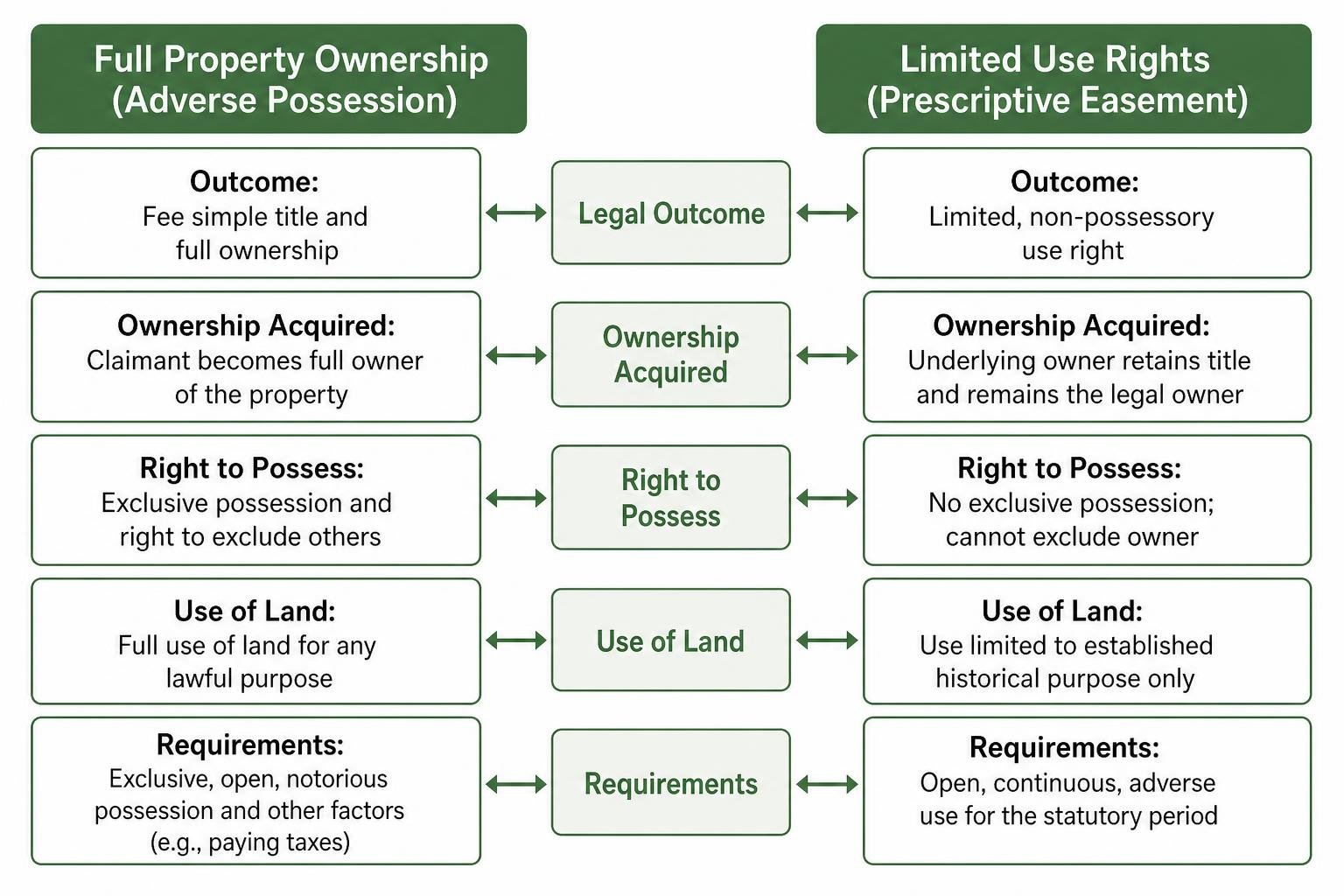
- Adverse Possession: Awards fee simple title and full ownership to the claimant. The adverse possessor completely ousts the original title holder and takes full ownership of the property, including the right to exclude others. This typically requires exclusive physical occupation, paying real estate taxes in many jurisdictions, and establishing total dominion over the land.
- Prescriptive Easement: Grants only a limited, non-possessory use right. The underlying property owner retains their deed, remains the titled owner, and continues paying property taxes. The easement holder can only use the designated strip for its established historical purpose (such as driving a car across a path or maintaining a drainage ditch).
When boundary disagreements escalate over boundary lines or rights-of-way, navigating real estate litigation representation is essential to protect your property rights and ensure the correct legal remedy is pursued.
| Feature | Adverse Possession | Prescriptive Easement |
|---|---|---|
| Ultimate Outcome | Full fee simple ownership title | Limited, non-possessory right of use |
| Titled Owner Status | Loses title and ownership entirely | Retains title, ownership, and residual rights |
| Scope of Right | Complete control and right to exclude | Restricted strictly to historical use scope |
| Exclusivity Test | Must exclude true owner completely | Must assert independent right without consent |
| Tax Requirements | Often requires paying property taxes | Does not require payment of property taxes |
Essential Legal Elements and Statutory Requirements
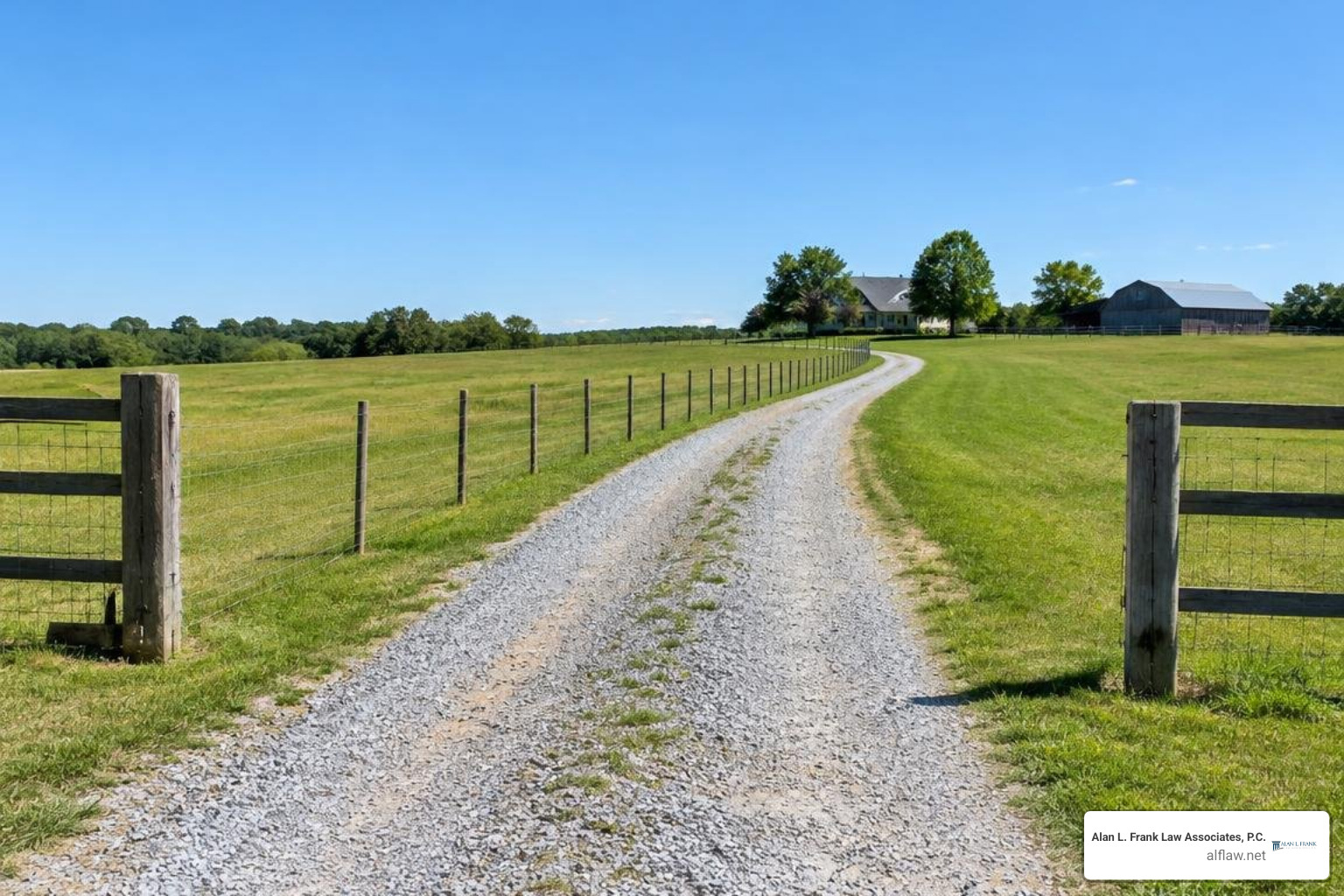
To establish an easement by prescription, a claimant bears the heavy burden of presenting clear and convincing evidence satisfying several strict common law elements. Because courts disfavor granting property rights without compensation or a deed, any ambiguity is generally resolved in favor of the servient landowner.
The Five Crucial Elements for Establishing Prescription
While terminology varies slightly by jurisdiction, an unpermitted land user must prove five core elements:
- Actual Use: The claimant must show physical, identifiable activity across the burdened parcel (such as vehicular passage, foot traffic, or utility line maintenance) rather than mere theoretical claims.
- Open and Notorious Use: The activity must be visible, obvious, and unconcealed. It must be sufficiently apparent that any vigilant landowner inspecting their boundaries would readily notice the intrusion.
- Adverse and Hostile (Under a Claim of Right): The use must occur without the landowner’s express or implied permission. In legal terms, “hostile” does not mean angry or violent; it means the user asserts a right to cross the land without recognizing the owner’s superior authority to forbid them. The historical Latin maxim nec vi, nec clam, nec precario captures this well: the use must be without force, without secrecy, and without permission.
- Continuous and Uninterrupted Duration: The use must continue without material break for the entire duration mandated by state law. Seasonal use can satisfy continuity if that pattern matches the nature of the property (such as using a mountain cabin path each summer), provided there is no prolonged abandonment or successful physical interruption by the titled owner.
- Uniform Route and Definite Scope: The claimant must establish that the travel followed a consistent, defined pathway rather than wandering randomly across the servient parcel.
When everyday neighbor interactions sour over shared access ways, knowing the legal mechanisms for resolving contentious neighbor disputes helps parties enforce their rights without causing needless escalation. If negotiations break down completely, understanding how to handle disputes with your neighbor ensures you take the right steps in court.
Exactly How Statutory Time Periods Vary by Jurisdiction
The length of time required for unpermitted use to mature into a prescriptive easement depends strictly on state statutes. In Pennsylvania and New Jersey, these timeframes are firmly established by state legislation and common law precedent.
- Pennsylvania: The claimant must prove continuous, open, notorious, and adverse use for a statutory period of 21 years. However, under Pennsylvania’s modern statutory framework for adverse possession of small residential lots (under one-half acre with a single-family home), specific 10-year rules can apply to title claims, though traditional right-of-way prescriptive easements generally adhere to the historic 21-year period as detailed in state publications on guidelines on adverse possession and prescriptive easements.
- New Jersey: Prescriptive rights generally follow the statutory threshold governing adverse rights, traditionally requiring 20 to 30 years depending on the specific classification of the uncultivated or developed real estate.
Across the United States, statutory time periods range from as few as 5 years to more than 20 years:
- 10-Year Jurisdictions: New York, Texas, Washington, and Oregon establish a 10-year statutory threshold of continuous adverse use.
- 18-Year Jurisdictions: Colorado requires more than 18 years of uninterrupted, hostile use.
- 20-Year Jurisdictions: Many traditional common law states set the baseline at 20 continuous years.
Evidentiary Proof, Transferability, and Defending Against Claims

Proving a claim that spans decades requires comprehensive documentary and physical evidence. Because prescriptive rights are rarely recorded in local county deed repositories before a lawsuit, a claimant must build a compelling evidentiary record.
Required Evidence to Prove or Contest Use Rights
When our attorneys litigate prescriptive easement claims, we rely on concrete historical records to establish or refute the elements of prescription:
- Historical Aerial and Satellite Imagery: Time-stamped GIS mapping and historic aerial photos provide objective proof of visible tire tracks, paved paths, or worn foot trails.
- Professional Boundary Surveys: A licensed land surveyor can locate existing pins, map the precise metes-and-bounds width of the disputed corridor, and confirm encumbrances. Property owners can begin by locating existing property surveys before commissioning costly new fieldwork.
- Maintenance Invoices and Physical Improvements: Invoices for gravel deliveries, asphalt paving, grading, or snow removal prove the claimant maintained the corridor under a claim of right.
- Third-Party Witness Affidavits: Statements from long-term neighbors, utility workers, delivery drivers, or former parcel owners detailing how long the path has been used.
- Photographic Records: Dated personal photographs showing historic use of the driveway or access route over several decades.
Transferability: Does a Prescriptive Easement Run with the Land?
Yes. Once a prescriptive easement successfully matures by satisfying the statutory timeline, it becomes an easement appurtenant. This means it attaches directly to the dominant estate and automatically transfers to subsequent buyers, even if it is not explicitly mentioned in the deed.
Furthermore, under the doctrine of tacking, a current property owner can combine their years of adverse use with the adverse use of previous owners, provided there is continuous privity of estate (such as an uninterrupted chain of deed transfers between the successive owners).
Common Defenses, Landowner Protections, and Extinguishment
Landowners facing an unwarranted easement claim have several powerful defenses under the law:
- Express Permission: Permission is the absolute antidote to a prescriptive easement. If the titled owner granted oral or written consent, the use is permissive, not hostile. A revocable license defeats any claim of prescription.
- Physical Interruption: If the titled owner effectively blocks the path (by erecting a locked gate, constructing a fence, or placing barriers) before the statutory period expires, the continuity clock resets to zero.
- Substantial Deviation: If the user regularly altered their path rather than using a uniform, defined route, the claim fails for lack of certainty.
- Abandonment and Non-Use: While established express easements rarely terminate through non-use alone, an unrecorded prescriptive right can be extinguished if the dominant owner abandons use alongside an intent to permanently relinquish it.
Landowners must also remain mindful of general legal restrictions on property rights when taking defensive actions to ensure they do not create separate liabilities while securing their boundaries.
Real Estate Transactions, Registration, and Valuation Impacts
An unrecorded prescriptive easement creates substantial legal and financial risks during real estate transactions. Because prescriptive rights originate through physical conduct rather than written instruments, standard municipal title searches often fail to discover them.
Quiet Title Actions and Judicial Declarations
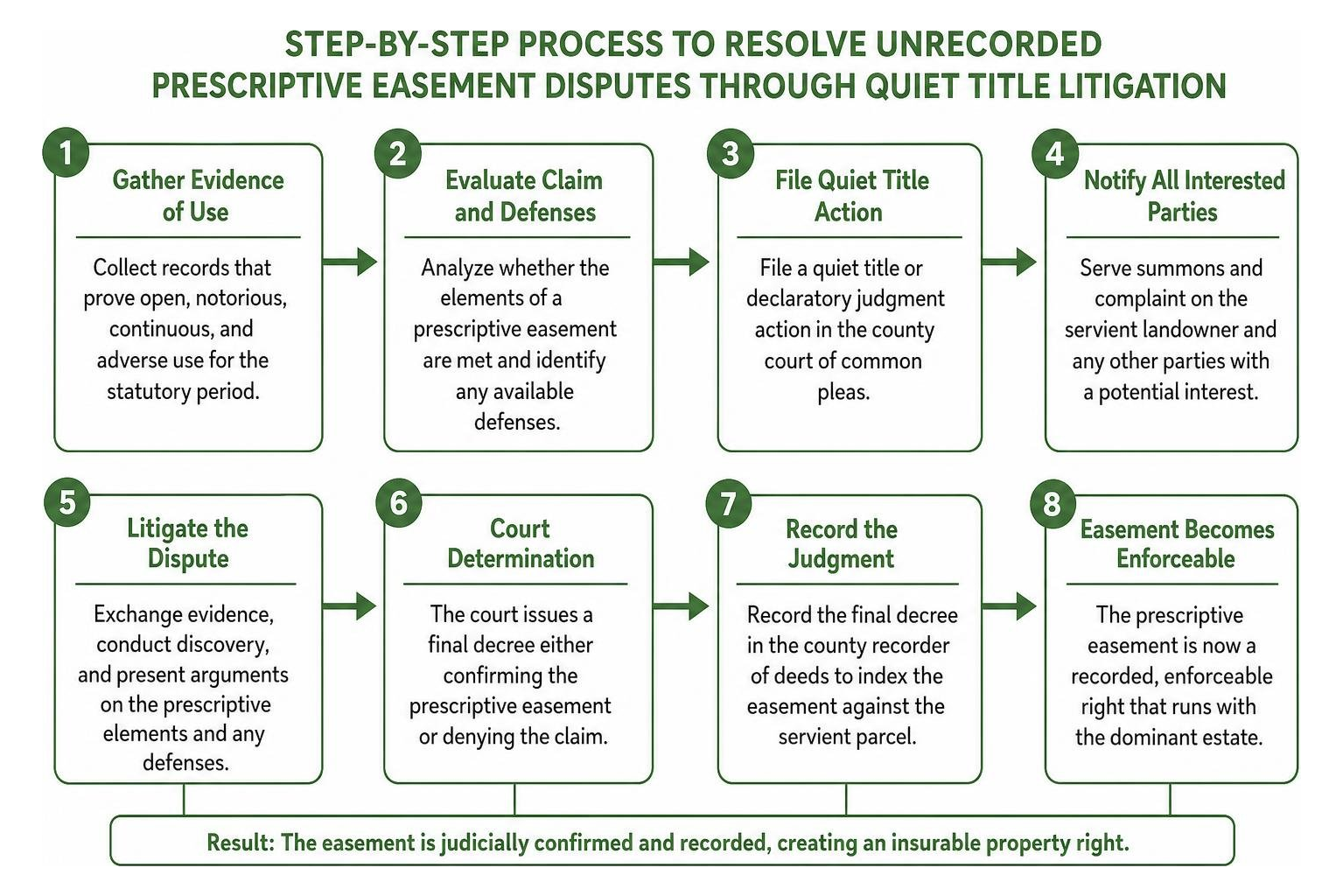
A prescriptive easement remains an unrecorded, equitable claim until a court formally adjudicates it. To convert unwritten continuous use into an insurable property right, the claimant must file a Quiet Title Action or an action for declaratory judgment in the appropriate county court of common pleas.
Once the court enters a final decree confirming the easement, the judgment is recorded in the county recorder of deeds, officially indexing the burden against the servient parcel’s chain of title.
Impact on Title Insurance and Market Value
- Title Policy Exceptions: Standard title insurance policies typically exclude unrecorded easements, boundary encroachments, and unrecorded physical rights-of-way discoverable by an accurate survey or visual site inspection. Buyers must review survey endorsements carefully to protect their investment.
- Diminution of Property Value: A property burdened by an unexpected prescriptive right-of-way can lose significant market value. It restricts building footprints, disrupts privacy, creates maintenance liabilities, and can frighten away prospective buyers.
- Financing and Development Roadblocks: Commercial lenders frequently refuse to fund acquisitions or construction loans if an unrecorded access dispute creates a cloud on title.
Frequently Asked Questions About Prescriptive Easements
What Is a Prescriptive Easement Claim’s Impact on Title and Property Value?
An unrecorded prescriptive easement can cloud title, complicate real estate transactions, and reduce market value. When a servient property is burdened by an easement, the owner loses the right to build over that land or exclude the easement holder.
Prospective purchasers can use these issues to negotiate a lower purchase price or demand that the seller clear title before closing. Conducting thorough due diligence for access and easements is vital before purchasing real estate.
Can a Prescriptive Easement Be Granted If Use Was Shared with the Owner?
Yes, but it depends heavily on the nature of the use. In many jurisdictions, “exclusive” in the context of prescriptive easements does not mean the claimant was the sole user. Instead, it means the claimant’s right to use the land does not depend on a right held by others.
However, if a neighbor uses a private driveway alongside the titled owner simply out of neighborly accommodation or shared convenience, courts often presume the use is permissive. To rebut this presumption, the claimant must show a distinct, adverse assertion of right beyond ordinary neighborly sharing.
How Can Landowners Proactively Prevent Prescriptive Rights?
Property owners can protect their land from prescriptive claims through simple, proactive measures:
- Grant Express, Written Permission: Provide the user with a written, revocable license stating clearly that use of the driveway or path is permissive and subject to revocation at any time.
- Post Statutory Signage: Post visible signs reading “Right to Pass by Permission, Subject to Control of Owner” or similar statutory language authorized by state law.
- Install Secure Fences and Gates: Secure boundaries with locked gates or physical barriers to interrupt any continuous passage before the statutory time period runs.
- Record Formal Declarations: In some jurisdictions, owners can record a formal statutory notice in the county land records declaring that all public or private access across the parcel is permissive.
Conclusion
Understanding prescriptive easements is essential for protecting your property investments. Whether you need to secure a vital access route you have used for decades or defend your land against an unauthorized neighborly crossing, taking early, strategic legal action is critical.
At Alan L. Frank Law Associates, P.C., our experienced attorneys have recovered multi-million dollar outcomes for clients across Pennsylvania and New Jersey. We understand the high stakes of boundary, title, and access disputes. If you are facing an unrecorded easement claim or need to protect your real estate assets, contact our dedicated commercial litigation attorneys today for a strategic consultation.