
Lyft Securities Litigation: Inside the $25 Million Investor Settlement


Lyft Securities Litigation: Inside the $25 Million Investor Settlement
Lyft Securities Litigation: What Happened to the IPO Claims?
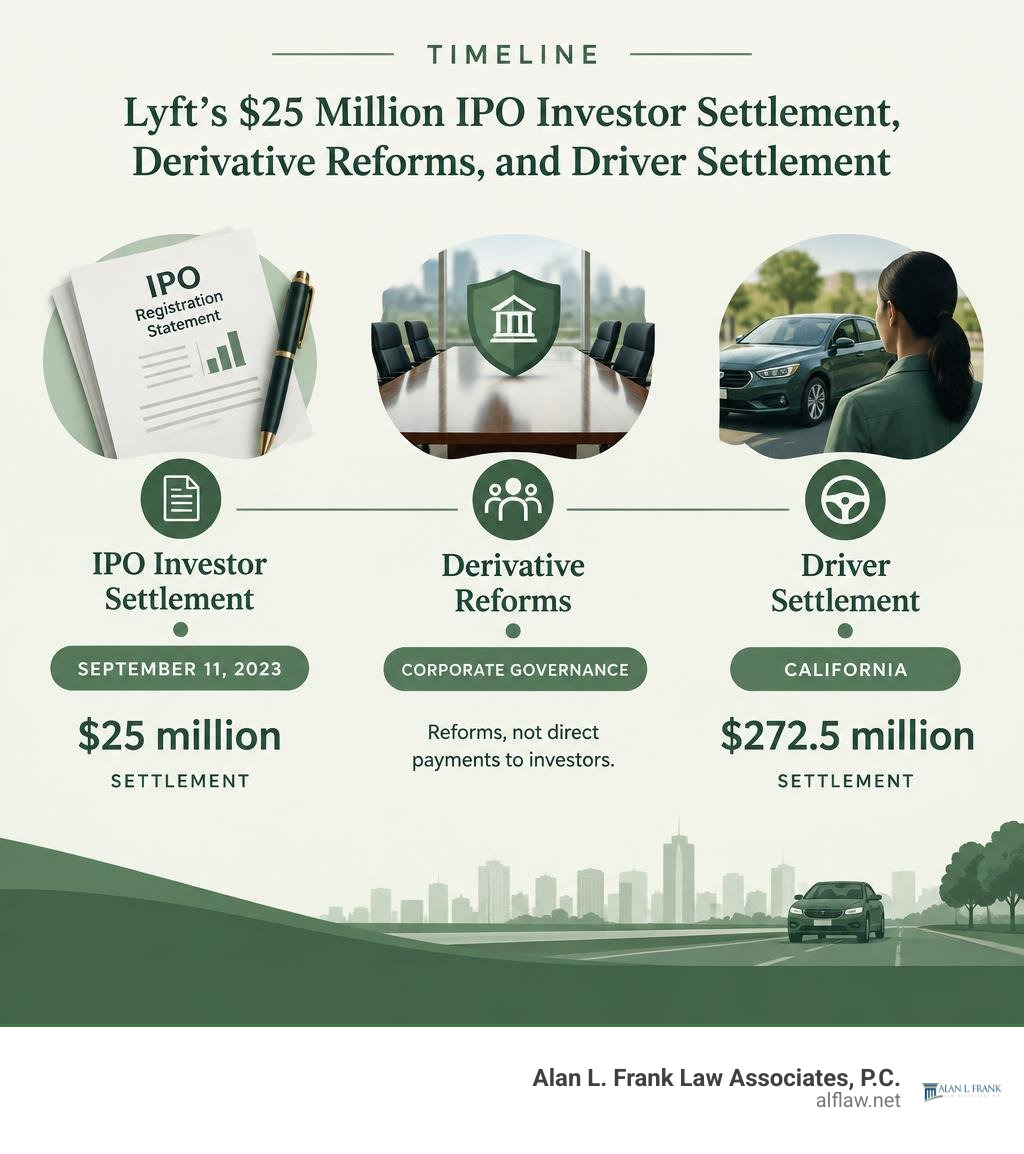
Lyft’s IPO investor class action ended in a $25 million settlement. Investors alleged that the company’s 2019 IPO registration statement left out important information about passenger safety, competition, and bike-share defects. A federal court approved the settlement and dismissed the case with prejudice on September 11, 2023.
Other Lyft lawsuits had different outcomes. Shareholder derivative claims led to corporate governance reforms, not direct payments to investors. A separate $272.5 million California settlement concerns driver classification, not IPO disclosures. This guide explains how the cases fit together and what each resolution means.
I’m Alan L. Frank, managing attorney at Alan L. Frank Law Associates, P.C. My experience with investment losses and complex business disputes informs this guide to Lyft securities litigation; the key dates and outcomes come first.
Lyft securities litigation glossary:
Origins and Allegations in the Lyft Securities Litigation
When Lyft launched its long-awaited initial public offering (IPO) in March 2019, it priced 32.5 million shares at $72.00 per share, generating roughly $2.34 billion in gross proceeds. For retail and institutional investors, the debut was pitched as a premier opportunity to capture the upside of the booming ride-sharing revolution. However, the optimism proved short-lived as underlying operational issues surfaced, triggering a steep decline in share value.
Dissatisfied shareholders initiated class action litigation, alleging that Lyft’s Form S-1 registration statement contained material misstatements and omissions in violation of Section 11 and Section 15 of the Securities Act of 1933. Under Section 11, issuers face strict liability for untrue statements of material fact or failures to state material facts required to make the offering documents not misleading.
The primary allegations leveled by the lead plaintiffs centered on three major operational areas:
- Undisclosed Safety Concerns: The registration statement touted Lyft’s deep commitment to user trust and safety while omitting growing numbers of sexual assault allegations involving drivers. Plaintiffs asserted that the lack of disclosure obscured substantial reputational and legal vulnerabilities.
- Eroding Market Share: While offering materials suggested sustainable competitive positioning, plaintiffs claimed Lyft was actively losing ground to its chief rival, Uber, amid aggressive pricing battles and promotional discounting.
- Bike-Share Braking Defects: The filings failed to highlight severe mechanical problems, including critical front-wheel braking defects in Lyft’s newly acquired fleet of shared electric bicycles, which ultimately forced safety-related recalls.
As detailed in the District Court opinion on Section 11 IPO omissions, these missing operational disclosures sat at the heart of the legal battle. When companies withhold material operational liabilities before floating public equity, investors often need to explore pursuing claims for securities litigation & investment losses to recover capital lost to artificial price inflation.
Material Omissions vs. Corporate Puffery
A foundational legal issue in the federal securities class action was whether Lyft’s public statements represented actionable, false assertions of fact or mere corporate puffery. Under long-standing Ninth Circuit legal standards, vague statements of corporate optimism—such as declaring a generalized “commitment to passenger trust”—are routinely dismissed as aspirational commentary that reasonable investors would not rely upon for investment decisions.
Lyft’s defense team moved to dismiss the complaint, arguing that safety descriptions were generalized corporate statements and that its Form S-1 already cautioned investors about “illegal, improper or otherwise inappropriate activities by users.” Applying the judicial notice doctrine, the court incorporated the full Form S-1 and its exhibits directly into its analysis.
The court drew a sharp legal distinction: while general statements regarding safety culture were non-actionable puffery, the total omission of widespread, known sexual assault incidents and the resulting reputational risks met the materiality threshold required to survive a motion to dismiss.
Procedural Milestones in the Federal Lyft Securities Litigation
Following the consolidation of multiple shareholder suits into In re Lyft Inc. Securities Litigation in the U.S. District Court for the Northern District of California, the litigation traversed several procedural hurdles. The federal court docket details for In re Lyft Inc. show that plaintiffs satisfied the heightened procedural hurdles of the Private Securities Litigation Reform Act (PSLRA) to proceed into formal discovery.
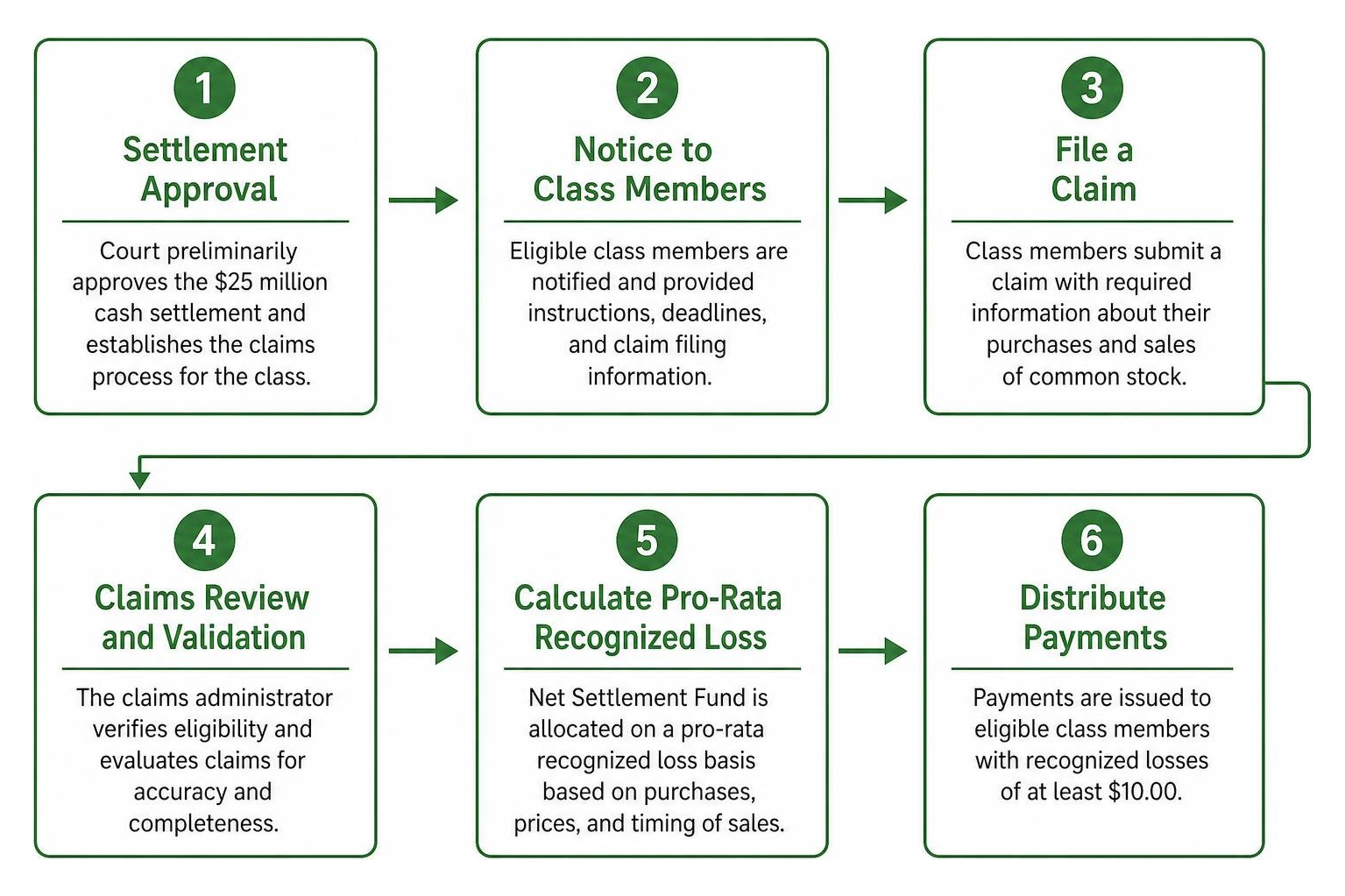
Facing potential trial damages estimated between $535 million and $777 million, the parties engaged in extensive private mediation sessions. These negotiations yielded a $25 million all-cash common fund settlement.
Key settlement provisions included:
- Class Certification & Scope: The class covered all individuals and entities who purchased Lyft Class A common stock pursuant or traceable to the March 2019 IPO registration statement.
- Pro-Rata Allocation Formula: The fund was distributed on a pro-rata recognized loss basis, accounting for purchase dates, transaction prices, and disposal timing, featuring a $10.00 minimum payment threshold.
- Cy Pres Distribution: Any residual funds that could not be economically distributed to class members were directed to the Bluhm Legal Clinic at Northwestern University Pritzker School of Law to advance investor protection education.
- Attorneys’ Fees: Class counsel received court approval for fees representing 25% of the settlement fund ($6.25 million) plus reimbursement for litigation expenses.
On September 11, 2023, the federal court granted final approval to the $25 million settlement, dismissing all federal claims against Lyft with prejudice. Concurrently, parallel state-level Section 11 class actions pending in California state court were coordinated and resolved to prevent overlapping recoveries.
Shareholder Derivative Suits and Corporate Governance Reforms
Running parallel to the direct investor class actions were multiple shareholder derivative suits filed in federal and state venues. Unlike class action securities litigation—where damaged shareholders recover monetary damages directly from the company—derivative lawsuits are brought by existing shareholders on behalf of the corporation itself. These suits argued that members of Lyft’s Board of Directors and executive suite breached their fiduciary duties, committed corporate waste, and subjected the business to Section 11(f) contribution liabilities under the Securities Act.
The consolidated federal derivative litigation culminated in a comprehensive settlement, formally documented in the Exhibit 1 Stipulation of Derivative Settlement. For aggrieved shareholders, holding corporate issuers accountable through legal action frequently involves leveraging derivative litigation to force internal structural reforms when leadership oversight fails.
Mandatory Corporate Governance Mandates
The derivative settlement required Lyft to implement and maintain a rigorous series of corporate governance reforms for a minimum term of three years. These internal enhancements targeted the operational blind spots identified during the IPO litigation:
- Executive Compensation Clawback Provisions: Implementation of enhanced clawback rules empowering the board to recover incentive-based compensation from senior executives in cases of material financial restatements or severe ethical misconduct.
- Whistleblower & Compliance Enhancements: Expansion of an independent, anonymous compliance reporting hotline, paired with mandatory protocols requiring immediate escalation of safety and regulatory concerns to the Audit Committee.
- Enhanced Board Oversight: Creation of dedicated board-level oversight responsibilities focusing specifically on safety risk metrics, driver vetting procedures, and regulatory compliance.
Under the negotiated terms, Lyft’s Directors and Officers (D&O) liability insurers funded $700,000 in plaintiffs’ attorneys’ fees and expenses, along with individual service awards of up to $1,500 for the named derivative plaintiffs.
Comparing Shareholder Derivative Actions to the Lyft Securities Litigation
| Settlement Feature | Class Action Securities Litigation | Shareholder Derivative Litigation |
|---|---|---|
| Direct Beneficiary | Damaged stock purchasers | The corporate entity (Lyft, Inc.) |
| Primary Remedy | $25 million cash common fund | 3-year corporate governance mandates |
| Funding Source | Lyft corporate/insurance funds | D&O insurers ($700,000 legal fees) |
| Shareholder Action Required | Submit Proof of Claim form | None (reforms apply automatically) |
| Legal Scope | Section 11 & Section 15 claims | Breach of fiduciary duty & corporate waste |
| Release Breadth | Releases IPO-related disclosure claims | Full waiver under California Civil Code §1542 |
The derivative resolution included broad releases shielding officers and directors from related future fiduciary claims, including explicit waivers of unknown claims under California Civil Code Section 1542.
Financial Impact, Driver Misclassification, and Ongoing Legal Risks
Beyond securities-related claims, Lyft has navigated significant legal exposure regarding its core gig-economy operational model. Most notably, the company addressed massive state-level labor claims through a $272.5 million settlement resolving driver misclassification actions brought under California’s Private Attorneys General Act (PAGA) and related statutes for the period covering April 5, 2016, through December 15, 2020.
As disclosed in Lyft’s regulatory filings, including the October 2026 Form 8-K legal disclosures, the company recorded a substantial $210 million pre-tax accrual in the fourth quarter of 2025 to account for this resolution.
The settlement agreement permits Lyft to disburse the $272.5 million sum over a four-year installment timeline, subject to 5.0% simple annual interest after the first year, with cumulative interest capped at $12.4 million. This multi-year payment structure was designed to protect working capital while resolving historical labor exposure.
2024 Earnings Margin Reporting Error
Adding to Lyft’s public-market challenges, a significant disclosure incident occurred on February 13, 2024. During the release of its fourth-quarter 2023 financial results, an inadvertent clerical error in Lyft’s press release stated that the company anticipated an adjusted EBITDA margin expansion of approximately 500 basis points for full-year 2024.
The actual internal projection was 50 basis points.
The typographical error triggered extreme aftermarket volatility:
- Lyft’s stock price surged over 60% in aftermarket trading, climbing from its regular-session close of $12.13 to an intra-evening peak of $20.25.
- Trading volume exploded to over 500,000 shares per minute, driven by short sellers rushing to cover positions. At the time, short interest in Lyft stood at nearly 12% of outstanding shares.
- Approximately 24 minutes into the post-market earnings conference call, company executives corrected the record, explaining the 500-basis-point figure was an error.
The rapid retraction caused the stock to shed most of its immediate gains, prompting new shareholder class action filings under Section 10(b) and Rule 10b-5 of the Securities Exchange Act of 1934. These complaints alleged that the delayed correction constituted severe recklessness. When unexpected market turbulence stems from corporate reporting errors, identifying corporate fraud and reporting misconduct remains essential to protecting market integrity.
Forward-Looking Guidance and Non-GAAP Adjustments
As of October 2026, Lyft has managed these historical settlements within its broader operating budget. In its recent quarterly communications, management reaffirmed its operational metrics and Q3 2026 financial guidance.
To provide transparency regarding ongoing legal charges, the company excludes the financial effects of the California driver settlement and securities settlement legal reserves from its non-GAAP Adjusted EBITDA calculations. By categorizing these litigation liabilities as discrete items affecting general, administrative, and regulatory accruals, Lyft aims to present a normalized baseline of ongoing platform profitability.
Nevertheless, long-term performance remains exposed to key industry risks, including potential regulatory shifts in worker classification models, municipal insurance mandates, and competitive pressures across North American metropolitan markets.
Frequently Asked Questions About the Lyft Legal Settlements
What was the basis of the $25 million Lyft securities class action settlement?
The class action alleged that Lyft’s March 2019 IPO registration statement omitted critical negative facts regarding passenger sexual assault reports, market share losses to Uber, and braking safety recalls on its electric bike fleet. These claims were brought under Section 11 of the Securities Act of 1933 and resolved via a court-approved $25 million cash fund in September 2023.
How did the derivative settlement differ from the class action resolution?
The derivative settlement did not provide direct cash payouts to shareholders. Instead, it required Lyft to implement three years of structural corporate governance reforms—including an executive compensation clawback policy, an enhanced compliance hotline, and expanded board safety oversight. Insurers covered $700,000 in legal expenses.
How do driver misclassification settlements affect Lyft’s financial standing?
The $272.5 million California driver classification settlement required a $210 million accrual recorded in Q4 2025. While payable over four years with interest capped at $12.4 million, Lyft isolates these expenses within non-GAAP financial reconciliations to insulate its recurring Adjusted EBITDA from historical legal liabilities.
Conclusion
The resolution of the Lyft IPO securities litigation and parallel derivative suits highlights the critical importance of absolute transparency in corporate disclosures. Between the $25 million class action settlement, extensive corporate governance reforms, and the separate $272.5 million California driver misclassification resolution, Lyft has systematically addressed legacy legal exposure stemming from its early operating years.
At Alan L. Frank Law Associates, P.C., our practice represents retail and institutional investors in complex securities disputes, corporate governance conflicts, and financial recovery matters throughout Pennsylvania and New Jersey. From our offices in Philadelphia and Jenkintown, PA, we combine deep litigation experience with focused client advocacy to hold corporate issuers accountable. For seasoned guidance on shareholder rights and financial recovery, discover our comprehensive legal counsel in securities litigation to protect your investment portfolio.