
Why Smart Investors Trust Stock Fraud Attorneys to Reclaim Stolen Capital


Why Smart Investors Trust Stock Fraud Attorneys to Reclaim Stolen Capital
Why Stock Fraud Attorneys Matter When Your Capital Is at Risk
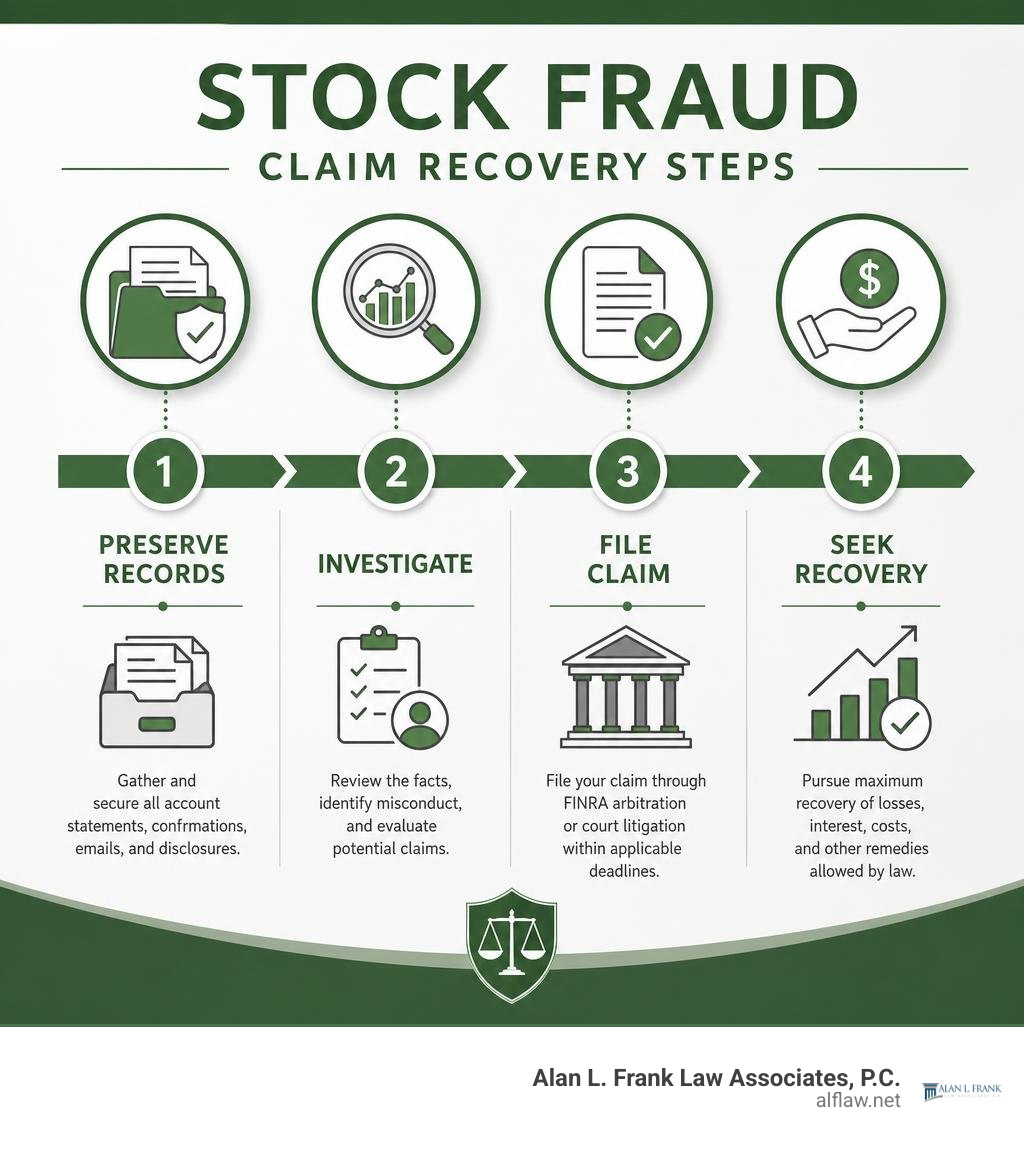
If you suspect a broker, adviser, company insider, or investment promoter caused losses through deception or misconduct, act quickly. Stock fraud attorneys can review account records, trade confirmations, emails, and disclosures to identify potential claims and pursue recovery through FINRA arbitration or court litigation.
Smart investors do not assume every loss is fraud. Markets fall. But warning signs such as unauthorized trades, excessive trading for commissions, misleading sales claims, hidden risks, or investments that did not fit your goals deserve careful review. Preserve your records, avoid altering communications, and get legal advice before deadlines or arbitration eligibility periods expire.
A strong claim may seek compensation for losses tied to misconduct, interest, certain costs, or other remedies allowed by the facts and applicable law. The key question is not simply whether your portfolio lost value, but whether someone violated a legal or professional duty and caused avoidable harm.
I am Alan L. Frank, Managing Attorney of Alan L. Frank Law Associates, P.C., with more than 20 years of experience handling complex commercial disputes and investment-loss matters. As a CPA, tax law graduate, and securities litigation attorney, I understand how stock fraud attorneys assess financial records, trace losses, and build claims for investors seeking accountability.
Simple guide to stock fraud attorneys:
Understanding Securities Deception and Major Market Schemes

Securities fraud occurs whenever a broker, advisory firm, or corporate insider employs dishonest practices to manipulate investment outcomes or induce individuals to purchase or sell securities. When markets correct, financial losses are natural. However, when those losses stem from deceit, deliberate concealment, or gross negligence, the situation shifts from normal market risk to actionable illegality governed by securities litigation.
Common Forms of Stock and Investment Fraud
Fraudulent activity across the securities industry manifests in numerous distinct patterns. Recognizing these practices is critical for investors who want to protect their portfolios:
- Churning (Excessive Trading): A broker excessively buys and sells securities within a client’s account primarily to generate commissions, regardless of whether the strategy aligns with the investor’s objectives.
- Unauthorized Trading: Executing transactions without the investor’s prior knowledge, consent, or explicit discretionary authority.
- Unsuitability: Recommending investments or complex financial strategies that directly contradict an investor’s stated risk tolerance, liquidity requirements, or time horizon.
- Misrepresentation and Omission: Fabricating positive data or concealing material risks regarding a company’s financial health, liquidity, or operational performance.
- Ponzi and Pyramid Schemes: Using capital from newer investors to pay artificial returns to earlier investors rather than generating genuine profits through legitimate commercial enterprise.
- Broker Negligence: Falling below industry standards through improper portfolio management, lack of due diligence, or outright broker malpractice and negligence.
Federal and State Securities Regulations That Protect Investors
Investors are protected by a comprehensive statutory framework designed to preserve capital market integrity:
- The Securities Act of 1933: Mandates that investors receive complete financial and other significant information concerning securities being offered for public sale, while prohibiting deceit and misrepresentations.
- The Securities Exchange Act of 1934: Regulates the secondary trading of securities, establishes broad regulatory oversight through the Securities and Exchange Commission (SEC), and contains Section 10(b) alongside Rule 10b-5, which makes employment of manipulative or deceptive devices unlawful.
- State “Blue Sky” Laws: State statutes, such as the Pennsylvania Securities Act of 1972 or the New Jersey Uniform Securities Law, provide local investors with powerful protections, often establishing clear private rights of action and liability standards against fraudulent promoters.
When and Why to Hire Dedicated Stock Fraud Attorneys
When an investment professional breaches their duty of loyalty, timely intervention is essential. Retaining an attorney who focuses on investor loss recovery ensures that subtle, systemic fraud is uncovered before account records are purged or legal filing windows lapse.

Critical Warning Signs of Broker Misconduct
Investors should watch for recurring red flags that indicate a broker has placed their personal remuneration above client welfare:
- Sudden, Unexplained Drops in Portfolio Equity: Massive drawdowns that occur while broader market benchmarks remain stable or trend upward.
- Excessive Friction and Hidden Fees: Voluminous trade confirmations accompanied by significant margin interest or transaction fees that erode account gains.
- Over-Concentration in High-Risk, Illiquid Products: Placing substantial portions of capital into private placements, non-traded REITs, or complex structured notes.
- Targeting Vulnerable Portfolios: Systematic retirement account exploitation, where conservative retirement funds are moved into speculative ventures.
- Unexpected Target Date Allocations: Severe, anomalous drops in assets intended for preservation, requiring a close look at target date fund losses.
Stock Fraud Counsel vs. General Securities Lawyers
A general corporate or transactional securities attorney structures mergers, drafts prospectuses, and ensures regulatory compliance for public companies. In contrast, investor advocacy counsel focuses on adversarial dispute resolution.
We concentrate on forensic account auditing, cross-examining financial advisors, analyzing brokerage clearing records, and litigating claims against major Wall Street broker-dealers to reclaim investor capital.
The Path to Financial Recovery: Investigation and Legal Proceedings

What Experienced Stock Fraud Attorneys Do to Build Your Case
Recovering stolen capital requires meticulous factual development. When we take on a claim, our investigative process includes:
- Account Forensics: Reconstructing month-by-month profit-and-loss statements, calculating turnover ratios, and establishing commission-to-equity percentages.
- Trade Log and Communication Auditing: Comparing actual order entries against client correspondence, phone logs, text messages, and email records.
- Regulatory History Scrutiny: Examining the Central Registration Depository (CRD) and BrokerCheck histories for prior customer complaints, regulatory suspensions, or terminations.
- Expert Witness Collaboration: Retaining certified fraud examiners, former regulatory compliance directors, and damage calculation specialists to formulate authoritative reports.
FINRA Arbitration Versus Courtroom Litigation
Most retail investors sign account agreements containing mandatory predispute arbitration clauses. Consequently, the vast majority of investor recovery actions do not take place in traditional state or federal courthouses. Instead, they proceed through the Financial Industry Regulatory Authority (FINRA) dispute resolution forum.
Arbitration before FINRA differs markedly from standard courtroom litigation:
- Neutral Panels: Cases are decided by a panel of one to three arbitrators rather than a civil jury.
- Streamlined Discovery: While traditional court depositions are rare in FINRA arbitration, document production guidelines are strictly enforced.
- Final and Binding Decisions: Arbitral awards are final, with extremely narrow grounds for judicial appeal, allowing investors to reach resolution far faster than multi-year civil court battles.
Understanding how to present claims involving stockbroker misconduct within this specialized forum requires seasoned FINRA attorneys who understand the nuances of the FINRA Code of Arbitration Procedure.
Calculating Damages, Legal Remedies, and Overcoming Defense Tactics
Determining the exact dollar amount of a claim requires an analysis of both actual losses and what the portfolio should have earned had it been managed properly.
Legal Remedies and Net Loss Calculations
| Remedy Model | Methodology | Typical Application |
|---|---|---|
| Out-of-Pocket Losses | Net invested capital minus remaining account equity and cash distributions. | Direct fraud, conversion, or outright capital misappropriation. |
| Rescission | Unwinding the transaction entirely; returning the security in exchange for the original purchase price plus statutory interest, less any dividends received. | Statutory Blue Sky law violations, unregistered securities, or failure to deliver required disclosures. |
| Well-Managed Portfolio Benchmark | Calculating the difference between the actual account performance and a suitable market index (e.g., a balanced 60/40 equity/bond index). | Unsuitability, over-concentration, and failure to diversify conservative assets. |
| Disgorgement / Punitive Damages | Requiring the broker or firm to return all commissions, margin interest, and advisory fees; additional punitive awards in cases of egregious malice. | Churning, deliberate breach of fiduciary duty, and systematic fraud. |
Rebutting Common Brokerage Firm Defenses
Brokerage defense firms routinely deploy aggressive arguments to evade liability. We counter these tactics using documented evidence:
- “The Client Was a Sophisticated Investor”: Wealth or business acumen does not grant a broker license to misrepresent material facts or conceal underlying risks.
- “The Investor Signed the Disclosures”: Boilerplate account forms and fine-print risk disclaimers do not excuse deliberate fraud, oral misrepresentations, or gross breaches of fiduciary obligation.
- “Losses Were Caused by Market Volatility”: By modeling performance against conservative benchmark indices, we prove that the portfolio’s decline was directly caused by unsuitable product selection rather than broader economic shifts.
- “Failure to Mitigate Damages”: Brokerage firms often argue that the customer received monthly account statements and should have stopped the trading sooner. We demonstrate that continuous reassurances from the broker lulled the investor into inaction.
Selecting the Right Legal Partner to Reclaim Lost Assets
How Stock Fraud Attorneys Charge for Legal Representation
Most investor loss recovery cases are handled on a contingency fee basis. Under a contingency agreement, the law firm receives an agreed-upon percentage of the financial recovery only if the claim is successful through settlement or an arbitration award. If no recovery is achieved, the client owes no attorney fees. This alignment ensures that our interests are completely identical to yours: maximizing net capital recovery.
Essential Questions to Ask During Your Case Evaluation
Before retaining legal representation, ask targeted questions to evaluate counsel’s qualifications:
- How much of your active practice is dedicated to securities arbitration and investor loss recovery?
- Have you handled claims involving the specific financial product or misconduct present in my case?
- Do you take cases through to a final arbitration hearing, or is your primary focus on quick, discounted settlements?
- What are the realistic challenges, timeframes, and range of financial recoveries associated with my claim?
Frequently Asked Questions About Stock Fraud Claims
What is the time limit for filing a stock fraud claim?
Under FINRA Rule 12206, no claim is eligible for arbitration where six years have elapsed from the occurrence or event giving rise to the claim. In addition, federal and state statutes of limitations—often ranging between two and five years from the date of discovery—apply to specific legal causes of action. Because determining these trigger dates is complex, immediate legal review is critical.
Can I recover investment losses if I signed a mandatory arbitration agreement?
Yes. Mandatory arbitration clauses do not restrict your substantive legal rights to recover damages; they merely dictate the forum where the dispute must be resolved. FINRA arbitration panels have full legal authority to grant compensatory damages, interest, attorney fees where permitted, and statutory awards.
How much does it cost to evaluate a securities fraud case?
Initial case reviews are typically provided at no upfront cost. We evaluate account statements, trade confirmations, and related correspondence to determine whether an actionable claim exists before any formal engagement begins.
Conclusion
Losing significant wealth to securities fraud can jeopardize your financial future, but you do not have to accept the loss as bad luck. When financial advisors and brokerage institutions violate state, federal, or regulatory duties, legal avenues exist to recover your capital. Alan L. Frank Law Associates, P.C. leverages decades of nationwide litigation insight, forensic financial background, and dedicated investor advocacy to hold wrongdoers accountable. If you suspect your portfolio suffered from misconduct, pursue an evaluation of your options for securities litigation and investment loss recovery to start reclaiming what is rightfully yours.