
Navigating Sarbanes-Oxley Fraud Claims and Whistleblower Retaliation Protections


Navigating Sarbanes-Oxley Fraud Claims and Whistleblower Retaliation Protections
The Legal Framework Governing Sarbanes-Oxley Fraud Claims
Sarbanes-Oxley fraud claims are legal actions arising from violations of the Sarbanes-Oxley Act of 2002 (SOX), a federal statute that imposes criminal penalties for securities fraud, mandates executive certification of financial reports under Sections 302 and 906, requires adequate internal controls over financial reporting under Section 404, and protects whistleblowers from retaliation under Section 806. Investors harmed by fraudulent financial statements may pursue civil recovery, while employees who report suspected fraud and suffer adverse employment actions can seek reinstatement, back pay, and compensatory damages through an OSHA administrative complaint or federal court action. Congress enacted SOX following massive accounting scandals at Enron, WorldCom, and Tyco that wiped out billions of dollars in shareholder value. The statute transformed federal securities regulation by targeting corporate governance, internal controls, and executive accountability.
At its core, SOX ensures financial transparency. It establishes clear reporting mandates for publicly traded corporations, subjects accounting firms to independent oversight through the Public Company Accounting Oversight Board (PCAOB), and arms regulators with enforcement mechanisms against corporate deception.
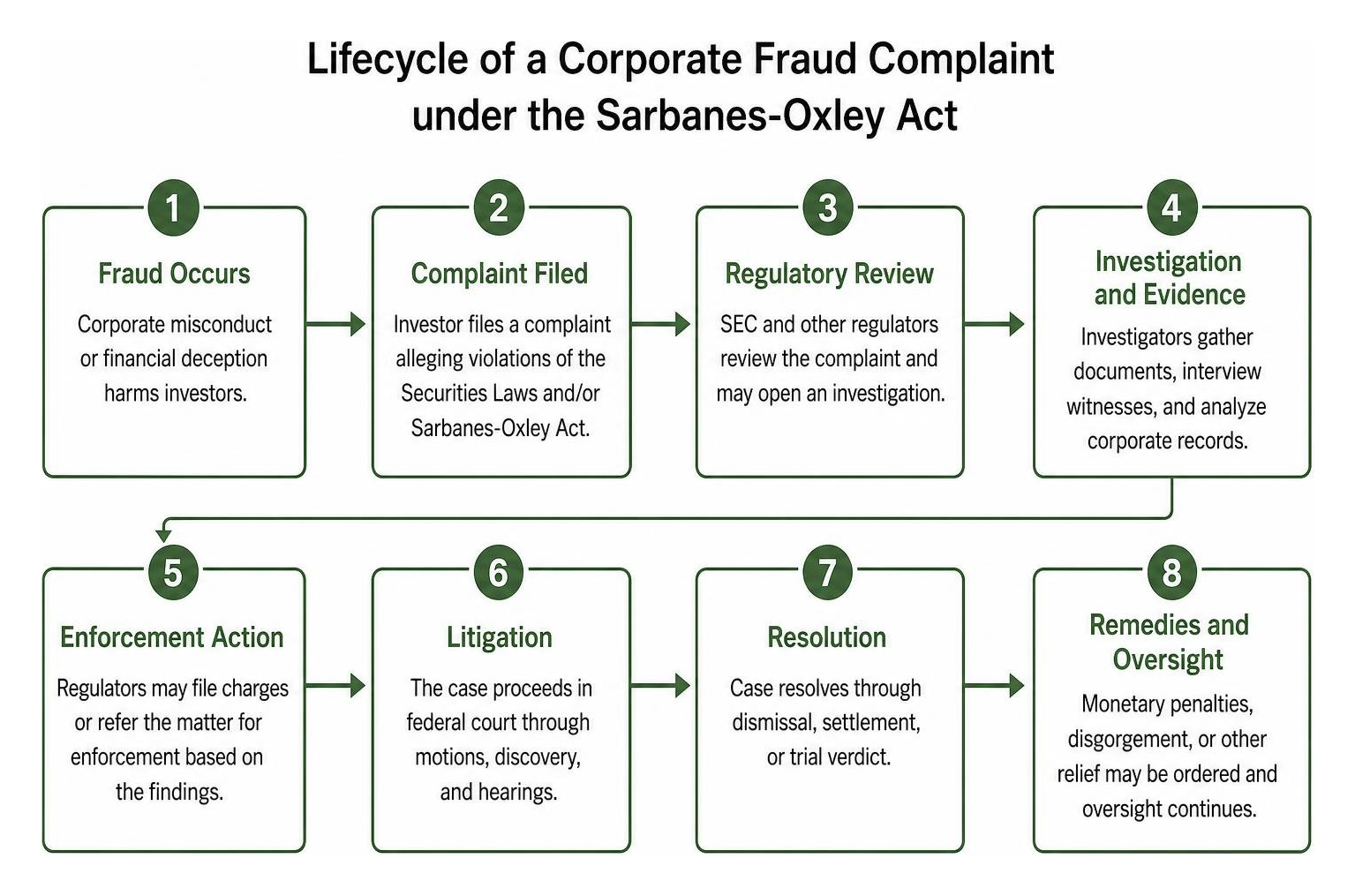
Key Statutory Provisions: Sections 302, 404, 802, and 906
SOX establishes a comprehensive compliance network through several key sections:
- Section 302 (Corporate Responsibility for Financial Reports): Mandates that principal executive and financial officers personally certify the accuracy of periodic reports filed with the Securities and Exchange Commission (SEC). Certifying officers confirm they have reviewed the report, that it contains no material misstatements, and that internal disclosure controls are functioning effectively.
- Section 404 (Management Assessment of Internal Controls): Requires annual reports to include an internal control report stating management’s responsibility for establishing and maintaining adequate Internal Controls over Financial Reporting (ICFR). Management must assess the operational effectiveness of these controls, and registered public accounting firms must attest to this assessment (subject to exemptions for Emerging Growth Companies).
- Section 802 (Criminal Penalties for Altering Documents): Imposes fines and up to 20 years’ imprisonment for knowingly altering, destroying, mutilating, concealing, or falsifying records to obstruct or influence a federal agency investigation or bankruptcy proceeding. It also mandates that audit workpapers be retained for seven years.
- Section 906 (Corporate Responsibility for Financial Reports): A criminal companion to Section 302, Section 906 requires CEOs and CFOs to accompany periodic financial reports with written certifications stating that the filing fully complies with the Securities Exchange Act of 1934 and fairly presents the company’s financial condition.
| Statutory Provision | Type of Liability | Mental State Requirement | Statutory Penalties / Remedies |
|---|---|---|---|
| SOX Section 302 | Civil / SEC Enforcement | Negligence / Failure to maintain adequate internal disclosure controls | SEC civil enforcement, injunctions, officer disgorgement, restatements |
| SOX Section 906 | Criminal | Knowing violation (awareness of defect) vs. Willful violation (intentional deceit) | Knowing: Up to $1,000,000 fine and 10 years imprisonment Willful: Up to $5,000,000 fine and 20 years imprisonment |
When public companies fail to establish these basic guardrails, the consequences can be catastrophic. In the landmark SEC complaint against Koss Corporation, regulators targeted comprehensive breakdowns in internal controls where management failed to maintain basic segregation of duties, allowing executive embezzlement to bypass routine financial reporting checks for years.
Whistleblower Retaliation Protections Under Sections 806 and 1107
A regulatory framework is only as effective as the detection mechanisms that support it. Recognizing that internal employees often identify corporate malfeasance first, SOX established civil and criminal protections against workplace retaliation.
Section 806 (18 U.S.C. § 1514A) provides a robust civil remedy for employees of publicly traded companies, their consolidated subsidiaries, and their contractors or subcontractors who suffer adverse employment actions because they reported unlawful conduct. Protected disclosures include providing information regarding:
- Mail fraud, wire fraud, bank fraud, or securities fraud
- Violations of SEC rules and regulations
- Federal law provisions relating to fraud against shareholders
As detailed in the Department of Labor SOX whistleblower digest, an employee initiating a claim must first file an administrative complaint with the Occupational Safety and Health Administration (OSHA) within 180 days of the retaliatory action. If the Department of Labor does not issue a final decision within 180 days, the whistleblower may remove the claim from the administrative system to seek de novo review and a jury trial in federal district court.
Complementing this civil framework, Section 1107 (18 U.S.C. § 1513(e)) establishes criminal penalties. Anyone who knowingly, with the intent to retaliate, takes any action harmful to a person—including interfering with their lawful employment or livelihood—for providing truthful information to a law enforcement officer regarding the commission of any federal offense faces fines and up to 10 years’ imprisonment.
Evidentiary Standards in Whistleblower Retaliation Litigation
SOX whistleblower litigation employs a specialized burden-shifting framework designed to favor employees who expose potential fraud.
To establish a prima facie case under Section 806, a plaintiff must show:
- They engaged in protected activity;
- The employer knew or suspected they engaged in that activity;
- They suffered an unfavorable personnel action (e.g., termination, demotion, suspension, blacklisting); and
- The protected activity was a contributing factor in the unfavorable action.
Once the plaintiff establishes this prima facie case, the burden shifts entirely to the employer. The employer must demonstrate by clear and convincing evidence—a significantly higher standard than a preponderance of the evidence—that it would have taken the identical adverse personnel action in the absence of the protected activity (the “same-action defense”).
How Courts Evaluate Protected Activity in Sarbanes-Oxley Fraud Claims
A central issue in SOX litigation is what qualifies as “protected activity.” An employee does not need to prove that an actual securities violation or shareholder fraud occurred. Instead, the legal inquiry centers on whether the employee held a reasonable belief that the reported conduct constituted a violation.
The reasonable belief test requires two distinct components:
- Subjective belief: The employee must have genuinely believed the employer engaged in unlawful misconduct.
- Objective reasonableness: A reasonable person with similar training and experience, in the same circumstances, would conclude the conduct was unlawful.
Federal courts have adopted an accessible, plaintiff-friendly framework for evaluating protected activity. In landmark Third Circuit precedent, federal courts confirmed that a whistleblower does not need to allege fraud with legal particularity or reference specific statutory sections in their internal report. Raising concerns about internal accounting control failures, unsupported journal entries, or misleading investor metrics satisfies the objective reasonableness threshold.
Employees who uncover corporate deception can review their administrative options and the protections available under the SEC whistleblower program to preserve their remedies while reporting unlawful corporate practices.
Pleading Standards and Burden of Proof in Sarbanes-Oxley Fraud Claims
Unlike common-law retaliation actions, SOX does not require an employee to prove that their protected report was the primary or “but-for” cause of their discharge. The plaintiff only needs to show that the disclosure was a contributing factor—meaning it tended to affect the employment decision in any way.
Plaintiffs frequently establish this causal link through:
- Temporal proximity: Close timing between the internal disclosure and the adverse disciplinary action.
- Pretextual explanations: Sudden shifts in performance evaluations after years of positive ratings.
- Inconsistent application of corporate policy: Subjecting the whistleblower to selective disciplinary enforcement.
When an employer fails to meet its clear and convincing burden, the prevailing employee is entitled to statutory relief designed to make them whole:
- Full reinstatement to their former position with identical seniority status
- Back pay with interest
- Uncapped compensatory damages for emotional distress, reputational harm, and pain and suffering
- All litigation costs, expert witness fees, and reasonable attorney fees
Landmark Decisions and Real-World Corporate Fraud Case Studies

Federal court opinions illustrate the practical applications of SOX’s reporting, accounting, and anti-retaliation provisions.
Internal Control Breakdowns: SEC v. Koss Corporation and Auditor Liability
The intersection of weak internal controls and corporate fraud is visible in the litigation surrounding Koss Corporation. A senior executive diverted more than $30 million in company funds through cashier’s checks, unauthorized wire transfers, and fraudulent balance-sheet adjustments over several fiscal years.
In the subsequent shareholder class litigation, Puskala v. Koss Corporation, the court addressed the stringent pleading thresholds under the Private Securities Litigation Reform Act (PSLRA). While apparent authority allows corporate liability for fraudulent executive statements, establishing primary Section 10(b) fraud claims against third parties—such as independent auditing firms—requires specific allegations of scienter (knowledge or severe recklessness), rather than mere negligence in performing an audit.
Meanwhile, the SEC pursued officer reimbursement remedies under SOX Section 304, which mandates that chief executives return incentive compensation and stock sale profits received following noncompliant financial statements. Investors harmed by these reporting failures often pursue recovery through securities litigation investment losses claims to redress deceptive management practices.
Retaliation Jurisprudence: Murray v. UBS and Thomas v. Tyco
The anti-retaliation protections under Section 806 were clarified by the Supreme Court in Murray v. UBS Securities, LLC (2024). In that case, a financial research strategist was fired after refusing to skew independent research reports to appease trading desks.
The Supreme Court resolved a circuit split by holding that a SOX whistleblower does not need to prove retaliatory intent or animus as part of their initial burden. A plaintiff must simply show that their protected whistleblowing was a contributing factor in the adverse employment decision. The burden then rests entirely on the employer to prove it acted without retaliatory bias.
Similarly, in Thomas v. Tyco International Management Co., the federal court held that reporting internal control deficiencies—such as hiring unqualified accounting staff lacking CPA credentials for multi-billion-dollar business units—constitutes protected activity under Section 806. The court affirmed that an employee’s professional expertise is central to assessing whether they maintained an objectively reasonable belief that management was undermining internal accounting controls under Section 404.
Strategic Considerations and the 2026 SOX Regulatory Landscape
Corporate compliance operates in an environment shaped by evolving administrative rules, technology, and overlapping statutory regimes.
Interplay Between SOX, Dodd-Frank, and Rule 10b-5 Claims
Plaintiffs and corporate counsel must manage multiple overlapping statutory frameworks:
- SOX vs. Dodd-Frank: While SOX Section 806 protects internal reporting to supervisors, the Dodd-Frank Act’s anti-retaliation provisions (post-Digital Realty Trust v. Somers) require whistleblowers to report directly to the SEC to qualify for Dodd-Frank anti-retaliation protections. However, Dodd-Frank offers substantial financial incentives—awarding between 10% and 30% of collected monetary sanctions exceeding $1 million.
- Statute of Limitations Coordination: Under Section 804 of SOX (28 U.S.C. § 1658(b)), private rights of action for securities fraud must be brought within two years of discovering the facts constituting the violation, or within five years after the violation occurred (statute of repose). In contrast, an OSHA Section 806 administrative complaint must be filed within 180 days.
- Cross-Forum Strategy: Whistleblowers and defrauded investors must balance federal court actions with other dispute resolution mechanisms. Our firm frequently evaluates how to coordinate federal claims with securities litigation strategies or examine FINRA as a forum for claims involving stockbroker misconduct. In broker-dealer disputes, working with experienced FINRA attorneys ensures claims are filed in the proper jurisdictional forum before time limits expire.
The 2026 Audit Horizon: PCAOB QC 1000, AS 2101, and AS 2201
As of 2026, the regulatory standards governing financial reporting and auditing have evolved. The PCAOB’s implementation of QC 1000 (A Firm’s System of Quality Control) forces public accounting firms to adopt risk-based quality control mechanisms that identify control deficiencies early.
Concurrently, modern interpretations of AS 2101 (Audit Planning) and AS 2201 (An Audit of Internal Control Over Financial Reporting That Is Integrated with An Audit of Financial Statements) require deeper testing of automated systems, enterprise risk management (ERM) frameworks, and continuous control monitoring (CCM) software.
Because corporate financial reporting increasingly relies on AI-driven automated controls, failure to maintain continuous data auditing can expose companies to Section 404 material weakness disclosures and subsequent Section 302 certification liabilities. When control failures or bad-faith practices lead to substantial portfolio damage, affected parties should look to consult with investment fraud attorneys near me to review their legal rights and recovery pathways.
Frequently Asked Questions About SOX Fraud and Whistleblower Claims
What is the deadline for filing a SOX Section 806 whistleblower retaliation complaint?
An employee must file a formal retaliation complaint with the Department of Labor (OSHA) within 180 days of the date they received notice of the adverse personnel action (such as receiving a termination letter). This administrative deadline is strictly enforced. Equitable tolling applies only in narrow, extraordinary circumstances, making prompt legal review essential to protect your rights.
What remedies are available to employees who prevail in a SOX retaliation claim?
Prevailing whistleblowers are entitled to comprehensive make-whole relief under 18 U.S.C. § 1514A(c). Statutory remedies include:
- Mandatory reinstatement with identical seniority
- Full back pay with interest
- Special damages covering uncapped emotional distress, pain and suffering, and reputational injury
- Reasonable attorney fees, expert witness costs, and all litigation-related expenses
What penalties do corporate officers face for false Section 302 and 906 certifications?
Executives who certify deficient or fraudulent periodic financial statements face both civil and criminal penalties:
- Civil Enforcement (SEC): Injunctions, civil monetary penalties, officer/director bans, and Section 304 compensation clawbacks.
- Section 906 Criminal Penalties: Signing a periodic report knowing it does not comply carries fines up to $1,000,000 and up to 10 years in prison. Willfully certifying a non-compliant report with fraudulent intent carries fines up to $5,000,000 and up to 20 years in federal prison.
Conclusion
The Sarbanes-Oxley Act remains an essential component of modern corporate governance, financial reporting integrity, and whistleblower protection. Navigating Sarbanes-Oxley fraud claims requires evaluating intersecting civil, criminal, and administrative frameworks—from technical Section 404 internal control audits to OSHA administrative actions and federal class litigation.
At Alan L. Frank Law Associates, P.C., we represent whistleblowers, defrauded shareholders, and businesses across Pennsylvania, New Jersey, and nationwide. Combining legal trial advocacy with forensic financial analysis, our team has secured multi-million-dollar recoveries in complex corporate disputes.
If you have uncovered corporate accounting fraud or suffered unlawful workplace retaliation, contact our experienced securities litigation team to schedule a confidential legal consultation.