
The Collapse of Molycorp and the Securities Fraud Battle That Followed


The Collapse of Molycorp and the Securities Fraud Battle That Followed
Molycorp Securities Class Action: What Happened?
The molycorp securities class action alleged that investors were misled about the progress of Project Phoenix, Molycorp’s mine expansion, as well as inventory costs and the commercial promise of a new product. The case was dismissed, appealed, and later settled after Molycorp filed for bankruptcy. In 2017, a court approved a $1.25 million settlement for eligible investors who bought Molycorp common stock from February 21, 2012, through October 15, 2013.
A separate, earlier Molycorp case focused on claims about rare earth minerals at its Mountain Pass mine. Keeping the two cases apart matters when reviewing the allegations and outcomes.
I’m Alan L. Frank, an attorney and CPA with more than 20 years of experience handling investment-loss and securities disputes. In this guide to the molycorp securities class action, I’ll explain the rulings, settlement, and lessons for investors.
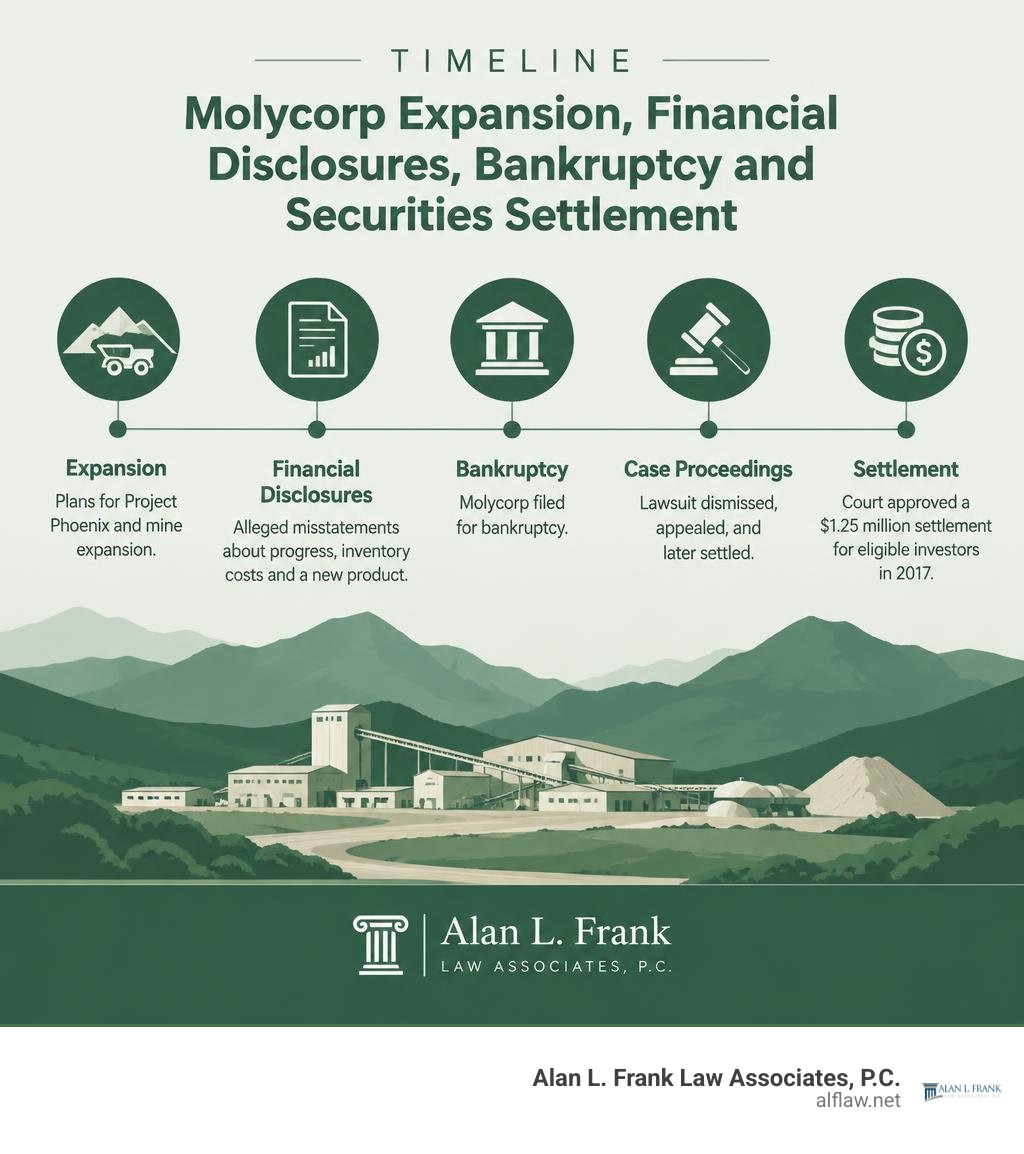
Simple guide to molycorp securities class action terms:
Origins of the Molycorp Securities Class Action
To understand why shareholders took legal action against Molycorp, Inc., we have to look back at the global rare earth market around 2010 to 2012. Rare earth elements (REEs) are a group of specialized minerals vital for manufacturing high-tech electronics, electric vehicle motors, wind turbines, and advanced defense systems. At the time, China controlled the overwhelming majority of global rare earth production and began restricting export quotas. This sent market prices soaring and created an urgent push in Western nations to establish alternative domestic sources.
Molycorp owned the Mountain Pass mine in California, positioning itself as the premier Western producer ready to break the supply bottleneck. The company launched massive capital-raising efforts, promoting a state-of-the-art modernization initiative known as “Project Phoenix.” Investors poured capital into Molycorp’s common and preferred shares, anticipating huge profits as the facility ramped up commercial extraction.

However, operational realities soon clashed with corporate optimism. Mining and refining rare earths involves intricate chemical separations, splitting light rare earth elements (LREEs)—such as lanthanum and cerium—from far more lucrative heavy rare earth elements (HREEs) like dysprosium and terbium. When extraction timelines slipped, costs skyrocketed, and promised financial metrics failed to materialize, shareholders suffered catastrophic losses.
For investors navigating sudden market collapses, recovering investment losses often hinges on whether corporate executives shared accurate operational data or covered up known bottlenecks while selling millions in company equity.
Project Phoenix Expansion and Production Targets
Project Phoenix was conceived as a multi-phase engineering overhaul designed to turn Mountain Pass into an ultra-modern mining hub:
- Phase I Goals: Intended to scale production capacity from roughly 3,000 metric tons up to 19,050 (or 19,500) metric tons of rare earth oxides per year, with a projected capital expenditure of around $531 million.
- Phase II Goals: Envisioned expanding total capacity to 40,000 metric tons annually.
Despite enthusiastic public statements about hitting these capacity milestones, internal execution ran into severe engineering bottlenecks. Construction delays mounted, chemical leaching processes failed to run at operational benchmarks, and contractor disputes boiled over—eventually leading Molycorp to terminate its primary engineering contractor, M&K Chemical Engineering, due to acute performance deficiencies. When management finally disclosed a six-month delay in Project Phoenix milestones, the stock plummeted 22.7% in a single day.
Financial Restatements and the Subsequent Stock Plunge
Operational hurdles were only part of the problem. On August 8, 2013, Molycorp shocked Wall Street by announcing that its previously issued unaudited financial statements for the quarter ending March 31, 2013, could no longer be relied upon.
The company’s Audit and Ethics Committee flagged serious accounting errors, primarily involving:
- Inventory Reconciliation Errors: Inaccurate valuation of cost of sales and finished rare earth product inventories.
- Severance Expense Accruals: Miscalculated and improperly timed severance liability charges.
The revelation of internal control failures and delayed quarterly Form 10-Q filings triggered an immediate 10% single-day decline in share price. Subsequent corrective disclosures regarding the commercial limitations of SorbX—a proprietary wastewater treatment product—caused another 21.4% drop, dragging the stock down to $5.58 and wiping out millions in investor value.
Core Allegations and Judicial Rulings
The litigation was consolidated in the U.S. District Court for the Southern District of New York under Civil Action No. 13-Civ-5697 (PAC). The lawsuit asserted claims under:
- Section 10(b) of the Securities Exchange Act of 1934 and SEC Rule 10b-5, alleging intentional or reckless misstatements regarding Project Phoenix progress, accounting accuracy, and product viability.
- Section 20(a) of the Exchange Act, holding executive officers liable as controlling persons.
- Sections 11, 12(a)(2), and 15 of the Securities Act of 1933 in related public offering actions.
Plaintiffs alleged that executives painted a misleading picture of smooth operational ramp-ups while masking severe engineering failures and financial inaccuracies. However, federal securities laws impose high hurdles at the initial motion-to-dismiss phase, as detailed in the District Court dismissal opinion.
Pleading Scienter in the Molycorp Securities Class Action
Under the Private Securities Litigation Reform Act of 1995 (PSLRA), plaintiffs cannot merely show that a corporate projection turned out wrong. They must plead specific facts giving rise to a “strong inference” of scienter—meaning the defendants acted with an intent to deceive, manipulate, or defraud, or with severe recklessness.
In Molycorp’s case, plaintiffs presented accounts from confidential witnesses, including former engineers and analytical chemists, who testified that key processing circuits were non-operational when management was publicly projecting timely completion. However, the court ruled that these accounts failed to prove that the named executive defendants possessed real-time internal reports directly contradicting their public statements at the exact time they spoke. Corporate mismanagement or overly optimistic engineering assessments do not automatically equal securities fraud under federal pleading standards.
Safe Harbor Protection and Commercial Viability Claims
The court also evaluated statements concerning SorbX, Molycorp’s proprietary chemical product marketed for municipal wastewater phosphorus extraction. When SorbX failed to generate anticipated commercial revenues, investors argued that management had overstated its market readiness.
The court rejected these claims under the PSLRA Statutory Safe Harbor for Forward-Looking Statements. The court determined that:
- Management’s statements regarding projected commercial adoption were forward-looking statements accompanied by meaningful cautionary language.
- Disclosures explicitly warned investors about technological risks, market acceptance hurdles, and the unproven nature of commercial-scale deployments.
- Because the warnings were tailored to the specific operational risks Molycorp faced, the statements were legally protected against fraud claims.
Settlement Terms and Derivative Case Coordination
Following the district court’s dismissal, the plaintiffs filed an appeal. During the appellate process, Molycorp’s deteriorating liquidity, compounded by falling rare earth prices, forced the company into Chapter 11 bankruptcy. Faced with bankruptcy automatic stays, complex insurance asset pools, and substantial litigation risk, the parties entered formal mediation.
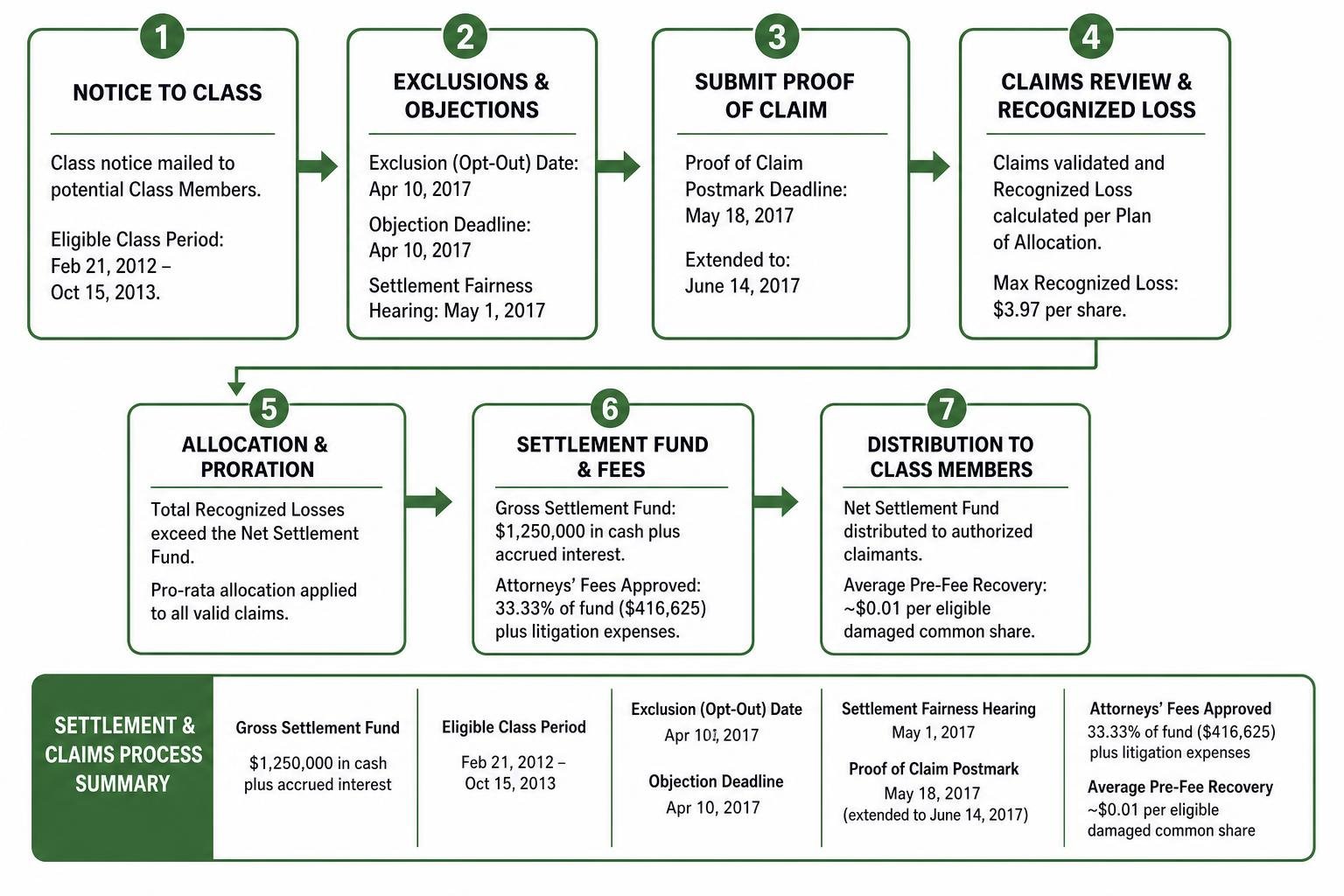
The negotiations produced a $1.25 million Gross Settlement Fund in cash, resolving the claims against individual executive defendants and their insurers without any admission of liability. The court granted final settlement approval on June 16, 2017.
Claims Process and Allocation for Damaged Shares
The Net Settlement Fund (gross settlement minus attorneys’ fees, litigation expenses, administrative costs, and taxes) was distributed to authorized claimants on a pro-rata basis under a court-approved Plan of Allocation.
As outlined in the official Class action settlement notice, each claimant’s recovery was determined by a Recognized Loss formula:
- Zero Recognized Loss: Shares purchased during the class period but sold prior to the first corrective disclosure on November 2, 2012, had no recognized loss because the alleged fraud had not yet been revealed to the market.
- Calculated Recognized Loss: Shares purchased between February 21, 2012, and October 15, 2013, and held through subsequent corrective disclosures were assigned loss amounts up to $3.97 per share, depending on the purchase timing and sale price.
- Pro-Rata Allocation: Because the total recognized losses across all damaged shares far exceeded the Net Settlement Fund, actual distributions were adjusted proportionally, resulting in an average payout of approximately $0.01 per damaged share.
Evaluating distributions and fee structures across complex corporate resolutions is an essential part of tracking class recovery outcomes.
Managing Follow-On Derivative Lawsuits Alongside the Molycorp Securities Class Action
When public companies suffer major stock declines, shareholder derivative suits frequently accompany securities class actions. In derivative actions, shareholders sue corporate directors on behalf of the corporation itself, alleging breaches of fiduciary duty, gross mismanagement, or waste of corporate assets.
In Molycorp’s litigation, parallel derivative actions were filed in state and federal courts, including the Delaware Court of Chancery. A central procedural issue was whether to stay (pause) the derivative litigation while the federal securities class action progressed.
Courts weigh several factors when deciding motions to stay follow-on derivative claims:
- Factual Overlap: Derivative claims often mirror the factual allegations of the class action (e.g., Project Phoenix milestones and inventory reporting).
- Contingent Harm and Indemnification: A major portion of the corporation’s alleged damages in a derivative suit is its potential liability in the securities class action. Proceeding simultaneously risks duplicative discovery and inconsistent judicial findings.
- Judicial Economy: Staying the derivative action avoids wasting corporate and judicial resources until the primary liability issues are resolved in the class case.
Courts regularly grant stays in these circumstances. However, if derivative claims involve distinct issues—such as executive compensation abuse or self-dealing—or if regulatory investigations close without action, courts may lift stays to let independent corporate governance claims proceed. Understanding these procedural dynamics is essential when structuring shareholder derivative strategies.
Key Takeaways for Mining and Securities Litigation

The Molycorp litigation offers critical lessons for institutional investors, legal practitioners, and corporate leadership across capital-intensive industries.
Scrutinizing Technical Mineral Disclosures
Mining ventures carry unique operational and geological risks that must be carefully evaluated:
- Assay Verification vs. Commercial Feasibility: Having traces of valuable minerals (like heavy rare earths) in a core sample does not mean they can be extracted profitably at scale. Investors and analysts must look beyond gross reserve claims and scrutinize metallurgical recovery rates.
- Capital Expenditure Overruns: Large industrial overhauls like Project Phoenix routinely experience engineering bottlenecks. When an issuer repeatedly promises aggressive timelines without discussing technical contingencies, investors should verify whether independent engineering audits support those milestones.
- Underwriter Due Diligence: In secondary public offerings, financial underwriters have an affirmative duty to conduct reasonable investigations into offering prospectus claims.
Lessons for Parallel Class and Derivative Claims
For attorneys and shareholders managing complex corporate disputes, the Molycorp saga highlights several procedural rules:
- PSLRA Pleading Discipline: Surviving a motion to dismiss requires specific documentary or witness evidence showing that executives possessed contrary facts when making optimistic statements.
- Bankruptcy Alters Recovery Realities: When an issuer enters Chapter 11, the primary recovery source shifts almost entirely to Director and Officer (D&O) liability insurance policies. This dynamic frequently forces modest cash settlements to avoid exhausting policy limits on legal defense costs.
- Coordinated Case Sequencing: Managing parallel class and derivative actions requires careful timing around discovery stays and settlement negotiations to maximize total shareholder value while protecting corporate assets.
Frequently Asked Questions About Molycorp Securities Litigation
What were the core allegations against Molycorp executives?
The primary allegations centered on claims that Molycorp executives issued false and misleading statements between 2012 and 2013 regarding the operational progress and construction timelines of Project Phoenix at the Mountain Pass mine. Additionally, plaintiffs alleged that the company concealed severe engineering bottlenecks, overstated the commercial readiness of its wastewater product SorbX, and misstated its financial results due to internal control deficiencies in inventory reconciliation and severance accruals.
What was the final settlement amount and recovery per share?
The securities class action settled for a gross amount of $1,250,000 in cash. After deducting court-approved attorneys’ fees (33.33%), litigation expenses, and administrative costs, the remaining Net Settlement Fund was distributed pro-rata to eligible claimants who bought shares between February 21, 2012, and October 15, 2013. The estimated average distribution across all damaged common shares was approximately $0.01 per share before deductions.
Why was the parallel shareholder derivative lawsuit stayed?
The parallel shareholder derivative actions were stayed under principles of judicial economy and prejudice prevention. Because the derivative suits were based on the same operational and financial disclosures as the securities class action, simultaneous litigation risked duplicative discovery, conflicting judicial rulings, and premature litigation over corporate indemnification obligations while the primary class action was still pending.
Conclusion
The rise and fall of Molycorp illustrates the volatile intersection of speculative industrial expansion, commodity market pressures, and federal disclosure laws. While the $1.25 million settlement provided a structured resolution for eligible class members, the case stands as a key example of the stringent pleading thresholds plaintiffs face under the PSLRA when challenging operational delays and forward-looking corporate projections.
At Alan L. Frank Law Associates, P.C., we draw on decades of combined legal and financial experience to advocate for shareholders, businesses, and institutional investors facing complex investment disputes. If you are evaluating portfolio losses resulting from potential disclosure fraud or accounting irregularities, explore your securities litigation options with our team today.