
What to Do If You Suspect Oil and Gas Fraud in Your Investment Portfolio


What to Do If You Suspect Oil and Gas Fraud in Your Investment Portfolio
How to Spot Oil and Gas Fraud Before Losses Grow
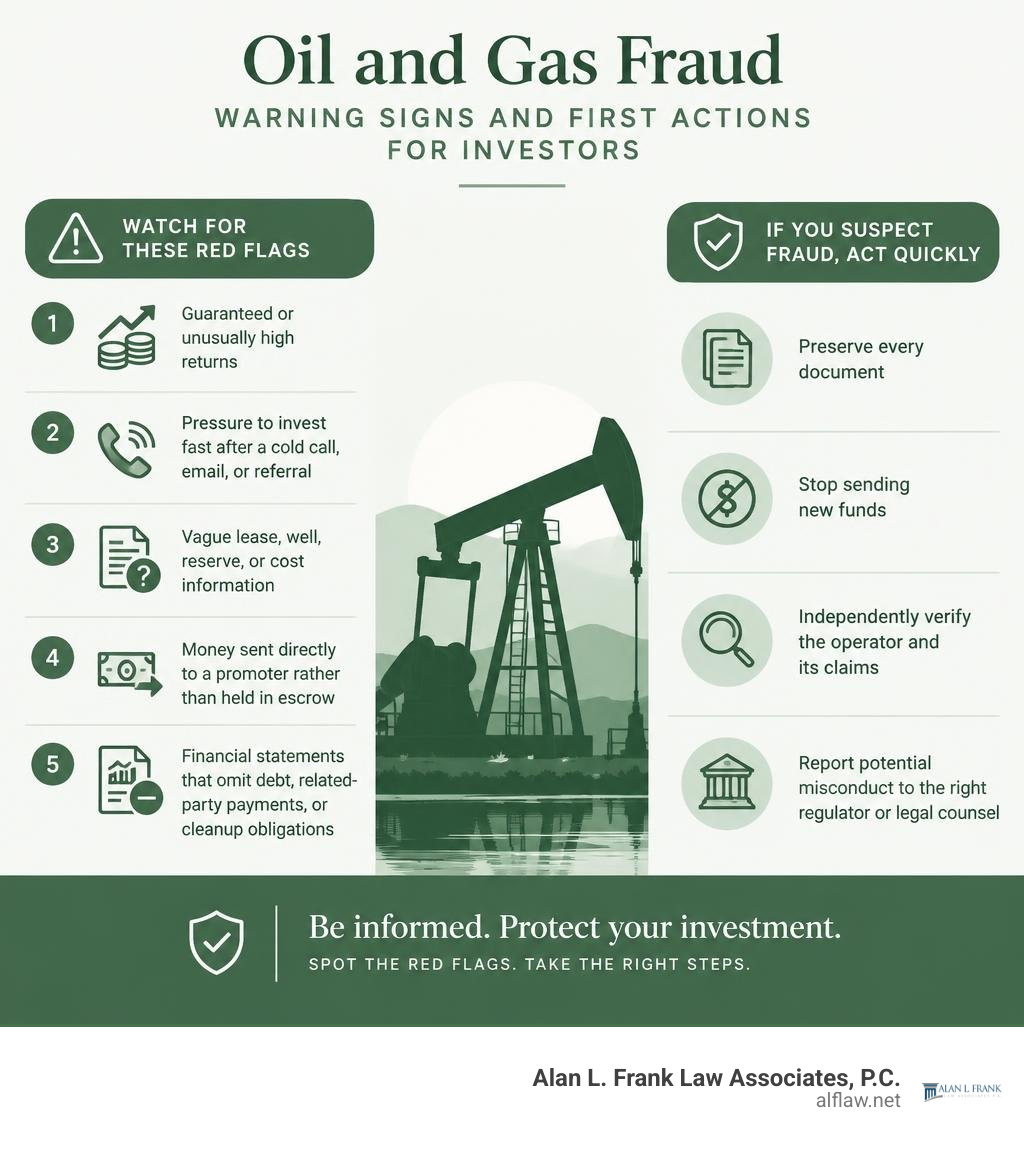
If you suspect oil and gas fraud in your portfolio, act quickly: preserve every document, stop sending new funds, independently verify the operator and its claims, and report potential misconduct to the right regulator or legal counsel. Common schemes include inflated reserve estimates, false drilling costs, missing investor funds, sham vendors, undisclosed cleanup liabilities, and misleading promises about returns.
Watch for these early red flags:
- Guaranteed or unusually high returns from drilling or production.
- Pressure to invest fast after a cold call, email, or referral.
- Vague lease, well, reserve, or cost information that cannot be checked.
- Money sent directly to a promoter rather than held in a clear escrow arrangement.
- Financial statements that omit debt, related-party payments, or cleanup obligations.
Energy investments can be complex, illiquid, and hard to value. That complexity can give a dishonest promoter room to hide weak assets, overstated production, or liabilities that may later destroy the investment’s value. The safest first move is to create a complete record of what you were told, what you signed, and where your money went.
I am Alan L. Frank, a CPA, attorney, and managing attorney at Alan L. Frank Law Associates, P.C., with more than 20 years of experience handling complex commercial disputes, securities matters, and investment-loss claims. My background in accounting, tax law, and litigation helps investors assess potential oil and gas fraud and pursue appropriate recovery options.
Oil and gas fraud further reading:
Common Types of Oil and Gas Fraud Targeting Portfolios
Energy sector investments carry inherent geological and commodity risks, but fraudulent promoters actively distort these risks to deceive investors. Deceptive issuers often exploit the specialized language of engineering reports and mineral rights to obscure the true financial health of a venture. When capital is diverted into non-producing assets or pocketed through undisclosed administrative fees, individual portfolios suffer substantial harm.
| Offering Feature | Legitimate Energy Venture | Fraudulent Energy Offering |
|---|---|---|
| Regulatory Registration | Registered with SEC/State or valid private placement exemption | Unregistered, evasive on exemptions, unlicensed promoters |
| Custody of Funds | Segregated third-party escrow accounts | Commingled operating accounts or direct transfers to promoters |
| Cost Transparency | Documented AFE (Authorization for Expenditure) with third-party audits | Inflated turnkey drilling costs, phantom soft-dollar markups |
| Production Disclosures | Verifiable state regulatory filings and audited reserve reports | Guaranteed monthly yields, unproven wildcat claims, no filings |
| Environmental Liabilities | Fully funded asset retirement obligations and adequate bonding | Undisclosed plugging liabilities, shell transfers of aging wells |
Identifying Private Placement and Reserve Reporting Oil and Gas Fraud
One of the most widespread schemes involves inflating estimated ultimate recovery (EUR) figures and proven reserves in private placement memorandums (PPMs). Dishonest promoters frequently misclassify speculative acreage as proven reserves to justify inflated subscription prices. Understanding how a private placement fraud attorney holds dishonest issuers accountable is critical when analyzing offering documents filled with fabricated line items.
Fraudsters often pad project development costs with bogus advisory fees, exaggerated accounting charges, and fictional engineering expenses. In a notable Fifth Circuit precedent on misrepresented project development expenses, the appellate court affirmed that presenting fabricated development cost worksheets in an energy venture constitutes actionable fraudulent inducement. Promoters cannot hide behind boilerplate disclaimer language or merger clauses when they knowingly provide false financial data to induce capital commitments.
Environmental Liability Dumping and Orphan Well Schemes
A growing financial threat in energy portfolios is the deliberate underreporting of Asset Retirement Obligations (AROs). When wells reach the end of their productive lives, operators are legally required to plug them and remediate the surface land. The Interstate Oil and Gas Compact Commission tallied 142,000 known orphan wells across 29 states in 2024, with regulators estimating hundreds of thousands more remain undocumented.
Unscrupulous operators spin off dying, unprofitable wells into undercapitalized shell companies to offload plugging obligations. This leaves investors holding shares in entities burdened with massive, undisclosed cleanup debts. As detailed in NASAA investor guidance on energy ventures, failing to account for full environmental liabilities can wipe out equity value when state regulators mandate immediate well remediation.
Misappropriation and Ponzi-Style Drilling Programs
In classic Ponzi-style energy programs, capital raised from new participants is used to pay “production dividends” to earlier investors rather than funding active drilling. Operators frequently inflate turnkey drilling contracts, charging the partnership millions of dollars for work completed by related entities at a fraction of the cost.
A prominent example includes the SEC enforcement action regarding misappropriated drilling funds involving a self-proclaimed energy promoter who raised over $80 million from hundreds of retail investors. Regulators revealed that tens of millions of dollars were siphoned directly from drilling accounts to fund lavish personal lifestyles while marketing materials claimed the money was dedicated to operational expenses.
Critical Warning Signs and Red Flags in Energy Portfolios

Detecting energy fraud requires careful analysis of corporate structure, operational records, and financial disclosures. Promoters who operate fraudulent ventures often rely on investor inertia, hoping that technical jargon prevents victims from noticing accounting anomalies.
Warning Signs of Oil and Gas Fraud in Unsolicited Offerings
Aggressive sales pitches are among the clearest indicators of fraudulent syndications. High-pressure boiler rooms routinely pitch direct participation programs, working interests, and limited partnerships using unsolicited calls and digital marketing campaigns. These promoters frequently claim that adjacent acreage is being drilled by major integrated producers to create a false sense of security.
These solicitations frequently target self-directed retirement funds, emphasizing high tax write-offs like intangible drilling cost (IDC) deductions to distract from poor asset quality. When dealing with self-directed IRAs, protecting retirement accounts from predatory financial advisers requires verifying that any recommended private placement meets baseline suitability standards.
Opaque Financial Disclosures and Shell Company Networks
Complex networks of affiliated entities often serve to conceal the true flow of investor funds. When promoters route money through multiple subsidiaries, they can easily inflate equipment invoices, charge excessive management fees, and obscure transactions between related parties.
Common disclosure warning signs include:
- Absence of independent escrow accounts, allowing immediate commingling of subscription proceeds.
- Invoices issued by single-employee vendors that share a business address with the promoter.
- Discrepancies between investor reports and state-reported production numbers, signaling phantom revenue.
- Failure to provide audited financial statements prepared by independent, certified public accountants.
Step-by-Step Guide: What to Do If You Suspect Energy Fraud

If you uncover discrepancies in your energy investments, structured action is vital to preserve your legal claims and maximize the likelihood of financial recovery.
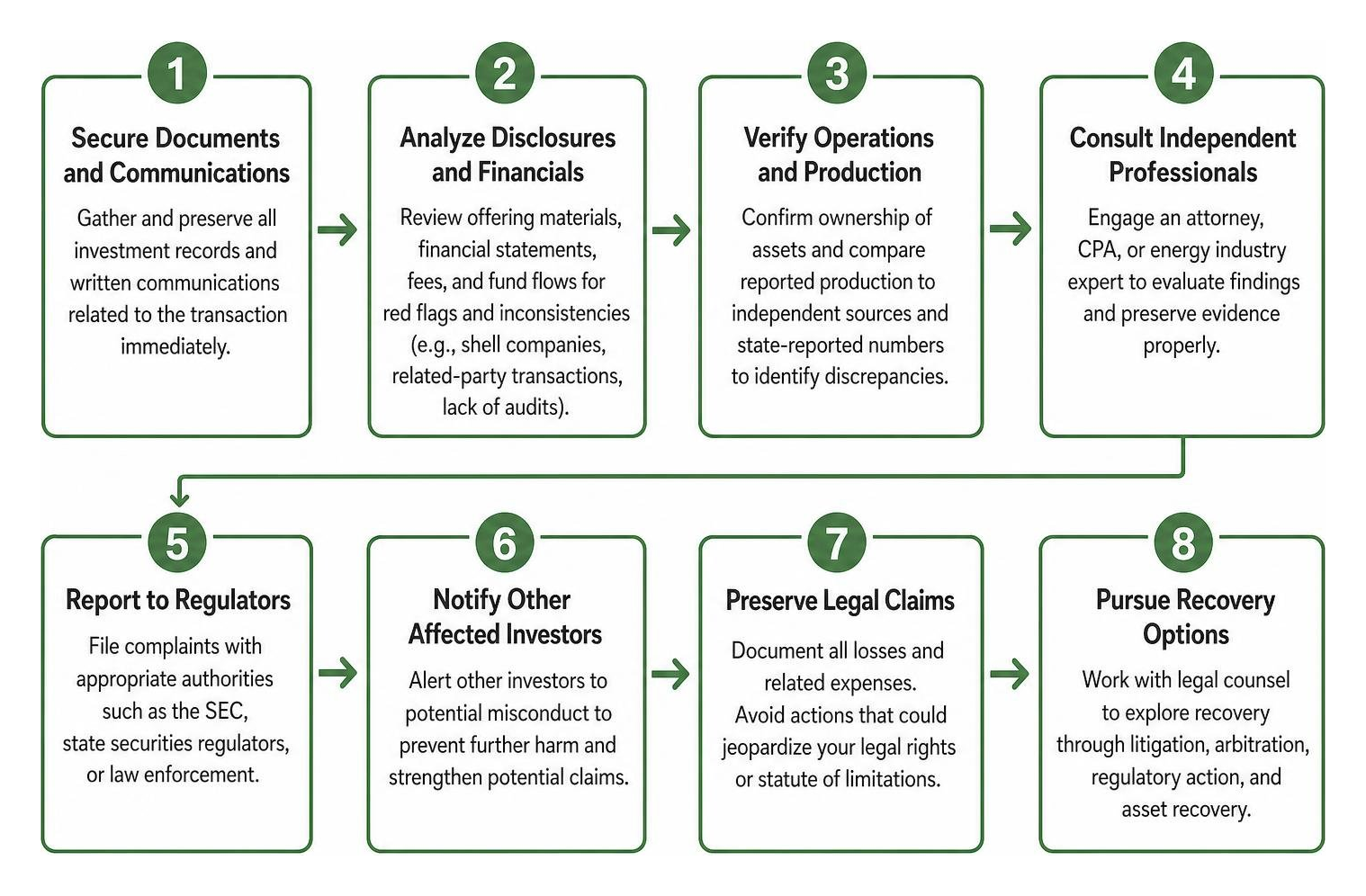
Step 1: Secure Investment Documentation and Written Communications
The moment misconduct is suspected, gather and preserve every record related to the transaction. Issuers facing regulatory scrutiny often alter digital portals or terminate corporate entities.
Essential records to collect immediately:
- Private Placement Memorandums (PPM), subscription agreements, and operating contracts.
- Bank wire confirmations, canceled checks, and escrow account instructions.
- Geological surveys, engineering reports, and Authorizations for Expenditure (AFE).
- Monthly joint interest billing (JIB) statements and revenue distribution stubs.
- All email correspondence, text messages, marketing decks, and promotional brochures.
Step 2: Conduct Independent Regulatory and Public Record Audits
Cross-reference the representations in your offering documents against public databases:
- SEC EDGAR System: Verify whether the offering filed a Form D or public registration, and review disclosures for reported litigation.
- State Securities Agencies: Confirm whether the salesperson and issuing entity are licensed to sell securities in your jurisdiction.
- State Energy Commissions: Check well completion reports, active permit statuses, and actual monthly production volumes against your distribution statements.
- County Land Records: Ensure the operator actually owns or leases the mineral rights pledged in the offering agreement.
Step 3: Retain Legal Counsel to Investigate and Trace Capital
Uncovering complex energy scams requires forensic accounting capabilities and seasoned legal representation. Understanding how oil investment fraud attorneys uncover energy scams and recover funds helps investors identify whether fund managers violated fiduciary duties, breached subscription contracts, or engaged in unlawful securities transactions. Experienced counsel can subpoena bank records, evaluate corporate structures, and freeze remaining assets before they are dissipated.
Legal Forums and Strategies for Recovering Energy Investment Losses
Victims of fraudulent energy offerings have several legal avenues to pursue recovery, depending on how the securities were marketed and sold.
Resolving Broker Misconduct via FINRA Arbitration
When retail brokers recommend private energy placements or speculative oil partnerships, they must adhere to FINRA suitability standards and perform rigorous due diligence. Broker-dealers cannot simply rely on the promoter’s promotional materials; they must independently confirm the legitimacy of the issuer’s claims.
If a financial advisor recommended an unsuitable energy program or failed to disclose material risks, investors can seek relief through the FINRA dispute forum for broker misconduct claims. Working alongside skilled FINRA arbitration attorneys allows defrauded individuals to hold brokerage firms accountable for supervisory failures.
Federal Securities Class Actions and Qui Tam Whistleblower Lawsuits
When public energy companies mislead shareholders regarding reserve valuations, production metrics, or environmental obligations, institutional and retail investors can pursue securities litigation remedies under the Securities Exchange Act of 1934.
Additionally, when oil and gas fraud directly harms government entities—such as underpaying federal or state mineral royalties, rigging lease auctions, or abandoning well plugging liabilities on public lands—whistleblowers can file qui tam lawsuits under the False Claims Act. Whistleblowers who provide original evidence of fraud can receive substantial statutory awards while helping recover public funds.
Frequently Asked Questions About Energy Investment Schemes
What is the statute of limitations for filing an oil and gas investment loss claim?
Statutory deadlines vary depending on the legal theory and the forum. For federal securities fraud claims under Section 10(b), actions generally must be filed within two years of discovering the fraud, or within five years of the fraudulent transaction.
Under state law claims, Texas, Pennsylvania, and New Jersey apply the “discovery rule,” which pauses the statute of limitations until the investor knew, or through reasonable diligence should have known, of the deceptive conduct. FINRA arbitration rules require claims to be submitted within six years of the event giving rise to the dispute.
Can defrauded energy investors recover funds if the operating company goes bankrupt?
Yes, recovery remains possible even if the primary operating company enters bankruptcy proceedings. Investors can pursue claims against culpable corporate officers, promoters, accounting firms, and broker-dealers who participated in the fraud.
In many cases, courts appoint an equity receiver to trace diverted funds and initiate clawback actions against insiders who received fraudulent transfers.
How do orphan well liabilities impact private energy fund valuations?
Undisclosed orphan well liabilities can render an energy fund insolvent. When operators fail to fund Asset Retirement Obligations, state regulatory agencies can issue compliance orders, seize operational bonds, or shut down active production across other leases.
These environmental liabilities encumber the fund’s balance sheet, drastically reducing the net asset value (NAV) and eliminating distributions for equity holders.
Conclusion
Detecting oil and gas fraud requires prompt, decisive action. Energy syndications and private placements carry unique structural complexities that dishonest operators exploit to divert capital and conceal mounting liabilities. By securing your records, verifying state production data, and identifying the true flow of funds, you can prevent further losses and establish a clear foundation for legal recovery.
At Alan L. Frank Law Associates, P.C., we bring extensive litigation experience to complex financial disputes. Our team assists clients nationwide from our offices in Philadelphia and Jenkintown, Pennsylvania, as well as New Jersey. If you suspect deceptive practices, unfulfilled drilling promises, or financial misrepresentation in your energy portfolio, consider pursuing recovery through securities litigation for investment losses to protect your rights and recover your capital.