
Real Estate Investment Scams: How Fake Coaching and Phantom Deals Cost Investors Millions


Real Estate Investment Scams: How Fake Coaching and Phantom Deals Cost Investors Millions
How to Spot a Real Estate Investment Scam
A real estate investment scam may promise profits from properties the seller does not own or cannot prove exist. Before investing, check the property deeds and liens in county records, request an independent valuation, and verify the people selling the deal. Do not rely on a coaching course, social media posts, or early payouts as proof that an investment is real.
Fraudsters can use polished presentations and high-return promises to make a phantom deal look credible. In some schemes, money from new investors pays earlier investors, hiding the losses until payments stop.
I’m Alan L. Frank, an attorney and CPA with more than 20 years of experience in complex litigation, including investment-loss and securities disputes. I’ll walk you through the signs of a real estate investment scam and the steps to take if you suspect one.
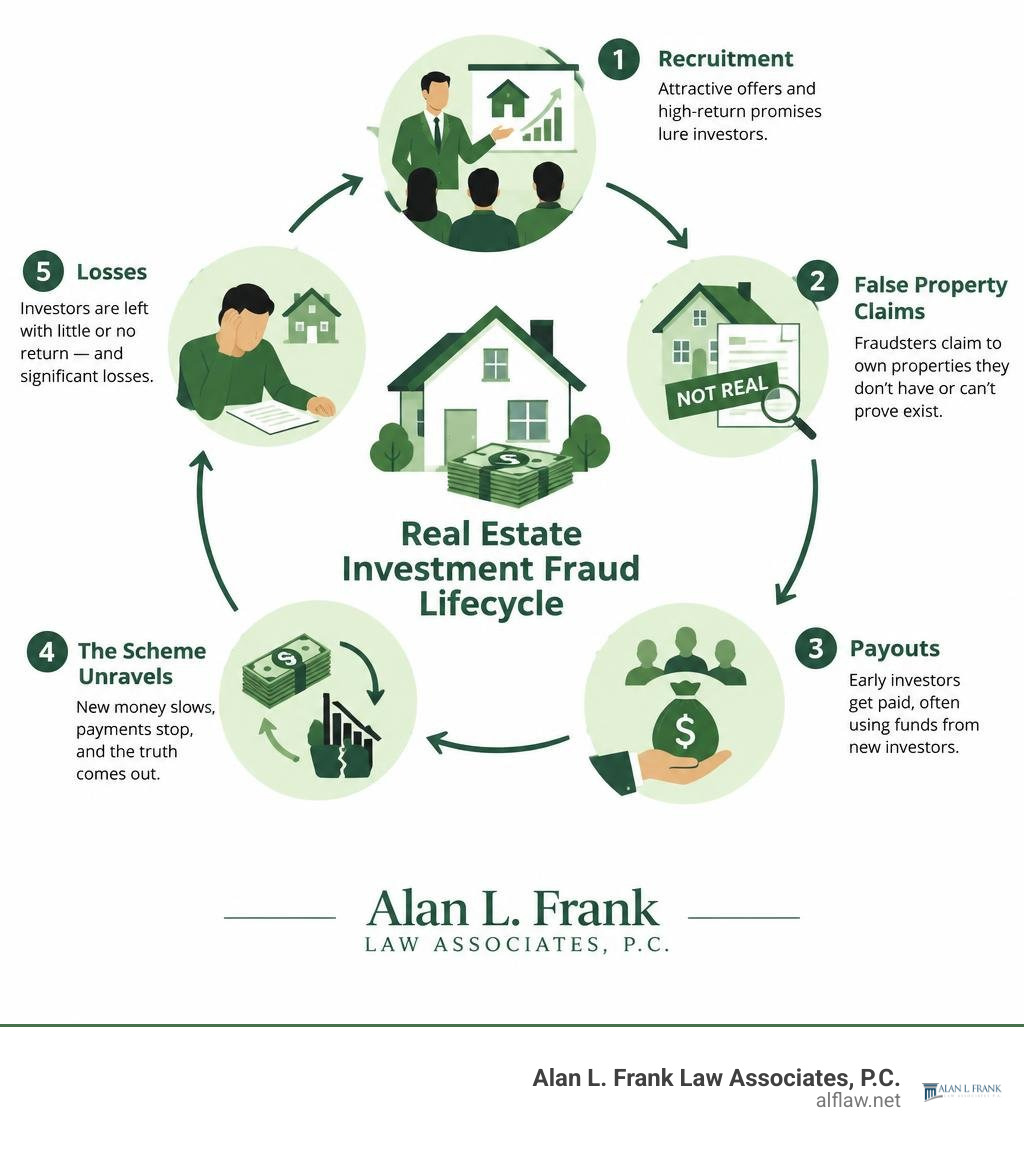
Real estate investment scam terms made easy:
Anatomy of a Real Estate Investment Scam: Common Tactics and Phantom Portfolios

Real estate has long been viewed as a cornerstone of wealth creation. Because physical property feels tangible and secure, scammers frequently exploit this trust to construct elaborate illusions of high-yield ventures. Fraudulent operators design offerings around distressed property turnarounds, commercial developments, or suburban fix-and-flips, dangling double-digit returns with little to no risk. In reality, the underlying portfolio is often heavily encumbered, radically inflated, or entirely nonexistent.
Promoters use aggressive sales scripts, slick marketing materials, and high-pressure seminars to solicit capital. Rather than deploying those funds into physical acquisitions or construction, the scheme operator uses fresh investor capital to fund an extravagant lifestyle, finance side gambles in speculative equities, or keep earlier investors quiet through fabricated returns. A clear example of this dynamic emerged in the Wells Real Estate fraud prosecution, where promoters raised $56 million from roughly 660 investors nationwide, claiming a massive, secure real estate portfolio that was vastly illusory.
Fabricated Asset Valuations and Phantom Property Deeds
The core engine of a phantom real estate offering is valuation manipulation. Scammers draft marketing decks presenting properties they do not own, or acquire single modest parcels and misrepresent their value tenfold. Some fraudsters go so far as using forged deeds, counterfeit notary stamps, and altered title reports to convince lenders and individual investors that their capital is secured by prime real estate.
These deceptive tactics were demonstrated in a high-profile case where a Queens District Attorney real estate indictment charged five individuals in a $3 million operation involving identity theft, fake entrepreneurship courses, and fraudulent notarization stamps used to transfer property without the owner’s authorization. When fraudsters bypass legitimate appraisal processes, victims are left holding worthless equity stakes or secondary liens subordinate to massive, undisclosed debts.
How Promissory Notes Fuel a Real Estate Investment Scam
To bypass institutional scrutiny, many operators raise funds using short-term promissory notes. Promising annual returns ranging from 12% to upwards of 80%, these unregistered debt instruments are pitched as safe, asset-backed opportunities with defined maturity windows.
Instead of generating revenue through property appreciation or rental cash flows, the promoter uses capital from incoming noteholders to satisfy interest obligations to previous cohorts. When the influx of new capital falters, the issuer defaults across the board. Understanding how these vehicles unravel is essential for any investor, which is why unmasking modern high-yield Ponzi schemes is a foundational step in identifying deceptive debt structures before they trigger catastrophic losses.
Recruitment Pipelines: Social Media, Fake Coaching, and Media Exploitation

Modern real estate fraudsters rarely wait for investors to find them; they build systematic recruitment pipelines across digital and traditional media channels. By combining the language of financial independence with aggressive digital marketing, bad actors create an aura of elite investment expertise.
The playbook often features:
- Sponsored Social Media Posts: Promoting exclusive wealth-building clubs, house-flipping masterminds, and passive cash-flow funds on platforms like Facebook and Instagram.
- Paid Broadcast Media: Buying airtime on local radio or podcast networks to pitch guaranteed real estate notes under the guise of an objective financial talk show.
- High-Ticket Mentorships: Charging thousands of dollars for real estate coaching bootcamps, only to steer novice graduates into the promoter’s own unregistered fund.
For instance, the SEC charges against Lamar Fletcher detailed how an operator raised $4.25 million from roughly 100 investors by joining property-investment social media groups and promising annualized returns of up to 80% on property he never bought.
Unregistered Brokers and Affinity Marketing
To expand their reach, organizers often recruit unregistered sales agents who leverage tight-knit community networks, cultural organizations, or church groups—a tactic known as affinity fraud. These agents pitch investments to their peers with absolute confidence, often blinded by hidden commissions that can siphon off up to 15% of the total raised capital.
When issuers conceal these internal fee structures and use unlicensed intermediaries to sell securities, they commit direct violations of state and federal securities laws. Working with counsel experienced in private placement fraud representation allows defrauded investors to identify every liable party in the promotional chain and pursue recovery from the entities and agents who facilitated the unregistered distribution.
The Drain on Self-Directed IRAs and Retirement Accounts
Retirees and individuals nearing retirement are primary targets for real estate scammers. Fraudsters understand that retirement accounts represent concentrated pools of liquid capital. Sales agents routinely guide prospective victims through rolling over traditional 401(k)s into self-directed IRAs (SDIRAs), which permit investments in private, non-traded real estate notes.
Because self-directed IRA custodians merely execute the account holder’s investment instructions without evaluating the legitimacy or risk of the underlying asset, investors mistakenly assume the custodian has vetted the offering. Unraveling why retirement accounts are targeted highlights how fraudsters exploit the administrative hands-off nature of SDIRAs to drain life savings into speculative or phantom portfolios.
Deceptive Structures: Shell Companies, Undisclosed Liens, and Ponzi Cycles
Fraudulent real estate operations rely on complex corporate scaffolding to hide the true movement of cash. Rather than operating transparently through a single registered partnership, organizers form webs of limited liability companies across multiple jurisdictions, making it difficult for an individual investor to track how their funds are deployed.
| Feature | Legitimate Real Estate Syndication | Fraudulent Real Estate Scheme |
|---|---|---|
| Asset Ownership | Property deed recorded in LLC name; public record | Unrecorded deeds, phantom parcels, or third-party ownership |
| Debt Disclosures | Full disclosure of senior debt, mortgages, and encumbrances | Undisclosed mortgages, hidden tax liens, unrecorded debt |
| Return Source | Rental income, property appreciation, refinances | Inflows from new investors; Ponzi-style distributions |
| Financial Transparency | Audited financial statements, regular third-party reporting | Vague updates, fabricated account statements, evasive managers |
| Broker Registration | Sold through FINRA-registered broker-dealers or Reg D exemptions | Unregistered sales agents, undisclosed commission structures |
Obscuring Ownership Through Multi-Tiered LLC Webs
By routing investor capital through multiple holding companies and subsidiary LLCs, organizers dilute equity and obscure senior liens. An investor may believe they are purchasing a first-lien equity stake in a multi-family renovation project, only to discover later that the property was already encumbered by private mortgages or tax liens. In severe cases, the managing entity assigns shares in an LLC that owns nothing more than a leasehold interest or a contract to buy that was never executed.
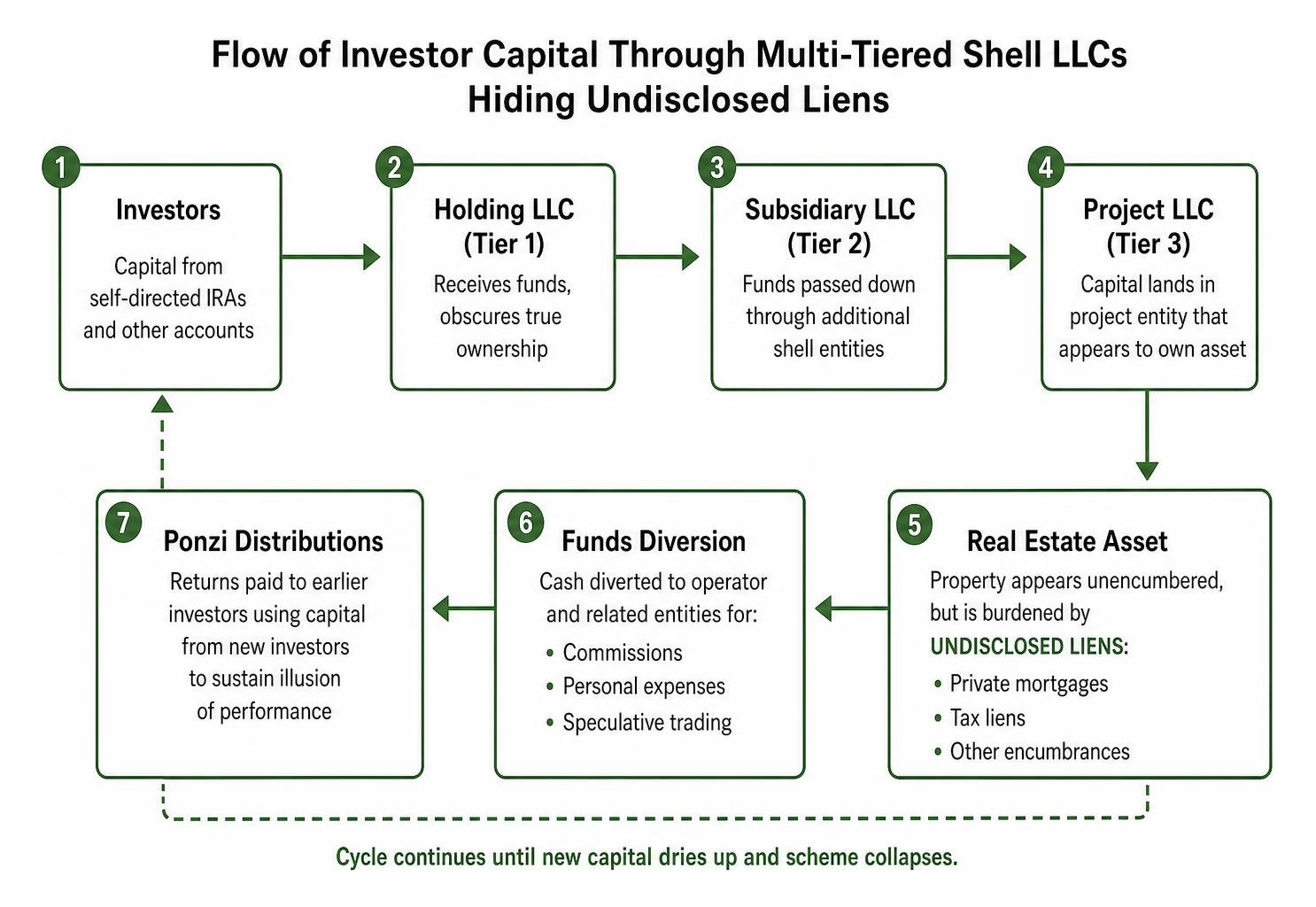
Ponzi Payouts Sustaining Illusionary Returns
Because phantom real estate generates zero organic operational revenue, the survival of the enterprise depends entirely on continuous capital intake. To maintain an appearance of solvency, the operator issues monthly or quarterly return distributions by transferring cash directly from accounts holding newly raised capital.
Behind the scenes, the operator diverts millions to luxury personal expenses, speculative equity day-trading, or high-risk futures contracts. In the Wells Real Estate matter, approximately $28 million of investor capital was diverted into speculative equities trading, and roughly $8 million was disbursed in Ponzi-like payments to existing investors while the company claimed a $450 million asset base that was worth only $11 million. Once redemption requests outpace new investor contributions, the structure collapses overnight.
Due Diligence and Fraud Detection: Protecting Capital from Phantom Deals
Conducting independent due diligence is essential prior to wiring funds or signing a private placement subscription agreement. Promoters often present convincing, professional documentation; verification must come directly from independent public records, regulatory filings, and neutral third-party experts.
Spotting Warning Signs of a Real Estate Investment Scam
Investors should be on high alert when encountering any of the following red flags:
- Guaranteed High Returns: Promises of 15% to 80% annual returns on real estate notes with “zero downside risk.”
- High-Pressure Timelines: Assertions that the opportunity is strictly limited and will close within 24 to 48 hours.
- Unregistered Offerings and Sellers: The entity and its promoters do not appear on SEC EDGAR or state regulatory databases.
- Inability to Inspect Deeds or Title Policies: The sponsor cannot or will not provide county recording parcel numbers, title insurance policies, or proof of title.
- Undisclosed Commissions: Sales agents receiving aggressive, non-standard referral commissions for sourcing capital.
- Payment Irregularities: Requests to wire funds to accounts held in names different from the operating entity listed in the private placement memorandum (PPM).
Essential Verification Steps Before Committing Capital
Before committing capital to any private real estate investment, follow this verification process:
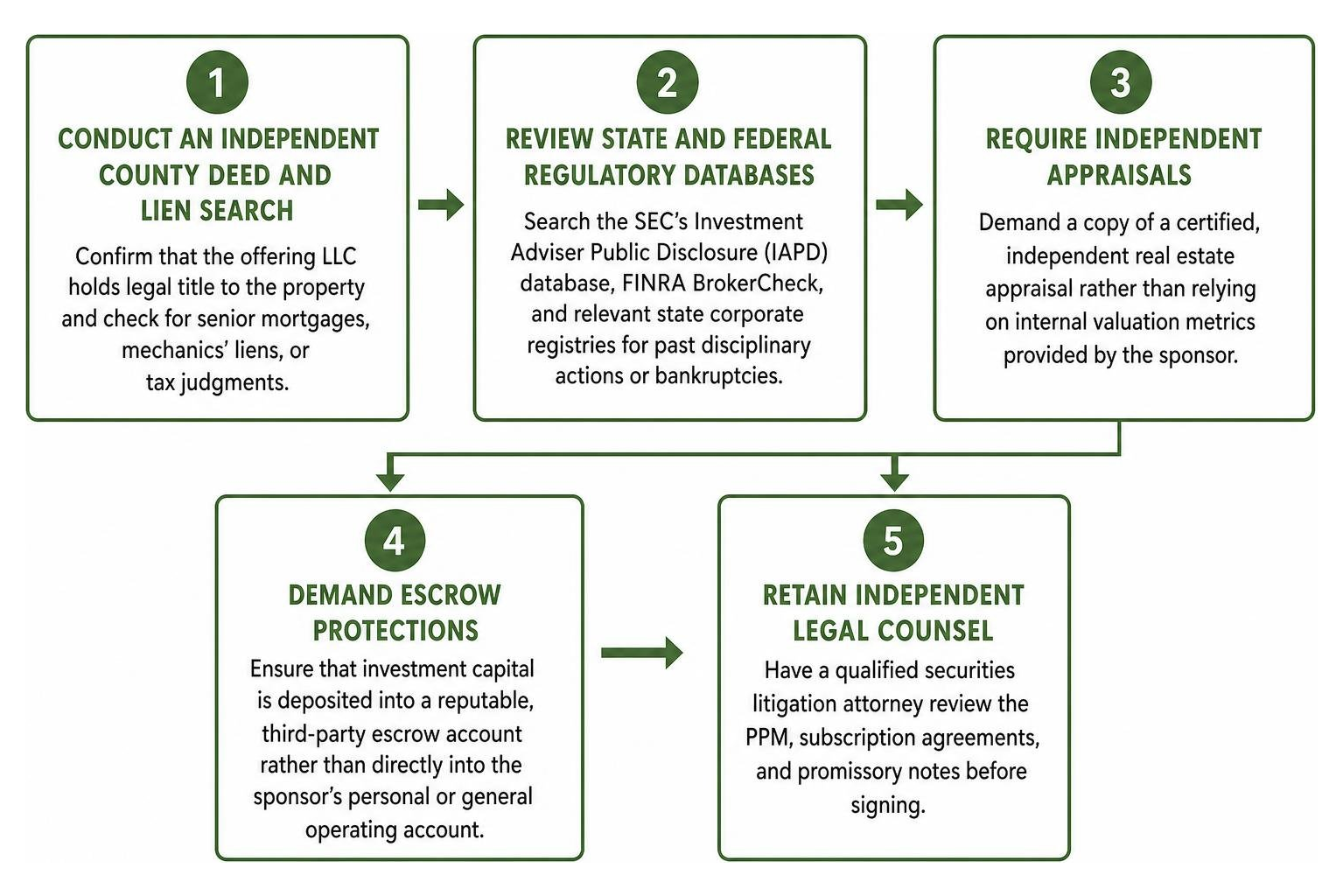
- Conduct an Independent County Deed and Lien Search: Confirm that the offering LLC holds legal title to the property and check for senior mortgages, mechanics’ liens, or tax judgments.
- Review State and Federal Regulatory Databases: Search the SEC’s Investment Adviser Public Disclosure (IAPD) database, FINRA BrokerCheck, and relevant state corporate registries for past disciplinary actions or bankruptcies.
- Require Independent Appraisals: Demand a copy of a certified, independent real estate appraisal rather than relying on internal valuation metrics provided by the sponsor.
- Demand Escrow Protections: Ensure that investment capital is deposited into a reputable, third-party escrow account rather than directly into the sponsor’s personal or general operating account.
- Retain Independent Legal Counsel: Have a qualified securities litigation attorney review the PPM, subscription agreements, and promissory notes before signing.
Legal Recourse and Regulatory Enforcement for Defrauded Investors
When a fraudulent real estate venture unravels, defrauded investors often feel overwhelmed and unsure where to turn. Fortunately, federal, state, and civil legal frameworks provide avenues to hold perpetrators accountable and pursue financial recovery.
Regulatory Coordination Across SEC and Law Enforcement
Large-scale real estate frauds frequently trigger parallel civil and criminal enforcement actions. The Securities and Exchange Commission (SEC) investigates unregistered securities sales, misrepresentations, and Ponzi mechanics, filing federal civil actions to freeze assets, impose civil monetary penalties, and appoint independent receivers.
Simultaneously, federal prosecutors from the U.S. Attorney’s Office, local District Attorneys, and agencies such as the U.S. Secret Service pursue criminal indictments for wire fraud, mail fraud, grand larceny, and money laundering. These proceedings often culminate in substantial prison sentences and court-mandated restitution orders against the promoters and their co-conspirators.
Pursuing Civil Recovery and Private Litigation
While criminal convictions provide accountability, government restitution funds rarely cover the full scope of investor losses. Defrauded investors must actively explore private civil litigation to secure meaningful financial recovery.
Private civil options include:
- Securities Fraud Lawsuits: Pursuing claims under federal securities laws (such as Rule 10b-5) and state blue-sky statutes against the company, founders, and controlling executives.
- Third-Party Liability Claims: Holding unregistered sales agents, participating broker-dealers, fraudulent appraisers, or escrow agents liable for aiding, abetting, or facilitating the fraud.
- Receivership Distribution and Clawback Actions: Coordinating with court-appointed receivers to ensure recovered assets are equitably distributed among victims.
Navigating these claims requires seasoned legal representation familiar with asset recovery and courtroom advocacy. Engaging in investment loss litigation allows victims to untangle deceptive LLC webs, identify hidden liquid assets, and demand accountability from institutional gatekeepers who permitted fraudulent funds to move unchecked.
Frequently Asked Questions about Real Estate Investment Scams
How do fraudsters fabricate entire real estate portfolios?
Scammers fabricate portfolios by creating marketing decks with images of properties they do not own, forging deeds, purchasing domain names that closely resemble established investment trusts, and using fraudulent notarizations. They also form shell corporations with names nearly identical to legitimate commercial real estate firms to confuse prospective investors during casual online searches.
What should I do immediately after discovering a fraudulent real estate deal?
If you discover you have invested in a fraudulent real estate deal:
- Preserve All Evidence: Immediately download and back up all emails, text messages, offering memoranda, promissory notes, wire transfer receipts, and marketing materials.
- Cease Direct Communication with the Promoter: Do not accept excuses, promised restructuring plans, or rollover note offers designed to delay legal action.
- Freeze Your Credit: If you provided personal identification details or tax documents, place a fraud alert or credit freeze with all major credit bureaus.
- Consult an Investment Fraud Attorney: Seek immediate legal representation to evaluate civil litigation options, freeze remaining liquid funds, and assert your claims in court.
Can investors recover money lost in a real estate Ponzi scheme?
Yes, recovery is possible through multiple legal channels. Defrauded investors can recover capital through civil litigation against the primary fraudsters, claims against negligent third parties (such as broker-dealers, banks, or appraisers who facilitated the scheme), participation in court-ordered receivership distributions, and the recovery of illicit profits clawed back from early investors or shell entities.
Protecting Your Investments from Deceptive Real Estate Schemes
Deceptive real estate offerings can cause devastating financial harm, particularly when life savings and retirement accounts are redirected into phantom assets and unregistered promissory notes. The sophisticated facade presented by promoters—reinforced by fake coaching courses, polished webinars, and unregistered sales networks—makes thorough, independent due diligence non-negotiable.
When real estate promoters violate securities laws, misrepresent portfolio values, or divert funds into Ponzi cycles, defrauded investors have clear legal avenues for recourse. At Alan L. Frank Law Associates, P.C., our legal team brings decades of combined experience in complex litigation, forensic accounting, and securities disputes to help clients across Pennsylvania and New Jersey unmask fraudulent operators and pursue maximum financial recovery.
If you suspect your capital has been compromised in a fraudulent real estate scheme or high-yield note program, review your options for securities litigation and investment loss recovery and speak with our experienced attorneys to begin safeguarding your financial future.