
The Best Local Construction Lawyers to Help You Build a Solid Case


The Best Local Construction Lawyers to Help You Build a Solid Case
How to Find the Right Construction Lawyer Near You
Start with lawyers licensed in your state who have handled your type of dispute. Ask about their work on construction defects, unpaid bills, delays, or contract claims. Check who will handle your case, how they charge, and whether a lien or claim deadline needs quick action. A nearby office can help, but relevant experience matters more than distance.
I’m Alan L. Frank, managing attorney at Alan L. Frank Law Associates, P.C. I have led the firm for over 20 years and handle complex commercial litigation; if you’re searching for a construction lawyer near me, this guide will help you ask the right questions before choosing counsel.
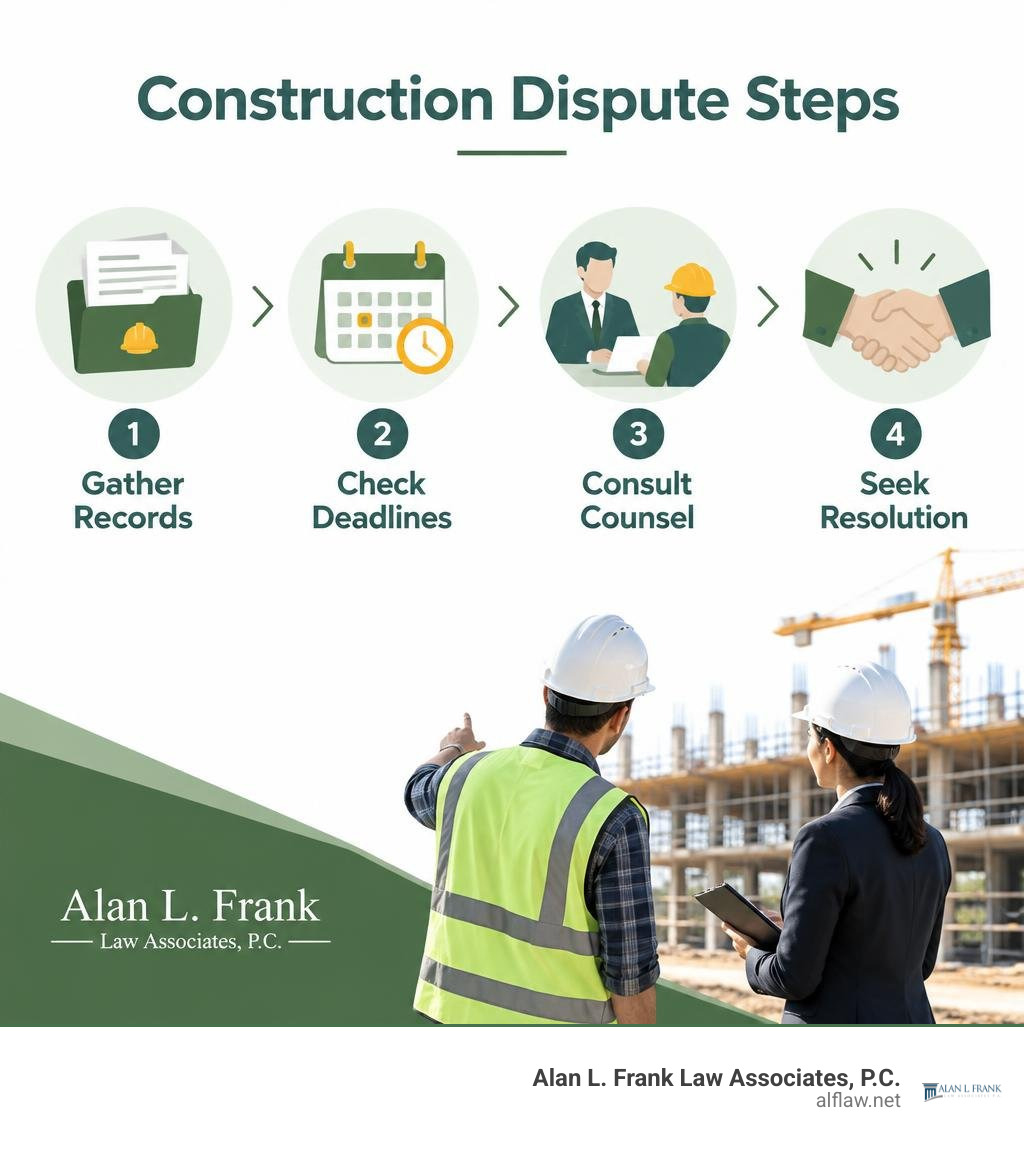
Essential construction lawyer near me terms:
Why You Need a Construction Lawyer Near Me for Building Disputes
Major building developments and residential renovations alike are complex endeavors. When multiple general contractors, trade subcontractors, architects, engineers, lenders, and property owners collaborate under tight deadlines, friction is almost inevitable. Project delays, design changes, sudden supply chain cost spikes, and defective workmanship can quickly transform a profitable jobsite into a legal battlefield.
Without experienced counsel, minor disagreements can escalate into catastrophic project shutdowns or devastating financial losses. When these high-stakes conflicts surface, having experienced legal representation in real estate litigation ensures that your contractual rights, property assets, and financial investments remain fully shielded under state law.
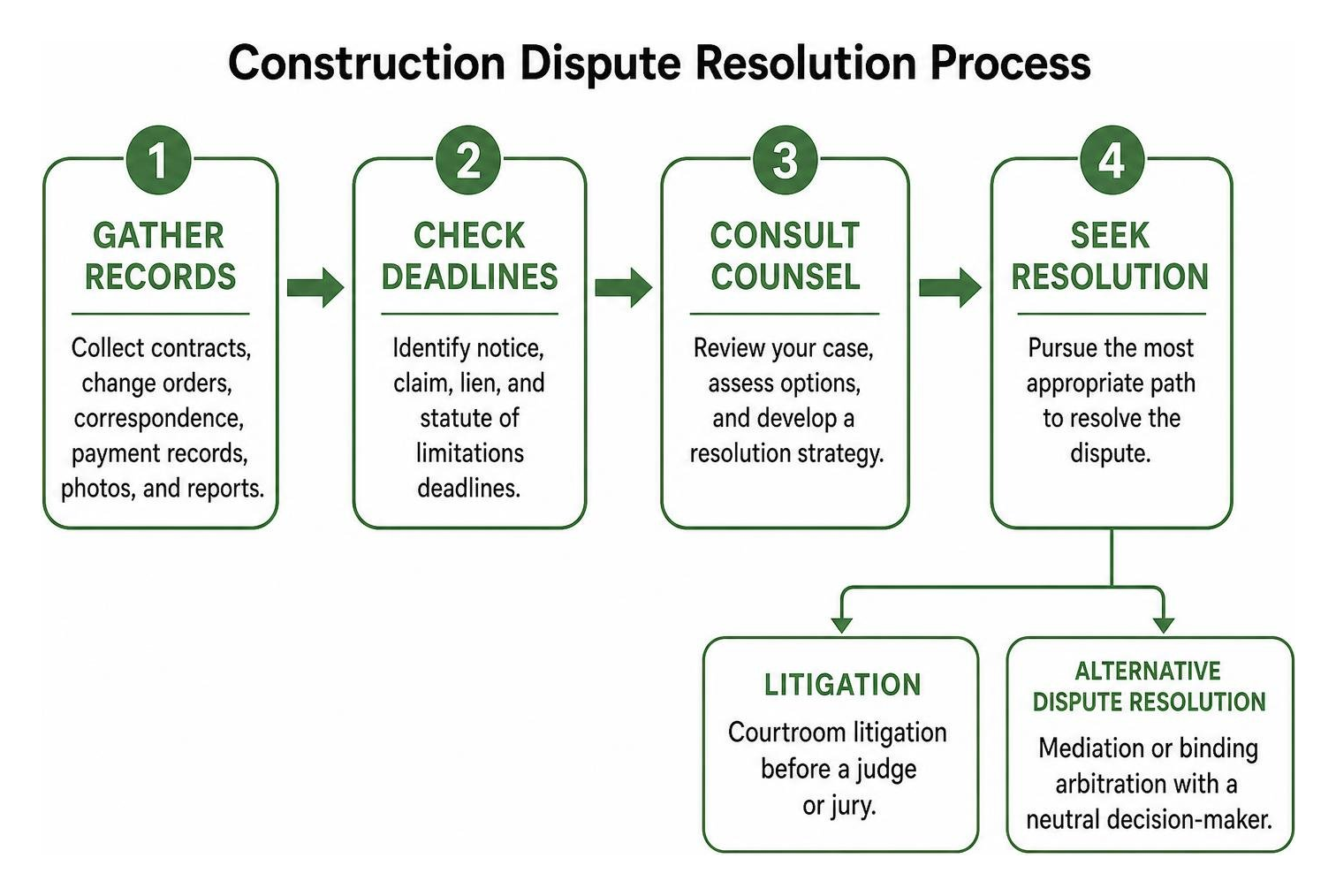
When a dispute arises, parties typically have two primary avenues for resolution: formal courtroom litigation or alternative dispute resolution (ADR), which includes binding arbitration and mediation. Selecting the appropriate forum can dictate the speed, expense, and ultimate success of your case.
| Dispute Feature | Courtroom Litigation | Alternative Dispute Resolution (ADR) |
|---|---|---|
| Primary Decision-Maker | Public Judge or Jury | Neutral Construction Arbitrator or Mediator |
| Public Record | Yes (all filings are public documents) | No (confidential proceedings and private outcomes) |
| Typical Timeline | 12 to 36+ months through formal trial | 3 to 12 months depending on arbitrator schedules |
| Evidentiary Discovery | Exhaustive depositions, subpoenas, and motion practice | Streamlined, targeted document exchange |
| Appeals Process | Full appellate review available | Extremely limited grounds to appeal binding arbitration |
Resolving Construction Defects and Structural Failures
Construction defects often remain hidden until months or even years after substantial completion. These latent failures frequently stem from substandard materials, improper soil analysis, uncoordinated architectural designs, or negligent trade execution.
- Subsurface & Foundation Failures: Inadequate soil compaction or miscalculated load-bearing engineering can trigger differential settling, cracked foundation walls, and severe structural movement. You must take strategic legal steps to avoid preventing foundation dispute failures before structural integrity degrades entirely.
- Building Envelope & Moisture Intrusion: Poorly sealed flashing, defective exterior insulation and finish systems (EIFS), and improperly installed building wraps allow water to seep behind masonry and drywall. Understanding legal remedies for handling severe water damage claims is essential to recovering remediation costs from culpable contractors.
- Roofing & Framing Defects: Incorrect truss installation, poor drainage slope, or missing underlayment can cause ponding, rot, and catastrophic structural failure. Property owners must act decisively in protecting projects from roofing defects before weather exposure destroys building interiors.
Handling Mechanics Liens, Payment Disputes, and Bond Claims
Cash flow is the lifeblood of every building project. When owners withhold progress payments, general contractors default on payment applications, or subcontractors fail to deliver specified work, payment disputes emerge quickly.
Mechanics liens provide contractors, subcontractors, and material suppliers with a statutory security interest against the real property they improved. However, the legal rules governing mechanics liens are rigid:
- Strict Timelines: Missing a statutory deadline by even a single day can permanently extinguish your lien rights.
- Preliminary Notices: In many jurisdictions, subcontractors must serve formal preliminary notices before recording a valid lien claim.
- Lien Foreclosure: If an owner refuses to satisfy an unpaid balance, a claimant must initiate a formal lien foreclosure action to force a judicial sale of the property to satisfy the debt.
For public works projects where municipal or state property cannot be liened, payment bonds and performance bonds take center stage. When working through complex bond claims and contract defaults, deploying seasoned commercial litigation strategies ensures claims are properly preserved and aggressively prosecuted.
Proactive Contract Drafting and Regulatory Compliance

The most effective way to win a construction dispute is to prevent it before ground is broken. Comprehensive contract drafting establishes clear risk allocation, defined performance scopes, and unambiguous dispute resolution mechanisms.
When we structure or review contracts for our clients, we focus heavily on clauses that frequently generate conflict:
- Scope of Work & Specification Clarity: Eliminating ambiguous descriptions of architectural finishes, structural specifications, and performance milestones.
- Change Order Governance: Establishing rigid, written protocols for scope additions, pricing approvals, and schedule adjustments to prevent runaway cost overruns.
- Delay Claims & Liquidated Damages: Defining excusable versus unexcusable delays, compensable weather impacts, and enforceable daily liquidated damages for late completion.
- Warranty Language: Clearly defining express warranties, manufacturer pass-through terms, and statutory warranty limitations. An in-depth review helps determine whether enforcing construction warranties provides an immediate avenue for repair costs without protracted litigation.
- Regulatory & Environmental Compliance: Ensuring all design and construction plans adhere to municipal zoning restrictions, historical preservation standards, stormwater run-off permits, and wetland preservation mandates.
Key Credentials to Look for in a Construction Attorney
Construction law is a highly specialized discipline requiring a mastery of both complex statutory law and intricate engineering, architectural, and project management practices. When selecting counsel across Pennsylvania or New Jersey, evaluate specific credentials:
- Extensive Trial and Arbitration Experience: Look for attorneys who regularly try cases before judges, juries, and specialized construction arbitration panels, rather than transactional-only practitioners.
- Peer-Reviewed Recognition: Top practitioners earn recognition such as an AV Preeminent rating from Martindale-Hubbell, representing the highest standard of legal ability and ethical excellence as rated by fellow attorneys and judges. Longstanding inclusions in peer directories like Best Lawyers further demonstrate industry-wide respect.
- Substantial Practical Knowledge: Attorneys with decades of experience navigating commercial developments, defect claims, and surety litigation bring valuable tactical insight to high-stakes cases. You can verify regional experience through trusted legal directories offering insight on state-specific construction defect counsel.
How to Choose a Construction Lawyer Near Me for Complex Projects
When evaluating legal representation for your building project, look beyond general commercial litigators. Construction projects require an attorney who understands the practical mechanics of a jobsite.
Ask potential counsel how often they review critical path method (CPM) scheduling charts, whether they routinely depose structural and geotechnical expert witnesses, and how familiar they are with local municipal building departments and regional court dockets. An attorney with deep familiarity with local building officials and regional judicial practices can identify procedural advantages early in the dispute.
Preparing for Your Initial Legal Consultation
Proper preparation for your initial consultation allows your attorney to quickly evaluate your legal position, calculate statutory deadlines, and map out an aggressive recovery strategy.
| Billing Arrangement | How It Works | Best Suited For |
|---|---|---|
| Hourly Rate | Billed in tenth-of-an-hour increments based on attorney experience level | Ongoing litigation, dynamic dispute defense, and comprehensive trial work |
| Flat Fee | A single set price for a clearly defined, non-litigation task | Contract reviews, single-document drafting, or mechanics lien filings |
| Contingency / Hybrid | Attorney receives an agreed percentage of recovered funds, or a reduced hourly rate paired with a success fee | High-value, clear-liability defect recoveries or substantial unpaid contractor claims |
Essential Documents to Bring to Your Consultation
- The Master Contract: The full executed agreement, along with all exhibits, general conditions, specifications, and design addenda.
- Change Orders & Requests for Information (RFIs): Both approved and disputed change orders, pending price requests, and written clarifications.
- Payment Applications & Invoices: Certified AIA G702/G703 payment applications, owner payment schedules, check copies, and lien waivers.
- Jobsite Daily Logs & CPM Schedules: Superintendent daily reports, project baseline schedules, monthly update logs, and weather delay notices.
- Defect Reports & Photographs: Engineering inspection evaluations, remediation estimates, expert assessments, and high-resolution dated photos of defects.
- Formal Written Notices: Default letters, cure notices, delay notifications, and statutory mechanics lien or bond claim correspondence.
Frequently Asked Questions About Construction Law
How much does it cost to hire a construction lawyer near me?
Legal fees depend heavily on the complexity of the project, the volume of documentation, and whether the dispute proceeds to trial. Most construction litigation is billed hourly, with rates reflecting the attorney’s trial record and specialized expertise. Discrete tasks, such as initial contract reviews or filing a mechanics lien, can sometimes be performed under a structured flat-fee arrangement.
What is the difference between arbitration and litigation in construction disputes?
Courtroom litigation takes place in a public court before a judge or jury, adhering to formal rules of civil procedure and broad evidentiary discovery. Arbitration is a private proceeding before one or more neutral arbitrators—often veteran construction attorneys or retired judges with industry expertise. Arbitration is typically faster and confidential, but offers very narrow grounds for judicial appeal.
What geographic areas do local construction lawyers typically cover?
Construction attorneys typically represent clients throughout the states where they are actively licensed. For instance, our firm regularly handles construction litigation, defect claims, and contract disputes across Pennsylvania (including Philadelphia and Jenkintown) and New Jersey. We regularly appear before municipal zoning boards, state trial courts, and federal district courts across the region.
Conclusion: Protect Your Project and Investment
Building disputes can quickly deplete capital reserves, derail construction financing, and undermine years of planning. Whether you are dealing with catastrophic structural defects, pursuing unpaid contractor claims, or defending against an unjustified mechanics lien, proactive legal strategy is critical.
At Alan L. Frank Law Associates, P.C., we draw upon decades of high-stakes commercial litigation experience to secure multi-million-dollar recoveries for our clients. We work closely with property owners, developers, and commercial contractors to resolve contentious disputes efficiently while aggressively protecting your bottom line.
For immediate answers regarding property damage and structural liability, explore our answers to frequently asked construction defect questions or reach out to our team directly to schedule a confidential case evaluation.