
Everything Shareholders Need to Know About the Altria Group Securities Litigation


Everything Shareholders Need to Know About the Altria Group Securities Litigation
What Shareholders Should Know About the Altria Group Securities Litigation
The Altria Group securities litigation ended in a $90 million cash settlement for eligible investors who purchased or acquired Altria securities from October 25, 2018, through April 1, 2020. The deadline to file a claim was April 5, 2022, and payments to approved claimants began May 12, 2023. This investor settlement is separate from Altria’s $235 million resolution of thousands of JUUL-related lawsuits.
Investors alleged that Altria and Juul misled shareholders about risks tied to Juul’s marketing and regulatory scrutiny. The sections ahead explain those claims, who qualified for payment, and how the other JUUL lawsuits differ.
I’m Alan L. Frank, managing attorney of Alan L. Frank Law Associates, P.C. My experience with investment-loss and securities disputes helps me explain what the Altria Group securities litigation means for shareholders without confusing it with the separate JUUL cases.

Quick altria group securities litigation definitions:
Origins of the Altria Group Securities Litigation and Key Allegations

To understand how Altria Group found itself defending against thousands of disgruntled shareholders, we have to look back at the shifting landscape of the tobacco industry in late 2018. Traditional cigarette volumes were declining, and legacy tobacco giants were scrambling to secure their footing in the rapidly expanding e-vapor market.
Enter Juul Labs, Inc. (JLI). By late 2018, Juul had captured over 70% of the United States e-cigarette market, driven by sleek, high-tech devices and flavored nicotine pods. Seeking immediate dominance in the alternative nicotine space, Altria announced a massive $12.8 billion cash investment in December 2018 to acquire a 35% non-voting stake in Juul.
The deal valued the startup at roughly $38 billion. However, as public health officials sounded alarms over a nationwide youth vaping epidemic, regulatory scrutiny intensified. The core allegations in the class action—initially filed as Klein v. Altria Group, Inc., 3:20-cv-00075 – CourtListener.com—centered on whether Altria and its top executives made materially false and misleading statements regarding the true commercial and regulatory risks of this partnership.
Plaintiffs alleged that Altria conducted inadequate due diligence or deliberately downplayed Juul’s aggressive youth-oriented marketing strategies. When federal regulators stepped in with flavor bans, marketing restrictions, and extensive investigations, the value of Altria’s multi-billion-dollar investment plummeted, wiping out billions of dollars in market capitalization.
The $12.8 Billion Juul Investment and Undisclosed Regulatory Risks
When Altria poured $12.8 billion into Juul, investors were led to believe the partnership would ensure long-term revenue growth. What corporate disclosures failed to adequately convey, according to plaintiffs, was the sheer vulnerability of Juul’s business model to regulatory intervention.
Juul was accused of deliberately targeting underage users with fruity, dessert-like flavors, social media influencers, and youth-oriented launch parties. By April 2019, the Food and Drug Administration (FDA) launched formal investigations into vaping-related health complications, and the Federal Trade Commission (FTC) began probing Juul’s marketing tactics.
As regulatory crackdowns mounted, Altria was forced to take severe accounting write-downs, drastically reducing the carrying value of its $12.8 billion investment. For shareholders who watched the stock decline, these losses were not simply standard market volatility—they were preventable harms resulting from undisclosed compliance risks. When corporations conceal operational risks of this magnitude, pursuing claims for securities litigation investment losses becomes the primary avenue for investors seeking accountability.
Key Legal Milestones in the Altria Group Securities Litigation
The legal journey began in early 2020 when individual investor Gabby Klein filed a class action complaint in the U.S. District Court for the Eastern District of New York. Recognizing that Altria is headquartered in Richmond, Virginia, the action was subsequently transferred to the U.S. District Court for the Eastern District of Virginia.
Following requirements under the Private Securities Litigation Reform Act (PSLRA), the court appointed Donald Sherbondy, Sarah Sherbondy, and the Construction Laborers Pension Trust as Lead Plaintiffs to represent the interests of tens of thousands of aggrieved investors.
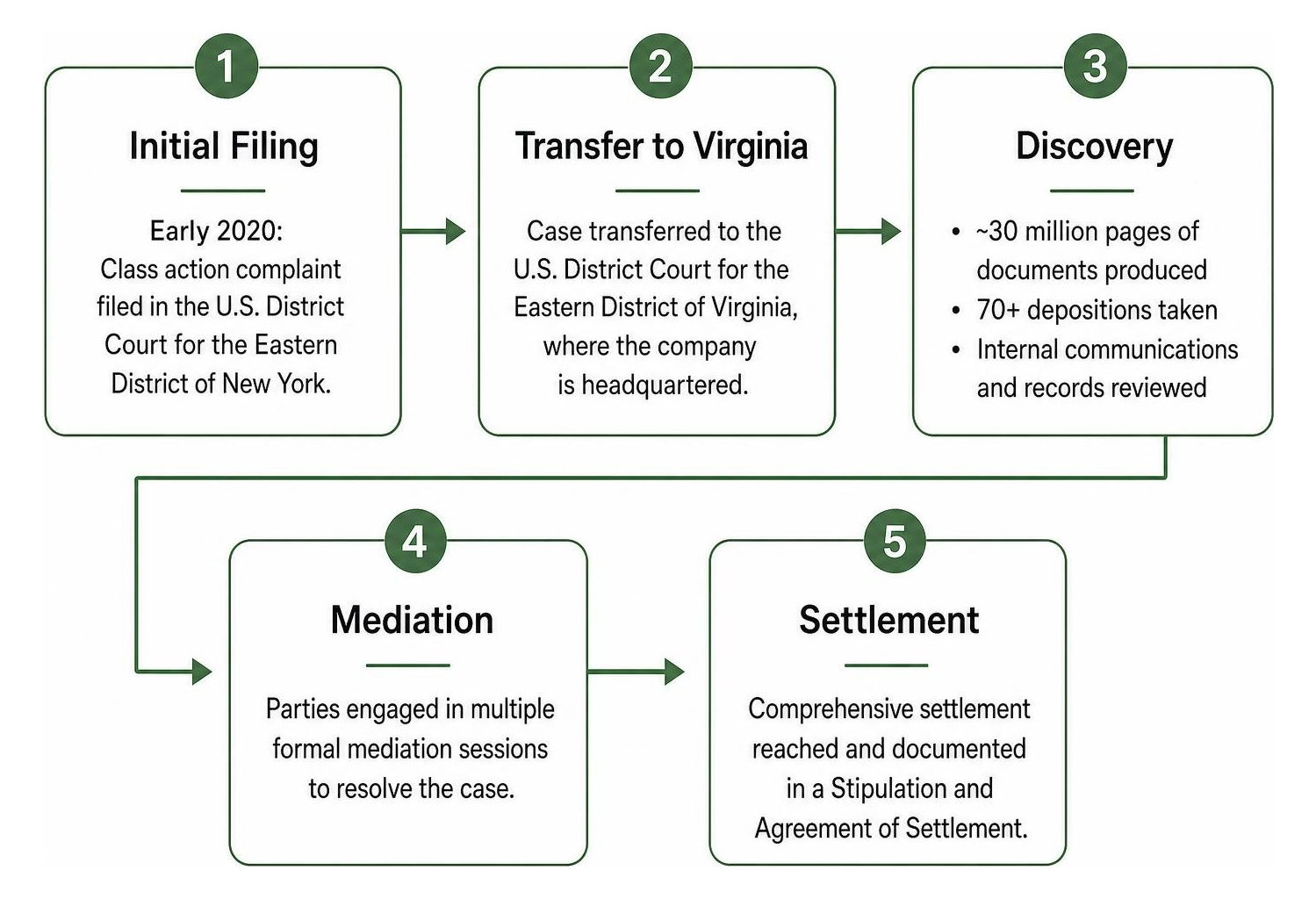
Over the course of extensive litigation, the parties engaged in exhaustive discovery:
- Defendants produced approximately 30 million pages of internal records and corporate communications.
- Counsel conducted more than 70 depositions of key executives, industry witnesses, and financial analysts.
- The parties engaged in multiple formal mediation sessions before reaching a comprehensive resolution, detailed in the formal Gabby Klein, et al. v. Altria Group, Inc., et al. 20-CV-00075-Stipulation and Agreement of Settlement.
Overview of the $90 Million Securities Class Action Settlement

The securities class action concluded with Altria and individual defendants agreeing to establish a $90 million, all-cash settlement fund. This fund was created to resolve all claims asserted on behalf of investors who purchased Altria common stock or other registered securities during the class period.
Rather than proceeding through a risky trial where damages could be contested for years, the settlement established immediate, guaranteed cash compensation. The court approved an independent Claims Administrator to manage claimant filings, review trade confirmations, and calculate individual payouts based on an approved Plan of Allocation.
For institutional and retail investors alike, navigating investment loss litigation without getting burned twice requires a clear understanding of how these funds are distributed, ensuring that all procedural deadlines are strictly met.
Class Period Eligibility in the Altria Group Securities Litigation
To qualify for a distribution from the $90 million fund, claimants had to satisfy precise eligibility criteria outlined in the court-approved settlement notice hosted on Gabby Klein v. Altria Group:
- Transaction Dates: You must have purchased or otherwise acquired Altria Group, Inc. publicly traded securities between October 25, 2018, and April 1, 2020, inclusive (the “Class Period”).
- Recognized Loss Calculation: You must have suffered a net financial loss under the court’s Plan of Allocation, which calculated damages based on purchase prices relative to stock drops following public corrective disclosures.
- Claim Filing Deadline: Claim forms, along with supporting brokerage statements and trade confirmations, had to be postmarked or submitted online by April 5, 2022.
- Exclusion and Objection Windows: Class members who wanted to exclude themselves to preserve independent lawsuit rights or file formal objections were required to submit their written requests by March 10, 2022.
Fund Distribution Timeline and Payment Approvals
Following final court approval and the resolution of all administrative reviews, the Claims Administrator calculated the Net Settlement Fund. This balance represented the $90 million cash pool minus court-approved attorney fees, litigation expenses, notice costs, and taxes.
Payments were issued on a pro-rata basis, proportional to each authorized claimant’s recognized loss. Formal distribution of checks and electronic payments commenced on May 12, 2023. These distributions brought resolution to tens of thousands of class members who participated in the recovery process. This outcome is precisely why smart investors trust stock fraud attorneys to reclaim stolen capital when corporate misstatements cause severe financial harm.
Comparing the $90M Settlement to Altria’s $235M MDL and Antitrust Lawsuits
Altria’s legal challenges extended well beyond this single securities class action. The company faced a web of overlapping litigation across state and federal courts, involving personal injury plaintiffs, school districts, state attorneys general, and direct product purchasers.
| Lawsuit Category | Primary Plaintiffs | Governing Court / Jurisdiction | Settlement / Case Value | Key Claims |
|---|---|---|---|---|
| Securities Class Action | Altria Shareholders (Purchasers from Oct 2018 – Apr 2020) | E.D. Virginia (No. 3:20-cv-00075) | $90 Million Cash (Paid May 2023) | Material misstatements regarding Juul’s regulatory risks, youth marketing, and asset impairment. |
| Multidistrict Litigation (MDL) | Consumers, School Districts, Local Governments (6,000+ cases) | N.D. California (MDL No. 2913) | $235 Million Agreement | Public nuisance, deceptive trade practices, product liability, and youth vaping epidemic harms. |
| E-Cigarette Antitrust Class Action | Direct & Indirect Device Purchasers, Retailers | N.D. California & Ninth Circuit | Active Litigation (Class Certified Feb 2026) | Monopolization, illegal non-compete agreements under the Sherman Act, and reduced market competition. |
Recognizing the distinction between these matters is vital. While the securities settlement directly compensated equity investors for share-price losses, the broader product liability cases addressed physical and municipal harms. We have seen similar multi-front litigation patterns in other major corporate actions, such as the lyft securities litigation inside the 25 million investor settlement, where operational disclosures and regulatory challenges triggered parallel legal battles.
Dissecting the $90M Investor Recovery Versus the $235M Multidistrict Settlement
In early 2023, Altria entered into a separate comprehensive agreement to resolve the vast majority of its pending e-vapor product liability and public nuisance claims consolidated in multidistrict litigation in the Northern District of California.
This $235 million settlement covered approximately 6,000 individual cases, including roughly 4,500 personal injury suits, 1,500 claims brought by school districts and municipal government entities, and approximately 50 consumer class actions.
Crucially, the $235 million resolution specifically excluded:
- Three enforcement actions prosecuted by state attorneys general.
- 35 lawsuits brought by sovereign Native American tribes.
- 17 federal antitrust actions.
- Three separate lawsuits pending in Canadian courts.
Financially, Altria absorbed the $235 million cost by recording a pre-tax charge in the second quarter of 2023. The company treated this charge as a “special item,” excluding it from its adjusted diluted earnings per share (EPS) calculations to reassure Wall Street that core operations remained stable.
E-Cigarette Antitrust Class Actions and Direct Purchaser Claims
The most enduring legal threat facing Altria and Juul stems from complex antitrust lawsuits brought under Sections 1 and 2 of the Sherman Act and the Clayton Act.
When Altria invested over $12 billion in Juul, plaintiffs allege the transaction was coupled with an unlawful, anti-competitive agreement:
- Altria agreed to pull its own proprietary e-vapor products (such as MarkTen and Green Smoke) from retail shelves.
- Altria agreed not to compete against Juul in the closed-system e-cigarette market.
- In exchange, Altria provided Juul with prime retail shelf space and logistics support, cementing Juul’s monopoly position and artificially inflating device prices for direct purchasers.
In February 2026, the federal court certified the direct purchaser class, allowing affected buyers to pursue aggregate damages collectively. Defendants appealed that certification order to the U.S. Court of Appeals for the Ninth Circuit, leaving this antitrust front an ongoing legal exposure.
Frequently Asked Questions About the Altria Settlement
Who was eligible to receive compensation from the $90 million settlement?
Eligibility for the $90 million securities settlement was restricted to individuals and institutions that purchased or acquired publicly traded Altria securities between October 25, 2018, and April 1, 2020.
To receive a cash payment, investors were required to submit a completed claim form along with trade documentation by April 5, 2022. Claimants who purchased outside of this specific window, or whose trades resulted in a net gain under the Plan of Allocation, were not eligible for payouts.
How did Altria account for these multi-million dollar legal resolutions?
Altria funded its $90 million securities settlement and subsequent $235 million multidistrict litigation settlement using available cash reserves and dedicated corporate reserves.
For public reporting purposes, Altria recognized a $235 million pre-tax charge in its Q2 2023 financial statements. By classifying these legal payouts as special items, Altria maintained consistency in its adjusted diluted EPS figures, mitigating panic among institutional shareholders regarding ongoing operating dividend yields.
How do securities class actions differ from direct antitrust litigation?
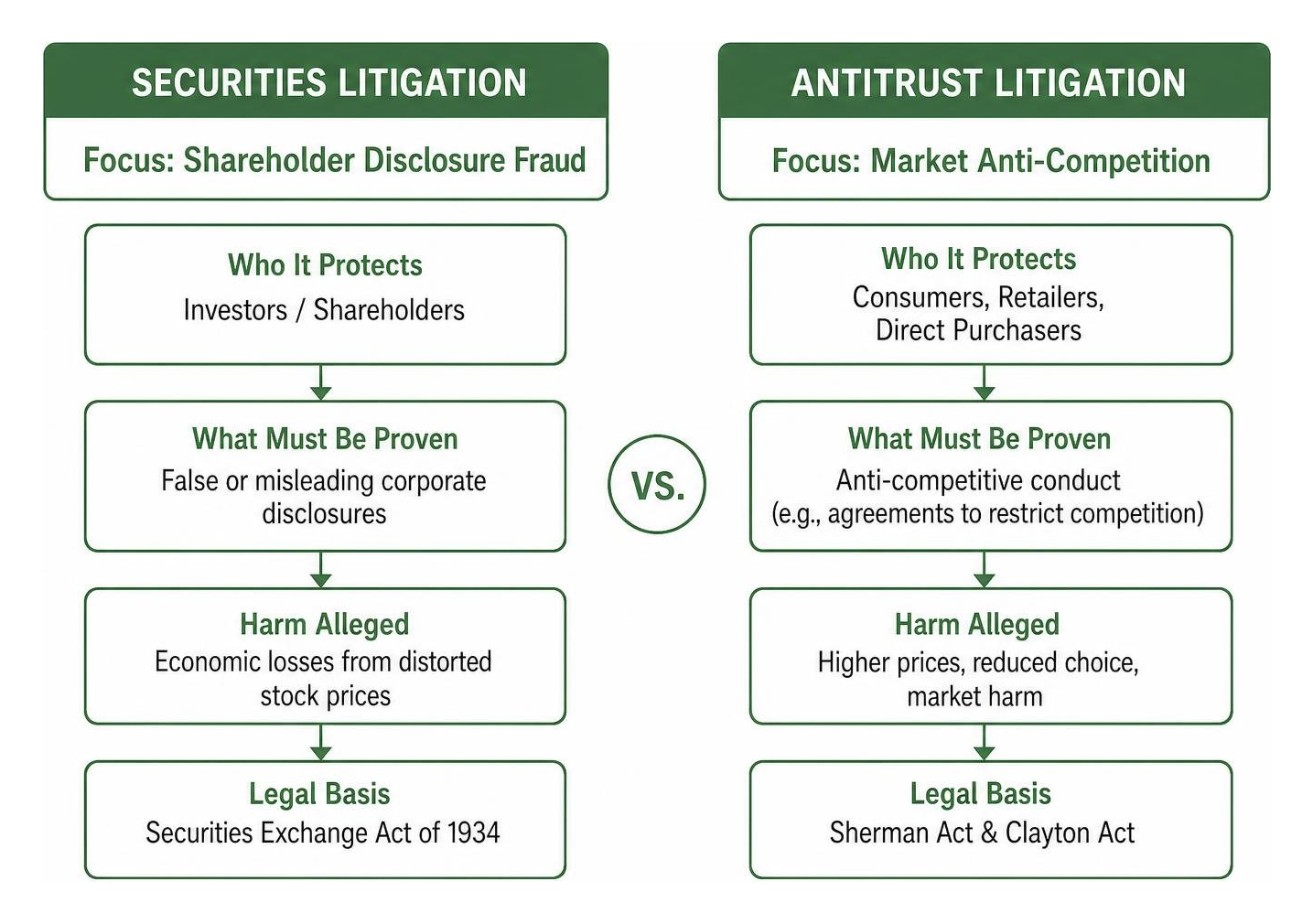
Securities class actions and antitrust class actions operate under distinct legal doctrines:
- Securities Litigation: Governed primarily by the Securities Exchange Act of 1934, these actions protect investors who suffered financial losses because corporate management made false or misleading disclosures. The focus is on market transparency and stock-price integrity. We often see these dynamic challenges play out in other industries, such as what is detailed in our guide on everything shareholders must know about geron securities litigation.
- Antitrust Litigation: Governed by the Sherman and Clayton Acts, antitrust cases protect consumers, retailers, and direct purchasers from anti-competitive behavior, such as price-fixing, market division, and non-compete conspiracies.
Conclusion
The resolution of the $90 million Altria securities class action and the subsequent multidistrict litigation underscore the critical importance of transparent corporate governance. When companies deploy billions of dollars into high-risk market acquisitions while obscuring regulatory and compliance dangers, public shareholders bear the brunt of the fallout.
At Alan L. Frank Law Associates, P.C., we represent investors in complex commercial disputes, corporate fraud matters, and institutional recovery actions. From our offices in Philadelphia and Jenkintown, Pennsylvania, as well as New Jersey, we help individuals and entities protect their capital and seek accountability across the nationwide legal landscape.
If you have suffered substantial portfolio losses due to corporate misstatements, broker misconduct, or disclosure failures, explore your legal options through our dedicated securities litigation team today.